UK Guidelines for the implementation of the EU Regulations for - - PowerPoint PPT Presentation

uk guidelines for the implementation of the eu
SMART_READER_LITE
LIVE PREVIEW

UK Guidelines for the implementation of the EU Regulations for - - PowerPoint PPT Presentation

UK Guidelines for the implementation of the EU Regulations for big-leafed mahogany ( Swietenia macrophylla ) Madeleine Groves Conventions & Policy Section (CAPS), Royal Botanic Gardens, Kew, UK CITES Scientific Authority for plants Guy


slide-1
SLIDE 1

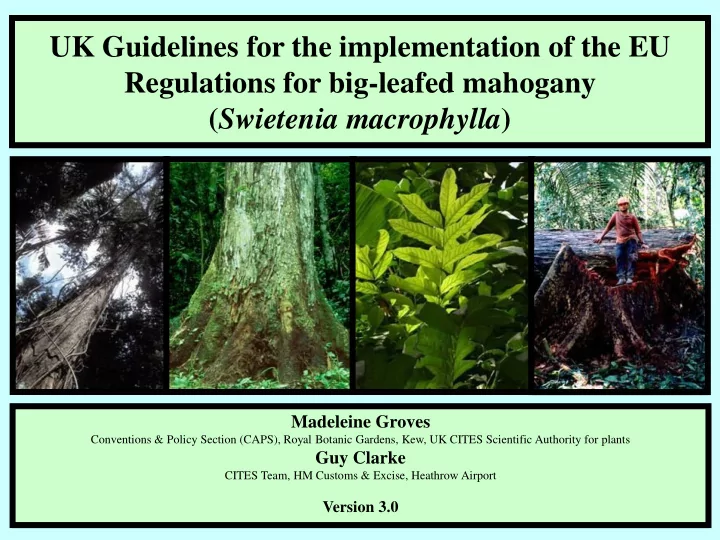
UK Guidelines for the implementation of the EU Regulations for big-leafed mahogany (Swietenia macrophylla)

Madeleine Groves

Conventions & Policy Section (CAPS), Royal Botanic Gardens, Kew, UK CITES Scientific Authority for plants

Guy Clarke

CITES Team, HM Customs & Excise, Heathrow Airport

Version 3.0

slide-2
SLIDE 2

The authors would like to thank the following for their assistance and expertise:

  • H.M. Customs & Excise:

Lance Cruse (Felixstowe Detection - CITES) Charles Mackay (CITES Team, Heathrow Airport) Les Gregory (Restrictions & Sanctions Team)

  • UK Scientific Authority for plants - Conventions and Policy Section (CAPS),

Royal Botanic Gardens, Kew:

Noel McGough Matthew Mustard Sabina Michnowicz Alec Fraser

  • Pictures:

Jimmy Grogan (IMAZON) Bud Petitdemange (APHIS, USDA, USA)

Acknowledgements

slide-3
SLIDE 3 Slide number

Swietenia macrophylla –Trade Information………………… ……………………………………….. 4 Swietenia macrophylla - Trade information…………………………………………………………... 5-6 Map 1 – Trade routes of Swietenia macrophylla (big-leafed mahogany)……………………………. 7 Tariff codes and ports of entry……………………………………………………………………….... 8-9 Procedures for importing Swietenia macrophylla - processing entries Step 1 – Determine that Swietenia macrophylla is being imported……………………………… 10 Step 2 – Confirm that the parts being imported after the 15th November 2003 are controlled under the EU Regulations………………………….…………………………11 Step 3 – Which documents are required upon entry to the UK from 15th November 2003?.......12 Step 4 – Check the documents……………………………………………………………………... 13 Step 5 – Entry procedure…………………………………………………………………………... 14 Step 6 – Inspect the shipment……………………………………………………………………… 15 Step 7 – Seizure procedures……………………………………………………………………….. 16 Step 8 – Restoration procedures…………………………………………………………………... 17 Conversion tables………………………………………………………………………………………. 18 -20 Appendices……………………………………………………………………………………………… 21 Contact details…………………………………………………………………………….. …………… 22 Copies of CITES documents…………………………………………………………………………… 23-40

Contents Page

slide-4
SLIDE 4

Swietenia macrophylla (big-leafed mahogany) – Trade Information

WHAT IS SWIETENIA MACROPHYLLA? WHICH EU ANNEX IS SWIETENIA MACROPHYLLA LISTED UNDER?

4

Swietenia macrophylla is a tropical hardwood tree species – there are three species in the genus Swietenia (Swietenia humilis, S. mahagoni and S. macrophylla) all from the Americas. Swietenia macrophylla is distributed throughout Belize, Brazil, Bolivia, Colombia, Costa Rica, Ecuador, El Salvador, Guatemala, Honduras, Mexico, Nicaragua, Panama, Peru and Venezuela. Swietenia humilis and S. mahagoni are both listed on Annex B and are practically non-existent in trade due to over-exploitation. 15th November 2003 – From this date logs, sawn wood, veneer sheets and plywood from all neotropical populations (neotropics = New Tropics i.e. Central and South America and the Caribbean) will be controlled under EU Annex B (CITES Appendix II). Prior to this date - populations from a number of range countries - Bolivia, Brazil, Colombia, Mexico, Peru and Costa Rica (all populations of the Americas) - were listed on Annex C (Appendix III).

slide-5
SLIDE 5

Swietenia macrophylla (big-leafed mahogany) – Trade Information

WHO ARE THE MAJOR IMPORTERS OF SWIETENIA MACROPHYLLA? Outside of Latin America, the USA is the largest consumer of Swietenia macrophylla. Other major importers include the Dominican Republic, Canada and the European Union. Within the EU, France, the UK, Spain, Germany, and the Netherlands are the largest importers. The primary producer and exporter of Swietenia macrophylla has been South America, with Brazil traditionally being the leading

  • exporter. However, other South American countries are also large

producers and exporters, especially Peru and Bolivia. Check with the CITES Team, Heathrow Airport to make sure there are no new or existing restrictions for exporting countries, such as bans on trade

  • r issuance/validation of permits.

WHO ARE THE MAJOR EXPORTERS OF SWIETENIA MACROPHYLLA? ARE THERE ANY QUOTAS FOR SWIETENIA MACROPHYLLA? Nicaragua has an export quota for 16,000 cubic metres of wood which came into force in 1997.

5

slide-6
SLIDE 6

Swietenia macrophylla (big-leafed mahogany) – Trade Information

ARE THERE OTHER TIMBER SPECIES IN TRADE CALLED MAHOGANY?

YES – the name ‘mahogany’ applies to many different species in trade. They include the African mahoganies (Khaya and Entandrophragma spp.), the Asian mahoganies (Shorea, Qualea spp.), Australian mahogany (Eucalyptus marginatus), Bastard mahogany (Batonia apetela), Indian mahogany (Cedrela toona) & Madiera mahogany (Persea indica). None of these species are listed under the EU Annexes.

ARE THERE OTHER NAMES USED FOR SWIETENIA MACROPHYLLA? YES – the following common or trade names may be used for Swietenia macrophylla – big-leafed mahogany, Brazilian or Honduran mahogany, genuine mahogany, caoba, mara (Spanish); águano; araputangá; cedroaraná; cedroi, mogno (Portugese); mahogani grands feuilles (French); Amerikaans mahonie (Dutch); bredbladet mahogni (Danish).

6

slide-7
SLIDE 7

C A N A D A U N I T E D S T A T E S

BOLIVIA BELIZE GUATEMALA

B R A Z I L

EUROPE ASIA

Trade with Europe and Asia Trade within South, Central and North America Exporting Country

Map 1 – Trade in Swietenia macrophylla (big-leafed mahogany) M E X I C O

PERU

7

slide-8
SLIDE 8

Tariff Codes & Ports of Entry

TARIFF HEADING FOR PLYWOOD

4412.13 - Plywood consisting solely of sheets of wood, each ply not exceeding 6 mm in thickness, and with at least one outer ply of tropical wood specified in subheading note 1 * 4412.14 - Plywood consisting solely of sheets of wood, each ply not exceeding 6 mm in thickness, and with at least one outer ply of non-coniferous wood 4412.22 - Other (meaning one ply, or more, that is greater than 6 mm in thickness), with at least one outer ply of non-coniferous wood, and with at least

  • ne ply of tropical wood specified in subheading note 1 *

8

*SUBHEADING NOTE 1 RELATING TO TARIFF HEADING FOR PLYWOOD

* Subheading Note 1: For the purposes of subheadings 4403.41 to 4403.49, 4407.24 to 4407.29, 4408.31 to 4408.39, and 4412.13 to 4412.99, the expression ‘tropical wood’ means

  • ne of the following types of wood:

Abura, Acajou d'Afrique, Afrormosia, Ako, Alan, Andiroba, Aningré, Avodiré, Azobé, Balau, Balsa, Bossé clair, Bossé foncé, Cativo, Cedro, Dabema, Dark Red Meranti, Dibétou, Doussié, Framiré, Freijo, Fromager, Fuma, Geronggang, Ilomba, Imbuia, Ipé, Iroko, Jaboty, Jelutong, Jequitiba, Jongkong, Kapur, Kempas, Keruing, Kosipo, Kotibé, Koto, Light Red Meranti, Limba, Louro, Maçaranduba, Mahogany, Makoré, Mandioqueira, Mansonia, Mengkulang, Meranti Bakau, Merawan, Merbau, Merpauh, Mersawa, Moabi, Niangon, Nyatoh, Obeche, Okoumé, Onzabili, Orey, Ovengkol, Ozigo, Padauk, Paldao, Palissandre de Guatemala, Palissandre de Para, Palissandre de Rio, Palissandre de Rose, Pau Amarelo, Pau Marfim, Pulai, Punah, Quaruba, Ramin, Sapelli, Saqui-Saqui, Sepetir, Sipo, Sucupira, Swietenia spp., Suren, Teak, Tauari, Tiama, Tola, Virola, White Lauan, White Meranti, White Seraya, Yellow Meranti.
slide-9
SLIDE 9

Tariff Codes & Ports of Entry

PORTS OF ENTRY (2003)

EPU Port Code Location 033…………………………………………..Bristol & Avonmouth 048…………………………………………..Swansea (Cardiff Airport) 065…………………………………………..Medway 071…………………………………………..Felixstowe 110…………………………………………..Liverpool 120 (airport)………………………………...Gatwick/Heathrow 150…………………………………………..Tilbury 191(airport)………………………………….Manchester 219…………………………………………..Teesport 241…………………………………………..Immingham 290…………………………………………..Southampton 515…………………………………………..Belfast 660…………………………………………..Birmingham

9

TARIFF HEADING FOR WOOD & ARTICLES OF WOOD = CHAPTER 44 THE FOLLOWING TARIFF CODES ARE USED FOR SWIETENIA MACROPHYLLA

Rough Wood………………………………………44034100 to 44034995 Sawn wood >6mm in thickness…………………..44072415 to 44072995 44079910 to 44079997 Veneers <6mm in thickness……………………... 44083111 to 44089095

slide-10
SLIDE 10

STEP 1 – Determine that Swietenia macrophylla is being imported

Caution

Traders may use other timber trade names to disguise the fact that big- leafed mahogany is being imported. These might be legitimate trade names used for other timber species. Please contact the CITES Team, Heathrow Airport or Lance Cruse (Felixstowe) for guidance.

Confirm that the importation is of Swietenia macrophylla

Check the shipping documents and verify the scientific name on the permit. Timber trade or common names can vary widely from country to country and it is more reliable to use the scientific (Latin) name when verifying whether a timber product is controlled or not. The scientific name for big-leafed mahogany is Swietenia macrophylla.

Identifying the timber

Please remember that identifying tree species by eye can be difficult and is often unreliable. All wood samples are ideally identified in a laboratory using anatomical features to ensure that the species is as stated on the permits.

10

slide-11
SLIDE 11

STEP 2 - Confirm that the parts being imported after 15th November 2003 are controlled under the EU Regulations

Source of timber Parts & derivatives controlled (unless otherwise stated in a Reservation)

  • Populations of the Neotropics
  • Countries outside the

Neotropics whether a Party or Non-Party to CITES Logs, sawn wood, veneer sheets and plywood Logs, sawn wood, veneer sheets and plywood 11

slide-12
SLIDE 12

STEP 3 - Which documents are required upon entry to the UK from 15th November 2003?

Source of timber Permits required at time of entry (these must be presented

prior to or together with the Import Entry)

  • Populations of the Neotropics
  • CITES Export permit issued and signed by designated CITES Management

Authority of the exporting country

  • CITES Import permit issued and signed by the UK CITES Management

Authority (defra)

  • Countries outside the Neotropics that

are a Party to CITES - e.g. Canada, Indonesia

  • CITES (Re)-export permit issued and signed by designated CITES

Management Authority of the re-exporting country

  • CITES Import permit issued and signed by the UK CITES Management

Authority (defra)

  • Countries outside the Neotropics that

are not Party to CITES

  • Comparable CITES documents issued by a designated Management

Authority

  • CITES Import permit issued and signed by the UK CITES Management

Authority (defra)

12 REMEMBER

You can expect to see shipments accompanied by Annex C permits arriving into the UK after the Annex B listing comes into force on 15th November 2003. Please contact the CITES Team for more information

  • n permit requirements for pre- and post 15th November 2003 shipments.
slide-13
SLIDE 13

STEP 4 – Check the documents

Check the following

Documents are originals and not photocopies or faxes. Documents have been authorised by a designated issuing authority (Contact CITES Team, Heathrow Airport for list of Management Authorities). Documents are correct for the shipment i.e. it has not been exported from another country.

  • Importer/Exporter details on bill of lading and invoice match those on

the CITES documents

  • Is the description of goods consistent on ALL documents?
  • Check any excess quantities in the shipment that are not invoiced
  • Check that the quantities on the invoice are equal to or less than those

shown on the CITES documents

  • If the quantities shown exceed those on the CITES documents initiate

forfeiture procedures (see Steps 7 & 8 -Seizures & Restoration). Documents are still valid (in date). 13

slide-14
SLIDE 14

STEP 5 – Entry Procedure

Remember - Never return original Export CITES documents to the importer

The Entry Endorsing the documents

CHIEF Entry Acceptance Advice (E2), Plain Paper Entry, Invoice and CITES documents.

Document distribution

  • CITES Export/Re-export permit - Input the required

details at the bottom of the original CITES permit including full entry details (import entry number, port and date) with a signature and date stamp.

  • CITES Import permit - Input the required details at the

bottom of the original CITES permit including full entry details (import entry number, port and date) with a signature and date stamp (box 26 & 27). CITES Export/Re-export Permits - keep and return to defra (Bristol), photocopied copies to importer if requested. CITES Import Permits - keep white & green copies and return to defra (Bristol). Yellow copy returned to importer.

14

slide-15
SLIDE 15

STEP 6 - Inspect the shipment

Health and Safety - Check the HS Series on the Intranet for full guidance.

Take the following into account when inspecting the shipment

Pests and Diseases – if an infestation is present call your local Forestry Commission officer/sub-contractor. What sort of examination is required? Partial turnout, X-ray, high-risk (call in relevant anti-smuggling team). Taking wood samples – wood samples can be analysed at the Jodrell Laboratory at the Royal Botanic Gardens, Kew. Please consult the CITES Team, Heathrow before taking any samples. 15

slide-16
SLIDE 16

STEP 7 - Seizure Procedures

Seizure to be noted on Chief using code ADTE (talk to EPU Freight Team for assistance). ACS 99 – Roll back UCN so that the agent can reuse by splitting and present new documentation (talk to freight Team for assistance). Notice of Seizure (and explanatory Seizure letter, if necessary) + copy of Notice 12A to be sent to importer. Inform agent of seizure. DCIS completed The wood has been identified as Swietenia macrophylla and the agent has confirmed there are no CITES documents, the goods are liable for seizure. The wood has been identified as Sweitenia macrophylla and the CITES documents with the entry are not valid. e.g. out of date permit, wrong species, wood quantity exceeds permit.

What are the grounds for seizure? Seizure Procedures

Talk to QW concerning the storage of seized goods. DCIS to be updated and seizure file to be initiated.

16

slide-17
SLIDE 17

STEP 8 - Restoration Procedures

It is Customs policy not to restore seized items unless valid retrospective CITES documents have been presented. Any restoration charges must be calculated using the published departmental scales. Minimum charge is £50. When correct documentation is produced restoration may be allowed. Please contact the CITES Team’s Senior Officer for advice

  • n Departmental restoration policy.

Restoration Procedures

A full explanation of the procedure can be found in Notice 12A ‘Compounding, seizure and restoration’

17

slide-18
SLIDE 18

Conversion Tables

Because timber can come in different forms i.e. logs, sawn timber and/or veneer sheets, the following formulas will help with conversion problems.

EXAMPLE 1,000 board feet of timber arrives at your port:

1,000 board feet of timber divided by 424 = 2.36 cubic metres of timber

EXAMPLE 1,000 kgms of timber arrives at your port:

1,000 kgms divided by 600 = 1.67 cubic metres

Continued on next page

CONVERT Board feet (usually expressed as pie tablares (PT)) to cubic metres (m3)

There are 424 PT per cubic metre

CONVERT Kilograms (kgms) of timber to cubic metres

There are 450-700 kgms of timber per cubic metre of timber. Use the guide figure of 600 kgms

18

slide-19
SLIDE 19

Conversion Tables

EXAMPLE 10,000 sq. feet (approx. 1 inch thick arrives at your port:

10,000 sq.feet x 1/12 (12 inches in a foot) x 0.0283 = 23.6 cubic metres of timber

EXAMPLE 25,000 square feet of veneer arrives at your port:

25,000 feet of veneer x 0.0929 = 2322.5 square metres

CONVERT Cubic feet of timber to cubic metres

Square feet x thickness in feet x 0.02832 = cubic metres (1 cubic foot = 0.02332 cubic metres)

CONVERT Square feet of veneer to cubic metres

Step 1 Convert square feet of veneer to square metres of veneer Square feet of veneer = length

  • f veneer in feet x width of

veneer in feet. Therefore square feet of veneer x 0.0929 = square metres (1 square foot = 0.0929 square metres)

Continued on next page

19

slide-20
SLIDE 20

Conversion Tables

EXAMPLE 25,000 square metres of veneer (0.6 millimetres thick) arrives at your port:

25,000 square metres of veneer x 0.0006 metre = 15 cubic metres of veneer

EXAMPLE 25,000 square feet of veneer (1/16

  • f an inch thick) arrives at your

port:

25,000 sq. feet of veneer x (1/16 of an inch thick x 1/12) x 0.02832 = 3.688 cubic metres

Ask the agent to convert the timber products into cubic metres (unit of measure on invoice is the same as on the CITES permit)

CONVERT Square metres of veneer to cubic metres of veneer Step 2 Square metres of veneer x veneer thickness = cubic metres CONVERT Cubic feet of veneer to cubic metres

Square feet x veneer thickness in feet x 0.02832 = cubic metres (1 cubic foot = 0.02832 cubic metres

20

slide-21
SLIDE 21
  • Contact Details
  • Copies of CITES

Documents

Appendices

21

slide-22
SLIDE 22

Contact Details

UK CITES Scientific Authority for Plants

Madeleine Groves (CITES Implementation Officer) Conventions and Policy Section Royal Botanic Gardens, Kew Richmond, Surrey TW9 3AE Tel: 020 8332 5723 Fax: 020 8332 5757 Email: m.groves@kew.org 22

HM Customs and Excise

CITES Team Custom House Tel: 020 8910 3830 Nettleton Road Fax: 020 89103833 Heathrow Airport Mobile out of hours: 07802 614670 TW6 2LA Email: CITESTeam.LHR@hmce.gsi.gov.uk