Type Systems TODAY: Winter Semester 2006 1. pairs, options, - - PowerPoint PPT Presentation

type systems
SMART_READER_LITE
LIVE PREVIEW

Type Systems TODAY: Winter Semester 2006 1. pairs, options, - - PowerPoint PPT Presentation

Plan PREVIOUSLY: unit, sequencing, let Type Systems TODAY: Winter Semester 2006 1. pairs, options, variants 2. recursion 3. state NEXT: exceptions? Week 8 NEXT: polymorphic (not so simple) typing December 6 December 6, 2006 - version 1.0


slide-1
SLIDE 1

Type Systems Winter Semester 2006

Week 8 December 6

December 6, 2006 - version 1.0

Plan

PREVIOUSLY: unit, sequencing, let TODAY:

  • 1. pairs, options, variants
  • 2. recursion
  • 3. state

NEXT: exceptions? NEXT: polymorphic (not so simple) typing

Pairs

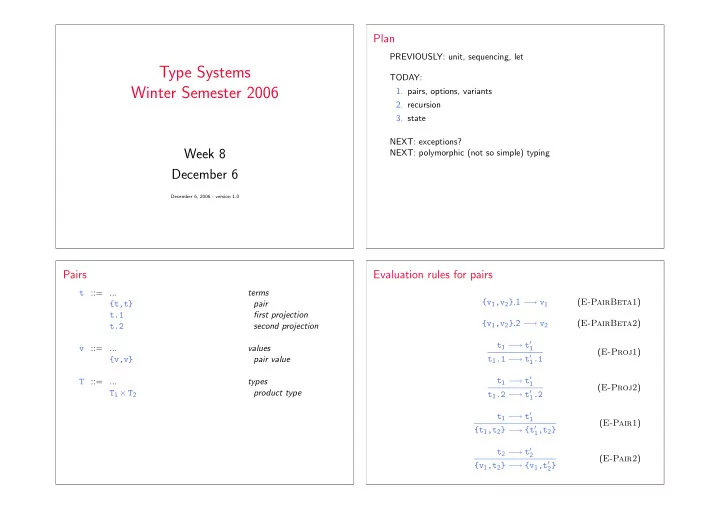
t ::= ... terms {t,t} pair t.1 first projection t.2 second projection v ::= ... values {v,v} pair value T ::= ... types T1 × T2 product type

Evaluation rules for pairs

{v1,v2}.1 − → v1 (E-PairBeta1) {v1,v2}.2 − → v2 (E-PairBeta2) t1 − → t′

1

t1.1 − → t′

1.1

(E-Proj1) t1 − → t′

1

t1.2 − → t′

1.2

(E-Proj2) t1 − → t′

1

{t1,t2} − → {t′

1,t2}

(E-Pair1) t2 − → t′

2

{v1,t2} − → {v1,t′

2}

(E-Pair2)

slide-2
SLIDE 2

Typing rules for pairs

Γ ⊢ t1 : T1 Γ ⊢ t2 : T2 Γ ⊢ {t1,t2} : T1 × T2 (T-Pair) Γ ⊢ t1 : T11 × T12 Γ ⊢ t1.1 : T11 (T-Proj1) Γ ⊢ t1 : T11 × T12 Γ ⊢ t1.2 : T12 (T-Proj2)

Tuples

t ::= ... terms {ti

i∈1..n}

tuple t.i projection v ::= ... values {vi

i∈1..n}

tuple value T ::= ... types {Ti

i∈1..n}

tuple type

Evaluation rules for tuples

{vi

i∈1..n}.j −

→ vj (E-ProjTuple) t1 − → t′

1

t1.i − → t′

1.i

(E-Proj) tj − → t′

j

{vi

i∈1..j− 1,tj,tk k∈j+ 1..n}

− → {vi

i∈1..j− 1,t′

j,tk

k∈j+ 1..n}

(E-Tuple)

Typing rules for tuples

for each i Γ ⊢ ti : Ti Γ ⊢ {ti

i∈1..n} : {Ti i∈1..n}

(T-Tuple) Γ ⊢ t1 : {Ti

i∈1..n}

Γ ⊢ t1.j : Tj (T-Proj)

slide-3
SLIDE 3

Records

t ::= ... terms {li=ti

i∈1..n}

record t.l projection v ::= ... values {li=vi

i∈1..n}

record value T ::= ... types {li:Ti

i∈1..n}

type of records

Evaluation rules for records

{li=vi

i∈1..n}.lj −

→ vj (E-ProjRcd) t1 − → t′

1

t1.l − → t′

1.l

(E-Proj) tj − → t′

j

{li=vi

i∈1..j− 1,lj=tj,lk=tk k∈j+ 1..n}

− → {li=vi

i∈1..j− 1,lj=t′

j,lk=tk

k∈j+ 1..n}

(E-Rcd)

Typing rules for records

for each i Γ ⊢ ti : Ti Γ ⊢ {li=ti

i∈1..n} : {li:Ti i∈1..n}

(T-Rcd) Γ ⊢ t1 : {li:Ti

i∈1..n}

Γ ⊢ t1.lj : Tj (T-Proj)

Sums and variants

slide-4
SLIDE 4

Sums – motivating example

PhysicalAddr = {firstlast:String, addr:String} VirtualAddr = {name:String, email:String} Addr = PhysicalAddr + VirtualAddr inl

:

“PhysicalAddr → PhysicalAddr+VirtualAddr” inr

:

“VirtualAddr → PhysicalAddr+VirtualAddr”

getName = λa:Addr. case a of inl x ⇒ x.firstlast | inr y ⇒ y.name;

New syntactic forms t ::= ... terms inl t tagging (left) inr t tagging (right) case t of inl x⇒t | inr x⇒t case v ::= ... values inl v tagged value (left) inr v tagged value (right) T ::= ... types T+T sum type T1+T2 is a disjoint union of T1 and T2 (the tags inl and inr ensure disjointness)

New evaluation rules t − → t′ case (inl v0)

  • f inl x1⇒t1 | inr x2⇒t2

− → [x1 → v0]t1 (E-CaseInl) case (inr v0)

  • f inl x1⇒t1 | inr x2⇒t2

− → [x2 → v0]t2 (E-CaseInr) t0 − → t′ case t0 of inl x1⇒t1 | inr x2⇒t2 − → case t′

0 of inl x1⇒t1 | inr x2⇒t2

(E-Case) t1 − → t′

1

inl t1 − → inl t′

1

(E-Inl) t1 − → t′

1

inr t1 − → inr t′

1

(E-Inr)

New typing rules Γ ⊢ t : T Γ ⊢ t1 : T1 Γ ⊢ inl t1 : T1+T2 (T-Inl) Γ ⊢ t1 : T2 Γ ⊢ inr t1 : T1+T2 (T-Inr) Γ ⊢ t0 : T1+T2 Γ, x1:T1 ⊢ t1 : T Γ, x2:T2 ⊢ t2 : T Γ ⊢ case t0 of inl x1⇒t1 | inr x2⇒t2 : T (T-Case)

slide-5
SLIDE 5

Sums and Uniqueness of Types

Problem: If t has type T, then inl t has type T+U for every U. I.e., we’ve lost uniqueness of types. Possible solutions:

◮ “Infer” U as needed during typechecking ◮ Give constructors different names and only allow each name

to appear in one sum type (requires generalization to “variants,” which we’ll see next) — OCaml’s solution

◮ Annotate each inl and inr with the intended sum type.

For simplicity, let’s choose the third. New syntactic forms t ::= ... terms inl t as T tagging (left) inr t as T tagging (right) v ::= ... values inl v as T tagged value (left) inr v as T tagged value (right) Note that as T here is not the ascription operator that we saw before — i.e., not a separate syntactic form: in essence, there is an ascription “built into” every use of inl or inr. New typing rules Γ ⊢ t : T Γ ⊢ t1 : T1 Γ ⊢ inl t1 as T1+T2 : T1+T2 (T-Inl) Γ ⊢ t1 : T2 Γ ⊢ inr t1 as T1+T2 : T1+T2 (T-Inr) Evaluation rules ignore annotations: t − → t′ case (inl v0 as T0)

  • f inl x1⇒t1 | inr x2⇒t2

− → [x1 → v0]t1 (E-CaseInl) case (inr v0 as T0)

  • f inl x1⇒t1 | inr x2⇒t2

− → [x2 → v0]t2 (E-CaseInr) t1 − → t′

1

inl t1 as T2 − → inl t′

1 as T2

(E-Inl) t1 − → t′

1

inr t1 as T2 − → inr t′

1 as T2

(E-Inr)

slide-6
SLIDE 6

Variants

Just as we generalized binary products to labeled records, we can generalize binary sums to labeled variants. New syntactic forms t ::= ... terms <l=t> as T tagging case t of <li=xi>⇒ti

i∈1..n

case T ::= ... types <li:Ti

i∈1..n>

type of variants New evaluation rules t − → t′ case (<lj=vj> as T) of <li=xi>⇒ti

i∈1..n

− → [xj → vj]tj (E-CaseVariant) t0 − → t′ case t0 of <li=xi>⇒ti

i∈1..n

− → case t′

0 of <li=xi>⇒ti

i∈1..n

(E-Case) ti − → t′

i

<li=ti> as T − → <li=t′

i> as T

(E-Variant) New typing rules Γ ⊢ t : T Γ ⊢ tj : Tj Γ ⊢ <lj=tj> as <li:Ti

i∈1..n> : <li:Ti i∈1..n> (T-Variant)

Γ ⊢ t0 : <li:Ti

i∈1..n>

for each i Γ, xi:Ti ⊢ ti : T Γ ⊢ case t0 of <li=xi>⇒ti

i∈1..n : T

(T-Case)

slide-7
SLIDE 7

Example

Addr = <physical:PhysicalAddr, virtual:VirtualAddr>; a = <physical=pa> as Addr; getName = λa:Addr. case a of <physical=x> ⇒ x.firstlast | <virtual=y> ⇒ y.name;

Options

Just like in OCaml...

OptionalNat = <none:Unit, some:Nat>; Table = Nat→OptionalNat; emptyTable = λn:Nat. <none=unit> as OptionalNat; extendTable = λt:Table. λm:Nat. λv:Nat. λn:Nat. if equal n m then <some=v> as OptionalNat else t n; x = case t(5) of <none=u> ⇒ 999 | <some=v> ⇒ v;

Enumerations

Weekday = <monday:Unit, tuesday:Unit, wednesday:Unit, thursday:Unit, friday:Unit>; nextBusinessDay = λw:Weekday. case w of <monday=x> ⇒ <tuesday=unit> as Weekday | <tuesday=x> ⇒ <wednesday=unit> as Weekday | <wednesday=x> ⇒ <thursday=unit> as Weekday | <thursday=x> ⇒ <friday=unit> as Weekday | <friday=x> ⇒ <monday=unit> as Weekday;