
SLIDE 1
CS322
Two fundamental concepts
- Algorithms/Programs
Algorithms were used since antiquity, but became an object
- f study only early in the 20th century.
- Universal Computer
In early “computers”, the program was part of the
- hardware. You had to rewire the computer to run a
different program. In contrast, a universal computer is a computer that can run any program. 1936 was the annus mirabilis of computation, the year where everything came to fit together. CS322
Before universal computers
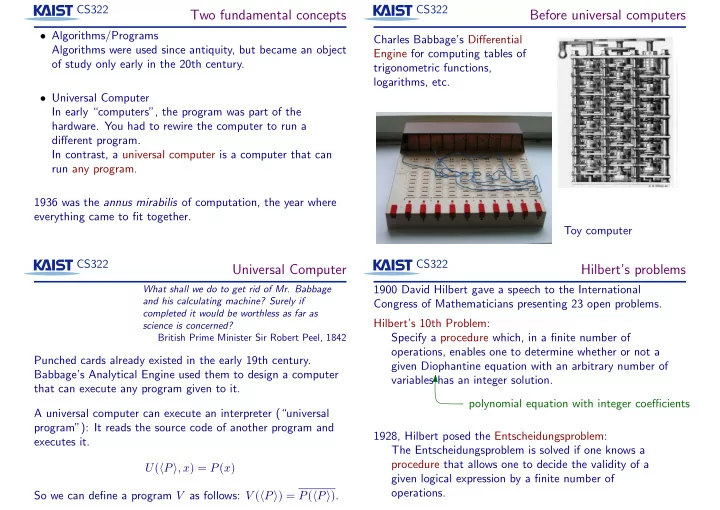
Charles Babbage’s Differential Engine for computing tables of trigonometric functions, logarithms, etc. Toy computer CS322
Universal Computer
What shall we do to get rid of Mr. Babbage and his calculating machine? Surely if completed it would be worthless as far as science is concerned? British Prime Minister Sir Robert Peel, 1842
Punched cards already existed in the early 19th century. Babbage’s Analytical Engine used them to design a computer that can execute any program given to it. A universal computer can execute an interpreter (“universal program”): It reads the source code of another program and executes it. U(P, x) = P(x) So we can define a program V as follows: V (P) = P(P). CS322
Hilbert’s problems
1900 David Hilbert gave a speech to the International Congress of Mathematicians presenting 23 open problems. Hilbert’s 10th Problem: Specify a procedure which, in a finite number of
- perations, enables one to determine whether or not a
given Diophantine equation with an arbitrary number of variables has an integer solution. polynomial equation with integer coefficients 1928, Hilbert posed the Entscheidungsproblem: The Entscheidungsproblem is solved if one knows a procedure that allows one to decide the validity of a given logical expression by a finite number of
- perations.