
Language and Computers Topic 1: Text and Speech Encoding Writing systems
Alphabetic Syllabic Logographic Systems with unusual realization Relation to language Comparison of systemsEncoding written language
ASCII Unicode Typing it inSpoken language
Transcription Why speech is hard to represent Articulation AcousticsRelating written and spoken language
From Speech to Text From Text to SpeechLanguage and Computers (Ling 384)
Topic 1: Text and Speech Encoding
Adriane Boyd∗ Department of Linguistics, OSU Autumn 2005
∗ The course was created by Markus Dickinson, Detmar Meurers and Chris Brew.1 / 59 Language and Computers Topic 1: Text and Speech Encoding Writing systems
Alphabetic Syllabic Logographic Systems with unusual realization Relation to language Comparison of systemsEncoding written language
ASCII Unicode Typing it inSpoken language
Transcription Why speech is hard to represent Articulation AcousticsRelating written and spoken language
From Speech to Text From Text to SpeechLanguage and Computers – where to start?
◮ If we want to do anything with language, we need a way
to represent language.
◮ We can interact with the computer in several ways:
◮ write or read text ◮ speak or listen to speech
◮ Computer has to have some way to represent
◮ text ◮ speech 2 / 59 Language and Computers Topic 1: Text and Speech Encoding Writing systems
Alphabetic Syllabic Logographic Systems with unusual realization Relation to language Comparison of systemsEncoding written language
ASCII Unicode Typing it inSpoken language
Transcription Why speech is hard to represent Articulation AcousticsRelating written and spoken language
From Speech to Text From Text to SpeechOutline
Writing systems Encoding written language Spoken language Relating written and spoken language
3 / 59 Language and Computers Topic 1: Text and Speech Encoding Writing systems
Alphabetic Syllabic Logographic Systems with unusual realization Relation to language Comparison of systemsEncoding written language
ASCII Unicode Typing it inSpoken language
Transcription Why speech is hard to represent Articulation AcousticsRelating written and spoken language
From Speech to Text From Text to SpeechWriting systems used for human languages
What is writing?
“a system of more or less permanent marks used to represent an utterance in such a way that it can be recovered more or less exactly without the intervention of the utterer.” (Peter T. Daniels, The World’s Writing Systems) “Words that stay.” (-Jen (Jim Henson), The Dark Crystal)
Different types of writing systems are used:
◮ Alphabetic ◮ Syllabic ◮ Logographic Much of the information on writing systems and the graphics used are taken from the amazing site http://www.omniglot.com.
4 / 59 Language and Computers Topic 1: Text and Speech Encoding Writing systems
Alphabetic Syllabic Logographic Systems with unusual realization Relation to language Comparison of systemsEncoding written language
ASCII Unicode Typing it inSpoken language
Transcription Why speech is hard to represent Articulation AcousticsRelating written and spoken language
From Speech to Text From Text to SpeechAlphabetic systems
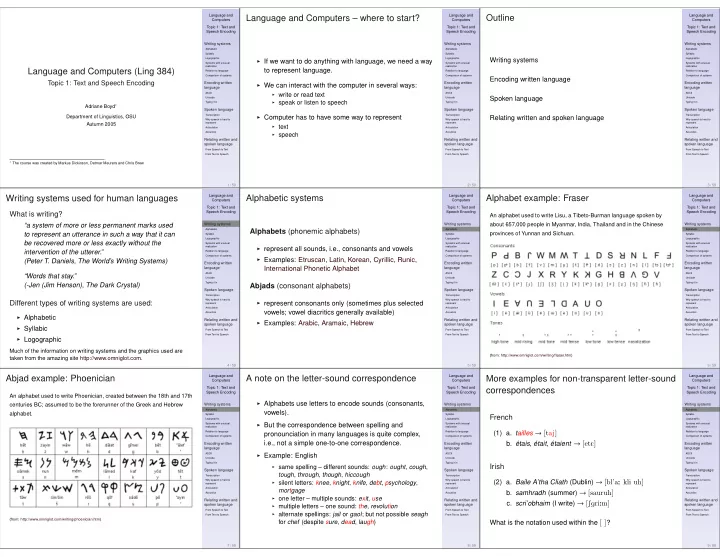
Alphabets (phonemic alphabets)
◮ represent all sounds, i.e., consonants and vowels ◮ Examples: Etruscan, Latin, Korean, Cyrillic, Runic,
International Phonetic Alphabet
Abjads (consonant alphabets)
◮ represent consonants only (sometimes plus selected
vowels; vowel diacritics generally available)
◮ Examples: Arabic, Aramaic, Hebrew
5 / 59 Language and Computers Topic 1: Text and Speech Encoding Writing systems
Alphabetic Syllabic Logographic Systems with unusual realization Relation to language Comparison of systemsEncoding written language
ASCII Unicode Typing it inSpoken language
Transcription Why speech is hard to represent Articulation AcousticsRelating written and spoken language
From Speech to Text From Text to SpeechAlphabet example: Fraser
An alphabet used to write Lisu, a Tibeto-Burman language spoken by about 657,000 people in Myanmar, India, Thailand and in the Chinese provinces of Yunnan and Sichuan.
(from: http://www.omniglot.com/writing/fraser.htm) 6 / 59 Language and Computers Topic 1: Text and Speech Encoding Writing systems
Alphabetic Syllabic Logographic Systems with unusual realization Relation to language Comparison of systemsEncoding written language
ASCII Unicode Typing it inSpoken language
Transcription Why speech is hard to represent Articulation AcousticsRelating written and spoken language
From Speech to Text From Text to SpeechAbjad example: Phoenician
An alphabet used to write Phoenician, created between the 18th and 17th centuries BC; assumed to be the forerunner of the Greek and Hebrew alphabet.
(from: http://www.omniglot.com/writing/phoenician.htm) 7 / 59 Language and Computers Topic 1: Text and Speech Encoding Writing systems
Alphabetic Syllabic Logographic Systems with unusual realization Relation to language Comparison of systemsEncoding written language
ASCII Unicode Typing it inSpoken language
Transcription Why speech is hard to represent Articulation AcousticsRelating written and spoken language
From Speech to Text From Text to SpeechA note on the letter-sound correspondence
◮ Alphabets use letters to encode sounds (consonants,
vowels).
◮ But the correspondence between spelling and
pronounciation in many languages is quite complex, i.e., not a simple one-to-one correspondence.
◮ Example: English
◮ same spelling – different sounds: ough: ought, cough,
tough, through, though, hiccough
◮ silent letters: knee, knight, knife, debt, psychology,
mortgage
◮ one letter – multiple sounds: exit, use ◮ multiple letters – one sound: the, revolution ◮ alternate spellings: jail or gaol; but not possible seagh
for chef (despite sure, dead, laugh)
8 / 59 Language and Computers Topic 1: Text and Speech Encoding Writing systems
Alphabetic Syllabic Logographic Systems with unusual realization Relation to language Comparison of systemsEncoding written language
ASCII Unicode Typing it inSpoken language
Transcription Why speech is hard to represent Articulation AcousticsRelating written and spoken language
From Speech to Text From Text to SpeechMore examples for non-transparent letter-sound correspondences
French
(1) a. tailles → [taj]
- b. ´
etais, ´ etait, ´ etaient → [etE]
Irish
(2) a. Baile A’tha Cliath (Dublin) → [bl’a: kli uh]
- b. samhradh (summer) → [sauruh]
- c. scri’obhaim (I write) → [Sgri:m]
What is the notation used within the [ ]?
9 / 59