
Language and Computers Topic 5: Machine Translation Introduction
Examples for Translations
Background: Dictionaries Transformer approaches Linguistic knowledge-based systems
Direct transfer systems Interlingua-based systems
Machine learning-based systems
Alignment
What makes MT hard? Evaluating MT systems References
Language and Computers (Ling 384)
Topic 5: Machine Translation
Adriane Boyd∗ Department of Linguistics, OSU Autumn 2005
∗ The course was created by Markus Dickinson, Detmar Meurers and Chris Brew.
1 / 67 Language and Computers Topic 5: Machine Translation Introduction
Examples for Translations
Background: Dictionaries Transformer approaches Linguistic knowledge-based systems
Direct transfer systems Interlingua-based systems
Machine learning-based systems
Alignment
What makes MT hard? Evaluating MT systems References
Outline
Introduction Background: Dictionaries Transformer approaches Linguistic knowledge-based systems Machine learning-based systems What makes MT hard? Evaluating MT systems References
2 / 67 Language and Computers Topic 5: Machine Translation Introduction
Examples for Translations
Background: Dictionaries Transformer approaches Linguistic knowledge-based systems
Direct transfer systems Interlingua-based systems
Machine learning-based systems
Alignment
What makes MT hard? Evaluating MT systems References
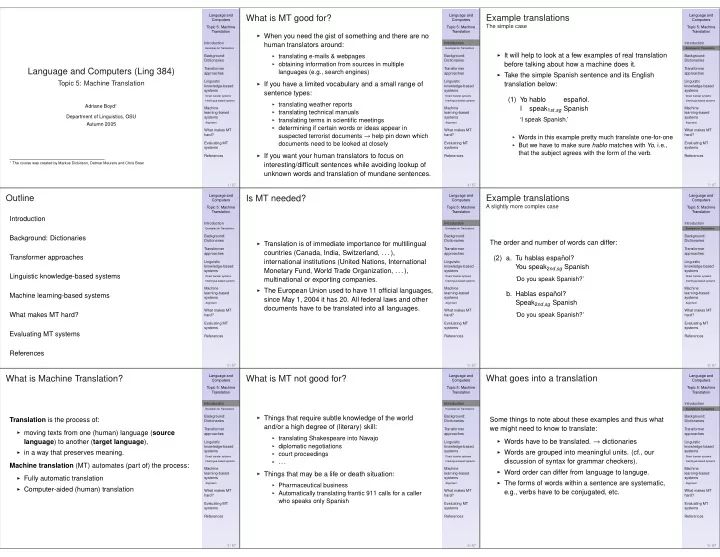
What is Machine Translation?
Translation is the process of:
◮ moving texts from one (human) language (source
language) to another (target language),
◮ in a way that preserves meaning.
Machine translation (MT) automates (part of) the process:
◮ Fully automatic translation ◮ Computer-aided (human) translation
3 / 67 Language and Computers Topic 5: Machine Translation Introduction
Examples for Translations
Background: Dictionaries Transformer approaches Linguistic knowledge-based systems
Direct transfer systems Interlingua-based systems
Machine learning-based systems
Alignment
What makes MT hard? Evaluating MT systems References
What is MT good for?
◮ When you need the gist of something and there are no
human translators around:
◮ translating e-mails & webpages ◮ obtaining information from sources in multiple
languages (e.g., search engines)
◮ If you have a limited vocabulary and a small range of
sentence types:
◮ translating weather reports ◮ translating technical manuals ◮ translating terms in scientific meetings ◮ determining if certain words or ideas appear in
suspected terrorist documents → help pin down which documents need to be looked at closely
◮ If you want your human translators to focus on
interesting/difficult sentences while avoiding lookup of unknown words and translation of mundane sentences.
4 / 67 Language and Computers Topic 5: Machine Translation Introduction
Examples for Translations
Background: Dictionaries Transformer approaches Linguistic knowledge-based systems
Direct transfer systems Interlingua-based systems
Machine learning-based systems
Alignment
What makes MT hard? Evaluating MT systems References
Is MT needed?
◮ Translation is of immediate importance for multilingual
countries (Canada, India, Switzerland, . . . ), international institutions (United Nations, International Monetary Fund, World Trade Organization, . . . ), multinational or exporting companies.
◮ The European Union used to have 11 official languages,
since May 1, 2004 it has 20. All federal laws and other documents have to be translated into all languages.
5 / 67 Language and Computers Topic 5: Machine Translation Introduction
Examples for Translations
Background: Dictionaries Transformer approaches Linguistic knowledge-based systems
Direct transfer systems Interlingua-based systems
Machine learning-based systems
Alignment
What makes MT hard? Evaluating MT systems References
What is MT not good for?
◮ Things that require subtle knowledge of the world
and/or a high degree of (literary) skill:
◮ translating Shakespeare into Navajo ◮ diplomatic negotiations ◮ court proceedings ◮ . . .
◮ Things that may be a life or death situation:
◮ Pharmaceutical business ◮ Automatically translating frantic 911 calls for a caller
who speaks only Spanish
6 / 67 Language and Computers Topic 5: Machine Translation Introduction
Examples for Translations
Background: Dictionaries Transformer approaches Linguistic knowledge-based systems
Direct transfer systems Interlingua-based systems
Machine learning-based systems
Alignment
What makes MT hard? Evaluating MT systems References
Example translations
The simple case ◮ It will help to look at a few examples of real translation
before talking about how a machine does it.
◮ Take the simple Spanish sentence and its English
translation below: (1) Yo I hablo speak1st,sg espa˜ nol. Spanish
‘I speak Spanish.’
◮ Words in this example pretty much translate one-for-one ◮ But we have to make sure hablo matches with Yo, i.e.,
that the subject agrees with the form of the verb.
7 / 67 Language and Computers Topic 5: Machine Translation Introduction
Examples for Translations
Background: Dictionaries Transformer approaches Linguistic knowledge-based systems
Direct transfer systems Interlingua-based systems
Machine learning-based systems
Alignment
What makes MT hard? Evaluating MT systems References
Example translations
A slightly more complex case
The order and number of words can differ: (2) a. Tu hablas espa˜ nol? You speak2nd,sg Spanish
‘Do you speak Spanish?’
- b. Hablas espa˜
nol? Speak2nd,sg Spanish
‘Do you speak Spanish?’
8 / 67 Language and Computers Topic 5: Machine Translation Introduction
Examples for Translations
Background: Dictionaries Transformer approaches Linguistic knowledge-based systems
Direct transfer systems Interlingua-based systems
Machine learning-based systems
Alignment
What makes MT hard? Evaluating MT systems References
What goes into a translation
Some things to note about these examples and thus what we might need to know to translate:
◮ Words have to be translated. → dictionaries ◮ Words are grouped into meaningful units. (cf., our
discussion of syntax for grammar checkers).
◮ Word order can differ from language to languge. ◮ The forms of words within a sentence are systematic,
e.g., verbs have to be conjugated, etc.
9 / 67