Why people care about spelling Language and Detection vs. - - PowerPoint PPT Presentation

why people care about spelling
SMART_READER_LITE
LIVE PREVIEW

Why people care about spelling Language and Detection vs. - - PowerPoint PPT Presentation

Language and Why people care about spelling Language and Detection vs. Correction Language and Computers Computers Computers Topic 4: Topic 4: Topic 4: Writers Aids Writers Aids Writers Aids Introduction Introduction


slide-1
SLIDE 1

Language and Computers Topic 4: Writer’s Aids Introduction Error causes

Keyboard mistypings Phonetic errors Knowledge problems

Difficult issues

Tokenization Inflection Productivity

Non-word error detection

Dictionaries N-gram analysis

Isolated-word error correction

Rule-based methods Similarity key techniques Probabilistic methods Minimum edit distance

Grammar correction

Syntax Computing with Syntax Grammar correction rules

Caveat emptor

Language and Computers (Ling 384)

Topic 4: Writer’s Aids (Spelling and Grammar Correction)

Adriane Boyd∗ Department of Linguistics, OSU Autumn 2005

∗ The course was created by Markus Dickinson, Detmar Meurers and Chris Brew.

1 / 72 Language and Computers Topic 4: Writer’s Aids Introduction Error causes

Keyboard mistypings Phonetic errors Knowledge problems

Difficult issues

Tokenization Inflection Productivity

Non-word error detection

Dictionaries N-gram analysis

Isolated-word error correction

Rule-based methods Similarity key techniques Probabilistic methods Minimum edit distance

Grammar correction

Syntax Computing with Syntax Grammar correction rules

Caveat emptor

Outline

Introduction Error causes Difficult issues Non-word error detection Isolated-word error correction Grammar correction Caveat emptor

2 / 72 Language and Computers Topic 4: Writer’s Aids Introduction Error causes

Keyboard mistypings Phonetic errors Knowledge problems

Difficult issues

Tokenization Inflection Productivity

Non-word error detection

Dictionaries N-gram analysis

Isolated-word error correction

Rule-based methods Similarity key techniques Probabilistic methods Minimum edit distance

Grammar correction

Syntax Computing with Syntax Grammar correction rules

Caveat emptor

Who cares about spelling?

Aoccdrnig to a rscheearch at Cmabrigde Uinervtisy, it deosn’t mttaer in waht oredr the ltteers in a wrod are, the olny iprmoetnt tihng is taht the frist and lsat ltteer be at the rghit pclae. The rset can be a toatl mses and you can sitll raed it wouthit

  • porbelm. Tihs is bcuseae the huamn mnid deos not

raed ervey lteter by istlef, but the wrod as a wlohe.

(See http://www.mrc-cbu.cam.ac.uk/personal/matt.davis/Cmabrigde/ for the story behind this supposed research report.)

A dootcr has aimttded the magltheuansr of a tageene ceacnr pintaet who deid aetfr a hatospil durg blendur.

3 / 72 Language and Computers Topic 4: Writer’s Aids Introduction Error causes

Keyboard mistypings Phonetic errors Knowledge problems

Difficult issues

Tokenization Inflection Productivity

Non-word error detection

Dictionaries N-gram analysis

Isolated-word error correction

Rule-based methods Similarity key techniques Probabilistic methods Minimum edit distance

Grammar correction

Syntax Computing with Syntax Grammar correction rules

Caveat emptor

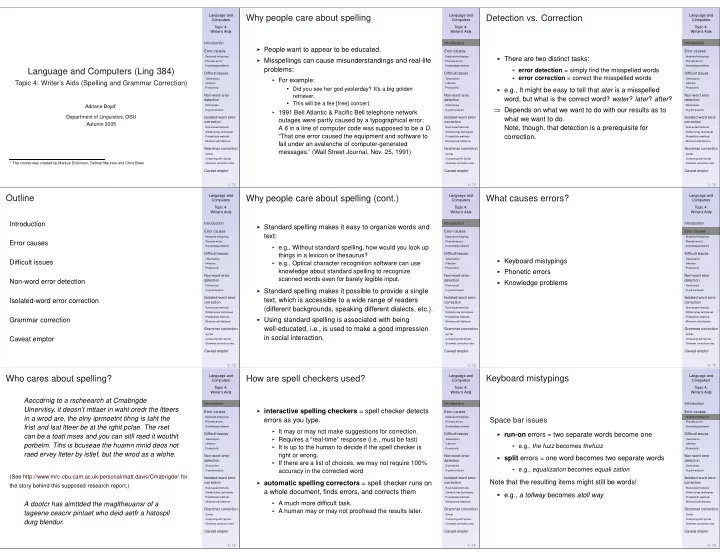
Why people care about spelling

◮ People want to appear to be educated. ◮ Misspellings can cause misunderstandings and real-life

problems:

◮ For example: ◮ Did you see her god yesterday? It’s a big golden

retriever.

◮ This will be a fee [free] concert. ◮ 1991 Bell Atlantic & Pacific Bell telephone network

  • utages were partly caused by a typographical error:

A 6 in a line of computer code was supposed to be a D. “That one error caused the equipment and software to fail under an avalanche of computer-generated messages.” (Wall Street Journal, Nov. 25, 1991)

4 / 72 Language and Computers Topic 4: Writer’s Aids Introduction Error causes

Keyboard mistypings Phonetic errors Knowledge problems

Difficult issues

Tokenization Inflection Productivity

Non-word error detection

Dictionaries N-gram analysis

Isolated-word error correction

Rule-based methods Similarity key techniques Probabilistic methods Minimum edit distance

Grammar correction

Syntax Computing with Syntax Grammar correction rules

Caveat emptor

Why people care about spelling (cont.)

◮ Standard spelling makes it easy to organize words and

text:

◮ e.g., Without standard spelling, how would you look up

things in a lexicon or thesaurus?

◮ e.g., Optical character recognition software can use

knowledge about standard spelling to recognize scanned words even for barely legible input.

◮ Standard spelling makes it possible to provide a single

text, which is accessible to a wide range of readers (different backgrounds, speaking different dialects, etc.).

◮ Using standard spelling is associated with being

well-educated, i.e., is used to make a good impression in social interaction.

5 / 72 Language and Computers Topic 4: Writer’s Aids Introduction Error causes

Keyboard mistypings Phonetic errors Knowledge problems

Difficult issues

Tokenization Inflection Productivity

Non-word error detection

Dictionaries N-gram analysis

Isolated-word error correction

Rule-based methods Similarity key techniques Probabilistic methods Minimum edit distance

Grammar correction

Syntax Computing with Syntax Grammar correction rules

Caveat emptor

How are spell checkers used?

◮ interactive spelling checkers = spell checker detects

errors as you type.

◮ It may or may not make suggestions for correction. ◮ Requires a “real-time” response (i.e., must be fast) ◮ It is up to the human to decide if the spell checker is

right or wrong.

◮ If there are a list of choices, we may not require 100%

accuracy in the corrected word

◮ automatic spelling correctors = spell checker runs on

a whole document, finds errors, and corrects them

◮ A much more difficult task. ◮ A human may or may not proofread the results later. 6 / 72 Language and Computers Topic 4: Writer’s Aids Introduction Error causes

Keyboard mistypings Phonetic errors Knowledge problems

Difficult issues

Tokenization Inflection Productivity

Non-word error detection

Dictionaries N-gram analysis

Isolated-word error correction

Rule-based methods Similarity key techniques Probabilistic methods Minimum edit distance

Grammar correction

Syntax Computing with Syntax Grammar correction rules

Caveat emptor

Detection vs. Correction

◮ There are two distinct tasks:

◮ error detection = simply find the misspelled words ◮ error correction = correct the misspelled words

◮ e.g., It might be easy to tell that ater is a misspelled

word, but what is the correct word? water? later? after? ⇒ Depends on what we want to do with our results as to what we want to do. Note, though, that detection is a prerequisite for correction.

7 / 72 Language and Computers Topic 4: Writer’s Aids Introduction Error causes

Keyboard mistypings Phonetic errors Knowledge problems

Difficult issues

Tokenization Inflection Productivity

Non-word error detection

Dictionaries N-gram analysis

Isolated-word error correction

Rule-based methods Similarity key techniques Probabilistic methods Minimum edit distance

Grammar correction

Syntax Computing with Syntax Grammar correction rules

Caveat emptor

What causes errors?

◮ Keyboard mistypings ◮ Phonetic errors ◮ Knowledge problems

8 / 72 Language and Computers Topic 4: Writer’s Aids Introduction Error causes

Keyboard mistypings Phonetic errors Knowledge problems

Difficult issues

Tokenization Inflection Productivity

Non-word error detection

Dictionaries N-gram analysis

Isolated-word error correction

Rule-based methods Similarity key techniques Probabilistic methods Minimum edit distance

Grammar correction

Syntax Computing with Syntax Grammar correction rules

Caveat emptor

Keyboard mistypings

Space bar issues

◮ run-on errors = two separate words become one

◮ e.g., the fuzz becomes thefuzz

◮ split errors = one word becomes two separate words

◮ e.g., equalization becomes equali zation

Note that the resulting items might still be words!

◮ e.g., a tollway becomes atoll way

9 / 72

slide-2
SLIDE 2

Language and Computers Topic 4: Writer’s Aids Introduction Error causes

Keyboard mistypings Phonetic errors Knowledge problems

Difficult issues

Tokenization Inflection Productivity

Non-word error detection

Dictionaries N-gram analysis

Isolated-word error correction

Rule-based methods Similarity key techniques Probabilistic methods Minimum edit distance

Grammar correction

Syntax Computing with Syntax Grammar correction rules

Caveat emptor

Keyboard mistypings (cont.)

Keyboard proximity

◮ e.g., Jack becomes Hack since h and j are next to each

  • ther on a typical American keyboard

Physical similarity

◮ similarity of shape, e.g., mistaking two physically similar

letters when typing up something handwritten

◮ e.g., tight for fight 10 / 72 Language and Computers Topic 4: Writer’s Aids Introduction Error causes

Keyboard mistypings Phonetic errors Knowledge problems

Difficult issues

Tokenization Inflection Productivity

Non-word error detection

Dictionaries N-gram analysis

Isolated-word error correction

Rule-based methods Similarity key techniques Probabilistic methods Minimum edit distance

Grammar correction

Syntax Computing with Syntax Grammar correction rules

Caveat emptor

Phonetic errors

phonetic errors = errors based on the sounds of a language (not necessarily on the letters)

◮ homophones = two words which sound the same

◮ e.g., red/read (past tense), cite/site/sight,

they’re/their/there

◮ Spoonerisms = switching two letters/sounds around

◮ e.g., Pleating and humming 11 / 72 Language and Computers Topic 4: Writer’s Aids Introduction Error causes

Keyboard mistypings Phonetic errors Knowledge problems

Difficult issues

Tokenization Inflection Productivity

Non-word error detection

Dictionaries N-gram analysis

Isolated-word error correction

Rule-based methods Similarity key techniques Probabilistic methods Minimum edit distance

Grammar correction

Syntax Computing with Syntax Grammar correction rules

Caveat emptor

Phonetic errors (cont.)

◮ letter substitution: replacing a letter (or sequence of

letters) with a similar-sounding one

◮ e.g., John kracked his nuckles.

instead of John cracked his knuckles.

◮ e.g., I study sikologee.

◮ word replacement: replacing one word with some

similar-sounding word

◮ e.g., John battled me on the back.

instead of John patted me on the back.

12 / 72 Language and Computers Topic 4: Writer’s Aids Introduction Error causes

Keyboard mistypings Phonetic errors Knowledge problems

Difficult issues

Tokenization Inflection Productivity

Non-word error detection

Dictionaries N-gram analysis

Isolated-word error correction

Rule-based methods Similarity key techniques Probabilistic methods Minimum edit distance

Grammar correction

Syntax Computing with Syntax Grammar correction rules

Caveat emptor

More examples for phonetic errors

(1) a. death in Venice

  • b. deaf in Venice

(2) a. give them an ice bucket

  • b. give them a nice bucket

(3) a. the stuffy nose

  • b. the stuff he knows

(4) a. the biggest hurdle

  • b. the biggest turtle

(5) a. a Coke and a danish

  • b. a coconut danish

13 / 72 Language and Computers Topic 4: Writer’s Aids Introduction Error causes

Keyboard mistypings Phonetic errors Knowledge problems

Difficult issues

Tokenization Inflection Productivity

Non-word error detection

Dictionaries N-gram analysis

Isolated-word error correction

Rule-based methods Similarity key techniques Probabilistic methods Minimum edit distance

Grammar correction

Syntax Computing with Syntax Grammar correction rules

Caveat emptor

Knowledge problems

◮ not knowing a word and guessing its spelling (can be

phonetic)

◮ e.g., sientist

◮ not knowing a rule and guessing it

◮ e.g., Do we double a consonant for ing words?

jog → joging joke → jokking

14 / 72 Language and Computers Topic 4: Writer’s Aids Introduction Error causes

Keyboard mistypings Phonetic errors Knowledge problems

Difficult issues

Tokenization Inflection Productivity

Non-word error detection

Dictionaries N-gram analysis

Isolated-word error correction

Rule-based methods Similarity key techniques Probabilistic methods Minimum edit distance

Grammar correction

Syntax Computing with Syntax Grammar correction rules

Caveat emptor

What makes spelling correction difficult?

◮ Tokenization: What is a word? ◮ Inflection: How are some words related? ◮ Productivity of language: How many words are there?

How we handle these issues determines how we build a dictionary.

15 / 72 Language and Computers Topic 4: Writer’s Aids Introduction Error causes

Keyboard mistypings Phonetic errors Knowledge problems

Difficult issues

Tokenization Inflection Productivity

Non-word error detection

Dictionaries N-gram analysis

Isolated-word error correction

Rule-based methods Similarity key techniques Probabilistic methods Minimum edit distance

Grammar correction

Syntax Computing with Syntax Grammar correction rules

Caveat emptor

Tokenization

Intuitively a “word” is simply whatever is between two spaces, but this is not always so clear.

◮ contractions = two words combined into one

◮ e.g., can’t, he’s, John’s [car] (vs. his car)

◮ multi-token words = (arguably) a single word with a

space in it

◮ e.g., New York, in spite of, deja vu

◮ hyphens (note: can be ambiguous if a hyphen ends a

line)

◮ Some are always a single word: e-mail, co-operate ◮ Others are two words combined into one:

Columbus-based, sound-change

◮ Abbreviations: may stand for multiple words

◮ e.g., etc. = et cetera, ATM = Automated Teller Machine 16 / 72 Language and Computers Topic 4: Writer’s Aids Introduction Error causes

Keyboard mistypings Phonetic errors Knowledge problems

Difficult issues

Tokenization Inflection Productivity

Non-word error detection

Dictionaries N-gram analysis

Isolated-word error correction

Rule-based methods Similarity key techniques Probabilistic methods Minimum edit distance

Grammar correction

Syntax Computing with Syntax Grammar correction rules

Caveat emptor

Inflection

◮ A word in English may appear in various guises due to

word inflections = word endings which are fairly systematic for a given part of speech

◮ plural noun ending: the boy + s → the boys ◮ past tense verb ending: walk + ed → walked

◮ This can make spell-checking hard:

◮ There are exceptions to the rules: mans, runned ◮ There are words which look like they have a given

ending, but they don’t: Hans, deed

17 / 72 Language and Computers Topic 4: Writer’s Aids Introduction Error causes

Keyboard mistypings Phonetic errors Knowledge problems

Difficult issues

Tokenization Inflection Productivity

Non-word error detection

Dictionaries N-gram analysis

Isolated-word error correction

Rule-based methods Similarity key techniques Probabilistic methods Minimum edit distance

Grammar correction

Syntax Computing with Syntax Grammar correction rules

Caveat emptor

Productivity

◮ part of speech change: nouns can be verbified

◮ tabled is a new verb coined after the noun table ◮

Calvin: I like to verb words. Hobbes: What? Calvin: I take nouns and adjectives and use them as verbs. Remember when “access” was a thing? Now, it’s something you do. It got verbed. Verbing weirds language. Hobbes: Maybe we can eventually make language a complete impediment to understanding.

◮ morphological productivity: prefixes and suffixes can be

added

◮ e.g., I can speak of un-email-able for someone who you

can’t reach by email.

◮ words entering and exiting the lexicon, e.g.:

◮ thou, or spleet ’split’ (Hamlet III.2.10) are on their way

  • ut

◮ SARS and wifi (or wi-fi) have entered recently 18 / 72

slide-3
SLIDE 3

Language and Computers Topic 4: Writer’s Aids Introduction Error causes

Keyboard mistypings Phonetic errors Knowledge problems

Difficult issues

Tokenization Inflection Productivity

Non-word error detection

Dictionaries N-gram analysis

Isolated-word error correction

Rule-based methods Similarity key techniques Probabilistic methods Minimum edit distance

Grammar correction

Syntax Computing with Syntax Grammar correction rules

Caveat emptor

Techniques used for spell checking

◮ Non-word error detection ◮ Isolated-word error correction ◮ Context-dependent word error detection and correction

→ grammar correction.

19 / 72 Language and Computers Topic 4: Writer’s Aids Introduction Error causes

Keyboard mistypings Phonetic errors Knowledge problems

Difficult issues

Tokenization Inflection Productivity

Non-word error detection

Dictionaries N-gram analysis

Isolated-word error correction

Rule-based methods Similarity key techniques Probabilistic methods Minimum edit distance

Grammar correction

Syntax Computing with Syntax Grammar correction rules

Caveat emptor

Non-word error detection

◮ non-word error detection is essentially the same thing

as word recognition = splitting up “words” into true words and non-words.

◮ How is non-word error detection done?

◮ using a dictionary (construction and lookup) ◮ n-gram analysis 20 / 72 Language and Computers Topic 4: Writer’s Aids Introduction Error causes

Keyboard mistypings Phonetic errors Knowledge problems

Difficult issues

Tokenization Inflection Productivity

Non-word error detection

Dictionaries N-gram analysis

Isolated-word error correction

Rule-based methods Similarity key techniques Probabilistic methods Minimum edit distance

Grammar correction

Syntax Computing with Syntax Grammar correction rules

Caveat emptor

Dictionaries

Intuition:

◮ Have a complete list of words and check the input

words against this list.

◮ If it’s not in the dictionary, it’s not a word.

Two aspects:

◮ Dictionary construction = build the dictionary (what

do you put in it?)

◮ Dictionary lookup = lookup a potential word in the

dictionary (how do you do this quickly?)

21 / 72 Language and Computers Topic 4: Writer’s Aids Introduction Error causes

Keyboard mistypings Phonetic errors Knowledge problems

Difficult issues

Tokenization Inflection Productivity

Non-word error detection

Dictionaries N-gram analysis

Isolated-word error correction

Rule-based methods Similarity key techniques Probabilistic methods Minimum edit distance

Grammar correction

Syntax Computing with Syntax Grammar correction rules

Caveat emptor

Dictionary construction

◮ Do we include inflected words? i.e., words with prefixes

and suffixes already attached.

◮ Pro: lookup can be faster ◮ Con: takes much more space, doesn’t account for new

formations (e.g. google → googled

◮ Want the dictionary to have only the word relevant for

the user → domain-specificity

◮ e.g., For most people memoize is a misspelled word,

but in computer science this is a technical term and spelled correctly.

◮ Foreign words, hyphenations, derived words, proper

nouns, and new words will always be problems for dictionaries since we cannot predict these words until humans have made them words.

◮ Dictionary should probably be dialectally consistent.

◮ e.g., include only color or colour but not both 22 / 72 Language and Computers Topic 4: Writer’s Aids Introduction Error causes

Keyboard mistypings Phonetic errors Knowledge problems

Difficult issues

Tokenization Inflection Productivity

Non-word error detection

Dictionaries N-gram analysis

Isolated-word error correction

Rule-based methods Similarity key techniques Probabilistic methods Minimum edit distance

Grammar correction

Syntax Computing with Syntax Grammar correction rules

Caveat emptor

Dictionary lookup

Several issues arise when trying to look up a word:

◮ Have to make lookup fast by using efficient lookup

techniques, such as a hash table

◮ Have to strip off prefixes and suffixes if the word isn’t an

entry by itself.

◮ running → run ◮ antireligious → religious both 23 / 72 Language and Computers Topic 4: Writer’s Aids Introduction Error causes

Keyboard mistypings Phonetic errors Knowledge problems

Difficult issues

Tokenization Inflection Productivity

Non-word error detection

Dictionaries N-gram analysis

Isolated-word error correction

Rule-based methods Similarity key techniques Probabilistic methods Minimum edit distance

Grammar correction

Syntax Computing with Syntax Grammar correction rules

Caveat emptor

N-gram analysis

◮ An n-gram here is a string of n letters.

a 1-gram (unigram) at 2-gram (bigram) ate 3-gram (trigram) late 4-gram . . . . . .

◮ We can use this n-gram information to define what the

possible strings in a language are.

◮ e.g., po is a possible English string, whereas kvt is not. 24 / 72 Language and Computers Topic 4: Writer’s Aids Introduction Error causes

Keyboard mistypings Phonetic errors Knowledge problems

Difficult issues

Tokenization Inflection Productivity

Non-word error detection

Dictionaries N-gram analysis

Isolated-word error correction

Rule-based methods Similarity key techniques Probabilistic methods Minimum edit distance

Grammar correction

Syntax Computing with Syntax Grammar correction rules

Caveat emptor

How do we store and use n-gram information?

◮ Store the number of times an n-gram appears (like in

Language Identification). But, maybe we just want to know if an n-gram is possible.

◮ We could have a list of possible and impossible n-grams

(1 = possible, 0 = impossible): po 1 kvt police 1 asdf

◮ Any word which has a 0 for any substring is a

misspelled word.

◮ Problems with such an approach:

◮ Information is repeated (po is in police) ◮ Requires a lot of computer storage space ◮ Inefficient (slow) when looking up every string 25 / 72 Language and Computers Topic 4: Writer’s Aids Introduction Error causes

Keyboard mistypings Phonetic errors Knowledge problems

Difficult issues

Tokenization Inflection Productivity

Non-word error detection

Dictionaries N-gram analysis

Isolated-word error correction

Rule-based methods Similarity key techniques Probabilistic methods Minimum edit distance

Grammar correction

Syntax Computing with Syntax Grammar correction rules

Caveat emptor

Bigram array

◮ Instead, we can define a bigram array = information

stored in a tabular fashion.

◮ An example, for the letters k, l, m, with examples in

parentheses . . . k l m . . . . . . k 1 (tackle) 1 (Hackman) l 1 (elk) 1 (hello) 1 (alms) m 1 (hammer) . . .

◮ The first letter of the bigram is given by the vertical

letters (i.e., down the side), the second by the horziontal

  • nes (i.e., across the top).

◮ This is a non-positional bigram array = the array 1’s

and 0’s apply for a string found anywhere within a word (beginning, 4th character, ending, etc.).

26 / 72 Language and Computers Topic 4: Writer’s Aids Introduction Error causes

Keyboard mistypings Phonetic errors Knowledge problems

Difficult issues

Tokenization Inflection Productivity

Non-word error detection

Dictionaries N-gram analysis

Isolated-word error correction

Rule-based methods Similarity key techniques Probabilistic methods Minimum edit distance

Grammar correction

Syntax Computing with Syntax Grammar correction rules

Caveat emptor

Positional bigram array

◮ To store information specific to the beginning, the end,

  • r some other position in a word, we can use a

positional bigram array = the array only applies for a given position in a word.

◮ Here’s the same array as before, but now only applied

to word endings: . . . k l m . . . . . . k l 1 (elk) 1 (hall) 1 (elm) m . . .

27 / 72

slide-4
SLIDE 4

Language and Computers Topic 4: Writer’s Aids Introduction Error causes

Keyboard mistypings Phonetic errors Knowledge problems

Difficult issues

Tokenization Inflection Productivity

Non-word error detection

Dictionaries N-gram analysis

Isolated-word error correction

Rule-based methods Similarity key techniques Probabilistic methods Minimum edit distance

Grammar correction

Syntax Computing with Syntax Grammar correction rules

Caveat emptor

Isolated-word error correction

◮ Having discussed how errors can be detected, we want

to know how to correct these misspelled words:

◮ The most common method is isolated-word error

correction = correcting words without taking context into account.

◮ Note: This technique can only handle errors that result

in non-words.

◮ Knowledge about what is a typical error helps in finding

correct word.

28 / 72 Language and Computers Topic 4: Writer’s Aids Introduction Error causes

Keyboard mistypings Phonetic errors Knowledge problems

Difficult issues

Tokenization Inflection Productivity

Non-word error detection

Dictionaries N-gram analysis

Isolated-word error correction

Rule-based methods Similarity key techniques Probabilistic methods Minimum edit distance

Grammar correction

Syntax Computing with Syntax Grammar correction rules

Caveat emptor

Knowledge about typical errors

◮ word length effects: most misspellings are within two

characters in length of original → When searching for the correct spelling, we do not

usually need to look at words with greater length differences.

◮ first-position error effects: the first letter of a word is

rarely erroneous → When searching for the correct spelling, the process is

sped up by being able to look only at words with the same first letter.

29 / 72 Language and Computers Topic 4: Writer’s Aids Introduction Error causes

Keyboard mistypings Phonetic errors Knowledge problems

Difficult issues

Tokenization Inflection Productivity

Non-word error detection

Dictionaries N-gram analysis

Isolated-word error correction

Rule-based methods Similarity key techniques Probabilistic methods Minimum edit distance

Grammar correction

Syntax Computing with Syntax Grammar correction rules

Caveat emptor

Isolated-word error correction methods

◮ Many different methods are used; we will briefly look at

four methods:

◮ rule-based methods ◮ similarity key techniques ◮ minimum edit distance ◮ probabilistic methods

◮ The methods play a role in one of the three basic steps:

  • 1. Detection of an error (discussed above)
  • 2. Generation of candidate corrections

◮ rule-based methods ◮ similarity key techniques

  • 3. Ranking of candidate corrections

◮ probabilistic methods ◮ minimum edit distance 30 / 72 Language and Computers Topic 4: Writer’s Aids Introduction Error causes

Keyboard mistypings Phonetic errors Knowledge problems

Difficult issues

Tokenization Inflection Productivity

Non-word error detection

Dictionaries N-gram analysis

Isolated-word error correction

Rule-based methods Similarity key techniques Probabilistic methods Minimum edit distance

Grammar correction

Syntax Computing with Syntax Grammar correction rules

Caveat emptor

Rule-based methods

One can generate correct spellings by writing rules:

◮ Common misspelling rewritten as correct word:

◮ e.g., hte → the

◮ Rules

◮ based on inflections: ◮ e.g., V+C+ing → V+CC+ing

(where V = vowel and C = consonant)

◮ based on other common spelling errors (such as

keyboard effects or common transpositions):

◮ e.g., CsC → CaC ◮ e.g., Cie → Cei 31 / 72 Language and Computers Topic 4: Writer’s Aids Introduction Error causes

Keyboard mistypings Phonetic errors Knowledge problems

Difficult issues

Tokenization Inflection Productivity

Non-word error detection

Dictionaries N-gram analysis

Isolated-word error correction

Rule-based methods Similarity key techniques Probabilistic methods Minimum edit distance

Grammar correction

Syntax Computing with Syntax Grammar correction rules

Caveat emptor

Similarity key techniques

◮ Problem: How can we find a list of possible corrections? ◮ Solution: Store words in different boxes in a way that

puts the similar words together.

◮ Example:

  • 1. Start by storing words by their first letter (first letter

effect),

◮ e.g., punc starts with the code P

.

  • 2. Then assign numbers to each letter

◮ e.g., 0 for vowels, 1 for b, p, f, v (all bilabials), and so

forth, e.g., punc → P052

  • 3. Then throw out all zeros and repeated letters,

◮ e.g., P052 → P52.

  • 4. Look for real words within the same box,

◮ e.g., punk is also in the P52 box. 32 / 72 Language and Computers Topic 4: Writer’s Aids Introduction Error causes

Keyboard mistypings Phonetic errors Knowledge problems

Difficult issues

Tokenization Inflection Productivity

Non-word error detection

Dictionaries N-gram analysis

Isolated-word error correction

Rule-based methods Similarity key techniques Probabilistic methods Minimum edit distance

Grammar correction

Syntax Computing with Syntax Grammar correction rules

Caveat emptor

Probabilistic methods

Two main probabilities are taken into account:

◮ transition probabilities = probability (chance) of going

from one letter to the next.

◮ e.g., What is the chance that a will follow p in English?

That u will follow q?

◮ confusion probabilities = probability of one letter

being mistaken (substituted) for another (can be derived from a confusion matrix)

◮ e.g., What is the chance that q is confused with p?

Useful to combine probabilistic techniques with dictionary methods

33 / 72 Language and Computers Topic 4: Writer’s Aids Introduction Error causes

Keyboard mistypings Phonetic errors Knowledge problems

Difficult issues

Tokenization Inflection Productivity

Non-word error detection

Dictionaries N-gram analysis

Isolated-word error correction

Rule-based methods Similarity key techniques Probabilistic methods Minimum edit distance

Grammar correction

Syntax Computing with Syntax Grammar correction rules

Caveat emptor

Confusion probabilities

◮ For the various reasons discussed above (keyboard

layout, phonetic similarity, etc.) people type other letters than the ones they intended.

◮ It is impossible to fully investigate all possible error

causes and how they interact, but we can learn from watching how often people make errors and where.

◮ One way of doing so is to build a confusion matrix = a

table indicating how often one letter is mistyped for another correct . . . r s t . . . . . . r n/a 12 22 typed s 14 n/a 15 t 11 37 n/a . . .

(cf. Kernighan et al 1999)

34 / 72 Language and Computers Topic 4: Writer’s Aids Introduction Error causes

Keyboard mistypings Phonetic errors Knowledge problems

Difficult issues

Tokenization Inflection Productivity

Non-word error detection

Dictionaries N-gram analysis

Isolated-word error correction

Rule-based methods Similarity key techniques Probabilistic methods Minimum edit distance

Grammar correction

Syntax Computing with Syntax Grammar correction rules

Caveat emptor

How is a mistyped word related to the intended?

Types of errors

◮ insertion = a letter is added to a word ◮ deletion = a letter is deleted from a word ◮ substitution = a letter is put in place of another one ◮ transposition = two adjacent letters are switched

Note that the first two alter the length of the word, whereas the second two maintain the same length.

General properties

◮ single-error misspellings = only one instance of an

error

◮ multi-error misspellings = multiple instances of errors

(harder to identify)

35 / 72 Language and Computers Topic 4: Writer’s Aids Introduction Error causes

Keyboard mistypings Phonetic errors Knowledge problems

Difficult issues

Tokenization Inflection Productivity

Non-word error detection

Dictionaries N-gram analysis

Isolated-word error correction

Rule-based methods Similarity key techniques Probabilistic methods Minimum edit distance

Grammar correction

Syntax Computing with Syntax Grammar correction rules

Caveat emptor

Minimum edit distance

◮ In order to rank possible spelling corrections, it can be

useful to calculate the minimum edit distance = minimum number of operations it would take to convert

  • ne word into another.

◮ For example, we can take the following five steps to

convert junk to haiku:

  • 1. junk → juk

(deletion)

  • 2. juk → huk

(substitution)

  • 3. huk → hku

(transposition)

  • 4. hku → hiku

(insertion)

  • 5. hiku → haiku

(insertion)

◮ But is this the minimal number of steps needed?

36 / 72

slide-5
SLIDE 5

Language and Computers Topic 4: Writer’s Aids Introduction Error causes

Keyboard mistypings Phonetic errors Knowledge problems

Difficult issues

Tokenization Inflection Productivity

Non-word error detection

Dictionaries N-gram analysis

Isolated-word error correction

Rule-based methods Similarity key techniques Probabilistic methods Minimum edit distance

Grammar correction

Syntax Computing with Syntax Grammar correction rules

Caveat emptor

Computing edit distances

Figuring out the worst case ◮ To be able to compute the edit distance of two words at

all, we need to ensure there is a finite number of steps.

◮ This can be accomplished by

◮ requiring that letters cannot be changed back and forth

a potentially infinite number of times, i.e., we

◮ limit the number of changes to the size of the material

we are presented with, the two words.

◮ Idea: Never deal with a character in either word more

than once.

◮ Result:

◮ In the worst case, we delete each character in the first

word and then insert each character of the second word.

◮ The worst case edit distance for two words is

length(word1) + length(word2)

37 / 72 Language and Computers Topic 4: Writer’s Aids Introduction Error causes

Keyboard mistypings Phonetic errors Knowledge problems

Difficult issues

Tokenization Inflection Productivity

Non-word error detection

Dictionaries N-gram analysis

Isolated-word error correction

Rule-based methods Similarity key techniques Probabilistic methods Minimum edit distance

Grammar correction

Syntax Computing with Syntax Grammar correction rules

Caveat emptor

Computing edit distances

Using a graph to map out the options ◮ To calculate minimum edit distance, we set up a

directed, acyclic graph, a set of nodes (circles) and arcs (arrows).

◮ Horizontal arcs correspond to deletions, vertical arcs

correspond to insertions, and diagonal arcs correspond to substitutions (and a letter can be “substituted” for itself).

Substitute x for y Insert y Omit x

38 / 72 Language and Computers Topic 4: Writer’s Aids Introduction Error causes

Keyboard mistypings Phonetic errors Knowledge problems

Difficult issues

Tokenization Inflection Productivity

Non-word error detection

Dictionaries N-gram analysis

Isolated-word error correction

Rule-based methods Similarity key techniques Probabilistic methods Minimum edit distance

Grammar correction

Syntax Computing with Syntax Grammar correction rules

Caveat emptor

Computing edit distances

An example graph ◮ Say, the user types in plog. ◮ We want to calculate how far away peg is (one of the

possible corrections). In other words, we want to calculate the minimum edit distance (or minimum edit cost) from plog to peg.

◮ As the first step, we draw the following directed graph: g e p g

  • l

p

39 / 72 Language and Computers Topic 4: Writer’s Aids Introduction Error causes

Keyboard mistypings Phonetic errors Knowledge problems

Difficult issues

Tokenization Inflection Productivity

Non-word error detection

Dictionaries N-gram analysis

Isolated-word error correction

Rule-based methods Similarity key techniques Probabilistic methods Minimum edit distance

Grammar correction

Syntax Computing with Syntax Grammar correction rules

Caveat emptor

Computing edit distances

Adding numbers to the example graph ◮ The graph is acyclic = for any given node, it is

impossible to return to that node by following the arcs.

◮ We can add identifiers to the states, which allows us to

define a topological order:

8 3 2 1 5 11 10 13 17 18 14 15 19 20 16 12 g e p g

  • l

p 4 9 7 6

40 / 72 Language and Computers Topic 4: Writer’s Aids Introduction Error causes

Keyboard mistypings Phonetic errors Knowledge problems

Difficult issues

Tokenization Inflection Productivity

Non-word error detection

Dictionaries N-gram analysis

Isolated-word error correction

Rule-based methods Similarity key techniques Probabilistic methods Minimum edit distance

Grammar correction

Syntax Computing with Syntax Grammar correction rules

Caveat emptor

Computing edit distances

Adding costs to the arcs of the example graph ◮ We need to add the costs involved to the arcs. ◮ In the simplest case, the cost of deletion, insertion, and

substitution is 1 each (and substitution with the same character is free).

l

  • g

p e g

1 1 1 1 1 1 1

p 5 6 7 9 4 12 16 20 19 15 14 18 17 13 10 11

1 1 1 1 1 1 1 1 1 1 1 1 1 1 1 1 1 1 1 1 1 1 1 1 1 1 1 1 1 1 1 1 1 1

8 1 2 3 ◮ Instead of assuming the same cost for all operations, in

reality one will use different costs, e.g., for the first character or based on the confusion probability.

41 / 72 Language and Computers Topic 4: Writer’s Aids Introduction Error causes

Keyboard mistypings Phonetic errors Knowledge problems

Difficult issues

Tokenization Inflection Productivity

Non-word error detection

Dictionaries N-gram analysis

Isolated-word error correction

Rule-based methods Similarity key techniques Probabilistic methods Minimum edit distance

Grammar correction

Syntax Computing with Syntax Grammar correction rules

Caveat emptor

Computing edit distances

How to compute the path with the least cost

We want to find the path from the start (1) to the end (2) with the least cost.

◮ The simple but dumb way of doing it:

◮ Follow every path from start (1) to finish (20) and see

how many changes we have to make.

◮ But this is very inefficient! There are 131 different paths

to check.

42 / 72 Language and Computers Topic 4: Writer’s Aids Introduction Error causes

Keyboard mistypings Phonetic errors Knowledge problems

Difficult issues

Tokenization Inflection Productivity

Non-word error detection

Dictionaries N-gram analysis

Isolated-word error correction

Rule-based methods Similarity key techniques Probabilistic methods Minimum edit distance

Grammar correction

Syntax Computing with Syntax Grammar correction rules

Caveat emptor

Computing edit distances

The smart way to compute the least cost ◮ The smart way to compute the least cost uses dynamic

programming = a program designed to make use of results computed earlier

◮ We follow the topological ordering. ◮ As we go in order, we calculate the least cost for that

node:

◮ We add the cost of an arc to the cost of reaching the

node this arc originates from.

◮ We take the minimum of the costs calculated for all arcs

pointing to a node and store it for that node.

◮ The key point is that we are storing partial results along

the way, instead of recalculating everything, every time we compute a new path.

43 / 72 Language and Computers Topic 4: Writer’s Aids Introduction Error causes

Keyboard mistypings Phonetic errors Knowledge problems

Difficult issues

Tokenization Inflection Productivity

Non-word error detection

Dictionaries N-gram analysis

Isolated-word error correction

Rule-based methods Similarity key techniques Probabilistic methods Minimum edit distance

Grammar correction

Syntax Computing with Syntax Grammar correction rules

Caveat emptor

Context-dependent word correction

Context-dependent word correction = correcting words based on the surrounding context.

◮ This will handle errors which are real words, just not the

right one or not in the right form.

◮ Essentially a fancier name for a grammar checker = a

mechanism which tells a user if their grammar is wrong.

44 / 72 Language and Computers Topic 4: Writer’s Aids Introduction Error causes

Keyboard mistypings Phonetic errors Knowledge problems

Difficult issues

Tokenization Inflection Productivity

Non-word error detection

Dictionaries N-gram analysis

Isolated-word error correction

Rule-based methods Similarity key techniques Probabilistic methods Minimum edit distance

Grammar correction

Syntax Computing with Syntax Grammar correction rules

Caveat emptor

Grammar correction—what does it correct?

◮ Syntactic errors = errors in how words are put together

in a sentence: the order or form of words is incorrect, i.e., ungrammatical.

◮ Local syntactic errors: 1-2 words away

◮ e.g., The study was conducted mainly be John Black. ◮ A verb is where a preposition should be.

◮ Long-distance syntactic errors: (roughly) 3 or more

words away

◮ e.g., The kids who are most upset by the little totem is

going home early.

◮ Agreement error between subject kids and verb is 45 / 72

slide-6
SLIDE 6

Language and Computers Topic 4: Writer’s Aids Introduction Error causes

Keyboard mistypings Phonetic errors Knowledge problems

Difficult issues

Tokenization Inflection Productivity

Non-word error detection

Dictionaries N-gram analysis

Isolated-word error correction

Rule-based methods Similarity key techniques Probabilistic methods Minimum edit distance

Grammar correction

Syntax Computing with Syntax Grammar correction rules

Caveat emptor

More on grammar correction

◮ Semantic errors = errors where the sentence structure

sounds okay, but it doesn’t really mean anything.

◮ e.g., They are leaving in about fifteen minuets to go to

her house.

⇒ minuets and minutes are both plural nouns, but only

  • ne makes sense here

There are many different ways in which grammar correctors work, two of which we’ll focus on:

◮ Bigram model (bigrams of words) ◮ Rule-based model

46 / 72 Language and Computers Topic 4: Writer’s Aids Introduction Error causes

Keyboard mistypings Phonetic errors Knowledge problems

Difficult issues

Tokenization Inflection Productivity

Non-word error detection

Dictionaries N-gram analysis

Isolated-word error correction

Rule-based methods Similarity key techniques Probabilistic methods Minimum edit distance

Grammar correction

Syntax Computing with Syntax Grammar correction rules

Caveat emptor

Bigram grammar correctors

We could also look at bigrams: now we are talking about bigrams of words, i.e., two words appearing next to each

  • ther.

◮ Question: Given the previous word, what is the

probability of the current word?

◮ e.g., given these, we have a 5% chance of seeing

reports and a 0.001% chance of seeing report (these report cards).

◮ Thus, we will change report to reports

◮ But there’s a major problem: we may hardly ever see

these reports, so we won’t know the probability of that bigram.

◮ (Partial) Solution: use bigrams of parts of speech.

◮ e.g., What is the probability of a noun given that the

previous word was an adjective?

47 / 72 Language and Computers Topic 4: Writer’s Aids Introduction Error causes

Keyboard mistypings Phonetic errors Knowledge problems

Difficult issues

Tokenization Inflection Productivity

Non-word error detection

Dictionaries N-gram analysis

Isolated-word error correction

Rule-based methods Similarity key techniques Probabilistic methods Minimum edit distance

Grammar correction

Syntax Computing with Syntax Grammar correction rules

Caveat emptor

Rule-based grammar correctors

We can write regular expressions to target specific error

  • patterns. For example:

◮ To a certain extend, we have achieved our goal.

◮ Match the pattern some or certain followed by extend,

which can be done using the regular expression some|certain extend

◮ Change the occurrence of extend in the pattern to

extent.

◮ Naber (2003) uses 56 such rules to build a grammar

corrector which works nearly as well as that in commercial products.

48 / 72 Language and Computers Topic 4: Writer’s Aids Introduction Error causes

Keyboard mistypings Phonetic errors Knowledge problems

Difficult issues

Tokenization Inflection Productivity

Non-word error detection

Dictionaries N-gram analysis

Isolated-word error correction

Rule-based methods Similarity key techniques Probabilistic methods Minimum edit distance

Grammar correction

Syntax Computing with Syntax Grammar correction rules

Caveat emptor

Beyond regular expressions

◮ But what about correcting the following:

◮ A baseball teams were successful.

◮ We should change A to The, but a simple regular

expression doesn’t work because we don’t know where the word teams might show up.

◮ A wildly overpaid, horrendous baseball teams were

  • successful. (Five words later; change needed.)

◮ A player on both my teams was successful. (Five words

later; no change needed.)

◮ We need to look at how the sentence is constructed in

  • rder to build a better rule.

49 / 72 Language and Computers Topic 4: Writer’s Aids Introduction Error causes

Keyboard mistypings Phonetic errors Knowledge problems

Difficult issues

Tokenization Inflection Productivity

Non-word error detection

Dictionaries N-gram analysis

Isolated-word error correction

Rule-based methods Similarity key techniques Probabilistic methods Minimum edit distance

Grammar correction

Syntax Computing with Syntax Grammar correction rules

Caveat emptor

Syntax

◮ Syntax = the study of the way that sentences are

constructed from smaller units.

◮ There cannot be a “dictionary” for sentences since there

is an infinite number of possible sentences: (6) The house is large. (7) John believes that the house is large. (8) Mary says that John believes that the house is large. There are two basic principles of sentence organization:

◮ Linear order ◮ Hierarchial structure (Constituency) 50 / 72 Language and Computers Topic 4: Writer’s Aids Introduction Error causes

Keyboard mistypings Phonetic errors Knowledge problems

Difficult issues

Tokenization Inflection Productivity

Non-word error detection

Dictionaries N-gram analysis

Isolated-word error correction

Rule-based methods Similarity key techniques Probabilistic methods Minimum edit distance

Grammar correction

Syntax Computing with Syntax Grammar correction rules

Caveat emptor

Linear order

◮ Linear order = the order of words in a sentence. ◮ A sentence has different meanings based on its linear

  • rder.

(9) John loves Mary. (10) Mary loves John.

◮ Languages vary as to what extent this is true, but linear

  • rder in general is used as a guiding principle for
  • rganizing words into meaningful sentences.

◮ Simple linear order as such is not sufficient to

determine sentence organization though. For example, we can’t simply say “The verb is the second word in the sentence.” (11) I eat at really fancy restaurants. (12) Many executives eat at really fancy restaurants.

51 / 72 Language and Computers Topic 4: Writer’s Aids Introduction Error causes

Keyboard mistypings Phonetic errors Knowledge problems

Difficult issues

Tokenization Inflection Productivity

Non-word error detection

Dictionaries N-gram analysis

Isolated-word error correction

Rule-based methods Similarity key techniques Probabilistic methods Minimum edit distance

Grammar correction

Syntax Computing with Syntax Grammar correction rules

Caveat emptor

Constituency

◮ What are the “meaningful units” of a sentence like Many

executives eat at really fancy restaurants?

◮ Many executives ◮ really fancy ◮ really fancy restaurants ◮ at really fancy restaurants ◮ eat at really fancy restaurants

◮ We refer to these meaningful groupings as

constituents of a sentence.

◮ There are many “tests” to determine what a constituent

is, but we will not concern ourselves with them here.

52 / 72 Language and Computers Topic 4: Writer’s Aids Introduction Error causes

Keyboard mistypings Phonetic errors Knowledge problems

Difficult issues

Tokenization Inflection Productivity

Non-word error detection

Dictionaries N-gram analysis

Isolated-word error correction

Rule-based methods Similarity key techniques Probabilistic methods Minimum edit distance

Grammar correction

Syntax Computing with Syntax Grammar correction rules

Caveat emptor

Hierarchical structure

◮ Constituents can appear within other constituents. We

can represent this in a bracket form or in a syntactic tree

◮ Constituents shown through brackets:

[[Many executives] [eat [at [[really fancy] restaurants]]]]

◮ Constituents displayed as a tree:

Many executives b eat at really fancy f restaurants e d c a

53 / 72 Language and Computers Topic 4: Writer’s Aids Introduction Error causes

Keyboard mistypings Phonetic errors Knowledge problems

Difficult issues

Tokenization Inflection Productivity

Non-word error detection

Dictionaries N-gram analysis

Isolated-word error correction

Rule-based methods Similarity key techniques Probabilistic methods Minimum edit distance

Grammar correction

Syntax Computing with Syntax Grammar correction rules

Caveat emptor

Categories

◮ We would also like some way to say that Many

executives and really fancy restaurants are the same type of grouping, or constituent, whereas at really fancy restaurants seems to be something else.

◮ For this, we will talk about different categories

◮ Lexical ◮ Phrasal 54 / 72

slide-7
SLIDE 7

Language and Computers Topic 4: Writer’s Aids Introduction Error causes

Keyboard mistypings Phonetic errors Knowledge problems

Difficult issues

Tokenization Inflection Productivity

Non-word error detection

Dictionaries N-gram analysis

Isolated-word error correction

Rule-based methods Similarity key techniques Probabilistic methods Minimum edit distance

Grammar correction

Syntax Computing with Syntax Grammar correction rules

Caveat emptor

Lexical categories

Lexical categories are simply word classes, or what you may have heard as parts of speech. The main ones are:

◮ verbs: eat, drink, sleep, ... ◮ nouns: gas, food, lodging, ... ◮ adjectives: quick, happy, brown, ... ◮ adverbs: quickly, happily, well, westward ◮ prepositions: on, in, at, to, into, of, ... ◮ determiners/articles: a, an, the, this, these, some,

much, ...

55 / 72 Language and Computers Topic 4: Writer’s Aids Introduction Error causes

Keyboard mistypings Phonetic errors Knowledge problems

Difficult issues

Tokenization Inflection Productivity

Non-word error detection

Dictionaries N-gram analysis

Isolated-word error correction

Rule-based methods Similarity key techniques Probabilistic methods Minimum edit distance

Grammar correction

Syntax Computing with Syntax Grammar correction rules

Caveat emptor

Determining lexical categories

How do we determine which category a word belongs to?

◮ Distribution: Where can these kinds of words appear in

a sentence?

◮ e.g., Nouns like mouse can appear after articles

(“determiners”) like the, while a verb like eat cannot.

◮ Morphology: What kinds of word prefixes/suffixes can

a word take?

◮ e.g., Verbs like walk can take a ed ending to mark them

as past tense. A noun like mouse cannot.

56 / 72 Language and Computers Topic 4: Writer’s Aids Introduction Error causes

Keyboard mistypings Phonetic errors Knowledge problems

Difficult issues

Tokenization Inflection Productivity

Non-word error detection

Dictionaries N-gram analysis

Isolated-word error correction

Rule-based methods Similarity key techniques Probabilistic methods Minimum edit distance

Grammar correction

Syntax Computing with Syntax Grammar correction rules

Caveat emptor

Closed & Open classes

We can add words to some classes, but not to others. This also seems to correlate with whether a word is “meaningful”

  • r just a function word = only meaning comes from its

usage in a sentence. Open classes: new words can be easily added:

◮ verbs ◮ nouns ◮ adjectives ◮ adverbs

Closed classes: new words cannot be easily added:

◮ prepositions ◮ determiners

57 / 72 Language and Computers Topic 4: Writer’s Aids Introduction Error causes

Keyboard mistypings Phonetic errors Knowledge problems

Difficult issues

Tokenization Inflection Productivity

Non-word error detection

Dictionaries N-gram analysis

Isolated-word error correction

Rule-based methods Similarity key techniques Probabilistic methods Minimum edit distance

Grammar correction

Syntax Computing with Syntax Grammar correction rules

Caveat emptor

Phrasal categories

What about phrases? Can we assign them categories? We can also look at their distribution and see which ones behave in the same way.

◮ The joggers ran through the park.

What other phrases can we put in place of The joggers?

58 / 72 Language and Computers Topic 4: Writer’s Aids Introduction Error causes

Keyboard mistypings Phonetic errors Knowledge problems

Difficult issues

Tokenization Inflection Productivity

Non-word error detection

Dictionaries N-gram analysis

Isolated-word error correction

Rule-based methods Similarity key techniques Probabilistic methods Minimum edit distance

Grammar correction

Syntax Computing with Syntax Grammar correction rules

Caveat emptor

Phrasal categories (cont.)

◮ Susan ◮ students ◮ you ◮ most dogs ◮ some children ◮ a huge, lovable bear ◮ my friends from Brazil ◮ the people that we interviewed

Since all of these contain nouns, we consider these to be noun phrases, abbreviated with NP .

59 / 72 Language and Computers Topic 4: Writer’s Aids Introduction Error causes

Keyboard mistypings Phonetic errors Knowledge problems

Difficult issues

Tokenization Inflection Productivity

Non-word error detection

Dictionaries N-gram analysis

Isolated-word error correction

Rule-based methods Similarity key techniques Probabilistic methods Minimum edit distance

Grammar correction

Syntax Computing with Syntax Grammar correction rules

Caveat emptor

Building a tree

Other phrases work similarly (S = sentence, VP = verb phrase, PP = prepositional phrase, AdjP = adjective phrase): Many executives NP eat at really fancy AdjP restaurants NP PP VP S

60 / 72 Language and Computers Topic 4: Writer’s Aids Introduction Error causes

Keyboard mistypings Phonetic errors Knowledge problems

Difficult issues

Tokenization Inflection Productivity

Non-word error detection

Dictionaries N-gram analysis

Isolated-word error correction

Rule-based methods Similarity key techniques Probabilistic methods Minimum edit distance

Grammar correction

Syntax Computing with Syntax Grammar correction rules

Caveat emptor

Phrase Structure Rules

◮ We can give rules for building these phrases. That is,

we want a way to say that a determiner and a noun make up a noun phrase, but a verb and an adverb do not.

◮ Phrase structure rules are a way to build larger

constituents from smaller ones.

◮ e.g., S → NP VP

This says:

◮ A sentence (S) constituent is composed of a noun

phrase (NP) constituent and a verb phrase (VP)

  • constituent. (hierarchy)

◮ The NP must precede the VP

. (linear order)

61 / 72 Language and Computers Topic 4: Writer’s Aids Introduction Error causes

Keyboard mistypings Phonetic errors Knowledge problems

Difficult issues

Tokenization Inflection Productivity

Non-word error detection

Dictionaries N-gram analysis

Isolated-word error correction

Rule-based methods Similarity key techniques Probabilistic methods Minimum edit distance

Grammar correction

Syntax Computing with Syntax Grammar correction rules

Caveat emptor

Some other English rules

◮ NP → Det N (the cat, a house, this computer) ◮ NP → Det AdjP N (the happy cat, a really happy house)

◮ For phrase structure rules, as shorthand parentheses

are used to express that a category is optional.

◮ We thus can compactly express the two rules above as

  • ne rule:

◮ NP → Det (AdjP) N ◮ Note that this is different and has nothing to do with the

use of parentheses in regular expressions.

◮ AdjP → (Adv) Adj (really happy) ◮ VP → V (laugh, run, eat) ◮ VP → V NP (love John, hit the wall, eat cake) ◮ VP → V NP NP (give John the ball) ◮ PP → P NP (to the store, at John, in a New York minute) ◮ NP → NP PP (the cat on the stairs)

62 / 72 Language and Computers Topic 4: Writer’s Aids Introduction Error causes

Keyboard mistypings Phonetic errors Knowledge problems

Difficult issues

Tokenization Inflection Productivity

Non-word error detection

Dictionaries N-gram analysis

Isolated-word error correction

Rule-based methods Similarity key techniques Probabilistic methods Minimum edit distance

Grammar correction

Syntax Computing with Syntax Grammar correction rules

Caveat emptor

Phrase Structure Rules and Trees

With every phrase structure rule, you can draw a tree for it. to P the Det store N NP PP

63 / 72

slide-8
SLIDE 8

Language and Computers Topic 4: Writer’s Aids Introduction Error causes

Keyboard mistypings Phonetic errors Knowledge problems

Difficult issues

Tokenization Inflection Productivity

Non-word error detection

Dictionaries N-gram analysis

Isolated-word error correction

Rule-based methods Similarity key techniques Probabilistic methods Minimum edit distance

Grammar correction

Syntax Computing with Syntax Grammar correction rules

Caveat emptor

Phrase Structure Rules in Practice

Try analyzing these sentences and drawing trees for them, based on the phrase structure rules given above.

◮ The man in the kitchen drives a truck. ◮ That dang cat squeezed some fresh orange juice. ◮ The mouse in the corner by the stairs ate the cheese.

64 / 72 Language and Computers Topic 4: Writer’s Aids Introduction Error causes

Keyboard mistypings Phonetic errors Knowledge problems

Difficult issues

Tokenization Inflection Productivity

Non-word error detection

Dictionaries N-gram analysis

Isolated-word error correction

Rule-based methods Similarity key techniques Probabilistic methods Minimum edit distance

Grammar correction

Syntax Computing with Syntax Grammar correction rules

Caveat emptor

Properties of Phrase Structure Rules

◮ generative = a schematic strategy that describes a set

  • f sentences completely.

◮ potentially (structurally) ambiguous = have more than

  • ne analysis

(13) We need more intelligent leaders. (14) Paraphrases:

  • a. We need leaders who are more intelligent.
  • b. Intelligent leaders? We need more of them!

◮ hierarchical = categories have internal structure; they

aren’t just linearly ordered.

◮ recursive = property allowing for a rule to be reapplied

(within its hierarchical structure). e.g., NP → NP PP PP → P NP The property of recursion means that the set of potential sentences in a language is infinite.

65 / 72 Language and Computers Topic 4: Writer’s Aids Introduction Error causes

Keyboard mistypings Phonetic errors Knowledge problems

Difficult issues

Tokenization Inflection Productivity

Non-word error detection

Dictionaries N-gram analysis

Isolated-word error correction

Rule-based methods Similarity key techniques Probabilistic methods Minimum edit distance

Grammar correction

Syntax Computing with Syntax Grammar correction rules

Caveat emptor

Context-free grammars

A context-free grammar (CFG) is essentially a collection of phrase structure rules.

◮ It specifies that each rule must have:

◮ a left-hand side (LHS): a single non-terminal element =

(phrasal and lexical) categories

◮ a right-hand side (RHS): a mixture of non-terminal and

terminal elements terminal elements = actual words

◮ A CFG tries to capture a natural language completely.

Why “context-free”? Because these rules make no reference to any context surrounding them. i.e. you can’t say “PP → P NP” when there is a verb phrase (VP) to the left.

66 / 72 Language and Computers Topic 4: Writer’s Aids Introduction Error causes

Keyboard mistypings Phonetic errors Knowledge problems

Difficult issues

Tokenization Inflection Productivity

Non-word error detection

Dictionaries N-gram analysis

Isolated-word error correction

Rule-based methods Similarity key techniques Probabilistic methods Minimum edit distance

Grammar correction

Syntax Computing with Syntax Grammar correction rules

Caveat emptor

Parsing

So, using these phrase structure (context-free) rules, parse a sentence = assign a structure to a sentence. Do you parse top-down or bottom-up (or a mixture)?

◮ top-down: build a tree by starting at the top (i.e. S →

NP VP) and working down the tree.

◮ bottom-up: build a tree by starting with the words at

the bottom and working up to the top. There are many, many parsing techniques out there.

67 / 72 Language and Computers Topic 4: Writer’s Aids Introduction Error causes

Keyboard mistypings Phonetic errors Knowledge problems

Difficult issues

Tokenization Inflection Productivity

Non-word error detection

Dictionaries N-gram analysis

Isolated-word error correction

Rule-based methods Similarity key techniques Probabilistic methods Minimum edit distance

Grammar correction

Syntax Computing with Syntax Grammar correction rules

Caveat emptor

Writing grammar correction rules

So, with context-free grammars, we can now write some correction rules, which we will just sketch here.

◮ A baseball teams were successful.

A followed by PLURAL NP: change A → The

◮ John at the taco.

The structure of this sentence is NP PP , but that doesn’t make up a whole sentence. We need a verb somewhere.

68 / 72 Language and Computers Topic 4: Writer’s Aids Introduction Error causes

Keyboard mistypings Phonetic errors Knowledge problems

Difficult issues

Tokenization Inflection Productivity

Non-word error detection

Dictionaries N-gram analysis

Isolated-word error correction

Rule-based methods Similarity key techniques Probabilistic methods Minimum edit distance

Grammar correction

Syntax Computing with Syntax Grammar correction rules

Caveat emptor

Is this really how spell checkers work?

As far as we know, yes, but:

◮ Many spell checkers are proprietary and the way they

work is kept secret; we don’t know how they work exactly, which hampers research and thereby progress.

◮ Others, such as aspell and ispell, are open source

spell checkers, meaning that anyone can

◮ contribute to their further development, and ◮ see how they work, which makes it possible to

understand exactly what they will and what they won’t catch.

(cf. http://aspell.sourceforge.net/ and http://fmg-www.cs.ucla.edu/fmg-members/geoff/ispell.html)

69 / 72 Language and Computers Topic 4: Writer’s Aids Introduction Error causes

Keyboard mistypings Phonetic errors Knowledge problems

Difficult issues

Tokenization Inflection Productivity

Non-word error detection

Dictionaries N-gram analysis

Isolated-word error correction

Rule-based methods Similarity key techniques Probabilistic methods Minimum edit distance

Grammar correction

Syntax Computing with Syntax Grammar correction rules

Caveat emptor

Dangers of spelling and grammar correction

◮ The more we depend on spelling correctors, the less we

try to correct things on our own. But spell checkers are not 100%

◮ A study at the University of Pittsburgh found that

students made more errors when using a spell checker! high SAT scores low SAT scores use checker 16 errors 17 errors no checker 5 errors 12.3 errors

(cf., http://www.wired.com/news/business/0,1367,58058,00.html)

70 / 72 Language and Computers Topic 4: Writer’s Aids Introduction Error causes

Keyboard mistypings Phonetic errors Knowledge problems

Difficult issues

Tokenization Inflection Productivity

Non-word error detection

Dictionaries N-gram analysis

Isolated-word error correction

Rule-based methods Similarity key techniques Probabilistic methods Minimum edit distance

Grammar correction

Syntax Computing with Syntax Grammar correction rules

Caveat emptor

A Poem on the Dangers of Spell Checkers

Michael Livingston (http://www.courses.rochester.edu/livingston/guide/phonix.html) Eye halve a spelling chequer It came with my pea sea. It plainly marques four my revue Miss steaks eye kin knot sea. Eye strike a key and type a word And weight four it two say Weather eye am wrong oar write It shows me strait a weigh. As soon as a mist ache is maid It nose bee fore two long And eye can put the error rite Its rare lea ever wrong. Eye have run this poem threw it I am shore your pleased two no Its letter perfect awl the weigh My chequer tolled me sew.

71 / 72 Language and Computers Topic 4: Writer’s Aids Introduction Error causes

Keyboard mistypings Phonetic errors Knowledge problems

Difficult issues

Tokenization Inflection Productivity

Non-word error detection

Dictionaries N-gram analysis

Isolated-word error correction

Rule-based methods Similarity key techniques Probabilistic methods Minimum edit distance

Grammar correction

Syntax Computing with Syntax Grammar correction rules

Caveat emptor

References

◮ The discussion is based on Markus Dickinson (to

appear). Writer’s Aids. In Keith Brown (ed.): Encyclopedia of Language and Linguistics. Second Edition.. Elsevier.

◮ A major inspiration for that article and our discussion is

Karen Kukich (1992): Techniques for Automatically Correcting Words in Text. ACM Computing Surveys, pages 377–439.

◮ For a discussion of the confusion matrix, cf. Mark D.

Kernighan, Kenneth W. Church and William A. Gale (1990). A spelling Correction Program Based on a Noisy Channel Model. In Proceedings of COLING-90.

  • pp. 205–210.

◮ An open-source style/grammar checker is described in

Daniel Naber (2003). A Rule-Based Style and Grammar

  • Checker. Diploma Thesis, Universit¨

at Bielefeld. http://www.danielnaber.de/languagetool/

72 / 72