Informatics 1 Lecture 8 Resolution (continued) Michael Fourman - - PDF document

informatics 1
SMART_READER_LITE
LIVE PREVIEW

Informatics 1 Lecture 8 Resolution (continued) Michael Fourman - - PDF document

In this lecture we consider formal descriptions of the relationships between a finite number of individuals. We may have different types of individual Informatics 1 Lecture 8 Resolution (continued) Michael Fourman "I am never really


slide-1
SLIDE 1

Informatics 1

Lecture 8 Resolution (continued)

Michael Fourman

1

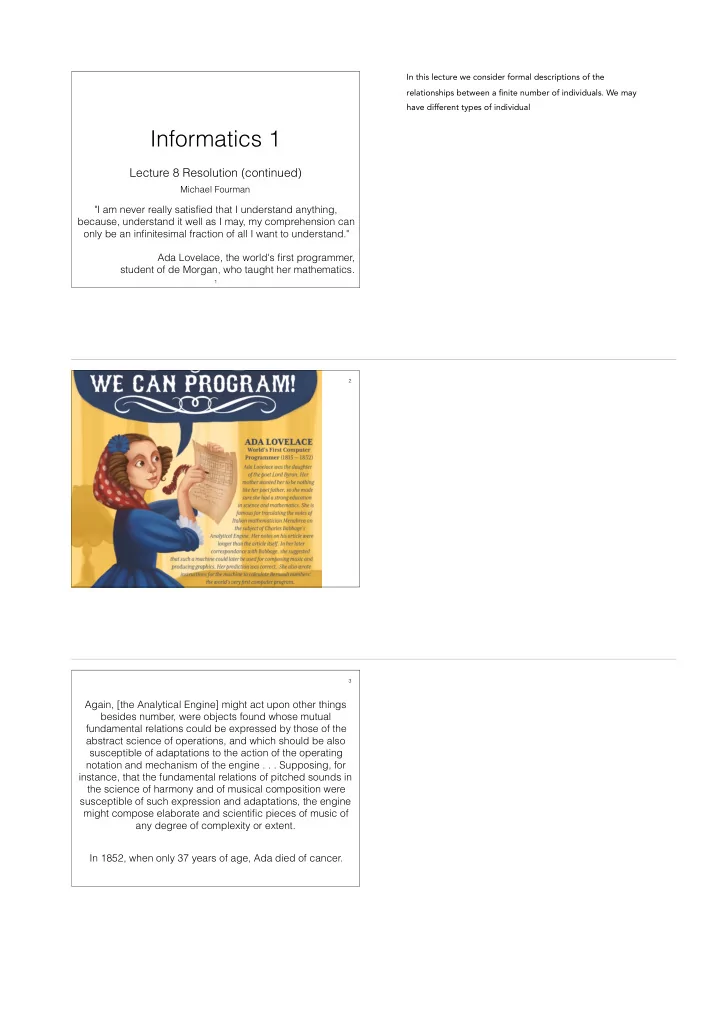
"I am never really satisfied that I understand anything, because, understand it well as I may, my comprehension can

  • nly be an infinitesimal fraction of all I want to understand."

Ada Lovelace, the world's first programmer,
 student of de Morgan, who taught her mathematics.

In this lecture we consider formal descriptions of the relationships between a finite number of individuals. We may have different types of individual

2 3

Again, [the Analytical Engine] might act upon other things besides number, were objects found whose mutual fundamental relations could be expressed by those of the abstract science of operations, and which should be also susceptible of adaptations to the action of the operating notation and mechanism of the engine . . . Supposing, for instance, that the fundamental relations of pitched sounds in the science of harmony and of musical composition were susceptible of such expression and adaptations, the engine might compose elaborate and scientific pieces of music of any degree of complexity or extent. In 1852, when only 37 years of age, Ada died of cancer.

slide-2
SLIDE 2

4

X⋁¬D Y⋁D X⋁Y Premises Conclusion Any assignment of truth values that makes all the premises true will make the conclusion true. The conclusion follows from the premises A valid inference

5

Any assignment of truth values that makes the conclusion false will make at least one of the premises false. For any valid inference X⋁¬D Y⋁D X⋁Y Premises Conclusion If some assignment abc of values for ABC makes the conclusion false then the assignments abcD and abcD̅ each make one or other of the two premises false. A special property

  • f this inference

X⋁¬D Y⋁D X⋁Y Premises Conclusion where D does 
 not occur in X or Y

slide-3
SLIDE 3

7

U⋁V⋁W⋁X⋁¬C X⋁Y⋁Z⋁C U⋁V⋁W⋁X⋁Y⋁Z

Resolution

8

¬A, C ¬B, D ¬E, B E, B A, E ¬E, A

A B C D E

¬A ¬B ¬C ¬D ¬E

¬E, C C, E E, D ¬E, D A D C B

Resolution gives the same information as our earlier graphical analysis.

Clausal Form

9

Resolution uses CNF a conjunction of disjunctions of literals

(¬A⋁C)⋀(¬B⋁D)⋀(¬E⋁B)⋀(¬E⋁A)⋀(A⋁E)⋀(E⋁B)⋀(¬B⋁¬C⋁¬D)

Clausal form is a set of sets of literals

{{¬A,C}, {¬B,D}, {¬E,B}, {¬E,A}, {A,E}, {E,B}, {¬B, ¬C, ¬D}}

Each set of literals represents the disjunction of its literals. An empty disjunction {} represents false ⊥. The clausal form represents the conjunction of these disjunctions (an empty conjunction {} represents true ⊤).

Using sets builds in idempotence, associativity and commutativity.

slide-4
SLIDE 4

Clausal Form

10

Clausal form is a set of sets of literals

{ {¬A,C}, {¬B,D}, {¬E,B}, {¬E,A}, {A,E}, {E,B},{¬B, ¬C, ¬D} }

A (partial) truth assignment makes a clause true iff it makes at least one of its literals true (so it can never make the empty clause {} true) A (partial) truth assignment makes a clausal form true iff it makes all of its clauses true ( so the empty clausal form {} is always true ).

11

Clausal form is a set of sets of literals

{ X0, X1, … , Xn-1 } where xi = { L0,…,Lmi-1 } Resolution rule for clauses

X Y where ¬A ∈ X, A ∈ Y (X ⋃ Y) \ { ¬A, A } If a valuation makes everything in the conclusion false then that valuation must make everything in one or

  • ther of the premises false.

If it makes A true, then it makes everything in X false If it makes A false, then it makes everything in Y false

If we have derived {} by resolution, then, for any valuation we are given, the special property lets us find a constraint that it violates. So there are no valuations satisfying all the constraints.

Davis Putnam Take a collection of clauses. For each propositional letter, A For each pair ∊⋀∊⋀A∊⋀A∊

  • if Areturn UNSAT

if Ais contingent remove any clauses containing A or A return SAT Where AA, A , and
 a clause is contingent if does not contain any complementary pair of literals Heuristic: start with variables that occur seldom.

On this slide, indentation indicates grouping. So, for each atom, we resolve all pairs satisfying A∊X ⋀ ¬A∊Y. Once all the A-resolvants have been produced we can forget about clauses containing A or ¬A. Removing clauses that contain A or ¬A will not prevent us

slide-5
SLIDE 5

13

A X ¬A Y

A contradictory cycle

¬A∨X ¬X∨¬A A∨Y ¬Y∨A X Y A {¬A} {A} {¬A, X} {¬X, ¬A} {A, Y} {¬Y, A} {}

14

A X ¬A Y

A contradictory cycle

¬A∨X ¬X∨¬A A∨Y ¬Y∨A X Y A {¬X, Y} {¬Y} {¬A, X} {¬X, ¬A} {A, Y} {¬Y, A} {} {X, Y} {X, ¬Y} {¬X, ¬Y} {Y} {Y, ¬Y}

15

¬A, C ¬B, D ¬C, ¬D ¬E, B E, B A, E ¬E, A

A B C D E

¬A ¬B ¬C ¬D ¬E

By our analysis of the picture, we know that any valuation satisfying the binary constraints must make A, B, C, D all true. So adding this new constraint makes an inconsistent set of constraints. Use resolution to show this directly.

slide-6
SLIDE 6

¬A, C ¬B, D ¬C, ¬D ¬E, B E, B A, E ¬E, A A

By our analysis of the picture, we know that any valuation satisfying the binary constraints must make A, B, C, D all true. So adding this new constraint makes an inconsistent set of constraints. Use resolution to show this directly.

17

¬A, C ¬B, D ¬C, ¬D ¬E, B E, B A, E ¬E, A C, E ¬E, C A

By our analysis of the picture, we know that any valuation satisfying the binary constraints must make A, B, C, D all true. So adding this new constraint makes an inconsistent set of constraints. Use resolution to show this directly.

18

¬A, C ¬B, D ¬C, ¬D ¬E, B E, B A, E ¬E, A C, E ¬E, C A B

By our analysis of the picture, we know that any valuation satisfying the binary constraints must make A, B, C, D all true. So adding this new constraint makes an inconsistent set of constraints. Use resolution to show this directly.

slide-7
SLIDE 7

19

¬A, C ¬B, D ¬C, ¬D ¬E, B E, B A, E ¬E, A C, E ¬E, C A B ¬E, D E, D

By our analysis of the picture, we know that any valuation satisfying the binary constraints must make A, B, C, D all true. So adding this new constraint makes an inconsistent set of constraints. Use resolution to show this directly.

20

¬A, C ¬B, D ¬C, ¬D ¬E, B E, B A, E ¬E, A C, E ¬E, C A B ¬E, D E, D C

By our analysis of the picture, we know that any valuation satisfying the binary constraints must make A, B, C, D all true. So adding this new constraint makes an inconsistent set of constraints. Use resolution to show this directly.

21

¬A, C ¬B, D ¬C, ¬D ¬E, B E, B A, E ¬E, A C, E ¬E, C A B ¬E, D E, D C ¬D, E ¬E, ¬D

By our analysis of the picture, we know that any valuation satisfying the binary constraints must make A, B, C, D all true. So adding this new constraint makes an inconsistent set of constraints. Use resolution to show this directly.

slide-8
SLIDE 8

22

¬A, C ¬B, D ¬C, ¬D ¬E, B E, B A, E ¬E, A C, E ¬E, C A B ¬E, D E, D C ¬D, E ¬E, ¬D D

By our analysis of the picture, we know that any valuation satisfying the binary constraints must make A, B, C, D all true. So adding this new constraint makes an inconsistent set of constraints. Use resolution to show this directly.

23

¬A, C ¬B, D ¬C, ¬D ¬E, B E, B A, E ¬E, A C, E ¬E, C A B ¬E, D E, D C ¬D, E ¬E, ¬D D ¬E, E ¬E, ¬E E, E ¬E, E

By our analysis of the picture, we know that any valuation satisfying the binary constraints must make A, B, C, D all true. So adding this new constraint makes an inconsistent set of constraints. Use resolution to show this directly.

24

¬A, C ¬B, D ¬C, ¬D ¬E, B E, B A, E ¬E, A C, E ¬E, C A B ¬E, D E, D C ¬D, E ¬E, ¬D D ¬E, E ¬E, ¬E E, E ¬E, E E

By our analysis of the picture, we know that any valuation satisfying the binary constraints must make A, B, C, D all true. So adding this new constraint makes an inconsistent set of constraints. Use resolution to show this directly.

slide-9
SLIDE 9

25

¬A, C ¬B, D ¬C, ¬D ¬E, B E, B A, E ¬E, A C, E ¬E, C A B ¬E, D E, D C ¬D, E ¬E, ¬D D ¬E, E ¬E, ¬E E, E ¬E, E E {}

By our analysis of the picture, we know that any valuation satisfying the binary constraints must make A, B, C, D all true. So adding this new constraint makes an inconsistent set of constraints. Use resolution to show this directly.

Resolution

26

A complete proof procedure for propositional logic that works on formulas expressed in conjunctive normal form. (Robinson 1965) Conjunctive Normal Form (CNF) Literal: a propositional variable p or its negation ¬p Clause: a disjunction of (a set of) literals. CNF: a conjunction of clauses.

Resolution

27

From two clauses C1 = (X∪ {A}), C2 = (Y∪ {¬A}) the resolution rule generates the new clause (X∪Y) = R(C1,C2)

where X and Y are sets of literals, not containing A or ¬A.

(X∪Y) is the resolvant A is the variable resolved on

slide-10
SLIDE 10

Resolution

28

A resolution refutation of a CNF (a set of clauses) is a sequence C1, C2, …, Cm of clauses such that Cm = {}, and each Ci is either a member of

  • r

the resolvant of two previous clauses in the proof: Ci = R(Cj,Ck), where j,k < i

Resolution

29

Any resolution proof can be represented as a DAG nodes are clauses in the proof. Clauses in are leaves: they have no incoming edges. Every clause Ci that arises from a resolution step has two incoming edges. One from each

  • f the clauses (Cj,Ck) that were resolved together to
  • btain Ci = R(Cj,Ck).

Each non-leaf node Ci is labeled by the variable that was resolved away to obtain it.

Resolution

30

{{¬Y}, {Z,Y}, {¬Z,¬X}, {¬Q,X}, {Q,¬Z,X}} {¬Z,¬X} {Z,Y} {Q,¬Z,X} {¬Q,X} {¬Z,X} {¬Z} {¬Y} {Z} {}

[{¬Y}, {Z,Y}, {¬Z,¬X}, {¬Q,X}, {Q,¬Z,X},{¬Z,X}, {¬Z}, {Z},{}]

Y Z X Q

slide-11
SLIDE 11

Refutation Resolution

31

{¬Z,¬X} {Z,Y} {Q,¬Z,X} {¬Q,X} {¬Z,X} {¬Z} {¬Y} {Z} {}

Y Z X Q

{Z,X} {¬Z,¬Y} {¬Q,Z,¬X} {Q,Z,¬X} {Z,¬X} {Z} {¬Z,Y} {¬Z} {}

Y Z X Q

these are disjunctions these are conjunctions is refuted by this that

From the resolution proof we cn derive a refutation. The lower tree demonstrates the fact that whatever values we choose for the variables, we will arrive at a clause that is false for our chosen values. This suffices to show that, no matter what choice of values we make, the conjunction is

(A?B:C)

32