Tuning Maps for Deep Brain Stimulation Trials Thomas Mera, MS - - PowerPoint PPT Presentation

tuning maps for deep brain stimulation trials
SMART_READER_LITE
LIVE PREVIEW

Tuning Maps for Deep Brain Stimulation Trials Thomas Mera, MS - - PowerPoint PPT Presentation

Tuning Maps for Deep Brain Stimulation Trials Thomas Mera, MS Product Development Manager May 23 rd , 2013 WILL BEGIN AT 12:00 EST Talking Points 1. Market Opportunities 2. DBS Tuning Maps 3. Kinesia ProView 4. Clinical Trial Data and


slide-1
SLIDE 1

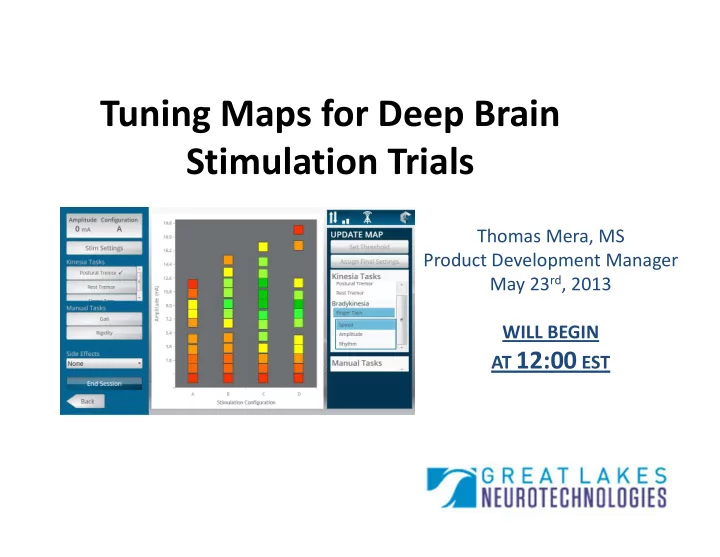
Tuning Maps for Deep Brain Stimulation Trials

Thomas Mera, MS Product Development Manager May 23rd, 2013 WILL BEGIN AT 12:00 EST
slide-2
SLIDE 2

Talking Points

  • 1. Market Opportunities
  • 2. DBS Tuning Maps
  • 3. Kinesia ProView
  • 4. Clinical Trial Data and Lessons
  • 5. Kinesia Technology Value Added
slide-3
SLIDE 3

Market Opportunities

slide-4
SLIDE 4

Parkinson’s Disease: Not So Simple!

SYMPTOMS Tremor Dyskinesias Bradykinesia Rigidity Gait Non-Motor et al. TREATMENTS TREATMENTS Levodopa Levodopa Rasagiline Rasagiline Duodopa Duodopa DBS DBS Exercise Exercise Neuroprotection? Neuroprotection? DEMOGRAPHICS DEMOGRAPHICS Over 60 Over 60 Growing Incidence Growing Incidence Neurodegeneration Neurodegeneration Medicare Medicare VA VA Access to Care Access to Care

slide-5
SLIDE 5

Deep Brain Stimulation

Targeted Electrical Stimulation of the Brain

Therapy State Management

slide-6
SLIDE 6

Clinician Training Symptom Tracking Paper Trails Sensitivity

Challenges with DBS Programming

slide-7
SLIDE 7

DBS Tuning Maps

slide-8
SLIDE 8

Quantitative Motor Assessment

TRADITIONAL HIGH SENSITIVITY

slide-9
SLIDE 9

Kinematic Response to DBS

Tremor tuning produces sudden, dramatic effects Bradykinesia tuning produces gradual, fine effects

slide-10
SLIDE 10

Monopolar Symptom Response

slide-11
SLIDE 11

Monopolar Symptom Response

slide-12
SLIDE 12

Monopolar Symptom Response

slide-13
SLIDE 13

Monopolar Symptom Response

slide-14
SLIDE 14

Monopolar Symptom Response

slide-15
SLIDE 15

Kinematic optimization of deep brain stimulation across multiple motor symptoms in Parkinson’s disease Mera TO, Vitek JL, Alberts JL, Giuffrida JP

  • J. Neurosci. Methods, vol. 198, no. 2, pp. 280–286, 2011.

Recently Accepted for Publication

Peer-Review Publication

Tuning Maps: Visualizing the Programming Space

Rest Tremor Finger Tapping-Speed

slide-16
SLIDE 16

Kinesia ProView Product Demo

slide-17
SLIDE 17

Commercialization

FDA Clearance to Market FDA Clearance to Market

  • 510k Clearance to Market
  • Intended Use
  • Kinesia is intended to monitor physical motion and muscle activity to quantify

kinematics of movement disorder symptoms such as tremor and assess activity in any instance where quantifiable analysis of motion and muscle activity is desired.

ISO, CE Mark, and TGA ISO, CE Mark, and TGA

  • ISO 13485:2003
  • European Medical Device Directive 93/42/EEC
  • Canadian Medical Device Conformity Assessment System
  • EMERGO EUROPE: Authorized Agent

Standards and Testing Standards and Testing

  • Tested to IEC 60601 Standards
  • Complies with FCC Part 15 Rules
  • HIPAA Compliant

U.S. Patent Protection

slide-18
SLIDE 18
slide-19
SLIDE 19
slide-20
SLIDE 20

HIPAA-Compliant Log-In

slide-21
SLIDE 21

Institute-Specific Patient List

slide-22
SLIDE 22

Programming Session Setup

slide-23
SLIDE 23

Tuning Map Screen

slide-24
SLIDE 24

Stimulation Setting Selection

130 Hz 60 µsec 130 Hz 60 µsec 130 Hz 60 µsec

slide-25
SLIDE 25

Sensor-Based Assessment

slide-26
SLIDE 26

Sensor-Based Assessment

slide-27
SLIDE 27

Manual Task Assessment

slide-28
SLIDE 28

Populated Tuning Map

slide-29
SLIDE 29

Context-Specific Information

slide-30
SLIDE 30

Select Side Effect

slide-31
SLIDE 31

Online Management

slide-32
SLIDE 32

Online DBS Programming Reports

slide-33
SLIDE 33

Clinical Trial Data and Lessons

slide-34
SLIDE 34

Tuning Maps: Rest Tremor

1 2 3 1 2 3 4 5 6 7 8 9 10 Contact Amplitude (v) 1 2 3 1 2 3 4 5 6 7 8 9 10 Contact Amplitude (v) 1 2 3 1 2 3 4 5 6 7 8 9 10 Contact Amplitude (v) 0.5 1 1.5 2 2.5 3 3.5 4

Subject A Subject B Subject C

slide-35
SLIDE 35

Subject 1: Rest Tremor

Clinician UPDRS Kinesia ProView

1 2 3 1 2 3 4 5 6 7 8 9 10 Contact Amplitude (v) 0.5 1 1.5 2 2.5 3 3.5 4 1 2 3 1 2 3 4 5 6 7 8 9 10 Contact Amplitude (v) 0.5 1 1.5 2 2.5 3 3.5 4

slide-36
SLIDE 36

Subject 1: Finger Tap

Clinician UPDRS ProView: Speed Amplitude

1 2 3 1 2 3 4 5 6 7 8 9 10 Contact Amplitude (v) cli sub7 , prog 1 FT

1 2 3 Contact 1 2 3 Contact 0.5 1 1.5 2 2.5 3 3.5 4

slide-37
SLIDE 37

Subject 1: Finger Tap Detail

Clinician UPDRS Motion Sensor Data

slide-38
SLIDE 38

Subject 2: Rest Tremor

Month 1 Month 4

1 2 3 1 2 3 4 5 6 7 8 9 10 Contact Amplitude (v) 0.5 1 1.5 2 2.5 3 3.5 4 1 2 3 1 2 3 4 5 6 7 8 9 10 Contact Amplitude (v) 0.5 1 1.5 2 2.5 3 3.5 4

slide-39
SLIDE 39

Subject 2: Finger Tap Bradykinesia

Month 1 Month 4

1 2 3 2 4 6 8 10 Contact Amplitude (v) 0.5 1 1.5 2 2.5 3 3.5 4 1 2 3 2 4 6 8 10 Contact Amplitude (v) 0.5 1 1.5 2 2.5 3 3.5 4

slide-40
SLIDE 40

Subject 3: Rest Tremor

Month 1 Month 2 Month 4

1 2 3 1 2 3 4 5 6 Contact Amplitude (v) 1 2 3 1 2 3 4 5 6 Contact 1 2 3 1 2 3 4 5 6 Contact 0.5 1 1.5 2 2.5 3 3.5 4

slide-41
SLIDE 41

Subject 3: Finger Tap Bradykinesia

Month 1 Month 2 Month 4

1 2 3 1 2 3 4 5 6 Contact Amplitude (v) 1 2 3 1 2 3 4 5 6 Contact 1 2 3 1 2 3 4 5 6 Contact 0.5 1 1.5 2 2.5 3 3.5 4

slide-42
SLIDE 42

Kinesia Technology Value Added

slide-43
SLIDE 43

Visual Assessment of Programming Space

  • Minimize Symptoms, Maximize Battery Life

Visual Assessment of Programming Space

  • Minimize Symptoms, Maximize Battery Life

High Sensitivity Symptom Differentiation

  • Detect Small Changes and Specific Symptom Response

to Unique Stimulation Configurations

High Sensitivity Symptom Differentiation

  • Detect Small Changes and Specific Symptom Response

to Unique Stimulation Configurations

Cloud-Based Data Storage

  • Track changes over time and minimize paper trails

Cloud-Based Data Storage

  • Track changes over time and minimize paper trails

ProView Value Added to DBS

slide-44
SLIDE 44
slide-45
SLIDE 45

Applications and Markets

Patient Care Clinical Trials DBS Programming

slide-46
SLIDE 46
slide-47
SLIDE 47

Patient Screening

  • Ready for DBS? Matching patient characteristics to

therapies

Patient Screening

  • Ready for DBS? Matching patient characteristics to

therapies

Post Programming Symptom Response

  • Do symptoms remain stable at home?

Post Programming Symptom Response

  • Do symptoms remain stable at home?

Intelligent and Remote Programming

  • Clinician controlled and algorithm-based programming

via telemedicine and broadband communications

Intelligent and Remote Programming

  • Clinician controlled and algorithm-based programming

via telemedicine and broadband communications

ProView and HomeView Value Added to DBS

+

slide-48
SLIDE 48

Questions?

Contact Information: Thomas Mera, MS Product Development Manager tmera@glneurotech.com 216-446-2438 http://glneurotech.com/kinesia/proview/