Y Non-Invasive Brain Stimulation and Behavioral Therapy - - PowerPoint PPT Presentation

y
SMART_READER_LITE
LIVE PREVIEW

Y Non-Invasive Brain Stimulation and Behavioral Therapy - - PowerPoint PPT Presentation

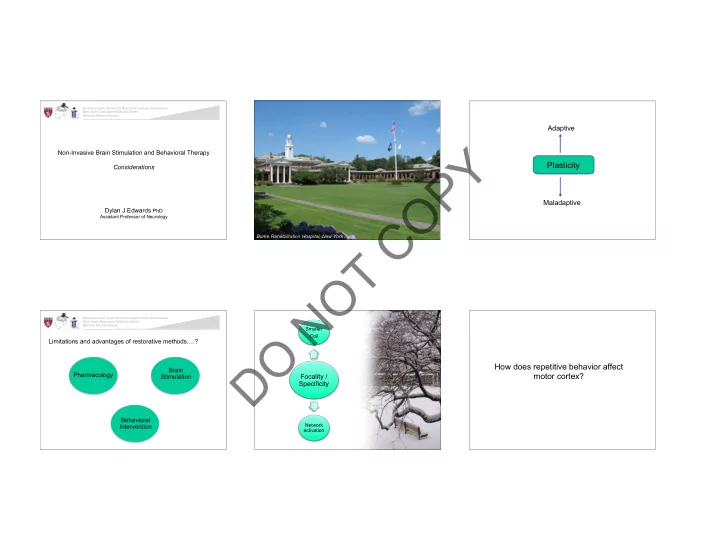
Berenson-Allen Center for Noninvasive Brain Stimulation Beth Israel Deaconess Medical Center Harvard Medical School Adaptive Y Non-Invasive Brain Stimulation and Behavioral Therapy Plasticity P Considerations O


slide-1
SLIDE 1

Berenson-Allen Center for Noninvasive Brain Stimulation Beth Israel Deaconess Medical Center Harvard Medical School

  • Non-Invasive Brain Stimulation and Behavioral Therapy
  • Considerations
  • Dylan J Edwards PhD

Assistant Professor of Neurology Burke Rehabilitation Hospital, New York

Plasticity

Adaptive Maladaptive

Berenson-Allen Center for Noninvasive Brain Stimulation Beth Israel Deaconess Medical Center Harvard Medical School

Pharmacology Behavioral Intervention Brain Stimulation Limitations and advantages of restorative methods….?

Focality / Specificity

Smaller Coil Network activation

How does repetitive behavior affect motor cortex?

D O N O T C O P Y

slide-2
SLIDE 2

Simple repetitive finger movements increase excitability Motor map changes with skilled practice

How does NIBS affect motor cortex?

tDCS SICF

Berenson-Allen Center for Noninvasive Brain Stimulation Beth Israel Deaconess Medical Center Harvard Medical School

SICF

300 250 200 150 100 50

Amplitude

(% control) 2 1 3 4 5 2.5 1.5 3.5 4.5

Inter-stimulus Interval (ms)

1.5 msec.

Ziemann et al, 1998 Periodicity ~ 1.5ms I-waves

TMS

Berenson-Allen Center for Noninvasive Brain Stimulation Beth Israel Deaconess Medical Center Harvard Medical School

D O N O T C O P Y

slide-3
SLIDE 3

Webster et al (2006)

Yozbatiran ¡et ¡al, ¡2009 ¡ Malcom ¡et ¡al, ¡2007 ¡ Hummel ¡et ¡al, ¡2007 ¡ Talelli ¡et ¡al., ¡2007 ¡ ¡ ¡ ¡Kim ¡ et ¡al., ¡2006 ¡Hummel ¡et ¡ al, ¡2006 ¡Khedr ¡et ¡al., ¡ 2005 ¡Hummel ¡et ¡al, ¡ 2005 ¡ ¡ Takeuchi, ¡et ¡al, ¡2008 ¡ Boggio ¡et ¡al, ¡2007 ¡ Fregni ¡et ¡al., ¡2006 ¡ Fregni ¡et ¡al., ¡2005 ¡ Mansur ¡et ¡al., ¡2005 ¡ Takeuchi ¡et ¡al., ¡2005 ¡ Boggio, ¡et ¡al., ¡2006 ¡ ¡ Werhahn, ¡et ¡al., ¡2003 ¡

IMPROVED CORTICOMOTOR OUTPUT FROM IPSI-LESIONAL M1 & IMPROVED MOTOR BEHAVIOUR

Webster et al (2006)

Functional Improvements sRT/cRT Pinch force acceleration fingers/thumb AROM Movement accuracy Purdue Pegboard JTT TMS correlates Resting MT Transcallosal Inhibition MEP Amplitude

IMPROVED CORTICOMOTOR OUTPUT FROM IPSI-LESIONAL M1 & IMPROVED MOTOR BEHAVIOUR

D Edwards

williamcalvin.com

Donald Hebb

“An excited neuron tends to decrease its discharge to inactive neurons, and increase this discharge to any active neuron, and therefore to form a route to it, whether there are intervening neurons between the two or not. With repetition, this tendency is prepotent in the formation of neural routes”. (Hebb, 1932, p.13).

The Organisation of Behaviour: A Neuropsychological Theory. D.O. HEBB (1949)

Rate-dependent TMS protocols

Low-frequency ~1Hz High-frequency ~10Hz

Excitatory

Inhibitory Excitatory

REPETITIVE

Intermittent

2 sec 8 sec

50Hz 5Hz

Continuous Excitatory

Excitatory

Inhibitory

THETA BURST

Glu

Ca++ Na+ AMPA Post-synaptic Dendritic spine Pre-synaptic NMDA AMPA Na+ Mg++ EPSP Long-term potentiation

Thickbroom (2007) Ex Brain Res.

Glu

AMPA Post-synaptic Dendritic spine Pre-synaptic NMDA Na+ Mg++ Ca++

CaM CaMKII

AMPA Ca++ Na+ EPSP

Long-term potentiation

Thickbroom (2007) Ex Brain Res.

D O N O T C O P Y
slide-4
SLIDE 4

Glu

AMPA NMDA Mg++ Ca++

CaM

Ca++

LTP/ LTD

CaMKII PP2B

C N Long-term depression

Thickbroom (2007) Ex Brain Res.

How does combined intervention affect motor cortex?

Altering cortical excitability before repetitive synaptic activity

Lang et al (2004)

  • 1mA 10mins tDCS
  • rTMS at 5Hz 100stim train at AMT – decreases SICI, but not lasting change in

excitability as tested by single pulse TMS

  • Result= after effects of tDCS can generate opposite effects of rTMS or

conversely can alter the after effects of tDCS

Berenson-Allen Center for Noninvasive Brain Stimulation Beth Israel Deaconess Medical Center Harvard Medical School Buch et al 2011, J Neurosci

Is coupling NIBS with therapy good?

If…

Motor Training tDCS

= improvement in function ‘X’ = improvement in function ‘X’

does… and…

Motor Training tDCS

+

= improvement in function

2X, X2, or 0??

Motor systems example

D O N O T C O P Y

slide-5
SLIDE 5

Berenson-Allen Center for Noninvasive Brain Stimulation Beth Israel Deaconess Medical Center Harvard Medical School

1mV Pre-tDCS Post-tDCS Post-Robot

Anodal tDCS combined with robotic motor training

Edwards et al (2009)

Group SICI Index

Conditioned / uncond MEP amplitude 0.5 1 p < 0.05

* *

Pre tDCS Post tDCS Post Robot

Edwards et al (2009)

Anodal tDCS combined with robotic motor training

Movement ¡Speed ¡(peak, ¡mean) ¡ Movement ¡Smoothness ¡ Aim ¡ Deviation ¡

“Kinematic Robot-Based Evaluation Scales and Clinical Counterparts to Measure Upper Limb Motor Performance in Patients With Chronic Stroke” (Bosecker et al, 2009)

Kinematic measures v clinical function Highest correlation with clinical function

NIH funded study 2012-2017 – tDCS and robotic motor training in stroke

  • 60 patients, Right hemiparesis
  • >6mnths post first ischemic stroke
  • Robotic protocol alternates S/E-wrist robot across sessions
  • tDCS 2mA, 35cm2, 0.9% NaCl soaked sponges

Training Period 3x / wk, 12 weeks, 36 sessions 1 hour shoulder/elbow/wrist robotic training tDCS or sham pre training (2 groups) CLINICAL, KINEMATIC, NEUROPHYSIOLOGY EVALUATION EVAL. EVAL. EVAL.

Combined tDCS-Robotic Training Study Design

EVAL. 1 wk 6 months EVAL. 1 wk

Upper ¡limb ¡robotics ¡at ¡Burke-­‑Cornell, ¡New ¡York

Robotics with brain stimulation in patients with motor dysfunction

Edwards PI: R01 HD069776 Prelim data for Nexstim NICHE Trial 2014

D O N O T C O P Y

slide-6
SLIDE 6

Berenson-Allen Center for Noninvasive Brain Stimulation Beth Israel Deaconess Medical Center Harvard Medical School

Other cortical areas?

Conclusions

  • Brain state influences the response to

neuromodulation

  • Homeostatic mechanisms may oppose further

enhancement when interventions are combined

  • Combined neuromodulation & behavioural therapy

can be effective

  • The optimal circumstances require further

investigation

Berenson-Allen Center for Noninvasive Brain Stimulation Beth Israel Deaconess Medical Center Harvard Medical School D J Edwards

Thank you

D O N O T C O P Y