Cross- -sectional Association of Job Strain and Systolic sectional - - PowerPoint PPT Presentation

cross sectional association of job strain and systolic
SMART_READER_LITE
LIVE PREVIEW

Cross- -sectional Association of Job Strain and Systolic sectional - - PowerPoint PPT Presentation

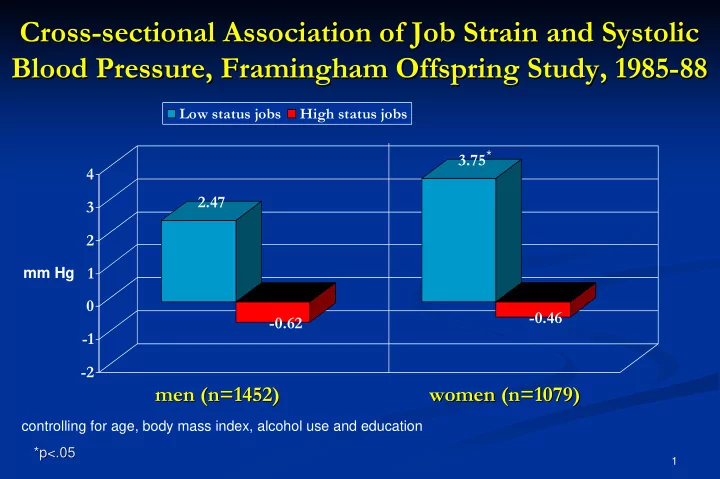
Cross- -sectional Association of Job Strain and Systolic sectional Association of Job Strain and Systolic Cross Blood Pressure, Framingham Offspring Study, 1985- -88 88 Blood Pressure, Framingham Offspring Study, 1985 Low status jobs High


slide-1
SLIDE 1

1

Cross Cross-

  • sectional Association of Job Strain and Systolic

sectional Association of Job Strain and Systolic Blood Pressure, Framingham Offspring Study, 1985 Blood Pressure, Framingham Offspring Study, 1985-

  • 88

88

2.47

  • 0.62

3.75

  • 0.46
  • 2
  • 1

1 2 3 4

mm Hg Low status jobs High status jobs

controlling for age, body mass index, alcohol use and education *p<.05 *p<.05

* *

men (n=1452) women (n=1079) men (n=1452) women (n=1079)

slide-2
SLIDE 2

2

Why greater effect of job strain if low SES? Why greater effect of job strain if low SES?

In NYC BP study

smoking, BMI, job physical exertion, shiftwork controlled in analysis

Hazards faced by lower SES workers

cardiotoxic chemicals, noise

  • ther job stressors: effort-reward imbalance, threat-avoidant vigilant work, job

insecurity life stressors: unemployment, crime, deteriorating urban physical and social environment, low & decreasing economic rewards psychological effects of these stressors: anger, depression unhealthy behaviors: less exercise

Resources, buffers available to higher SES workers

money, knowledge, power, prestige, social support, social network exercise facilities, better housing, nutrition, and medical care

Landsbergis P, Schnall P, Pickering T, Warren K, Schwartz J. Lower socioeconomic status among men in relation to the association between job strain and blood pressure. Scandinavian Journal of Work, Environment and Health 2003;29(3):206-215.

slide-3
SLIDE 3

3

Job demands Job demands-

  • control model:

control model: predictions for illness and behavior predictions for illness and behavior

slide-4
SLIDE 4

4

3 3-

  • Year Change in Smoking

Year Change in Smoking Prevalence and Job Decision Latitude Prevalence and Job Decision Latitude

Smoking

No No (n=142) Yes (n=7) No (n=13) Time 1 (baseline) Time 2 (3 years) Change in Job Decision Latitude Yes Yes (n=27) +1.5

  • 1.6
  • 0.3

+4.0

(controlling for age, race, education, marital status, and number of children at home)

F=4.37 (8,180) p=.005

Landsbergis PA, Schnall PL, Deitz DK, Warren K, Pickering TG, Schwartz JE. Job strain and health behaviors: results of a prospective study. American Journal of Health Promotion 1998;12(4), 237-245.

slide-5
SLIDE 5

5

Job stressors and sedentary behavior Job stressors and sedentary behavior

(Sweden population survey) (Sweden population survey)

Men Women OR# p OR# p Psychological demands

  • ns

1.38 .01 Monotonous work 1.31 .15 1.38 .11 Learning opportunities

  • 1.51

.04

  • 1.95

.002 Work process control

  • 1.25

.09

  • 1.24

.11 Social interaction

  • 1.60

.001

  • ns

#Top vs. bottom decile Odds Ratio, controlling for age and educat

Top vs. bottom decile Odds Ratio, controlling for age and education ion

Johansson G, Johnson JV, Hall EM. Johansson G, Johnson JV, Hall EM. Social Science and Medicine Social Science and Medicine 1991;32(7):837 1991;32(7):837-

  • 846

846

slide-6
SLIDE 6

6

Effort Effort-

  • reward imbalance (ERI) at work

reward imbalance (ERI) at work

and co and co-

  • occurrence of lifestyle risk factors (RF)
  • ccurrence of lifestyle risk factors (RF)

N=36,127 public employees in Finland N=36,127 public employees in Finland

BMI ≥ 25, current smoking, heavy drinking, physical inactivity: ORs fully adjusted with ERI scores at organizational level

1 vs. 0 RF 1.00 0.98 1.07 1.00 0.99 1.06 women women low ERI intermediate high ERI men men low ERI intermediate high ERI 2 vs. 0 RF 1.00 1.07 1.25 1.25 1.00 0.99 1.22 1.22 3 vs. 0 RF 1.00 1.02 1.44 1.44 1.00 1.00 1.36 1.36

Source: A. Kouvonen et al. (2006), BMC Public Health, 6: 24.

slide-7
SLIDE 7

7

How can we How can we do about this do about this problem? problem?

slide-8
SLIDE 8

8

slide-9
SLIDE 9

9

Economic, political context Organizational context

Downsizing Contingent work New systems of work organization

Social change Individual Tx, rehab

Interventions: what is being changed? Interventions: what is being changed?

Job characteristics

Low job control High job demands Social isolation

Stress response

Physiological effects (e.g., BP) Psychological effects (e.g., burnout) Health behaviors

Illness Individual coping Job redesign Organizational change Primary prevention Secondary prevention Tertiary prevention

slide-10
SLIDE 10

10

Economic, political context Organizational context

Downsizing Contingent work New systems of work organization

How do we go about changing it? How do we go about changing it?

Job characteristics

Low job control High job demands Social isolation

Stress response

Physiological effects (e.g., BP) Psychological effects (e.g., burnout) Health behaviors

Illness Legislation, regulation, workers compensation Employer initiated policies, programs, downsizing; Collective bargaining Employer initiated job redesign, supervisor training, participatory ergonomics, Joint L-M S&H committees Health promotion, EAPs Stress management Tx, Rehabilitation

slide-11
SLIDE 11

11

Murphy LR. Stress management in work settings: A critical review of the health effects. American Journal of Health Promotion 1996;11:112-135.

Why not solely stress management? Why not solely stress management?

  • Limited follow

Limited follow-

  • up

up (only 23% > 6 months)

(only 23% > 6 months)

  • Are benefits maintained?

Are benefits maintained?

  • Benefits seen also in control groups

Benefits seen also in control groups

  • Example: 20 BP studies: Avg. drop in systolic BP =

Example: 20 BP studies: Avg. drop in systolic BP =

  • 7.8 mm Hg (stress mgmt groups)

7.8 mm Hg (stress mgmt groups)

  • 4.9 mm Hg (control groups)

4.9 mm Hg (control groups)

  • About 1/3 of participants failed to learn techniques

About 1/3 of participants failed to learn techniques

Benefits seen, but Benefits seen, but…. ….

slide-12
SLIDE 12

12

Economic, political context Organizational context

Downsizing Contingent work New systems of work organization

How do we go about changing it? How do we go about changing it?

Job characteristics

Low job control High job demands Social isolation

Stress response

Physiological effects (e.g., BP) Psychological effects (e.g., burnout) Health behaviors

Illness Legislation, regulation, workers compensation Employer initiated policies, programs, downsizing; Collective bargaining Employer initiated job redesign, supervisor training, participatory ergonomics, Joint L-M S&H committees Health promotion, EAPs Stress management Tx, Rehabilitation

slide-13
SLIDE 13

13

  • Action research project, 1999

Action research project, 1999-

  • 2004

2004

  • >200 interventions to improve health, well

>200 interventions to improve health, well-

  • being and

being and work environment of 3,500 Copenhagen bus drivers work environment of 3,500 Copenhagen bus drivers

  • Labor

Labor-

  • management

management-

  • researcher cooperation

researcher cooperation

Copenhagen Healthy Bus project Copenhagen Healthy Bus project

Tuchsen et al. Unpublished manuscript.

  • Evaluation

Evaluation

  • Quantitative and qualitative assessments

Quantitative and qualitative assessments

  • Improvements in stress measures, job characteristics, and

Improvements in stress measures, job characteristics, and lifestyle lifestyle

  • Typical problems such as stress and physical hazards

Typical problems such as stress and physical hazards remain remain

slide-14
SLIDE 14

14

Copenhagen Healthy Bus project Copenhagen Healthy Bus project

examples of interventions examples of interventions

Tuchsen et al. Unpublished manuscript.

  • Job characteristics/work organization

Job characteristics/work organization

  • Test more flexible schedules

Test more flexible schedules

  • Meet drivers wishes on rotation, typical and holiday schedules

Meet drivers wishes on rotation, typical and holiday schedules

  • Better communication between management and drivers

Better communication between management and drivers

  • Life style

Life style

  • Smoking cessation, healthy diet courses

Smoking cessation, healthy diet courses

  • Fresh fruit available in garage

Fresh fruit available in garage

  • Competence/education

Competence/education

  • Education of managers in personnel mgmt and communication

Education of managers in personnel mgmt and communication

  • Courses on handling threats & violence; “know your bus”

Courses on handling threats & violence; “know your bus”

  • Physical work environment

Physical work environment

  • More resources for bus preventive maintenance

More resources for bus preventive maintenance

  • Joint labor

Joint labor-

  • management meetings

management meetings

slide-15
SLIDE 15

15

Copenhagen Healthy Bus project: Copenhagen Healthy Bus project:

changes from baseline (1999 changes from baseline (1999-

  • 2000) to follow

2000) to follow-

  • up (2003

up (2003-

  • 4)

4)

28 19 55 40 43 30 72 43 29 12 20 33 53 66 10 20 30 40 50 60 70 80 % Baseline Follow-up

Job stress Fatigue Can’t take Rush hour Managers Exercise Healthy full break time table do not >3.5 diet too tight treat drivers hrs/wk well

Tuchsen et al. Unpublished manuscript.

slide-16
SLIDE 16

16

Intervention Intervention (3 years) (3 years)

  • Individual

Individual-

  • level

level

  • Exercise

Exercise

  • Health fair, health education

Health fair, health education

  • Training in social skills and leadership

Training in social skills and leadership

Dutch manufacturing employees Dutch manufacturing employees

Maes S, Verhoeven C, Kittel F, Scholten H. Effects of a Dutch work-site wellness-health program: The Brabantia Project. American Journal of Public Health 1998;88(7):1037-1041.

  • Organizational

Organizational-

  • level

level

  • Support for lifestyle improvement

Support for lifestyle improvement

  • exercise facility

exercise facility

  • smoking policy + healthier food for cafeteria

smoking policy + healthier food for cafeteria

  • “Task group” of workers given greater authority over production

“Task group” of workers given greater authority over production

  • Greater task variety, job rotation

Greater task variety, job rotation

  • Training

Training

  • Reorganization of production line (to improve ergonomics)

Reorganization of production line (to improve ergonomics)

slide-17
SLIDE 17

17

Results Results (intervention, n=134 vs. control, n=130)

(intervention, n=134 vs. control, n=130)

  • Greater perceived “job control”,

Greater perceived “job control”, reduced “job demands” reduced “job demands”

  • Improved ergonomics

Improved ergonomics

  • Reduced cardiovascular risk

Reduced cardiovascular risk

  • Reduced absenteeism

Reduced absenteeism

  • from 15.8% to 7.7% (intervention)

from 15.8% to 7.7% (intervention)

  • From 14.3% to 9.5% (controls)

From 14.3% to 9.5% (controls)

Dutch manufacturing employees Dutch manufacturing employees

Maes S, Verhoeven C, Kittel F, Scholten H. Effects of a Dutch work-site wellness-health program: The Brabantia Project. American Journal of Public Health 1998;88(7):1037-1041.

slide-18
SLIDE 18

18

Intervention Intervention (8 months) (8 months)

  • Education program

Education program

  • Relaxation training

Relaxation training

  • Worker committees developed “action plans” (job conditions

Worker committees developed “action plans” (job conditions to be improved, proposed actions, responsible individuals, to be improved, proposed actions, responsible individuals, time table, priority), held weekly meetings time table, priority), held weekly meetings Groups Groups

  • 4 intervention groups (n=94); 1 control group (n=35)

4 intervention groups (n=94); 1 control group (n=35)

Swedish government office workers Swedish government office workers

Source: Orth-Gomer K, Eriksson I, Moser V, Theorell T, Fredlund P. Lipid lowering through work stress

  • reduction. international Journal of Behavioral Medicine 1994;1(3):204-214.
slide-19
SLIDE 19

19

Swedish government office workers

Work stimulation and autonomy

3.2 3.4 3.6 3.8 4.0

Intervention Controls Intervention 3.41 3.53 Controls 3.59 3.56 March October

Source: Orth-Gomer K, Eriksson I, Moser V, Theorell T, Fredlund P. Lipid lowering through work stress

  • reduction. international Journal of Behavioral Medicine 1994;1(3):204-214.

t=2.82, p<0.01

slide-20
SLIDE 20

20

Swedish government office workers

Supervisor support

1.8 2.0 2.2 2.4 2.6 2.8

Intervention Controls Intervention 2.07 1.93 2.19 Controls 2.57 2.4 March June October

Source: Orth-Gomer K, Eriksson I, Moser V, Theorell T, Fredlund P. Lipid lowering through work stress

  • reduction. international Journal of Behavioral Medicine 1994;1(3):204-214.

t=1.80, p<0.10

slide-21
SLIDE 21

21

Swedish government office workers

ApoB/ApoAI Ratio

0.74 0.76 0.78 0.80 0.82 0.84 0.86 0.88

Intervention Controls Intervention 0.84 0.81 0.79 Controls 0.78 0.78 March June October

Source: Orth-Gomer K, Eriksson I, Moser V, Theorell T, Fredlund P. Lipid lowering through work stress

  • reduction. international Journal of Behavioral Medicine 1994;1(3):204-214.

t=2.82, p<0.05

slide-22
SLIDE 22

22

Job Strain change and 3 Job Strain change and 3-

  • yr Work

yr Work Ambulatory BP change Ambulatory BP change (n=195 men, Time 1 (n=195 men, Time 1-

  • 2)

2)

  • 1

1

  • 5.3
  • 1.3
  • 0.9
  • 3.2

0.6

  • 8
  • 6
  • 4
  • 2

2 4 mm Hg

Strain Strain-

  • T1: no

T1: no

no no

yes yes yes yes no no no

no

yes yes yes yes Strain Strain-

  • T2: no yes

T2: no yes no yes no yes no yes no yes no yes no yes Systolic AmBP Systolic AmBP Diastolic AmBP Diastolic AmBP

controlling for age, race, body mass index, smoking, alcohol use, work site *p<.05, **p<.01, (vs Ref group) *p<.05, **p<.01, (vs Ref group)

Ref Ref

** ** * *

Schnall PL, Schwartz JE, Landsbergis PA, Warren K, Pickering TG. Psychosomatic Medicine 1998;60:697-706.

slide-23
SLIDE 23

23

Economic, political context Organizational context

Downsizing Contingent work New systems of work organization

How do we go about changing it? How do we go about changing it?

Job characteristics

Low job control High job demands Social isolation

Stress response

Physiological effects (e.g., BP) Psychological effects (e.g., burnout) Health behaviors

Illness Legislation, regulation, workers compensation Employer initiated policies, programs, downsizing; Collective bargaining Employer initiated job redesign, supervisor training, participatory ergonomics, Joint L-M S&H committees Health promotion, EAPs Stress management Tx, Rehabilitation

slide-24
SLIDE 24

24

Systems of work organization Systems of work organization

  • Lean production (Japanese production management)

Total quality management Quality circles

  • Team concept
  • Modular manufacturing
  • Reengineering, restructuring
  • Socio-technical systems

Self-directed worker teams (control pace, content) Longer cycle time More flexible work organization

  • High-performance work organizations

Landsbergis PA, Cahill J, Schnall P. Journal of Occupational Health Psychology 1999;4(2):108-130.

slide-25
SLIDE 25

25

Swedish auto assembly Swedish auto assembly-

  • line workers

line workers (36 men, 29 women) (36 men, 29 women) Compared traditional assembly Compared traditional assembly-

  • line to:

line to: More flexible work organization (socio More flexible work organization (socio-

  • technical)

technical)

Physiological impact of more flexible Physiological impact of more flexible work organization work organization

Melin B, Lundberg U, Soderlund J, Granqvist M. Psychophysiological stress reactions of male and female assembly workers: a comparison between two different forms of work organization. Journal of Organizational Behavior 1999;20:47-61.

slide-26
SLIDE 26

26

Source: Melin B, Lundberg U, Soderlund J, Granqvist M. Psychophysiological stress reactions of male and female assembly workers: a comparison between two different forms of work organization. Journal of Organizational Behavior 1999;20:47-61.

slide-27
SLIDE 27

27

slide-28
SLIDE 28

28

Source: Melin B, Lundberg U, Soderlund J, Granqvist M. Psychophysiological stress reactions of male and female assembly workers: a comparison between two different forms of work organization. Journal of Organizational Behavior 1999;20:47-61.

slide-29
SLIDE 29

29

Economic, political context Organizational context

Downsizing Contingent work New systems of work organization

How do we go about changing it? How do we go about changing it?

Job characteristics

Low job control High job demands Social isolation

Stress response

Physiological effects (e.g., BP) Psychological effects (e.g., burnout) Health behaviors

Illness Legislation, regulation, workers compensation Employer initiated policies, programs, downsizing; Collective bargaining Employer initiated job redesign, supervisor training, participatory ergonomics, Joint L-M S&H committees Health promotion, EAPs Stress management Tx, Rehabilitation

slide-30
SLIDE 30

30

Downsizing and 7.5 yr CVD mortality Downsizing and 7.5 yr CVD mortality

(22,430 Finnish municipal workers, age 19 (22,430 Finnish municipal workers, age 19-

  • 62, in 4 cities)

62, in 4 cities)

1 1.50 2.00 1 2 3

Odds Ratio

<8% (ref) <8% (ref) Personnel decrease in each Personnel decrease in each

  • ccup
  • ccup. group in each city

. group in each city: :

Vahtera Vahtera J, J, Kivimaki Kivimaki M, M, Pentti Pentti J, J, Linna Linna A, A, Virtanen Virtanen M, M, Virtanen Virtanen P, Ferrie JE. P, Ferrie JE. BMJ BMJ 2004; 2004; 328: :555. .

Adjusted for age, sex, SES, type of employment; *p<.05; p(trend) <0.043

8 8-

  • 18%

18% >18% >18%

* *

slide-31
SLIDE 31

31

  • Staffing; flextime; rest breaks

Staffing; flextime; rest breaks

  • SF hotel cleaners

SF hotel cleaners – – workload quotas workload quotas

  • Labor

Labor-

  • management programs

management programs

  • NY state hospitals

NY state hospitals – – workplace violence prevention programs workplace violence prevention programs

  • Family friendly programs

Family friendly programs

  • childcare, eldercare, family leave, flextime

childcare, eldercare, family leave, flextime

  • Need to evaluate such programs for worker health impacts

Need to evaluate such programs for worker health impacts

  • 30

30-

  • day heart attack death rate in California hospitals with an

day heart attack death rate in California hospitals with an RN union was 6.8% lower than non RN union was 6.8% lower than non-

  • union hospitals

union hospitals

  • adjusted for many hospital variables (including annual discharg

adjusted for many hospital variables (including annual discharges, MD es, MD ratios, hospital size, cardiac Tx services, teaching hospital, u ratios, hospital size, cardiac Tx services, teaching hospital, urban rban-

  • rural)

rural)

Collective bargaining Collective bargaining

Ash M, Seago JA. The effect of registered nurses’ unions on heart attack mortality. Industrial and Labor Relations Review 2004; 57:422.

slide-32
SLIDE 32

32

Economic, political context Organizational context

Downsizing Contingent work New systems of work organization

How do we go about changing it? How do we go about changing it?

Job characteristics

Low job control High job demands Social isolation

Stress response

Physiological effects (e.g., BP) Psychological effects (e.g., burnout) Health behaviors

Illness Legislation, regulation, workers compensation Employer initiated policies, programs, downsizing; Collective bargaining Employer initiated job redesign, supervisor training, participatory ergonomics, Joint L-M S&H committees Health promotion, EAPs Stress management Tx, Rehabilitation

slide-33
SLIDE 33

33

  • U.S. ergonomic regulations (rescinded in 2001)

U.S. ergonomic regulations (rescinded in 2001)

  • Rest breaks, task variability, job rotation/enlargement, work pa

Rest breaks, task variability, job rotation/enlargement, work pace, job design ce, job design

  • U.S. state legislation

U.S. state legislation

  • Minimum staffing levels (nurses)

Minimum staffing levels (nurses)

  • Bans on mandatory overtime (health care workers)

Bans on mandatory overtime (health care workers)

Legislative & regulatory efforts Legislative & regulatory efforts

  • Swedish Work Environment Act (1977)

Swedish Work Environment Act (1977)

  • European Union directive (12 June 1989)

European Union directive (12 June 1989)

  • alleviate monotonous work at predetermined pace to reduce health

alleviate monotonous work at predetermined pace to reduce health effects effects

  • European Commission Guidance on work

European Commission Guidance on work-

  • related stress (2000)

related stress (2000)

  • European labor

European labor-

  • management agreement (8 October 2004)

management agreement (8 October 2004)

  • Includes work

Includes work-

  • related stress and its causes among risks to be prevented

related stress and its causes among risks to be prevented

  • Employers’ responsibility; workers’ participation in implementat

Employers’ responsibility; workers’ participation in implementation ion

slide-34
SLIDE 34

34

  • Integrate health promotion/occupational health

Integrate health promotion/occupational health

  • WellWorks Project

WellWorks Project -

  • 24 Massachusetts worksites

24 Massachusetts worksites When workers aware of employer changes to reduce When workers aware of employer changes to reduce workplace hazards workplace hazards more likely to participate in more likely to participate in smoking cessation, nutrition, workplace hazard activities smoking cessation, nutrition, workplace hazard activities

  • Occupational medicine clinics

Occupational medicine clinics

  • Occupational cardiology

Occupational cardiology

  • Worksite surveillance programs

Worksite surveillance programs

Newer programs to reduce Newer programs to reduce cardiovascular risks due to job stressors cardiovascular risks due to job stressors

slide-35
SLIDE 35

35

Occupational and Environmental Medicine Clinics

Prevention or early detection of work and environmentally-related disease Interdisciplinary team approach Variety of services

Patient education Industrial hygiene Ergonomics Social work, support groups Research

slide-36
SLIDE 36

36

Personal health education

smoking cessation primary care MD follow-ups

Occupational health education

work environment role in disease causation, prevention and Tx

As a result

atmosphere of trust patients more responsive and engaged

New goal: Diagnose and treat work stress-related disease

Occupational and Environmental Medicine Clinics

Integrate occupational health and health promotion in daily practice

slide-37
SLIDE 37

37

Occupational Cardiology Occupational Cardiology

link cardiologists, CV health promotion experts and link cardiologists, CV health promotion experts and

  • ccupational health specialists to:
  • ccupational health specialists to:

Conduct work site screening/surveillance

For risk factors, such as hypertension Exposure to job stressors (and changes over time) High risk occupations

Include occupational Hx in standard cardiologic work-up Develop RTW guidelines for cardiac patients

including workplace modifications

Expand use of ambulatory monitoring techniques

Belkic K, Schnall P, Landsbergis P, Baker D. Conclusions and thoughts for a future agenda regarding the workplace and cardiovascular health. Occupational Medicine: State of the Art Reviews. 2000;15(1):307-321.

slide-38
SLIDE 38

38

Ambulatory (Upper Arm) Blood Pressure Ambulatory (Upper Arm) Blood Pressure (ABPM) Monitoring (ABPM) Monitoring (“gold standard”)

(“gold standard”)

Monitor automatically measures BP at preset

intervals (can monitor for 24+ hrs)

Validity improved due to:

Repeated measures Patients go about normal activities

ABPM predicts cardiovascular morbidity better

than clinic BP

Expensive

Alternative: wrist monitor

  • Monitor automatically measures BP at preset

Monitor automatically measures BP at preset intervals (can monitor for 24+ hrs) intervals (can monitor for 24+ hrs)

  • Validity improved due to:

Validity improved due to:

  • Repeated measures

Repeated measures

  • Patients go about normal activities

Patients go about normal activities

  • ABPM predicts cardiovascular morbidity better

ABPM predicts cardiovascular morbidity better than clinic BP than clinic BP

  • Expensive

Expensive

  • Alternative: wrist monitor

Alternative: wrist monitor

Pickering TG. Ambulatory monitoring and blood pressure variability. London: Science Press; 1991.

slide-39
SLIDE 39

39

Hidden (“occult”) hypertension Hidden (“occult”) hypertension

Normal clinic (office) BP + elevated ambulatory BP

  • Normal clinic (office) BP

Normal clinic (office) BP

  • + elevated ambulatory BP

+ elevated ambulatory BP

slide-40
SLIDE 40

40

Hidden (“occult”) Hypertension is associated Hidden (“occult”) Hypertension is associated with higher LV Mass & more carotid plaque with higher LV Mass & more carotid plaque

100 110 120 130 140 150 160

50 60 70 80 90 100 110 120

30

LVMI g/m2 % with carotid plaque Systolic Pressure mmHg Normal BP Hidden HPT True HPT LVMI Carotid plaque Clinic BP Ambulatory BP

Liu et al Ann Int Med 1999;131:564 Liu et al Ann Int Med 1999;131:564

slide-41
SLIDE 41

41

Prevalence of hidden (“occult”) hypertension Prevalence of hidden (“occult”) hypertension if normal clinic BP if normal clinic BP

Belkic K, Schnall P, Landsbergis P, et al.: Hypertension at the workplace: An occult disease? The need for work site surveillance. In Theorell T (ed), Everyday Biological Stress Mechanisms: Advances in Psychosomatic Medicine. Basel, Switzerland: Karger, 2001, 116–38. Gallo LC et al. Job characteristics, occupational status and ambulatory cardiovascular activity in women. Ann Behav Med 2004;28(1): 62-73.

Prevalence Prevalence Cutpoint Cutpoint MEN MEN % N

  • Mt. Sinai Work & Health study

10.3% 3/29 DBP >85

  • Mt. Sinai Work & Health study

6.0% 7/117 SBP >140 Kent Ohio residents 27.2% 28/103 SBP >140

  • Mt. Sinai Work & Health study

5.9% 2/34 SBP >140 NYC Work Site BP study NYC Work Site BP study 20.6% 36/175 DBP >85 WOMEN WOMEN

  • Mt. Sinai Work & Health study

12.3% 13/106 DBP >85

slide-42
SLIDE 42

42

Hidden (“occult”) hypertension Hidden (“occult”) hypertension

Requires:

Counseling Treatment Workplace stressor assessment Workplace intervention

However, patients do not often receive these

because their office BP appears normal.

Current screening for hypertension inadequate

  • Requires:

Requires:

  • Counseling

Counseling

  • Treatment

Treatment

  • Workplace stressor assessment

Workplace stressor assessment

  • Workplace intervention

Workplace intervention

  • However, patients do not often

However, patients do not often receive these receive these because their office BP appears normal. because their office BP appears normal.

  • Current screening for hypertension inadequate

Current screening for hypertension inadequate

slide-43
SLIDE 43

43

Summary of prevention strategies Summary of prevention strategies

Integrate health promotion/occupational health

Workplace policies on exercise, smoking, nutrition Suggest stress management Suggest work-family (childcare, flexible schedules, family leave) Suggest job redesign, career ladders, worker participation

Educate labor and management

Present this research Document health ins. costs of HTN, HD, sick leave, psych

Worksite screening/surveillance programs

Ambulatory monitoring for high BP Identify job stressors, high risk jobs Work with labor-management safety & health committees

Evaluate on-going work site changes

Staffing & O/T rules, contract provisions, downsizing

  • Integrate health promotion/occupational health

Integrate health promotion/occupational health

  • Workplace policies on exercise, smoking, nutrition

Workplace policies on exercise, smoking, nutrition

  • Suggest stress management

Suggest stress management

  • Suggest work

Suggest work-

  • family (childcare, flexible schedules, family leave)

family (childcare, flexible schedules, family leave)

  • Suggest job redesign, career ladders, worker participation

Suggest job redesign, career ladders, worker participation

  • Educate labor and management

Educate labor and management

  • Present this research

Present this research

  • Document health ins. costs of HTN, HD, sick leave, psych

Document health ins. costs of HTN, HD, sick leave, psych

  • Worksite screening/surveillance programs

Worksite screening/surveillance programs

  • Ambulatory monitoring for high BP

Ambulatory monitoring for high BP

  • Identify job stressors, high risk jobs

Identify job stressors, high risk jobs

  • Work with labor

Work with labor-

  • management safety & health committees

management safety & health committees

  • Evaluate on

Evaluate on-

  • going work site changes

going work site changes

  • Staffing & O/T rules, contract provisions, downsizing

Staffing & O/T rules, contract provisions, downsizing
slide-44
SLIDE 44

44

NIOSH http://www.cdc.gov/niosh/topics/stress/ Center for Social Epidemiology http://www.workhealth.org Job Content Questionnaire (JCQ) http://www.uml.edu/Dept/we/jcq/htm International conference on Work Environment and Cardiovascular Disease, March 9-11, 2005, Newport Beach, CA http://www.coeh.uci.edu/ICOH/

For Further Information For Further Information