TUNGSTEN-FIBRE REINFORCED TUNGSTEN COMPOSITES: A NOVEL CONCEPT FOR - - PDF document

tungsten fibre reinforced tungsten composites a novel
SMART_READER_LITE
LIVE PREVIEW

TUNGSTEN-FIBRE REINFORCED TUNGSTEN COMPOSITES: A NOVEL CONCEPT FOR - - PDF document

18 TH INTERNATIONAL CONFERENCE ON COMPOSITE MATERIALS TUNGSTEN-FIBRE REINFORCED TUNGSTEN COMPOSITES: A NOVEL CONCEPT FOR IMPROVING THE TOUGHNESS OF TUNGSTEN J. Riesch 1, *, T. Hschen 1 , A. Galatanu 2 , J.-H. You 1 1 Max-Planck-Institut fr


slide-1
SLIDE 1

18TH INTERNATIONAL CONFERENCE ON COMPOSITE MATERIALS

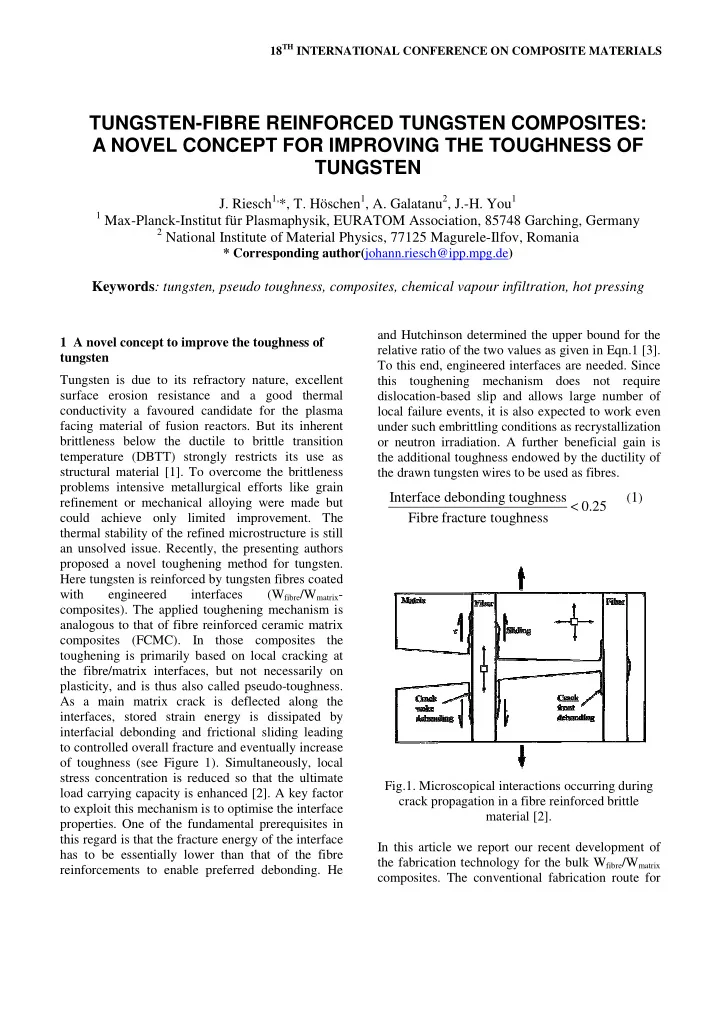
1 A novel concept to improve the toughness of tungsten Tungsten is due to its refractory nature, excellent surface erosion resistance and a good thermal conductivity a favoured candidate for the plasma facing material of fusion reactors. But its inherent brittleness below the ductile to brittle transition temperature (DBTT) strongly restricts its use as structural material [1]. To overcome the brittleness problems intensive metallurgical efforts like grain refinement or mechanical alloying were made but could achieve only limited improvement. The thermal stability of the refined microstructure is still an unsolved issue. Recently, the presenting authors proposed a novel toughening method for tungsten. Here tungsten is reinforced by tungsten fibres coated with engineered interfaces (Wfibre/Wmatrix- composites). The applied toughening mechanism is analogous to that of fibre reinforced ceramic matrix composites (FCMC). In those composites the toughening is primarily based on local cracking at the fibre/matrix interfaces, but not necessarily on plasticity, and is thus also called pseudo-toughness. As a main matrix crack is deflected along the interfaces, stored strain energy is dissipated by interfacial debonding and frictional sliding leading to controlled overall fracture and eventually increase

  • f toughness (see Figure 1). Simultaneously, local

stress concentration is reduced so that the ultimate load carrying capacity is enhanced [2]. A key factor to exploit this mechanism is to optimise the interface

  • properties. One of the fundamental prerequisites in

this regard is that the fracture energy of the interface has to be essentially lower than that of the fibre reinforcements to enable preferred debonding. He and Hutchinson determined the upper bound for the relative ratio of the two values as given in Eqn.1 [3]. To this end, engineered interfaces are needed. Since this toughening mechanism does not require dislocation-based slip and allows large number of local failure events, it is also expected to work even under such embrittling conditions as recrystallization

  • r neutron irradiation. A further beneficial gain is

the additional toughness endowed by the ductility of the drawn tungsten wires to be used as fibres.

25 . toughness fracture Fibre toughness debonding Interface <

(1) Fig.1. Microscopical interactions occurring during crack propagation in a fibre reinforced brittle material [2]. In this article we report our recent development of the fabrication technology for the bulk Wfibre/Wmatrix

  • composites. The conventional fabrication route for

TUNGSTEN-FIBRE REINFORCED TUNGSTEN COMPOSITES: A NOVEL CONCEPT FOR IMPROVING THE TOUGHNESS OF TUNGSTEN

  • J. Riesch1,*, T. Höschen1, A. Galatanu2, J.-H. You1

1 Max-Planck-Institut für Plasmaphysik, EURATOM Association, 85748 Garching, Germany 2 National Institute of Material Physics, 77125 Magurele-Ilfov, Romania

* Corresponding author(johann.riesch@ipp.mpg.de)

Keywords: tungsten, pseudo toughness, composites, chemical vapour infiltration, hot pressing

slide-2
SLIDE 2

tungsten-base materials is powder metallurgy [4] (due to the refractory nature of tungsten). However, a powder metallurgical processing route requires very high temperatures and pressures for the consolidation process and would therefore impose serious impacts on the properties of Wf/Wm-

  • composites. The engineered interfaces and also the

fibre alignment in the composite would be possibly

  • destroyed. Extensive research effort is necessary to

evaluate the applicability of powder metallurgy for the fabrication of Wf/Wm composites. An alternative processing route for tungsten without severe thermo-mechanical impact which is widely used for the fabrication of coatings is chemical vapour deposition (CVD). This technique was already successfully applied to the single-fibre Wf/Wm-mini-composites by the author’s group [5]. The single-fibre composites consisted of a tungsten filament (diameter: 150 µm) coated with a thin film (thickness: 1 µm) to form a well-defined interface layer using magnetron sputtering (PVD) embedded into a thick mantle of dense tungsten (1-1.5 mm) produced by CVD. This CVD-based fabrication of the single-filament composites was not difficult and could produce large number of specimens with different interface coatings in a single batch. However, CVD method could not be applied to a multi-filament composite system due to the low quality of matrix filling. A variant of CVD is the chemical vapour infiltration (CVI) technique. Here the conventional CVD process is combined with an additional infiltration step to fill porous or fibrous preforms. Currently the CVI technique is widely used for the fabrication of fibre-reinforced ceramic composites (e.g. C/C, SiC/SiC, SiC/Si3N4) [6]. The main advantages of CVI are relatively low processing temperatures and minimal mechanical impact. In this work we applied the CVI process on tungsten (W-CVI) to fabricate multi-filament bulk composites of Wf/Wm system. Dedicated equipment was used to achieve a reasonably high matrix filling quality by means of a controlled temperature gradient. 2 Synthesis of Wf/Wm-composites by the chemical vapour infiltration of tungsten (W-CVI) We designed the multi-fibre Wf/Wm-composites in such a way as to consist of hundreds of aligned fibre reinforcements embedded in a rather dense tungsten matrix with preserved interfacial films as illustrated schematically in Figure 2. Commercial product of drawn wire with a diameter of 150 µm was used as fibre. At first the wires were arranged in a regular pattern to form a uni-directional fibre preform. The preform should provide an accurate positioning of the fibres in equal distances with each other but also allow free access to all fibres at the same time. The distance was chosen to be 100 µm which led to final fibre volume fraction of about 30 %. The unidirectional configuration of the fibres was supposed to simplify the interpretation of experimental results as well as the production itself. To achieve the well defined fibre architecture we used a commercial winding device actually to be used for electro-magnetic coils. The tungsten wire was wound around a frame equipped with spacer foils to form a preform which required considerable manual efforts. An example of a final preform is shown in Figure 3. Fig.2 Architecture of a Wfibre/Wmatrix-composite sample: Continuous tungsten wires are embedded into a dense tungsten matrix (produced by W-CVI) with coated interfaces. The interface coating can be made either before or after the preform winding process. In the latter case, the whole fibre bundle has to be coated at once. The advantage of a single wire coating process is that the technique is straightforward to use and flexible in terms of quality management. But the thin surface coatings have to withstand the mechanical damage to be caused during the preform preparation. In this work, we made wire coating on the preform after

  • winding. Tungsten oxide film was deposited by

direct oxidation of the surface. The formed oxide film was not stoichiometric (WOx) and expected to have a sufficiently low toughness to fulfil the crack deflection criterion. For comparison bare wires

Matrix: W-CVI Interface: WOx Fibre: Drawn W-wire

slide-3
SLIDE 3

3 TUNGSTEN-FIBRE REINFORCED TUNGSTEN COMPOSITES: A NOVEL CONCEPT FOR IMPROVING THE TOUGHNESS OF TUNGSTEN

without any further coating (as variety of weak interface) were also used as reinforcement. Fig.3. Tungsten wire preform for uni-directional Wf/Wm-composites. The wire is wound around a frame with a uniform distance. Finally, the tungsten matrix was deposited within the preform by CVI. The heterogeneous reaction on the material surface of tungsten hexafluoride (WF6) with hydrogen (H2) was used according to Eqn.2 [7].

HF W H WF

C

6 3

800 300 2 6

+    →  +

° −

(1) There are two main technical constraints in implementing the CVI processing: On one hand, low temperature process is advantageous since high density can be most likely obtained with a low deposition rate. On the other hand, preferably large deposition rate is needed to keep the processing time and costs at acceptable limit [6]. By means of forced reactant gas flow combined with temperature gradient along the preform, it is possible to control the deposition rate and obtain dense composites in a reasonable time [6]. The forced flow improves the gas transport to the material surface in the interior of the preform. The applied temperature gradient suppresses the premature enclosing of hollow spaces (form big pores and allow no gas access) by controlling the deposition rate. 3 Setup of W-CVI and first deposition experiments We devised a dedicated tubular reactor inserted in a vacuum furnace chamber which enabled both forced gas flow and building of temperature gradient. A movable local heat source was integrated to move the heating front. Concurrent background heating was also possible. A schematic drawing together with a photograph of the setup is shown in Figure 4. Fig.4. Schematic illustration of W-CVI setup (left) showing the tube reactor in a vacuum furnace chamber and a photograph of the real setup (right) showing a tube reactor and a movable local heater. The simplest way to generate the forced flow in the wound preform is to ingest the gas from the inside of the preform and force it to flow out of the interior through the clamped wires to the outer surface. The main gas flow is therefore directed perpendicular to the wires. After having passed through the fibres the gas expands within the tube reactor and is then exhausted by a powerful vacuum pump locating at the chamber bottom. Although the tube reactor and the connected exhaust tube were not gas-tight, there was only negligible amount of gas leakage into the main chamber (no sensible deposit was found), possibly due to self sealing during initial coating. A series of exploring experiments were performed to gain a better insight into the deposition mechanism

  • f the W-CVI process. In the following, details of

the initial experiments carried out for process development are presented.

W-wire

slide-4
SLIDE 4

The initial experiment was conducted to study the deposition behaviour at several different temperature

  • profiles. The runtime of the full deposition charge

was 14 hours (reaction gas floating). For both WF6 and H2 the gas flux was kept constant, each at 125 sccm (standard cubic centimetre per minute) and 500 sccm respectively. The experiment was scheduled in three temporal sequences, where distinct thermal scenario was applied for each sequence. The temperature profile indicating the scenarios is shown in Figure 5 (the drop in the curves in zone 1 was due to experimental difficulties). In the first part (4.4 h) background heat was combined with local heating at a fixed position. A constant temperature gradient was built along the fibre axis. In this case we could examine the influence of a specified temperature gradient on the deposition behaviour. The average temperature at the bottom of the preform was 426°C (T1), at the middle part 390°C (T2), and at the top 368°C (T3). The mean gradient was 0.725°C/mm. In the second regime of the experiment (6.25 h), only the background heat was present. Thus the preform was subjected to nearly uniform temperature (T1 = 441°C; T2 = 336°C; T3 = 433°C). In the last part of the experiment (3.25 h), the background heat was raised up stepwise with a mean rate of 0.17°C/min without local heating to estimate the possibility of faster deposition. Fig.5 Temperature profile during initial W-CVI experiment for three measuring positions showing different thermal scenarios: Zone 1 – temperature gradient; Zone 2 – constant temperature; Zone 3 – increasing temperature. After the CVI process the coated fibres showed quite uniform thickness (50 µm) of the deposited matrix

  • mantle. The CVI coatings grew to such an extent

that the fibres were almost touching each other. On the outside of the bundle thicker deposition layer was formed. There were just minor differences between bottom (T1 position) and top location (T3 position). Figure 6 shows a cross-section of the material taken in the bottom area. The remaining porosity in this area was about 20 % whereas the centre parts (28 %) where slightly more porous than the inside (17 %) and the outside (22 %). It should be noticed that the assessed pore volume fraction was calculated using scanning electron micrographs. The porosity is concentrated in-between the fibres whereas the deposited film itself is dense. Resulting quality of the composite was dependent on the thermal conditions of CVI deposition. Thus we’ll discuss the effect of processing conditions separately for different parts. At first, the bottom part (uniform temperature during whole process) is distinguished from the top part (temperature gradient was active). Secondly, deposition domains with stable and rising background heating are also discussed respectively. In the bottom region a uniform temperature of about 435°C was maintained for the main part of the experiments (77 % of the process time). This region was therefore only affected by the forced gas flow through the fibres. At the beginning of CVI processing the deposition of the system was dominated and controlled by the chemical reaction. Thanks to the forced gas flow, there was always sufficient amount of reactant gas available near the

  • surfaces. This indicates that the deposition rate there

have been governed by the chemical reaction rate. This leads to a uniform deposition everywhere in the

  • preform. In the course of the CVI process, the

distance between the surfaces of neighbouring fibres became smaller as the deposition proceeded. Accordingly the size of the pores was decreased. This development hinders the gas transport to the composite interior more and more until the limiting factor is finally no longer the chemical reaction but the gas transport. From now on the deposition rate is strongly depended on the location within the fibre

  • bundle. As the reaction gas has to first diffuse into

the fibre bundle before the reaction can take place the deposition rate decreases with the distance from the preform surface. That feature led to fast growth

  • f the outer coating layer eventually blocking the

pores at the two outermost fibre layers (see Figure 4). The blocking (enclosing) appeared at the inside as well as on the outside of the fibre bundle preform.

1 3 2

slide-5
SLIDE 5

5 TUNGSTEN-FIBRE REINFORCED TUNGSTEN COMPOSITES: A NOVEL CONCEPT FOR IMPROVING THE TOUGHNESS OF TUNGSTEN

Fig.6. Cross-section through fibre bundle W-CVI at bottom location (T1 position): Relatively uniform coating of fibres until almost touching, then blocking of the outer layers. The thermal gradient had no significant influence on the results. This means that the temperature gradient was not strong enough to improve the deposition quality (especially density). In the lower temperature parts tungsten coating grew more slowly but finally also there the gas transport became the limiting step (although this happens later than at the hotter areas) and the channelling into the preform was blocked at the outside. The increase of the reaction temperature improved mainly the deposition speed but not the transport of the gases. In the regions being already blocked, the raised temperature promoted growth on the outside. In areas where this was not the case only the blocking is promoted. The W-CVI processing combined with forced gas flow was shown to be capable of coating each fibre uniformly within the fibre preform up to a thickness

  • f 50 µm. This processing in combination with a

suitable redensification technique could be an adequate method for producing Wf/Wm-composites. Several attempts were made in order to consolidate the as-processed specimens by simple hot pressing. Two different processing conditions were tested (see Figure 7). A moderate temperatures of 1450°C in combination with a pressure of 58MPa and higher temperatures of 1700°C with a similar pressure (60MPa) but a much slower pressuring rate and longer holding times. The results are shown in Figure 8. Regarding the amount of densification the two considered test conditions showed no significant

  • difference. For both conditions the density was

about 93 % in the testing zone. An important concern when applying hot pressing has been the precise fibre arrangement before the compaction. In areas where the arrangement was not ideal resulting densification was poor. Regarding the low temperature specimens the compaction was not sufficient: The coated fibres were just loosely bonded together. For the high temperature case the compactness quality was comparable to the bulk material counterpart. Fig.7. History of the temperature and pressure used for redensification by hot pressing under two different conditions. 4 Conclusions and Outlook The first experiments on the chemical infiltration of tungsten onto a fibrous preform give reasonable prospect that this could be an adequate technique for producing Wf/Wm-composites. By means of forced gas flow CVI it is possible to uniformly deposit tungsten within a fibrous preform up to a density of 80 %. Nevertheless the remaining concentrated porosity leads to a loose compactness and is therefore not acceptable. A thermal gradient of 0.17°C/min for 4 h has no significant influence on the results. Redensification of Wf/Wm-composites by hot pressing allows further densification up to maximum 93 %. The hot pressing requires a high temperature

  • f

1700°C to get acceptable

  • compactness. Nevertheless the necessary high

temperatures and high pressures debilitate the advantages of the CVI-process. The thermo- mechanical compaction step imposes serious impacts on the interfacial integrity and on the microstructure (e.g. recrystallisation of wires).

  • utside

inside

200 µm

slide-6
SLIDE 6

Fig.8 Cross sections of Wf/Wm-composite after redensification by hot pressing. Left: moderate temperature of 1450° C, pressure of 58 MPa, fast process; Right: high temperature of 1700 ° C, pressure 60 MPa; slow process. Further experiments have been conducted to study the influence of the thermal gradient in more detail and try to improve the densification. These studies will be reported elsewhere. A further scope of interest is the inclusion of an interface formation possibility either before or after producing the preform and a possible powder metallurgical processing route. Acknowledgements Authors are grateful to Calvin Prentice and Archer Technicoat Ltd. for their experience and support in conducting the CVI work. We thank as well the workshop of IPP for their excellent technical support and Osram GmbH, Schwabmünchen for providing the tungsten wire. This work was partly supported by European Fusion Development Agreement in the framework of the MAT-WWALLOYS Research Project. References

[1] R. Lässer, N. Baluc, J.-L. Boutard, E. Diegele, S. Dudarev, M. Gasparotto, A. Möslang, R. Pippan, B. Riccardi and B. van d. Schaaf. Structural materials for DEMO: The EU development, strategy, testing and

  • modeling. Fusion Engineering and Design 82, No. 5-14,

511–520, 2007. [2] A.G. Evans. Overview No. 125: Design and life prediction issues for high-temperature engineering ceramics and their composites. Acta Materialia 45, No. 1,

  • S. 23–40, 1997

[3] M. Y. He and Hutchinson. Crack deflection at an interface between dissimilar elastic materials. International Journal of Solids Structure, 25(9):1053- 1067, 1989. [4] E. Lassner and W.-D. Schubert. Tungsten – Properties, Chemistry, Technology of the Element, Alloys and Chemical Compounds. New York: Kluwer Academic/ Plenum Publishers, 1999 [5] J. Du, T. Höschen, M. Rasinski, S. Wurster, W. Grosinger and J.-H. You. Feasibility study of a tungsten wire reinforced tungsten matrix composite with ZrOx interfacial coatings. Composite Science and Technology 70, Is. 10, 1482-1489, 2010. [6] T.M. Besmann, D.P. Stinton and R.A. Lowden. Overview of chemical vapour infiltration: International conference on high temperatures ceramic matrix

  • composites. Bordeaux, 1993

[7] A.F. Zinn. Chemical Vapor Deposition of Tungsten. in: T.Kodas, M. Hampden-Smith (Editor), Thechemistry

  • f metal CVD, VCH Verlagsgesellschaft GmbH, 1994

200 µm