
SLIDE 1
School of Physics & Center for Relativistic Astrophysics
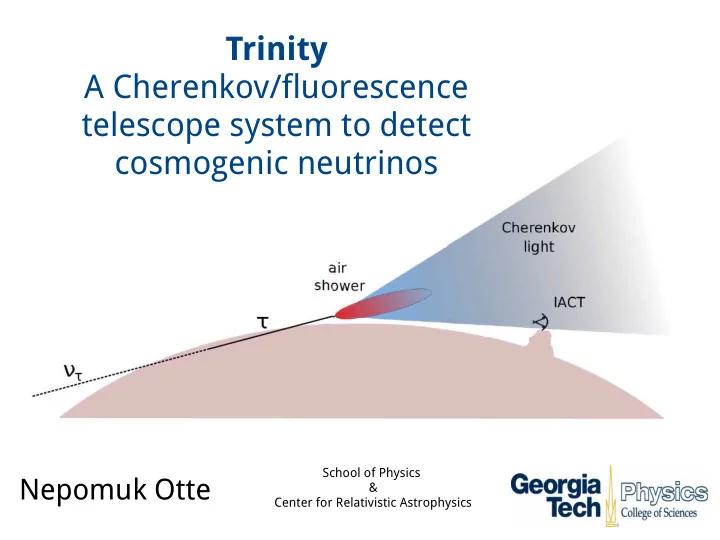
Trinity A Cherenkov/fluorescence telescope system to detect - - PowerPoint PPT Presentation
Trinity A Cherenkov/fluorescence telescope system to detect cosmogenic neutrinos School of Physics Nepomuk Otte & Center for Relativistic Astrophysics Target sensitivity 10 -9 GeV/s/cm 2 /sr Science Motivation: What is the
School of Physics & Center for Relativistic Astrophysics
10-9 GeV/s/cm2/sr NTA 3yrs Target sensitivity
UHECR?
detected ν flux to 109 GeV?
physics Science Motivation:
Observations of SNRs with VERITAS 3
Image in camera
–
Angular resolution <0.1°
–
Energy resolution 10%
–
Excellent background suppression
Nepomuk Otte 4
Nepomuk Otte 5
Neutrino/tau physics (vertical acceptance) Light emission pattern (azimuthal acceptance)
Image intensity (energy threshold) Image resolution (angular resolution / background suppression)
Works best for:
Limiting factors:
convert
make it out
Probability for ν conversion and emergence of τ from ground
ν energy Target material: Rock with ρ = 2.65 g/cm3
elevation
Nepomuk Otte 7
10°
Lots of Cherenkov light scattered outside of primary 1° cone
Nepomuk Otte 10
Azimuth acceptance: ~360° For 109 GeV τ: ~200 photons per m2 in telescope if shower is 80 km away Yield: 30 photons / MeV
Keilhauer et al. 2012
80 km
Detection threshold 1 neutrino In 3 years 25% duty cycle Uncertain by a factor of two
360° azimuthal FoV and 5° vertical FoV 1m2 effective mirror area Minimum 0.3° angular resolution >10 pixel per image → Signal sampling speed 100 MS/s Single photoelectron resolution
A transit imaging atmospheric Cherenkov telescope to survey half of the very high energy γ-ray sky
Astropart.Phys. 72 (2016) 46-54
Scaled down to 1m2 mirror:
FOV of 5 × 60 sq deg
3622 → pixel
sensor size 3x3mm →
2 (SiPMs)
Costs per station (optics only): ~$50,000
Nepomuk Otte 14
Photon arrival times spread out to ~10 µs “slow” 100MS/s DAQ sufficient → NSB: 36mm2 pixel record about 4 photon / 1 → μs Single pe signal stretched to 100 ns
Kieda (1995)
Nepomuk Otte 15
photodetector amplifier + shaper 100 MS/s, 8 bit FADC
SiPMs as photodetectors
3x3 mm2 sensor + light concentrator
Continuous sampling with 100 MS/s Signal processing and trigger in FPGA
Allows flexible trigger schemes using time and amplitude information
Cost per channel ~$100
Nepomuk Otte 16
Nepomuk Otte 17
Very good angular resolution and energy reconstruction
Background photon rates Cosmic Ray background Signal extraction and triggering
Advanced methods can significantly improve sensitivity and lower energy threshold
Data analysis: How well can up-going showers separated from down-going ones
Nepomuk Otte 19
With CORSIKA 7.56 modified to do Cherenkov emission for upward going particles (credit to D. Heck) Curved atmosphere with changing index of refraction VERITAS atmospheric attenuation models generated with modtran Restrict simulations to gammas
first interaction always the same (100m above ground) pure em-shower no hadronic component, which widens Cherenkov footprint
No LPM effect (important above 107 GeV), which makes shower longer
side view detector plane Tau trajectory Cherenkov photon tracks 100m 1 km
Nepomuk Otte 22
~ 50 km ~10° α<5° τ decay Cherenkov cone <10 km ~5° FoV in vertical Most extreme situation with:
within 50 km >60 km Showers start to be fully contained in camera if it is >60 km from telescope
1 km above ground
Nepomuk Otte 24
~3 time sensitivity of Cherenkov Cherenkov Fluorescence Azimuthal acceptance ~20° ~360° Elevation acceptance ~5° ~5° Area on ground 120,000m2 20,000m2
IOTA site on Kitt Peak, AZ