Trends Driving Healthcare Technology The Healthcare system needs - - PDF document

trends driving healthcare technology the healthcare
SMART_READER_LITE
LIVE PREVIEW

Trends Driving Healthcare Technology The Healthcare system needs - - PDF document

Agenda Hur bedrivs framgngsrikt forskningssamarbete mellan industri och akademi inom medicinsk teknik? The European Healthcare landscape in the future Defining the challenges Linkping The large company strategy Open


slide-1
SLIDE 1

/ GE /

Hur bedrivs framgångsrikt forskningssamarbete mellan industri och akademi inom medicinsk teknik?

  • Linköping

2012-09-05

Bengt Nielsen, Ph.D

Chairman NovaMedTech

e-mail: nielseninnovation@gmail.com

Agenda

  • The European Healthcare landscape in the future
  • Defining the challenges
  • The large company strategy
  • Open Innovation – is it a sustainable model?
  • Examples of successful collaborations between

academia, SME’s and large industry

  • We need a new model for R&D and innovations
  • Conclusions

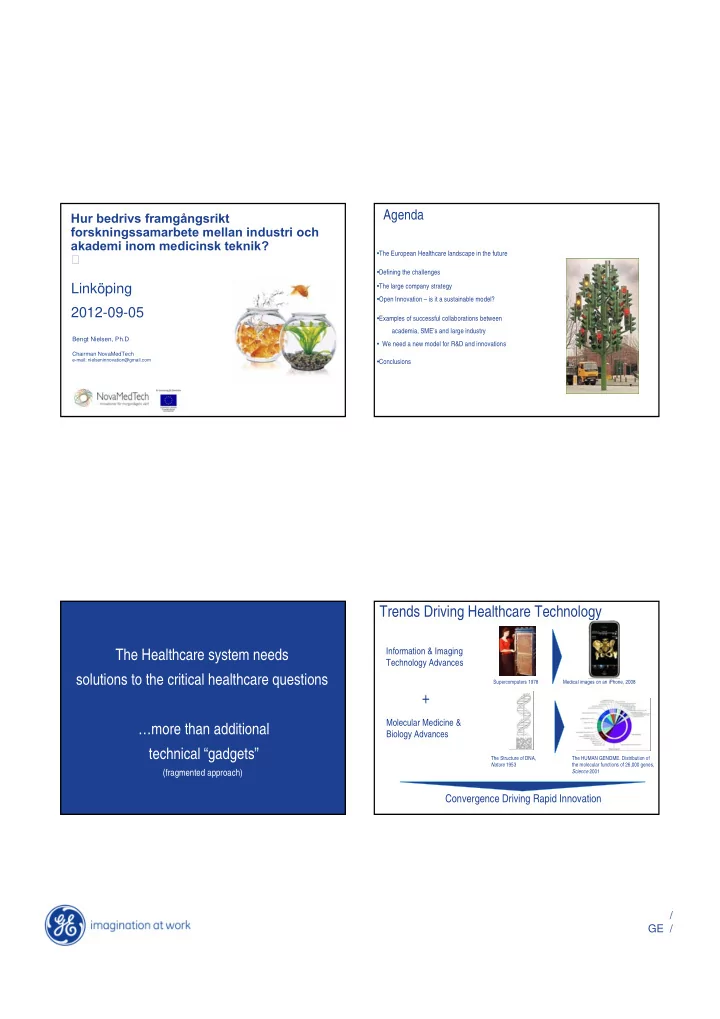
The Healthcare system needs solutions to the critical healthcare questions …more than additional technical “gadgets”

(fragmented approach)

Trends Driving Healthcare Technology

Information & Imaging Technology Advances

The HUMAN GENOME. Distribution of the molecular functions of 26,000 genes, Science 2001 Medical images on an iPhone, 2008 Supercomputers 1978 The Structure of DNA, Nature 1953

Molecular Medicine & Biology Advances

+

Convergence Driving Rapid Innovation

slide-2
SLIDE 2

/ GE /

What are the challenges ahead?

Societal health challenges in Europe

  • An ageing population
  • Growing prevalence of

chronic diseases

  • A declining labour force
  • Rising health care costs

Courtesy: COCIR R&I Task Force

Outcome of the present model

The fundamental driver of high costs & quality issues is the inconsistency of healthcare delivery &

  • utcomes from region to region, state to state, & even hospital to hospital. Such variance is bad for your

health & the healthcare system as a whole Courtesy: COCIR R&I Task Force

Personalized Healthcare Needed!

Chronic Diseases

Focus: chronic diseases - there are some 150 million patients with chronic conditions in the EU Vision: high quality, patient-centred affordable healthcare across the EU Areas of work:

  • Health Research
  • Health Technology Assessment
  • eHealth, TeleHealth and mHealth
  • Patient Safety & Quality of Care

Courtesy: COCIR R&I Task Force

slide-3
SLIDE 3

/ GE / The healthcare landscape in Europe toward 2020

Objectives

  • Technology marches forward on all

fronts: from Imaging technologies to nanotechnology supported by ICT/e- Health, from material sciences to molecular medicine

  • Healthcare is not viewed as a cost, but

as a major investment

  • Create the Molecular Medicine

Market supported by technologies

  • 20% of GDP is spent on healthcare, a

large chunk of which goes towards technological improvements

  • The political economies of Europe

focus on entrepreneurism

  • Health systems are able to reform

their business models to promote cost-effective innovation.

The vision

  • Technology has improved, and

can now cure (Diag & Treat) more efficiently the chronic diseases

  • Leverage the Healthcare in

Europe, with a better Access & Quality and decreased the cost

  • e-health has ensured that

healthcare is well managed

  • Create European Jobs and

Growth

  • Reinforce thanks to innovative

technologies the development

  • f Personalized medicine

(future medical practice)

Courtesy: COCI R R&I Task Force

The healthcare landscape in Europe toward 2020

Critical factors

  • Incentives for improving

technologies

  • Regulators and payers work

harmoniously together to ensure that innovation meets the needs of the population, and that all individuals have access to the latest, most effective medical interventions

  • Industry forms partnerships to

innovate

  • Create the IT infrastructure as an

enabler for new medical practice (e-Health, Molecular Medicine, …)

Possible positives

  • The society-wide financial

benefits of patients being able to return to work, or live independently, has more than paid back innovation costs

  • Healthcare companies are seen as

the chief drivers of innovation

  • Significant cost savings as a result
  • f innovative technologies
  • The system promotes greater equality
  • f care.

Possible negatives

  • Chronic disease continues to rise

Today 2020

Courtesy: COCI R R&I Task Force

The Healthcare challenges:

The education/ competence perspective

Innovation occurs at the intersection of disciplines

Animal Research Care Areas:

Innovation

Physicists Biologists Mathematicians Physicians: NM, oncology, cardiology, neurology Computer Scientists Chemists Mechanical Engs

Patient centric Development IP Patients Research Centers Societies Biotechnology IP

PRACTICAL REALITY…

  • Cancer plan
  • Cardio plan
  • Other plans

(Maternal & Infant Care, Prevention, Mental Health, Infectious diseases, Ambulatory, Emergency, etc)

“Hardware + Wetware + Software”

The key stakeholders landscape:

Academia SME’s Large companies Regulatory bodies Governments
slide-4
SLIDE 4

/ GE /

Point of focus Academia SME Large Company Publications Very important Less important

Less important in early stage Research

Patent Less important Very important Very important Time scale Years Months/ weeks Quarter Clinical Very important Less important

Less important until the late stage

Technology Important Critical Critical Marketing/ Products Less important Critical Critical Regulatory approvals Less important Critical Critical Risks taking Yes Yes No

The different priorities of key stakeholders

All 3 parties needs to collaborate together well tuned in order to find new solutions

The large company view and research model & process

”Seed Funding”

to selected partners to kick off specific research projects Enabling fast results & external research funding

R&D funnel

From Academic Research to business: Large Company

3-5 years

BD

Clinical Research being persued to develop new technology & applications from In vitro to PoC in man.

Enabling productification & clinical validation for the Healthcare market introduction (upscaling, manufacturing, marketing, sales, regulatory, launch)

Academic & SME & Pharma Collaboration

Building a Business Developent, BD Funnel

5 years

  • r

Critical things that needs to be considered before decisions on investment:

Many large companies, has a huge freedom and many challenges: 1. Purchase/ license, create JV’s

  • r develope internally.

2. Decision is depending upon:

  • subject/ area
  • speed to market
  • core competence within the company
  • maturness of the idea/ technology
  • health economics assessment

3. ...but the shareholders want dividend and minimize risk

With courtesy from GE Healthcare

slide-5
SLIDE 5

/ GE /

Regulatory Process is becoming more challenging Drug Development : Very high risk

Net Cost: $802 Million Invested Over 15 Years Net Cost: $802 Million Invested Over 15 Years

5,000–10,000 Screened 250 Enter Preclinical Testing 5 Enter Clinical Testing 1

Compound Success Rates by Stage Compound Success Rates by Stage

Approved by the FDA Approved by the FDA

16 14 12 10 8 6 4 2 Phase II 100–300 Patient Volunteers Used to Look for Efficacy and Side Effects Phase III 1,000–5,000 Patient Volunteers Used to Monitor Adverse Reactions to Long-Term Use FDA Review Approval Additional Post- Marketing Testing

Phase I 20–80 Healthy Volunteers Used to Determine Safety and Dosage

Preclinical Testing Laboratory and Animal Testing Discovery (2–10 Years)

Years Years

Source: Tufts Center for the Study of Drug Development

With courtesy from Pfizer

Research

Pre- clinical Clinical Feasibility studies

Definitive patient studies Life cycle

Entry into man Product Launch

Research and Development in Molecular Imaging

R

D

&

Clinical Function

The Medical Device Directory is becoming a very similar process to the drug regulations

10 -15 years

  • The large company is focusing on development

(late stage projects)

  • Minimizing risk

….but

  • Large companies are needed for market introd

within Healthcare The large company focus:

slide-6
SLIDE 6

/ GE /

The marketing, product and business challenges

The journey from idea to reality........ Innovation ”no man’s land” or the ”valley of death”

Research and solution design Years 10 15 Product phase

Many different types of competence needed to bridge the gap... But also new models for bringing product to market!

The critical gap ”valley”

Relative Relative Cost Cost

Examples of successful research projects & commercialization

Seen from a large company horizon

slide-7
SLIDE 7

/ GE / 20 Years of User-Based Innovation - Licensing

1990 1995 2000 2005

MSK Neuro Body Vasc Cardiac

2010

2D CINE PROBE MOTSA 2DFSE 3DFSE DeltaFLOW ReportCard Cartigram FSE IDEAL BREASE PROP 2.0 MR Touch Inflow IR 3D HEART CINE IR 3D ASL LAVA-FLEX eDWI FGRE TC Ready Brain PROP 3.0 StarMap VIBRANT- FLEX QuickStep Velocity CUBE COSMIC BRAVO SWAN BrainStat ARC FT-MRA FR FSE SmartPrep Black Blood Tagging Spiral MDE SSFSE Fast CINE DWI SmartStep EPI

FLAIR

iDRIVE Nav 3D FIESTA PROS E VIBRANT TRICKS MR Echo fgret 3D MDE MERGE DTI PROP LAVA 2D FIESTA FIESTA C FIESTA FS SWIFT BrainWave ASSET Platform

With courtesy from GE Healthcare

Omnyx created with one goal: to transform pathology globally through digitization

  • Independent company established & funded in March 2008
  • 50/50 GE and UPMC joint venture
  • Developing scanner & enterprise pathology software
  • Two locations: Pittsburgh, PA (headquarters) and Piscataway, NJ USA
  • 90 employees
  • UPMC Pathologists on staff intimately involved in product design
  • GE is exclusive distributor for the company’s products
  • UPMC Clinical expertise / GE Engineering expertise

Omnyx is a successful example of a JV between Academia & GE

With courtesy from GE Healthcare

Development of Vscan (handheld ultrasound) is a good example of GE Healthcare collaborating with a Norvegian SME’s and Universities, focusing on micro-electronics.

More than 15 new applications under development on Vscan!

With courtesy from GE Healthcare

What changes will come due to the challenging healthcare product development landscape?

slide-8
SLIDE 8

/ GE /

The partnership journey… shifting the needle forward

Competence model

  • Full Open Innovation
  • High degree of openness

(open source)

  • Long-term partnerships

Control model

  • IP/Legacy
  • Low degree of openness
  • One-off partnerships

Cooperation model

  • Selective Open Innovation
  • Medium degree of openness
  • Long-term partnerships

... cultural change and segmentation critical

Nokia Siemens

New model needed!

Research 1-3 prototypes

External Funding 2-3 years funding garantie

30-35 partners

Partners pay for technology at cost?

Clinical validation phase

3 years 3 years 3 years

Large Company

3 years

Technical PoC

8-10 units

1-3 units

Idea

Product Launch

Clinical/ product development

Prototype

SME Summary & Conclusions:

  • The development has to be focused on a real healtcare problem
  • All parties need to work tight together to accelerate R&D and clinical introduction
  • Researchers has often limited knowledge on the challenges

to move from an idea to a commercial product

  • Sometimes a naive view from inventors on the value of their invention
  • The Healthcare system need disease solutions more than technical

gadgets

  • Collaboration is a good way to gain knowledge and take

better decisions together

  • An increased focus on clinical disease solutions makes

the innovation validation much more diligent & difficult.

  • The changing world of healthcare will put more focus on:

access to healthcare, quality of care and cost of therapy

“It is not the strongest species that survive, nor the most intelligent, but the ones most responsive to change”

Charles Darwin

Thank You!