Transportation Emissions MARCH 04, 2020 PRESENTATION TO THE SENATE - - PDF document

transportation emissions
SMART_READER_LITE
LIVE PREVIEW

Transportation Emissions MARCH 04, 2020 PRESENTATION TO THE SENATE - - PDF document

3/3/2020 Transportation Emissions MARCH 04, 2020 PRESENTATION TO THE SENATE ENVIRONMENTAL QUALITY COMMITTEE AND SENATE TRANSPORTATION COMMITTEE CALIFORNIA AIR RESOURCES BOARD 1 Air Quality Successes Criteria Pollutants NOx emissions have


slide-1
SLIDE 1

3/3/2020 1

Transportation Emissions

MARCH 04, 2020

PRESENTATION TO THE SENATE ENVIRONMENTAL QUALITY COMMITTEE AND SENATE TRANSPORTATION COMMITTEE

CALIFORNIA AIR RESOURCES BOARD

1

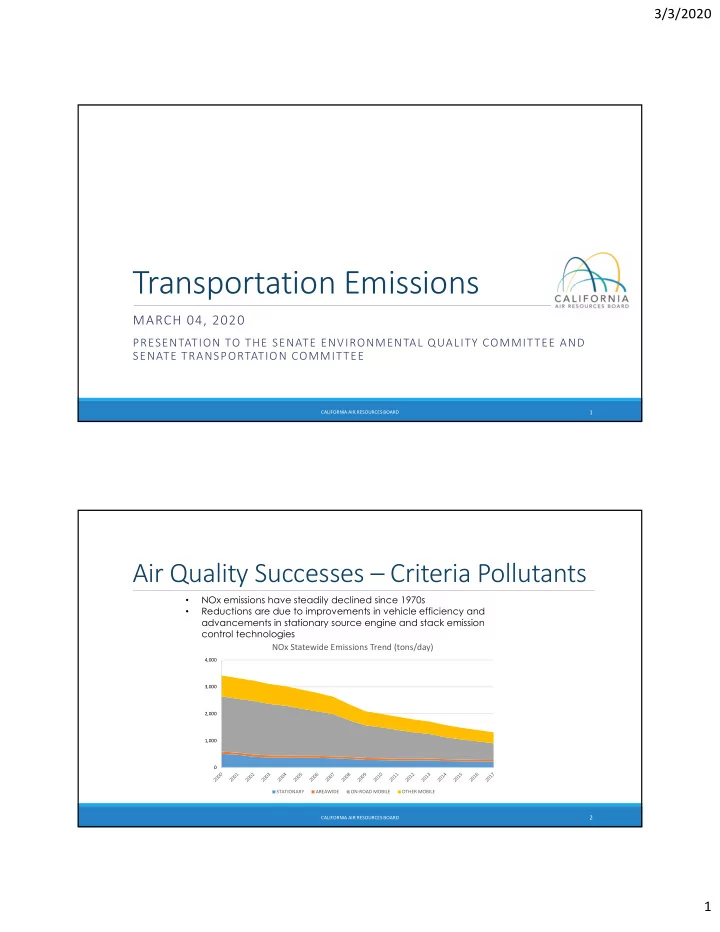
Air Quality Successes – Criteria Pollutants

2

  • NOx emissions have steadily declined since 1970s
  • Reductions are due to improvements in vehicle efficiency and

advancements in stationary source engine and stack emission control technologies

1,000 2,000 3,000 4,000

NOx Statewide Emissions Trend (tons/day)

STATIONARY AREAWIDE ON‐ROAD MOBILE OTHER MOBILE CALIFORNIA AIR RESOURCES BOARD

slide-2
SLIDE 2

3/3/2020 2

3

Health Impacts

Reducing NOX emissions is important because NOX is a precursor to

  • zone, a smog‐forming

pollutant.

CALIFORNIA AIR RESOURCES BOARD

Ozone Progress

2006 2019

2031 0.075 2023 0.08 0.110 Attainment years

San Joaquin Valley South Coast

Ozone (ppm)

8-hr 0.070 2037 4

CALIFORNIA AIR RESOURCES BOARD

slide-3
SLIDE 3

3/3/2020 3

Greenhouse Gas Emission Trends

5

‐60% ‐40% ‐20% 0% 20% 40% 60% 2000 2001 2002 2003 2004 2005 2006 2007 2008 2009 2010 2011 2012 2013 2014 2015 2016 2017

Change Since 2000 GDP Population GHG Emissions GHG Emissions per Capita GHG Emissions per GDP

Source: 2019 Edition, California Greenhouse Gas Emission Inventory: 2000‐2017

CALIFORNIA AIR RESOURCES BOARD

Transportation Sector: Largest source of GHG and NOx Emissions

CALIFORNIA AIR RESOURCES BOARD

6

Source: 2019 Edition, California Greenhouse Gas Emission Inventory: 2000‐2017 Source: CARB Emission Inventory

slide-4
SLIDE 4

3/3/2020 4

Widespread Electrification

  • By 2035: 100% new car sales are ZEVs; All school buses, marine port &

airport equipment are ZEVs

  • By 2045: All passenger vehicles on the road are ZEVs

Transportation Sector: Targets for Pathway to Zero‐Carbon

7

CALIFORNIA AIR RESOURCES BOARD

Increased Transportation Options to Reduce VMT

  • By 2035: Reduce vehicle miles traveled per capita by 25%
  • By 2045: High-quality, efficient travel options for all Californians

Light‐Duty Vehicle Regulations that Impact ZEVs

Advanced Clean Cars II

  • Goal:

Reduce GHG emissions and increase ZEVs from automakers beyond 2025 Reduce NOx emissions to help attain Ozone Standards in 2031 in South Coast

  • Method:

Increased requirements for ZEVs, and lowered GHG and criteria fleet requirements Clean Miles Standard

  • Goal:

Reduce emissions, promote ZEVs, and reduce VMT within ride-hailing fleets

  • Method:

Set annual GHG targets and minimum required electric VMT

8

CALIFORNIA AIR RESOURCES BOARD

slide-5
SLIDE 5

3/3/2020 5

GHG and NOx Emissions from Light‐Duty Vehicles

CALIFORNIA AIR RESOURCES BOARD

9

Source: 2019 Edition, California Greenhouse Gas Emission Inventory: 2000‐2017

GHG and NOx Emissions from Heavy‐Duty Vehicles

CALIFORNIA AIR RESOURCES BOARD

10

Source: 2019 Edition, California Greenhouse Gas Emission Inventory: 2000‐2017

slide-6
SLIDE 6

3/3/2020 6

Heavy‐Duty Vehicles and Freight Incentives

CARB’s Heavy‐Duty Incentives Portfolio

CALIFORNIA AIR RESOURCES BOARD

11

Pre‐commercial demonstrations Early commercial pilots Broad purchase incentives Fleet turnover Financing assistance for fleets

South Coast Highlights Need for Federal Action

12

200 400 2020 2025 2030

NOx (tons per day) Federally-Regulated Sources: Interstate Trucks, Planes, Trains, & Ships

2000 2005 2010 2015 800

California-Regulated Sources:

Cars, Trucks, & Equipment

600

CALIFORNIA AIR RESOURCES BOARD

slide-7
SLIDE 7

3/3/2020 7

Beyond ZEVs – Reducing VMT

  • Even 100 percent ZEVs aren’t sufficient to achieve air quality and GHG
  • goals. VMT reduction is increasingly important.
  • Expand travel choices that reduce the need to drive alone.
  • Design our communities in a way that makes it easy, convenient, and

safe for people to choose these options

  • Align state policies and programs to support reducing VMT

13

20% of Household Income is spent on transportation

CALIFORNIA AIR RESOURCES BOARD

 LCFS provides

substantial support for transportation electrification

 Fuels supported by the LCFS

displaced over two billion gallons

  • f petroleum fuel in 2018

Volume Credits

Low Carbon Fuel Standard Supports Diverse and Growing Alternative Fuel Pool

14

slide-8
SLIDE 8

3/3/2020 8

Thank You

CALIFORNIA AIR RESOURCES BOARD

15