Translation Buffers (TLBs) To perform virtual to physical address - - PDF document

translation buffers tlb s
SMART_READER_LITE
LIVE PREVIEW

Translation Buffers (TLBs) To perform virtual to physical address - - PDF document

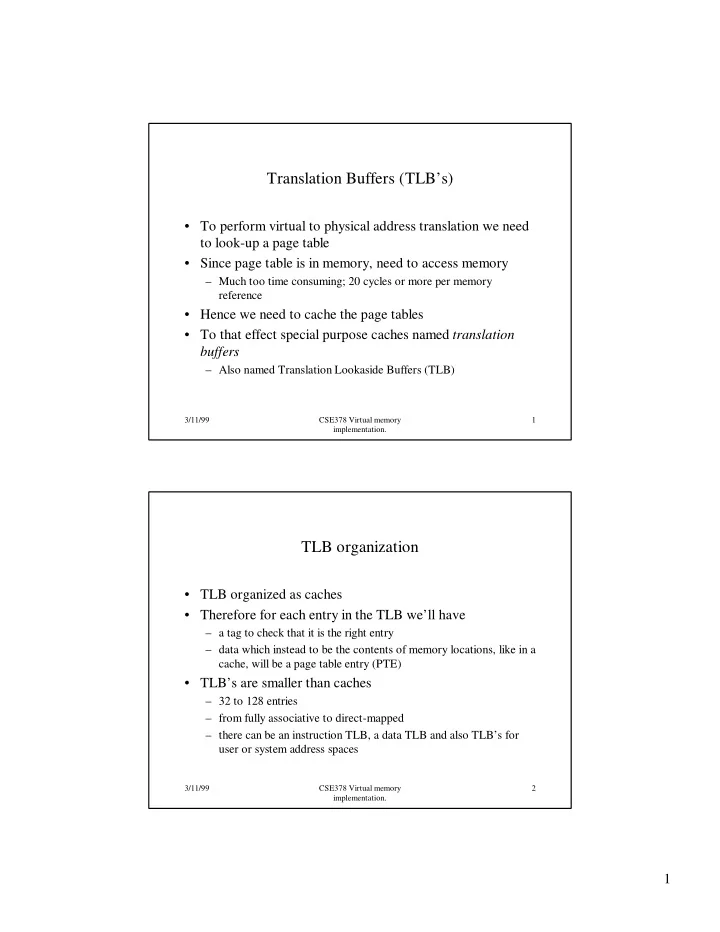
Translation Buffers (TLBs) To perform virtual to physical address translation we need to look-up a page table Since page table is in memory, need to access memory Much too time consuming; 20 cycles or more per memory reference


slide-1
SLIDE 1

1

3/11/99 CSE378 Virtual memory implementation. 1

Translation Buffers (TLB’s)

  • To perform virtual to physical address translation we need

to look-up a page table

  • Since page table is in memory, need to access memory

– Much too time consuming; 20 cycles or more per memory reference

  • Hence we need to cache the page tables
  • To that effect special purpose caches named translation

buffers

– Also named Translation Lookaside Buffers (TLB)

3/11/99 CSE378 Virtual memory implementation. 2

TLB organization

  • TLB organized as caches
  • Therefore for each entry in the TLB we’ll have

– a tag to check that it is the right entry – data which instead to be the contents of memory locations, like in a cache, will be a page table entry (PTE)

  • TLB’s are smaller than caches

– 32 to 128 entries – from fully associative to direct-mapped – there can be an instruction TLB, a data TLB and also TLB’s for user or system address spaces

slide-2
SLIDE 2

2

3/11/99 CSE378 Virtual memory implementation. 3

TLB organization

Offset Virtual page number Index tag Physical frame number v d prot

3/11/99 CSE378 Virtual memory implementation. 4

From virtual address to memory location (highly abstracted; revisited)

ALU Virtual address TLB Physical address hit cache Main memory miss hit miss

slide-3
SLIDE 3

3

3/11/99 CSE378 Virtual memory implementation. 5

Address translation

  • At each memory reference the hardware searches the TLB

for the translation

– TLB hit and valid PTE the physical address is passed to the cache – TLB miss, either hardware or software (depends on implementation) search page table in memory.

  • If PTE is valid, contents of the PTE loaded in the TLB and back to

step above

  • In hardware the TLB miss takes a few cycles
  • In software takes up to 100 cycles
  • In either case, no context-switch
  • If PTE is invalid, we have a page fault (even on a TLB hit)

3/11/99 CSE378 Virtual memory implementation. 6

TLB Management

  • TLB’s organized as caches

– If small could be fully associative – Current trend: larger (about 128 entries); separate TLB’s for instruction and data; Some part of the TLB reserved for system – TLB’s are write-back. The only thing that can change is dirty bit + any other information needed for page replacement algorithm (cf. CSE 451)

  • MIPS 3000 TLB (old)

– 64 entries: fully associative. “Random” replacement; 8 entries used by system – On TLB miss, we have a trap; software takes over but no context- switch

slide-4
SLIDE 4

4

3/11/99 CSE378 Virtual memory implementation. 7

TLB management (ct’d)

  • At context-switch, the virtual page translations in the TLB

are not valid for the new task

– Invalid the TLB (set all valid bits to 0) – Or append a Process ID (PID) number to the tag in the TLB. When a new task takes over, the O.S. creates a new PID. – PID are recycled and entries corresponding to “old PID” are invalidated.

3/11/99 CSE378 Virtual memory implementation. 8

Paging systems -- Hardware/software interactions

  • Page tables

– Managed by the O.S. – Address of the start of the page table for a given process is found in a special register which is part of the state of the process – The O.S. has its own page table – The O.S. knows where the pages are stored on disk

  • Page fault

– When a program attempts to access a location which is part of a page that is not in main memory, we have a page fault

slide-5
SLIDE 5

5

3/11/99 CSE378 Virtual memory implementation. 9

Page fault detection (simplified)

  • Page fault is an exception
  • Detected by the hardware (invalid bit in PTE either in TLB
  • r page table)
  • To resolve a page fault takes 100,000’s cycles (disk I/O)

– The program that has a page fault must be interrupted

  • A page fault occurs in the middle of an instruction

– In order to restart the program later, the state of the program must be saved and instructions must be restartable

  • State consists of all registers, including PC and special

registers 9such as the ne giving the start of the page table address)

3/11/99 CSE378 Virtual memory implementation. 10

Page fault handler

  • Page fault exceptions are cleared by an O.S. program

called the page fault handler which will

– Grab a physical frame from a free list maintained by the O.S. – Find out where the faulting page resides on disk – Initiate a read for that page – Choose a frame to free (if needed), I.e., run a replacement algorithm – If the replaced frame is dirty, initiate a write of that frame to disk – Context-swith, I.e., give the CPU to a task ready to proceed

slide-6
SLIDE 6

6

3/11/99 CSE378 Virtual memory implementation. 11

Completion of page fault

  • When the faulting page has been read from disk ( a few ms

later)

– The disk controller will raise an interrupt (another form of exception) – The O.S. will take over (context-switch) and modify the PTE (in particular, make it valid) – The program that had the page fault is put on the queue of tasks ready to be run

3/11/99 CSE378 Virtual memory implementation. 12

Two extremes in the memory hierarchy

PARAMETER L1 PAGING SYSTEM block (page) size 16-64 bytes 4K-8K (also 64K) miss (fault) time 10-100 cycles (20-1000 ns) Millions of cycles (3-20 ms) miss (fault) rate 1-10% 0.00001-0.001% memory size 4K-64K Bytes (impl. depend.) Gigabytes (depends on ISA)

slide-7
SLIDE 7

7

3/11/99 CSE378 Virtual memory implementation. 13

Other extreme differences

  • Mapping: Restricted (L1) vs. general (Paging)

– Hardware assist for virtual addres translation (TLB)

  • Miss handler

– Harware only for caches – Software only for paging system (context-switch) – Hardware and/or software for TLB

  • Replacement algorithm

– Not important for caches – Very important for paging system

  • Write policy

– Always write back for paging systems

3/11/99 CSE378 Virtual memory implementation. 14

Some optimizations

  • Speed-up of the most common case (TLB hit + L1 Cache

hit)

– Do TLB look-up and cache look-up in parallel

  • possible if cache index independent of virtual address translation

(good only for small caches)

– Have cache indexed by virtual addresses but with physical tags – Have cache indexed by virtual addresses but with virtual tags

  • these last two solutions have additional problems referred to as

synonyms