Transit Mobility Framework and Regional Planning Project Best - - PowerPoint PPT Presentation

transit mobility framework and regional planning project
SMART_READER_LITE
LIVE PREVIEW

Transit Mobility Framework and Regional Planning Project Best - - PowerPoint PPT Presentation

Transit Mobility Framework and Regional Planning Project Best Practices Update June 26, 2019 1 Source: King County Metro 2 BEST PRACTICES FOR CENTERING EQUITY AND SUSTAINABILITY IN METROS POLICIES TRAVEL TRENDS KEY FINDINGS


slide-1
SLIDE 1

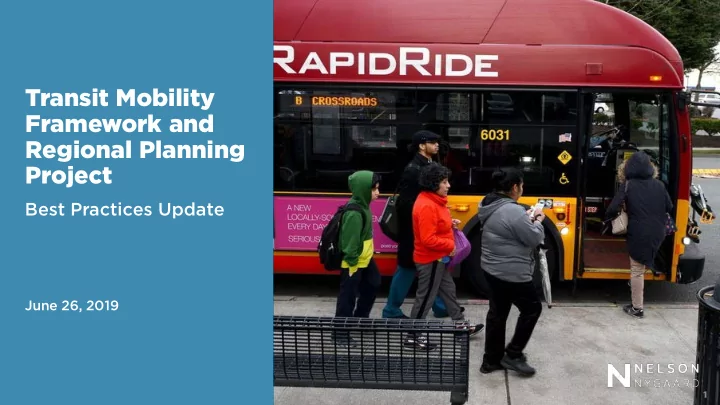
Transit Mobility Framework and Regional Planning Project

Best Practices Update

June 26, 2019

1
slide-2
SLIDE 2

2

Source: King County Metro

slide-3
SLIDE 3

GUIDING PRINCIPLES

3

IDENTIFY BEST PRACTICES ACROSS METRO’S DIVISIONS EQUITY C CAB ABINE NET FEEDBACK/DIRECTION ON MOST PROMISING BEST PRACTICES

BEST PRACTICES FOR CENTERING EQUITY AND SUSTAINABILITY IN METRO’S POLICIES

TRAVEL TRENDS – KEY FINDINGS EVALUATION OF KEY BEST PRACTICES EQUITY C CAB ABINE NET RECOMMENDATIONS ON BEST PRACTICES TO INCORPORATE

slide-4
SLIDE 4

RESEARCH AREAS

  • Mobility services, including Americans with Disabilities

Act (ADA) services

  • Capital program
  • Transfer facilities and walk/bike/car access
  • Transit-supportive land use and street space
  • Innovative and emerging technologies
  • Workforce development and support
  • Community engagement
  • Customer communications
  • Fare programs and enforcement (ongoing study)

What research areas are we missing?

4

slide-5
SLIDE 5

DRAFT GUIDING PRINCIPLE 1: INVEST WHERE NEEDS ARE GREATEST

5

  • Where and when is transit

service needed?

  • What types of services, related

improvements, and rider programs could best meet people’s needs?

Pote tenti tial Best P t Practi tices

  • Measure M Ordinance (Los Angeles, CA)
  • Voter-approved transportation funding

measure built with strong community leadership

  • Metro Transit Equity Approach

(Minneapolis-St Paul, MN)

  • Adding 150-200 new or replacement bus

shelters, the majority of which are within racially concentrated areas of poverty

  • Utah Transit Authority (UTA)
  • Provides free fixed-route service to ADA

paratransit-eligible riders

  • Began tracking such rides in 2011 to evaluate

ridership trends for ADA-eligible riders on paratransit service vs. fixed-route service

Key que questions ns: Mobility services Capital program Transfer facilities and bike/walk/car access Innovative and emerging technologies Relevant research areas:

slide-6
SLIDE 6

DRAFT GUIDING PRINCIPLE 2: ADDRESS CLIMATE CHANGE

6

  • What would make the biggest

impact in reducing greenhouse gas emissions from vehicles?

Pote tenti tial Best P t Practi tices

  • PBOT – 2035 Transportation System Plan

Evaluation Criteria (Portland, OR)

  • Developed a new Major Project Evaluation

scoring system that incorporates safety, neighborhood access, opportunity access, health, equity, and climate

Key que question: n: Mobility services Transfer facilities and bike/walk/car access Transit-supportive land use and street space Relevant research areas: Innovative and emerging technologies

Hawthorne Bridge, Portland, OR

slide-7
SLIDE 7

DRAFT GUIDING PRINCIPLE 3: INNOVATE EQUITABLY AND SUSTAINABLY

7

  • What types of new mobility

services and technologies would best serve the populations mentioned?

  • How can we implement

these services equitably and sustainably?

  • How will we measure success?

Pote tenti tial Best P t Practi tices

  • Pinellas Suncoast Transit Authority – TD

Late Shift (Pinellas County, FL)

  • Provide low-income mobility options when

fixed-route bus service is not available via monthly on-demand ride vouchers

  • MBTA – On-Demand Paratransit Pilot

Program (Boston, MA)

  • Offer discounted trips on Uber, Lyft, and

Curb services to supplement agency-

  • perated paratransit service
  • King County Metro Community

Connections Program (King County, WA)

  • Metro works with local governments and

community partners to develop innovative and cost-efficient transportation solutions in areas of King County that don’t have the infrastructure, density, or land use to support regular, fixed-route bus service.

Key que questions ns: Mobility services Innovative and emerging technologies Relevant research areas:

slide-8
SLIDE 8

DRAFT GUIDING PRINCIPLE 4: ENSURE SAFETY

8

  • What are the amenities and

supports that make transit feel safe?

Pote tenti tial Best P t Practi tices

  • Orange County Transportation Authority

Safe Transit Stops Grant Program (Orange County, CA)

  • Competitive grant program for communities

to improve passenger amenities at bus stops

Key que questions ns: Relevant research areas: Transfer facilities and bike/walk/car access Fare programs and enforcement (ongoing study) Capital program Customer communication

Bus stop with interactive information, ticket vending, seating, and shelter (Las Vegas, NV)

slide-9
SLIDE 9

DRAFT GUIDING PRINCIPLE 5: ENCOURAGE DENSE, AFFORDABLE HOUSING NEAR TRANSIT

9

  • What is Metro’s role related to

affordable housing?

  • How can Metro use its influence

to increase housing affordability and minimize displacement near transit?

Pote tenti tial Best P t Practi tices

  • TransLink Transit Oriented Communities

(Vancouver, BC)

  • Design guidelines to create more livable

places around transit in Metro Vancouver

  • LA Metro Transit-Oriented Communities

(Los Angeles, CA)

  • Systemwide Design Policy to provide a safe,

accessible and comfortable experience; connect stations to the greater regional network; and orient stations to neighborhood destinations and pedestrian routes

  • Transit Oriented Denver (Denver, CO)
  • Denver’s Transit Oriented Development

Strategic Plan is heavily focused on affordability and partnership with RTD, the transit provider

Key que questions ns: Transit-supportive land use and street space Relevant research areas:

slide-10
SLIDE 10

DRAFT GUIDING PRINCIPLE 6: IMPROVE ACCESS TO MOBILITY

10

  • How can Metro influence

allocation of public space in ways that support accessibility?

  • What would be most helpful in

increasing access to mobility services?

Pote tenti tial Best P t Practi tices

  • BART Station Access Guidelines (Bay

Area, CA)

  • Prioritizes funding for walk, bike, and car

access to BART stations based on agency and community goals and values

  • King County Metro VIA to Transit (King

County, WA)

  • On-demand service that connects people to

transit centers and stations in southeast Seattle and Tukwila

Key que questions ns: Transit-supportive land use and public space Transfer facilities and bike/walk/car access Innovative and emerging technologies Relevant research areas: Capital program

slide-11
SLIDE 11

DRAFT GUIDING PRINCIPLE 7: PROVIDE FAST, RELIABLE, INTEGRATED MOBILITY SERVICES

11

  • How can Metro influence partners

to help deliver excellent, integrated services?

  • How can Metro partner with

jurisdictions with fewer resources, recognizing that partnerships may not be financial?

  • What is the right mix of services?
  • What types of services should be

prioritized?

Pote tenti tial Best P t Practi tices

  • Allegheny County Port Authority

(Pittsburgh)

  • Transit pass holders have free access to bike

share, for trips lasting 15 minutes or fewer

Key que questions ns: Mobility services Innovative and emerging technologies Relevant research areas: Community engagement

Bus Only lane to improve transit speed and reliability (Portland, OR)

slide-12
SLIDE 12

DRAFT GUIDING PRINCIPLE 8: SUPPORT OUR WORKFORCE

12

  • How can Metro support career

paths in a way that makes the workplace more inclusive?

  • How can Metro contract for

services in a way that advances equity?

  • How do we help our workforce

prepare for innovations in mobility?

Pote tenti tial Best P t Practi tices

  • Los Angeles Vision Zero: Dignity-Infused

Community Engagement Strategy (Los Angeles, CA)

  • Recruitment strategy for engagement “Street

Teams” includes creating paid opportunities for young people transitioning out of foster care, survivors of gender-based violence, aging adults, and those experiencing other barriers to employment.

Key que questions ns: Workforce development and support Mobility services Innovative and emerging technologies Relevant research areas:

slide-13
SLIDE 13

DRAFT GUIDING PRINCIPLE 9: ALIGN OUR INVESTMENTS WITH OUR VALUES

13

  • What does it mean to use

resources in a way that is aligned with our values?

  • How do we secure less-

regressive funding sources (and address regressive impacts)?

Pote tenti tial Best P t Practi tices

  • Oakland Department of Transportation

Strategic Plan (Oakland, CA)

  • Aligning city budget with goals: equitable jobs

and housing, holistic community safety, vibrant sustainable infrastructure, and responsive trustworthy government

Key que questions ns: Mobility services Capital program Relevant research areas: Workforce development and support Community engagement

Vibrant city street (Oakland, CA)

slide-14
SLIDE 14

DRAFT GUIDING PRINCIPLE 10: ENGAGE DELIBERATELY AND TRANSPARENTLY

14

  • What strategies should Metro

use to improve our engagement practices?

  • How can we demonstrate
  • penness to shared decision-

making and co-creation?

Pote tenti tial Best P t Practi tices

  • Mobility Equity Framework – Greenlining

Institute

  • City of Seattle Public Outreach Liaison

Program (Seattle, WA)

  • Metro Transit (Minneapolis, MN) Transit

Assistance Program

  • Invest in community liaisons within

neighborhoods to raise awareness and trust in the program

Key que questions ns: Community engagement Customer communications Relevant research areas:

slide-15
SLIDE 15

POTENTIAL BEST PRACTICE CONTACTS

15

  • Equity Cabinet members – Local knowledge
  • Local Jurisdictions – Agency connections
  • TransitCenter – Technology, rider engagement, and accessibility
  • TransForm – Equity in mobility
  • Greenlining – Mobility Equity Framework
  • PolicyLink – Equity and climate resiliency
  • National Resources Defense Council – Sustainable mobility and

American Cities Climate Challenge What organzations, agencies, and people should be on our list?

Who ho What at Engagement S t Stra trate tegy Equity Cabinet Members Local knowledge Equity Cabinet Local Jurisdictions Agency connections/partnerships Interviews TransitCenter Technology, rider engagement, and accessibility Interviews, publication review TransForm Equity in mobility Interviews, publication review Greenlining Mobility Equity Framework Team member PolicyLink Equity and climate resiliency Interviews, publication review National Resources Defense Council Sustainable mobility and American Cities Climate Challenge Interviews, publication review Transit Cooperative Research Program (TCRP) Best practices studies across multiple transit research areas Publication review

slide-16
SLIDE 16

THANK YOU!

Emily Yasukochi 206-576-9977 eyasukochi@nelsonnygaard.com