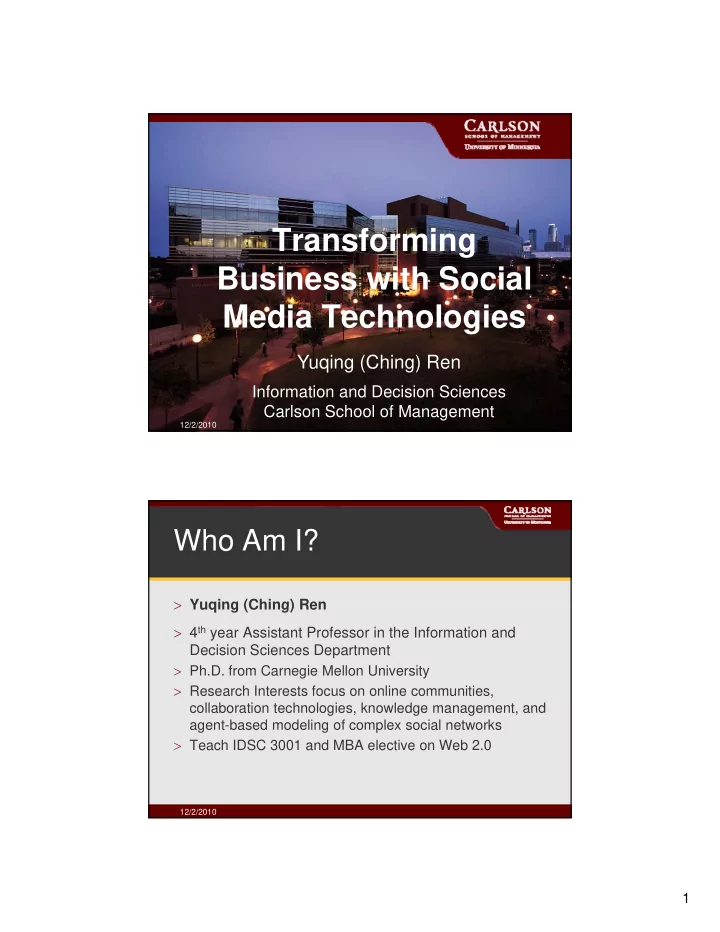
Transforming Business with Social Media Technologies Media - - PDF document

transforming business with social media technologies
SMART_READER_LITE
LIVE PREVIEW

Transforming Business with Social Media Technologies Media - - PDF document

Transforming Business with Social Media Technologies Media Technologies Yuqing (Ching) Ren Information and Decision Sciences Carlson School of Management 12/2/2010 Who Am I? > Yuqing (Ching) Ren > Yuqing (Ching) Ren > 4 th year


slide-1
SLIDE 1

1

Transforming Business with Social Media Technologies

12/2/2010

Media Technologies

Yuqing (Ching) Ren

Information and Decision Sciences Carlson School of Management

Who Am I?

> Yuqing (Ching) Ren > Yuqing (Ching) Ren > 4th year Assistant Professor in the Information and Decision Sciences Department > Ph.D. from Carnegie Mellon University > Research Interests focus on online communities, collaboration technologies, knowledge management, and

12/2/2010

collaboration technologies, knowledge management, and agent-based modeling of complex social networks > Teach IDSC 3001 and MBA elective on Web 2.0

slide-2
SLIDE 2

2

Agenda

> Engaging consumers and employees > Engaging consumers and employees > MovieLens Community research > Open innovation and crowdsourcing > Amazon Mechanical Turk research > Open source and peer production

12/2/2010

> Open source and peer production > Wikipedia research

Read This Book!

> Wikinomics: How Mass Collaboration Changes Everything, by Don Tapscott and Anthony D. Williams

12/2/2010 4

slide-3
SLIDE 3

3

Why Web 2.0?

> Facebook has 500 million users with 70% outside of US users with 70% outside of US > Wikipedia has 3 million+ articles in English, all created by volunteers > Apache Web Server, an Open Source Software project, is the infrastructure for ~50% of all websites M i l M l i l O li

12/2/2010 5

> Massively Multiplayer Online Games were a $1 billion market in North America & Europe in 2006 > Dell, IBM, and NASA creating spaces in Second Life

Web 1.0 to Web 2.0

W b 1 0 W b 2 0 > Web 1.0

> Static > Publishing > Non user enhanced

> Web 2.0

> Dynamic > Collaborating > User generated

12/2/2010 6

The old Web is about sites, clicks, and eyeballs The new web is about communities, participation, and peering

slide-4
SLIDE 4

4

Web 1.0 versus Web 2.0

12/2/2010 7

Web 2.0 as a Platform

> According to Tim O'Reilly Web 2 0 is the > According to Tim O Reilly, Web 2.0 is the business revolution caused by the move to the Internet as platform, and the key to success is users add value and building databases that get better the more people use it

12/2/2010

slide-5
SLIDE 5

5

Key Tools of Web 2.0

> Blogs - An online journal that keeps a g j p running chronology of entries. > Wikis - A website that anyone can edit directly from within the browser > Social Networks - Online community that allows users to establish a personal profile and communicate with others > Other Tools (RSS, Folksonomies, Mashups,

12/2/2010

> Other Tools (RSS, Folksonomies, Mashups, Virtual Worlds, Rich Media, Twitter/microblogging)

Wikinomics: The Art and Science of Peer Production

> Wikinomics, the new model of innovation and value , creation called "peer production" or peering, describes what happens when masses of people and firms collaborate openly to drive innovation and growth in their industries

12/2/2010 10

slide-6
SLIDE 6

6

The Four Principles

  • f The New Web

>Openness >Openness >Peering >Sharing

12/2/2010 11

>Acting globally

NBA on Social Media

> Among professional leagues, N.B.A. has the most f F b k (5 3 illi ) th t f ll fans on Facebook (5.3 million), the most followers

  • n Twitter (2.1 million) and the most viewed videos
  • n YouTube (438 million).

> All 30 teams have a presence on Facebook and

  • Twitter. Nearly 200 players — more than 40 percent

f th l h T itt t

12/2/2010

  • f the league — have Twitter accounts.

> Besides workouts and lunch, players also express sentiments: “Loosing people eryday, enjoy ya life n i know its hard but try n do so wit no regrets!”

slide-7
SLIDE 7

7

Coca-Cola Social Media

> To build “brand love” and “brand value” > Feeds on Twitter > Video on YouTube ($100K)

  • Happiness machine on campus

> Expedition206.com

  • Three 20-sth to 206 countries

12/2/2010

  • Blog on Twitter and Flickr

Engaging Consumers as Prosumers

12/2/2010

slide-8
SLIDE 8

8

A New Model of Prosumption

> Customers do more than customize or > Customers do more than customize or personalize their wares; they can self-organize to create their own designs or ads. > It makes big impacts with fewer resources > It innovates more rapidly and engages stakeholders in loyal communities

12/2/2010

stakeholders in loyal communities > It benefits from positive feedback loops that are difficult for competitors to reverse

15 12/2/2010 16

slide-9
SLIDE 9

9

The Twister Bot

12/2/2010 17

http://mindstorms.lego.com/MeetMDP/RobT.aspx

Change of Marketing Funnel

> Purchase of customers are > Purchase of customers are not the end of marketing, but only half-done. From that point, firm needs to support and empower customers to make them

12/2/2010

happy, because this can lead to even bigger sales.

18

slide-10
SLIDE 10

10

Mass Connectors

> Mass influencers who issue their influence through massive social networks. These people often use Twitter or Facebook as channel to influence others and are heavily trusted. > 80% impressions from 6.2% or 11 million very connected people with 537 (versus 133 for average people) friends or followers

12/2/2010

average people) friends or followers

19

Mass Mavens

> Mass influencers who issue their influence through bogs, discussion forums, online reviews. These people are extremely productive and are highly likely to cover top several search results of related online search terms. > 1.31 billion post every year from 13.4% or 24 million people (not just blogging but also 60%

12/2/2010

million people (not just blogging but also 60% from discussion forums, ratings, and reviews)

20

slide-11
SLIDE 11

11

Harnessing Prosumer Communities

> More than customization > Losing control > Customer tool kits and context orchestration > Becoming a peer > Sharing the fruits

12/2/2010

> Sharing the fruits

21 12/2/2010 22

slide-12
SLIDE 12

12

12/2/2010 23

Community Growth 02-07

12/2/2010 24

slide-13
SLIDE 13

13

Revenue and Units Sold (02-07)

12/2/2010 25

Partnership and Revenue Sharing

> Design challenges and the Bestee Awards g g > $20,000 for Design of the Year > Thursday hourly awesome giveaway > Street Team Points > Tell friends and get points > Tee Riffic photos and Tee V ($15 per photo used)

12/2/2010

p ($ p p ) > Link to Threadless from other sites ($3 per sale)

26

slide-14
SLIDE 14

14

How to Build a Vibrant Online Community

12/2/2010

Not An Easy Task

> Delloitte ‘s 2008 Tribalization of Business Survey > Delloitte s 2008 Tribalization of Business Survey > A majority of communities have fewer than 500 active members and 50% respondents said biggest obstacle to making communities is to get people engaged > Companies also reported a significant impact from the

  • communities. 35% have seen an increase in word-of-

th f th i b d 28% h th i ll

12/2/2010

mouth for their brands, 28% have seen their overall brand awareness, 24% have seen increase customer loyalty and bringing outsides ideas into the firm.

28

slide-15
SLIDE 15

15

Critical Mass Theory

(Oliber, Marwell, & Teixeira 1985)

> “Snob and bandwagon effects” g > To predict the probability , extent, and effectiveness

  • f group action, you need to consider two variables:

> The shape of the production function > Heterogeneity of resources and interests in the population with interests being the values

12/2/2010

popu at o t te ests be g t e a ues individuals place on the public goods and resources being what individuals must contribute to achieve it

29

Two Bases of Commitment to Groups

(Prentice, Miller, and Lightdale, 1994)

> Group Identity > Group Identity

> Commitment to the group as a whole & what it stands for > Group commitment can be independent of commitment to its members (e.g., National Rifle Association, Sierra Club)

> Interpersonal Bonds

> Commitment to the group through commitment to its members

12/2/2010 30

> Commitment to the group through commitment to its members > Like the group to the extent one knows, likes & feels similar to particular members (e.g., Fraternity, friend circles)

slide-16
SLIDE 16

16

Translating from Theory to Design

Guidelines Identity Based Bond Based Guidelines Identity-Based Commitment Bond-Based Commitment Provide detailed information

  • about a social category
  • emphasizing group

homogeneity

  • highlighting out-group

presence

  • about particular members
  • emphasizing interpersonal

similarity

  • highlight individual

identities Facilitate

  • to the group
  • to individual others

12/2/2010 31

repeated exposure Support communication

  • with one’s entire group
  • with individual others

Research Site: MovieLens.org

> Personalized movie recommendation site > Personalized movie recommendation site > Discussion forums added in June 2005 > New features > Movie groups > Profiles page R t ti it

12/2/2010 32

> Recent activity page > Commenting

slide-17
SLIDE 17

17

Ten Movie Groups

> Ten clusters of users with similar size and level of activities based on cosine similarity between user movie ratings > Animal names such as Tiger, Bear, …

12/2/2010 33

Group Profiles

> Group membership p p > Group name and icon > Group statement > Group homogeneity > Representative movies > High rating movies

12/2/2010 34

g g > Frequently rated movies > Out-group presence > Group rankings

slide-18
SLIDE 18

18

Group Membership

12/2/2010 35

Group Homogeneity

12/2/2010 36

slide-19
SLIDE 19

19

Comparison with Other Groups

12/2/2010 37

Individual Profiles

> Individual information > User ID and picture > Movie group > Personal information > Interpersonal similarity > Similarly rated movies

12/2/2010 38

y > Differently rated movies > Movie predictions

slide-20
SLIDE 20

20

12/2/2010 39

Similar Ratings Different Ratings Predictions

12/2/2010 40

slide-21
SLIDE 21

21

Main Findings

> Theory-inspired designs increased self-report > Theory inspired designs increased self report commitment, visit frequency, and contribution > 11%-100% increase in visit frequency > More features were sometimes (not always) better > Newcomers and old-timers responded differently, d d i

12/2/2010 41

and newcomers were more open and responsive to the new features

Crowdsourcing & Open Innovation

12/2/2010

slide-22
SLIDE 22

22

From R&D to C&D

> Invention model > Open Innovation Model

> Innovating from within by building global research facilities and hiring the best talent > Come from labs > External connections could produce high profitable innovations (50% from outside of the company) > Come through labs

12/2/2010

  • 7,500 researchers

> “Not invented here”

  • 1.5 million talents

> “Proudly found elsewhere”

43

Problems In Search of Solutions

> P&G and its connect and develop initiative > P&G and its connect and develop initiative (from 9K researchers to 1.8 million scientists and engineers) > The Pringles Prints example > The strategy enables P&G to focus on areas where they’re going to be world

12/2/2010 44

areas where they re going to be world class and to source technology in areas where they don’t need to be leading edge

slide-23
SLIDE 23

23

12/2/2010 45

Open Innovation Marketplace

> Solvers: choose a Discipline and search for a p Challenge that you can solve! Submit the winning solution and earn cash awards from $5,000 to $1,000,000. Or visit one of our Pavilions to search for Challenges based on areas of interest. > Seekers: tapping into the solver community can generate more ideas and solutions enabling Seekers

12/2/2010

generate more ideas and solutions, enabling Seekers to produce breakthrough products, accelerate their development cycles and stay ahead of the competition through innovation and faster time to market.

slide-24
SLIDE 24

24

Challenge Disciplines

> Business and Entrepreneurship C t S i d I f ti T h l > Computer Science and Information Technology > Mathematics and Statistics > Engineering and Design > Physical Sciences > Food/Agriculture > Life Sciences

12/2/2010

> Chemistry

Pavilions

> SAP > NASA > Nature > Developing Countries > Clean Tech > Global Health

12/2/2010

> Public Good > Emergency Response

slide-25
SLIDE 25

25

Four Challenges Types

> The Big Idea: the Ideation Challenge g g

> Brainstorm new idea (reward guaranteed)

> The Design: Theoretical Challenges

> A detailed description of a solution (get a reward or technical evaluation of the solution)

> The Proof: Reduction to Practice Challenges

> A description of solution together with physical evidence

12/2/2010

p g p y that it is the best solution

> The Final Product: eRFP Challenges

> To submit proposal of how one’s skills and experiences fit what seeks want (terms negotiated)

Chemistry Examples

> A process to improve the stability of > A process to improve the stability of viscous whipped food products is needed (50K) > A technology is desired that produces a pleasant scent upon stretching of an elastomer film (50K)

12/2/2010

( ) > An adhesive suitable for high temperature bonding is desired (30K)

slide-26
SLIDE 26

26

Engineering Examples

> A material is needed to replace > A material is needed to replace aluminum that has similar thermal properties (15K) > Novel anti-fingerprint coating material is desired (50K) > The Seeker wants to identify the origin

12/2/2010

> The Seeker wants to identify the origin

  • f unpleasant flavor of a food product

and to find ways to eliminate it (50K)

One More …

> A challenge seeking the design of an affordable solar- g g g powered device to prevent or limit the spread of malaria had been solved. The Challenge was posted by Mark Bent, CEO of SunNight Solar. > Mark’s interest in eradicating malaria comes from his

  • wn personal experience, and from his ongoing desire

to help the world’s most vulnerable populations.

12/2/2010

p p p > I asked Mark to provide some thoughts on the background of this Challenge, which he has kindly done in the post below. Next week we’ll hear from the Solver

  • f this Challenge, Tom Kruer.
slide-27
SLIDE 27

27

Seekers

> Confidentiality and Convenience. Become an y InnoCentive Seeker to reach out to thousands of Solvers. It's easy and secure. Seeker and Solver identities are kept completely confidential, and InnoCentive manages the entire intellectual property (IP) transfer process. > Pay for Results -- Not Trial and Error. As a Seeker

  • rganization you'll present your toughest problems in

12/2/2010

  • rganization, you'll present your toughest problems in

InnoCentive's Open Innovation Marketplace . Each Challenge is associated with a financial incentive, and payment is only made to the Solver who provides the solution that you select as the best for your requirements.

Solvers

> In order to ensure security for both the Solver and Seeker, we d l l d t t i f ti Pl t need your legal name and contact information. Please enter a valid e-mail address. You will need to confirm your e-mail address to activate your account. > You agree that your registration information at all times correctly represents your professional affiliation, experience, qualifications and ability to transact business. > If you submit a Proposed Solution in response to an

12/2/2010

> If you submit a Proposed Solution in response to an InnoCentive Challenge Statement, you agree that you are the

  • wner of the submitted Proposed Solution and that you are

legally free to make the disclosure and to convey the intellectual property rights being offered to the Seeker.

slide-28
SLIDE 28

28

Harnessing Open Innovation

> Creating liquidity > Creating liquidity

> too few buyers and sellers

> Instilling the culture

> CEO level leadership and a commitment to appropriate staffing, incentives, etc.

> Harvesting external ideas

12/2/2010 55

> Harvesting external ideas

> Getting the right ratio > Pushing the envelope

Organizational Learning

(James March 1993)

> Exploration includes search variation risk > Exploration includes search, variation, risk taking, experimentation, play, flexibility, discovery, innovation > Exploitation includes refinement, choice, production, efficiency, selection, implementation, execution

12/2/2010 56

> Maintaining an appropriate balance between exploration and exploitation is a primary factor in system survival and prosperity.

slide-29
SLIDE 29

29

Adaptation on Rugged Landscape (Levinthal 1997)

> Local Search > Global Search > Tightly coupled

  • rganizations can not

engage in exploration without forgoing the

12/2/2010 57

without forgoing the benefits of exploitation.

The Coase’s Law

> Coase (1937) The Nature of Firm > Coase (1937) The Nature of Firm

> Search costs of finding suppliers > Contracting costs of negotiating prices > Coordination costs of meshing products / processes > … the Internet has caused transactions to plunge so steeply that it has become more useful to read

12/2/2010

p y Coase’s Law, in effect, backward: shrink firm boundaries until the costs of performing internally no longer exceeds the cost of performing it externally.

slide-30
SLIDE 30

30

Other Platforms

12/2/2010

Crowdsourcing

> The act of taking a job traditionally performed by a designated agent (usually an employee) and outsourcing it to an undefined, generally large group of people in the form of an open call > InnoCentive.com (seeker & solver) > Threadless.com (t-shirt design contests) > Amazon Mechanical Turk (requester & worker)

12/2/2010

> Amazon Mechanical Turk (requester & worker) > Facebook translation and Netflix 1M Prize

slide-31
SLIDE 31

31

Amazon Mechanical Turk

12/2/2010

Online Marketplaces for Work

12/2/2010

slide-32
SLIDE 32

32

Quality Issues in AMT

> Human Intelligence Tasks (HITs) are often trivial g ( ) > Little control over a large number of tasks > Low payment does not motivate people > “I've tried now posting the same job three times - with more instructions each time - and yet the people completing the job aren't doing it right. […] Any ideas h t t b tt d t ?”

12/2/2010

  • n how to get better data accuracy?”

Task Significance in Job Design

> “One’s job has a positive impact on other j p p people” > Alumni caller raised more money after reading stories about how funding had helped students (Grant, 2008) > Life guards who read stories on people who were saved indicated more job dedication

12/2/2010

were saved indicated more job dedication (Grant, 2008) > Interpersonal contact with beneficiaries can improve performance (Grant et al., 2007)

slide-33
SLIDE 33

33

Research Questions

> Q1: Does task significance matter in online > Q1: Does task significance matter in online marketplaces for work? In other words, can we influence work quantity or quality by informing them how their work will benefit others? > Q2: How does the effect of task significance compare to alternative ways of task and incentive task such as task size and monetary rewards?

12/2/2010

task size and monetary rewards?

Laboratory Experiment

> Between-subject and 8 conditions j > Presence and absence of task significance > One paragraph vs. three paragraphs > 20 cents vs. 30 cents per paragraph > 163 participants randomly assigned to a condition > Training task before 30 minutes of work

12/2/2010

g > 10 minutes Post-Questionnaire

slide-34
SLIDE 34

34

Spell Checking Task

> Paragraphs taken from Wikipedia g p p > Business, Music and Sports > Inserted 3-7 spelling errors per paragraph

In spite of popular belief, actuaries do not always "atempt" to predict aggregate future events. Often "there" work may relate to determining the cost of financial liabilities that have already "ocurred", called retrospective reinsurance, or the development or re-pricing of new products. Actuaries

12/2/2010

also design and maintain products and systems. They are involved in "financal" reporting of companies’ assets and liabilities. They must communicate complex concepts to clients who may not share their language or depth of knowledge. Actuaries work under a strict code of ethics that covers their communications and work products, but their clients may not adhere to those same standards when "enterpreting" the data or using it within different kinds of businesses.

Task Interface

“These paragraphs come from articles on Wikipedia, a free

  • nline encyclopedia that anyone can edit. Wikipedia was

launched in 2001 and is currently the largest and most popular general reference on the Internet. It hosts more than 3 million articles in English and is ranked as the 6th most visited website in the world. Despite its success, Wikipedia has received many

12/2/2010

p p y criticisms about the reliability and accuracy of its articles. By fixing typographical and spelling errors in these paragraphs, you will help improve the quality of these articles. Many Internet users who read and refer to these articles will benefit from your work.”

slide-35
SLIDE 35

35

Summary of Results

Means and Standard Deviations of Manipulation Conditions

Number of Paragraphs Task Accuracy Condition Low High Low High Task Significance 13.82 (4.41) 14.02 (5.89) 0.65* (0.15) 0.60* (0.20) Task Size 12 42* 15 40* 0 63 0 61

12/2/2010

Task Size 12.42 (4.02) 15.40 (5.76) 0.63 (0.18) 0.61 (0.17) Monetary Payment 13.66 (4.75) 14.17 (5.58) 0.62 (0.19) 0.62 (0.16)

Task Significance Works… Only If People Notice It

12/2/2010

Effects of Task Significance on Task Performance

slide-36
SLIDE 36

36

Open Source & Peer Production

12/2/2010

Peer Production

> A new way of producing goods > A new way of producing goods and services that harnesses the power of mass collaboration > A way of producing goods and services that relies entirely on self-organizing, egalitarian

12/2/2010

self organizing, egalitarian communities of individuals who come together voluntarily to produce a shared outcome

slide-37
SLIDE 37

37

Open Source

> A set of principles and practices on > A set of principles and practices on how to write software, the most important of which is that the source code is openly available

> The software can be freely given away or sold > The source code must either be included or freely

12/2/2010

y

  • btainable

> Redistribution of modifications must be allowed

Nobody owns it, Everybody uses it, Anyone can improve it

Open Source History

> GNU project in 1983 p j > Free Software Foundation in 1985 > Linux kernel released in 1991

12/2/2010

Richard Stallman Linux Torvalds

slide-38
SLIDE 38

38

What Motivates People To Freely Contribute

> A better product > A better product > Fun and altruism. People love it. They feel passionate

about their area of expertise and revel in creating something new or better

> Experience, exposure, and connections. Good

people earn status within the community that could be valuable in their careers

12/2/2010 75

valuable in their careers

> They do get paid, well, some of them do. IBM and

Intel are two largest contributors to Linux in terms of manpower

Intrinsic vs. Extrinsic Motivation

> Intrinsic motivation occurs when ti it ti fi b i h an activity satisfies basic human needs for competence, control, and

  • autonomy. It makes the activity

interesting and likely to be performed for its own sake rather than as a means to an end (Deci and Ryan 2000).

12/2/2010

y ) > Extrinsic motivation stems from the environment external to the task and is usually applied by someone other than the person being motivated (Johns 1996).

slide-39
SLIDE 39

39

How Peer Production Work

> Leadership. The most skilled and experienced

members provide leadership and help integrate contributions from the community.

> Division of Labor. Peering taps into voluntary

motivations and self selection in a way that helps assign the right person to the right task.

> Intellectual Property Right Communities of

12/2/2010

> Intellectual Property Right. Communities of

producers use “general public licenses” to guarantee users the right to share and modify creative works provided that any modifications are shared with the community.

Other Platforms and Money

12/2/2010

slide-40
SLIDE 40

40

Wikipedia Project

12/2/2010

The Power of Organizing without Organizations

> A book about "what > A book about what happens when people are given the tools to do things together, without needing traditional

12/2/2010

needing traditional

  • rganizational

structures.”

80

slide-41
SLIDE 41

41

Wisdom of Crowds

> Large groups of people are g g p p p smarter than an elite few, no matter how brilliant, better at solving problems, fostering innovation, making decisions, and predicting the future > Poll the audience

12/2/2010

> Poll the audience > Prediction markets > Wikipedia articles

Diversity Paradox

> There is an interesting paradox in online > There is an interesting paradox in online self-organizing groups like Wikipedia and

  • pen source software projects

> Diversity in background, expertise, and perspectives is one of the four conditions that are essential to harness the “wisdom of crowd”

12/2/2010

essential to harness the wisdom of crowd > Different background and perspectives may lead to conflict, low group cohesion, and high turnover

slide-42
SLIDE 42

42

Research Questions

> How does (tenure and interest) diversity affect > How does (tenure and interest) diversity affect group productivity and member withdrawal in

  • nline self-organizing groups?

> How are the effects of diversity similar or different in the online groups and why? H d iti h di it

12/2/2010

> How does group composition such as diversity evolve in online self-organizing groups?

83

Wikipedia: the Free Encyclopedia

12/2/2010

slide-43
SLIDE 43

43

12/2/2010

Research Setting

12/2/2010

slide-44
SLIDE 44

44

12/2/2010 12/2/2010

slide-45
SLIDE 45

45

WikiProjects 2002-2007

1400 25000 200 400 600 800 1000 1200

# Projects

5000 10000 15000 20000

# Editors

Our analysis starts here

12/2/2010

200 Jan 02 Jul 02 Jan 03 Jul 03 Jan 04 Jul 04 Jan 05 Jul 05 Jan 06 Jul 06 Jan 07 Jul 07

Time Total number of projects Editors who have joined projects

Sample WikiProjects

> January 2008 dump of English Wikipedia > January 2008 dump of English Wikipedia (text of all articles and talk pages, including their complete edit history)

> 648 projects created after July 2004 > 3619 project quarters

12/2/2010

slide-46
SLIDE 46

46

Effects of Tenure Disparity

12/2/2010

Effects of Interest Variety

12/2/2010

slide-47
SLIDE 47

47

Evolution of Tenure Disparity

12/2/2010 93

Evolution of Interest Variety

12/2/2010 94

slide-48
SLIDE 48

48

Summary of Findings

> Curvilinear effects of tenure diversity > Curvilinear effects of tenure diversity > Overly positive effects of interest diversity > Evolution of diversity toward “optimal levels” > Self-organizing in online group allows us to harness the wisdom of a diverse crowd while

12/2/2010

harness the wisdom of a diverse crowd while suffering less of the negative consequences

Peer Production in the Workplace

> Self organized approach to teaming > Time allocation > Decision making > Resource allocation

12/2/2010

> Corporate communication

96

slide-49
SLIDE 49

49

Impact of Wiki on Hierarchy

> We are shifting from closed and > We are shifting from closed and hierarchical workplaces with rigid employment relationships to increasingly self-organized, distributed, and collaborative human capital networks that d k l d d f

12/2/2010

draw knowledge and resources from inside and outside the firm.

97

Impact of Wiki on Communication

> Management innovation like the Retail > Management innovation like the Retail Leadership Forum change the rules with respect to whom people talk to, how they talk to each other, and what they talk about. In most workplaces talking to your boss's boss is a no-no. Disrespecting the established

12/2/2010

p g channels of authority might even get you fired.

98

slide-50
SLIDE 50

50

What is Changing?

> Work has become more cognitively complex, more g y p , team-based and collaborative, more dependent on social skills, more time pressured, more reliant on technological competence, more mobile, and less dependent on geography. > The N-Gen’s norms reflect a desire for creativity, social connectivity fun freedom speed and

12/2/2010

social connectivity, fun, freedom, speed, and diversity in workplace whereas previous generations value loyalty, seniority, security, and authority.

99

Best Buy’s Twelpforce

> Supporting the brand promises with the knowledge of 150 000 * Know all that we know * 150,000 Know all that we know

12/2/2010

slide-51
SLIDE 51

51

TagTrade

I 2006 d ith th CEO’ t $50 000 > In 2006, armed with the CEO’s support, a $50,000 budget, and some volunteers, Jeff Severts started experimenting a prediction market. > TagTrade is open to Best Buy’s 115K US

  • employees. About 2,100 choose to participate with

$1M fake money The top trader wins a $200 gift

12/2/2010

$1M fake money. The top trader wins a $200 gift certificate.

101

Tag Trade Video

12/2/2010

slide-52
SLIDE 52

52

IBM Use of Social Media

> Three principles to harvest the value p p > Grassroots passion: make it easier for people to connect with those with similar interests > Self-serve co-generation: promote self-serve ability by making it easier to add and share information > Planned serendipity: to ensure that people, data, d li ti i l t d th t d

12/2/2010

and applications are circulated so that under- explored expertise and relationships will surface

103

Three Applications at IBM

> ThinkPlace an open forums for employee innovation > ThinkPlace an open forums for employee innovation

> Suggest ideas, comment, rate, sort, prototype, implement > 160K users and 18K ideas (350 adopted to 500 million)

> SmallBlue to visualize and leverage social networks > “find” to search for people with desired knowledge > “net” to visualize community around a topic

12/2/2010

> “reach” to validate a person’s expertise > “ego” to visualize one’s personal network > Beehive for social networking and relationship building

104

slide-53
SLIDE 53

53

Thank You. Questions?

Yuqing Ren, Ph.D. Assistant Professor Carlson School of Management University of Minnesota

12/2/2010

chingren@umn.edu 612-625-5242 @yuqingren