
SLIDE 1
Transformative High Resolution Cryo-Electron Microscopy Jon Lorsch, - - PowerPoint PPT Presentation
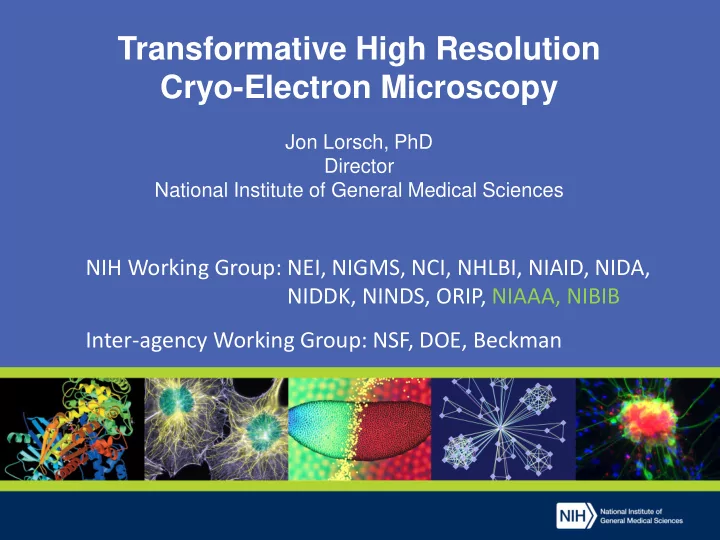
Transformative High Resolution Cryo-Electron Microscopy Jon Lorsch, PhD Director National Institute of General Medical Sciences NIH Working Group: NEI, NIGMS, NCI, NHLBI, NIAID, NIDA, NIDDK, NINDS, ORIP, NIAAA, NIBIB Inter-agency Working
Co-Chairs Jon Lorsch (NIGMS) Cathy Lewis and Susan Gregurick Paul Sieving (NEI) Belinda Seto Working Group Coordinators: Mary Ann Wu (NIGMS) Jim Deatherage (NIGMS) Houmam Araj (NEI) OSC Ravi Basavappa Becky Miller Ellie Murcia IC Members Dan Gallahan (NCI) John (Randy) Knowlton (NCI) Alison Yao (NIAID) Rao Rapaka (NIDA) Salvatore Sechi (NIDDK) Paula Flicker (NIGMS) Denis Buxton (NHLBI) Manjit Hanspal (NHLBI) Jue Chen (NHLBI) James Luo (NHLBI) Margaret Sutherland (NINDS) Malgorzata Klosek (ORIP)
TRPV1 Ion Channel: Mediates burn sensation, Yifan Cheng UCSF
Rotavirus Particles Niko Grigorieff, Janelia Farms
Initial Investment, 1-2 CryoEM microscopes, local facility Significant Investment, 3-4 CryoEM microscopes, regional facility Major Investment, 5+ CryoEM microscopes, HTP comprehensive facility Planned investment
Notice Number: NOT-RM-16-022
Release Date: June 24, 2016 Response Date: August 8, 2016
Need and Capacity
for National Centers for automated high- resolution cryoEM data collection for SPA
resources also needed
Training and Workforce
required for success
Structural biologists Neophyte biologists
Centers essential
materials at home Technology Development
sections of cells
instrumentation
subtomogram averaging
storage needs
, 46 responses
Misasi et al. (2016) Science 351: 1343
Sirohi et al. (2016) Science 352: 467,
Verba, K.A. et al. (2016) Science, 352:1542
Glutamate dehydrogenase (1.8A) Merk et al. Cell 165, 1698, 2016
Comprehensive Centers (3)
Year 1 Year 2 Year 3 Year 4 Year 5
Total Equipment (4 microscopes/center)
$22M $22M $22M
$66M Operations
$4M $6.4M $10.5M $10.5M $10.5M
$41.9M User Training & Service
(4 FTEs/center)
$0.6M $1.2M $2.5M $2.5M $2.5M
$9.3M
$26.6M $29.6M $35M $13M $13M
$117.2M
Research Grants (R21,R01)
TC Yearly
Total Cryoelectron Tomography R&D
$3M
$15M
Single Particle R&D
$2.4M
$12M
$5.4M
$27M All Activities
Year 1 Year 2 Year 3 Year 4 Year 5
Total
$32M $35M $40.4M $18.4M $18.4M
$144.2M