
SLIDE 1
e x p o n e n t i a l a n d l o g a r i t h m i c f u n c t i o n s
MHF4U: Advanced Functions
Transformations of Logarithmic Functions
- J. Garvin
Slide 1/13
e x p o n e n t i a l a n d l o g a r i t h m i c f u n c t i o n s
Transformations of Logarithmic Functions
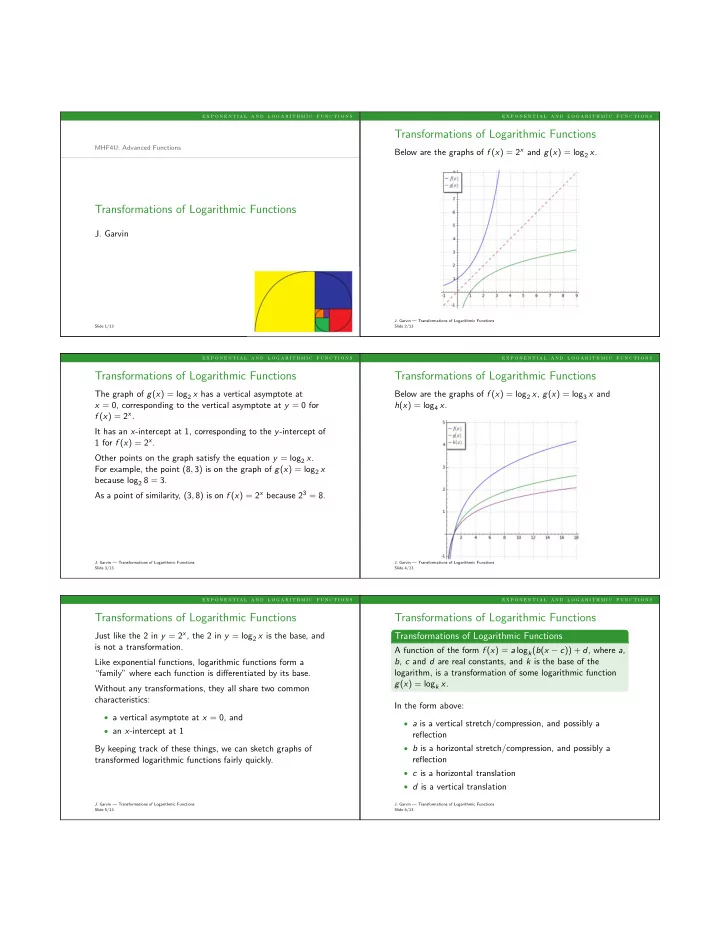
Below are the graphs of f (x) = 2x and g(x) = log2 x.
- J. Garvin — Transformations of Logarithmic Functions
Slide 2/13
e x p o n e n t i a l a n d l o g a r i t h m i c f u n c t i o n s
Transformations of Logarithmic Functions
The graph of g(x) = log2 x has a vertical asymptote at x = 0, corresponding to the vertical asymptote at y = 0 for f (x) = 2x. It has an x-intercept at 1, corresponding to the y-intercept of 1 for f (x) = 2x. Other points on the graph satisfy the equation y = log2 x. For example, the point (8, 3) is on the graph of g(x) = log2 x because log2 8 = 3. As a point of similarity, (3, 8) is on f (x) = 2x because 23 = 8.
- J. Garvin — Transformations of Logarithmic Functions
Slide 3/13
e x p o n e n t i a l a n d l o g a r i t h m i c f u n c t i o n s
Transformations of Logarithmic Functions
Below are the graphs of f (x) = log2 x, g(x) = log3 x and h(x) = log4 x.
- J. Garvin — Transformations of Logarithmic Functions
Slide 4/13
e x p o n e n t i a l a n d l o g a r i t h m i c f u n c t i o n s
Transformations of Logarithmic Functions
Just like the 2 in y = 2x, the 2 in y = log2 x is the base, and is not a transformation. Like exponential functions, logarithmic functions form a “family” where each function is differentiated by its base. Without any transformations, they all share two common characteristics:
- a vertical asymptote at x = 0, and
- an x-intercept at 1
By keeping track of these things, we can sketch graphs of transformed logarithmic functions fairly quickly.
- J. Garvin — Transformations of Logarithmic Functions
Slide 5/13
e x p o n e n t i a l a n d l o g a r i t h m i c f u n c t i o n s
Transformations of Logarithmic Functions
Transformations of Logarithmic Functions
A function of the form f (x) = a logk(b(x − c)) + d, where a, b, c and d are real constants, and k is the base of the logarithm, is a transformation of some logarithmic function g(x) = logk x. In the form above:
- a is a vertical stretch/compression, and possibly a
reflection
- b is a horizontal stretch/compression, and possibly a
reflection
- c is a horizontal translation
- d is a vertical translation
- J. Garvin — Transformations of Logarithmic Functions
Slide 6/13