TRANSBOUNDARY RELATIONSHIP BETWEEN BOTSWANA AND SOUTH AFRICA OVER - - PowerPoint PPT Presentation

transboundary relationship
SMART_READER_LITE
LIVE PREVIEW

TRANSBOUNDARY RELATIONSHIP BETWEEN BOTSWANA AND SOUTH AFRICA OVER - - PowerPoint PPT Presentation

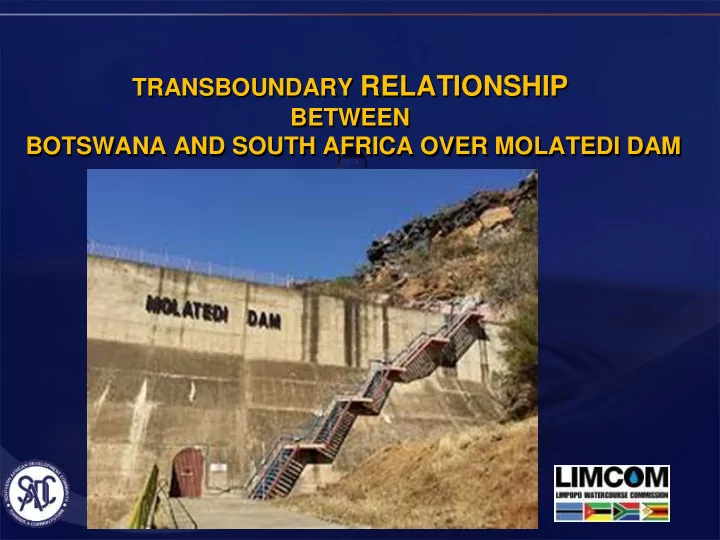
TRANSBOUNDARY RELATIONSHIP BETWEEN BOTSWANA AND SOUTH AFRICA OVER MOLATEDI DAM Location Brief Facts on the Molatedi Dam Catchment Area - 8787 km2 Surface Area - 3600 ha (full supply level) Impounds - Marico river Total


slide-1
SLIDE 1

TRANSBOUNDARY RELATIONSHIP BETWEEN BOTSWANA AND SOUTH AFRICA OVER MOLATEDI DAM

slide-2
SLIDE 2

Location

slide-3
SLIDE 3

Brief Facts on the Molatedi Dam

  • Catchment Area - 8787 km2
  • Surface Area
  • 3600 ha (full supply level)
  • Impounds
  • Marico river
  • Total Capacity
  • 203 000 000 cubic meters
  • Height
  • 29 m
  • Earth Fill dam
slide-4
SLIDE 4

History

  • 1. The

Dam was built as part

  • f

a collaborative effort between;

  • Department
  • f

Water Affairs

  • f

the then Bophuthatswana

  • Department of water Affairs of the Republic of South

Africa

  • Water Utilities Corporation of Botswana
slide-5
SLIDE 5

History The Dam was built as an effort to optimally utilise the water resources of the Marico River which borders RSA and Botswana The river flows in an easterly direction for approximately 253 km before joining the Crocodile River to form Limpopo River

slide-6
SLIDE 6

Applicable Legal Framework

  • 1. Three parties entered into an agreement for the

construction,

  • peration,

maintenance and supply of water – TSWASA Agreement 1998

  • 2. Agreement revised in 2014 as a result of;
  • Incorporation of Bophuthatswana into RSA
  • Revised

SADC Protocol

  • n

Shared Water courses (August 2000)

  • Establishment of Joint Permanent Technical

Committee between RSA and Botswana

slide-7
SLIDE 7

Revised Protocol on Shared Watercourses in SADC which makes provision for the coordinated management, protection and utilisation of shared water resources within the region 2008 Agreement between RSA and Botswana

  • n Water Supply Across the Border

facilitating authorised water supply across the two counties (incl local authorities and individuals) Limpopo River Basin Agreement establishing LIMCOM

slide-8
SLIDE 8

Challenges Associated With The Dam

  • 1. Institutional Reforms
  • 2. Climate Change leading to changes in yields

and consequently allocations

slide-9
SLIDE 9

Challenges Associated With The Dam

Current allocations done after a study on the hydrology, with Botswana not really being involved in the study leading to protracted negotiations on the allocations. Gaps still remain.

  • 3. Scarcity of resources and increasing water

demand as well as conflicting interests in the resource (domestic vs commercial use)

  • 4. Power supply challenges being faced by RSA
slide-10
SLIDE 10

Opportunities

Scheme gives an example of cooperation between the two states over a strategic resource and gives encouragement that it is possible to cooperate for the benefit of both states. Diversification of economic activities (dam amenties)

slide-11
SLIDE 11

Challenges in implementing existing legal framework/ Lessons Learnt

  • 1. The Revised TSWASA agreement was drafted

without due cognisance to existing legal frameworks that govern shared watercourses. 2. During negotiations, too much emphasis on the technical aspects

  • n

not

  • n

the environmental and social aspects.

  • 3. Dispute resolution clauses being ineffective.
  • 4. The agreement makes NO provision should the

dam completely dry up

slide-12
SLIDE 12

Challenges in implementing existing legal framework

  • 5. The

agreement does NOT provide for the “Buying out” of water allocations

  • 6. The Agreement is silent on periodic revision

and monitoring (revised

  • nly

if the yields should change)

slide-13
SLIDE 13

CONCLUSION

  • Need to revise the agreement, having applied
  • ur minds to the various governance

documents that exist and ensure proper alignment.

  • Not doing so, shall lead to disputes which we

are already seeing signs of.

  • “When the well’s dry, we know the worth of

water” per Benjamin Franklin

  • THANK YOU
slide-14
SLIDE 14