TRAMS Wa lking diffic ulty is the mo st c o mmo n physic a l - - PDF document

trams
SMART_READER_LITE
LIVE PREVIEW

TRAMS Wa lking diffic ulty is the mo st c o mmo n physic a l - - PDF document

6/18/2015 Trekking Poles to Aid Multiple Sclerosis (TRAMS): A Comparison of Psychosocial Impact and Function with Walking Assistive Devices in Persons with Multiple Sclerosis Do na ld A. Ba ro ne , DO E va n T . Co he n, PT , MA, PhD, NCS Sa


slide-1
SLIDE 1

6/18/2015 1

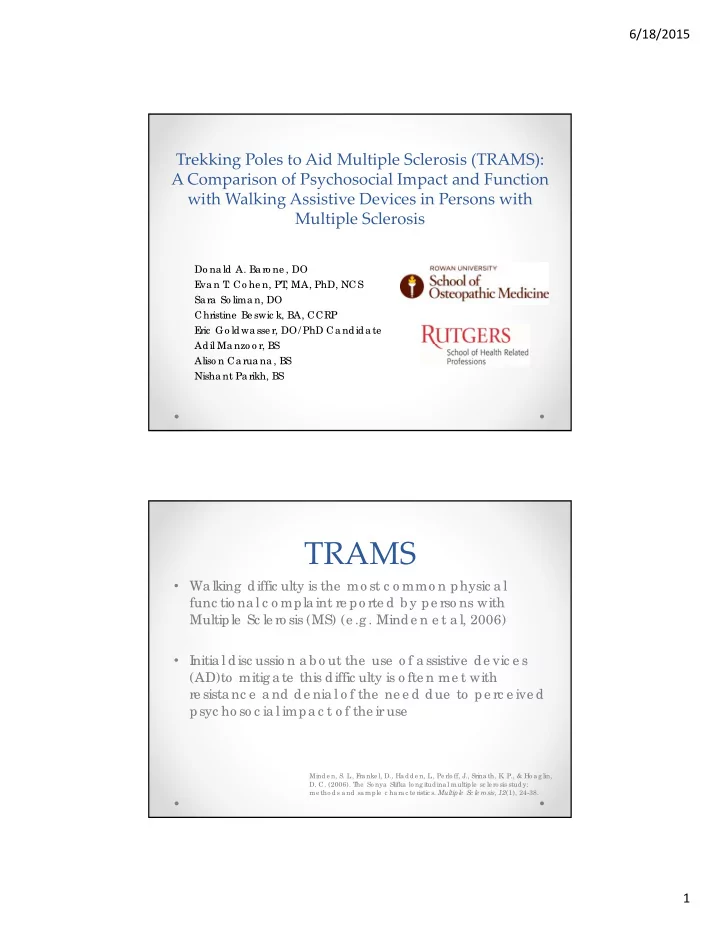
Trekking Poles to Aid Multiple Sclerosis (TRAMS): A Comparison of Psychosocial Impact and Function with Walking Assistive Devices in Persons with Multiple Sclerosis

Do na ld A. Ba ro ne , DO E va n T . Co he n, PT , MA, PhD, NCS Sa ra So lima n, DO Christine Be swic k, BA, CCRP E ric Go ldwa sse r, DO/ PhD Ca ndida te Adil Ma nzo o r, BS Aliso n Ca rua na , BS Nisha nt Pa rikh, BS

TRAMS

  • Wa lking diffic ulty is the mo st c o mmo n physic a l

func tio na l c o mpla int re po rte d b y pe rso ns with Multiple Sc le ro sis (MS) (e .g . Minde n e t a l, 2006)

  • I

nitia l disc ussio n a b o ut the use o f a ssistive de vic e s (AD)to mitig a te this diffic ulty is o fte n me t with re sista nc e a nd de nia l o f the ne e d due to pe rc e ive d psyc ho so c ia l impa c t o f the ir use

Minde n, S. L ., F ra nke l, D., Ha dde n, L ., Pe rlo ff, J., Srina th, K . P., & Ho a g lin,

  • D. C. (2006). T

he So nya Slifka lo ng itudina l multiple sc le ro sis study: me tho ds a nd sa mple c ha ra c te ristic s. Multiple S c le ro sis, 12(1), 24-38.

slide-2
SLIDE 2

6/18/2015 2

TRAMS

Ob je c tive : T

  • c o mpa re the

psyc ho so c ia l impa c t o f, a nd wa lking func tio n with, 3 AD in pe rso ns with MS:

  • Sing le po int c a ne (SPC)
  • Na rro w-b a se d fo ur po int

c a ne (F PC)

  • T

re kking po le (T P)

TRAMS

  • I

nitia l sub je c t re c ruitme nt ta rg e te d pa tie nts fro m o ur MS c linic with c o nfirme d MS dia g no sis b y Mc Do na ld c rite ria (2010) a nd pe rc e ive d wa lking diffic ulty no t re q uiring mo re tha n unila te ra l suppo rt

slide-3
SLIDE 3

6/18/2015 3

TRAMS

  • At the study sc re e ning visit, E

DSS e va lua tio n wa s pe rfo rme d a nd pa tie nts with E DSS sc o re s up to a nd inc luding 6.0 we re e lig ib le fo r inc lusio n

Study Variables

  • Six-Minute Wa lk T

e st (6WMT ) dista nc e

  • Psyc ho so c ia l I

mpa c t o f Assistive De vic e s Sc a le (PI ADS)

  • 26-ite m q ue stio nna ire
  • “Ho w is yo ur _______ a ffe c te d b y using the ________”
  • 12-ite m Multiple Sc le ro sis Wa lking Sc a le (MSWS-12)
  • Ac tivity-Spe c ific Ba la nc e Co nfide nc e Sc a le (ABC)
  • 5-I

te m Mo difie d F a tig ue I mpa c t Sc a le (MF I S-5)

  • Visua l Ana lo g Sc a le o f F

a tig ue (VASF )

slide-4
SLIDE 4

6/18/2015 4

Methods – Study Design

Assessed for eligibility (n=19) Excluded (n=3)

► Not meeting inclusion criteria (n=3) ► Declined to participate (n=0) ► Other reasons (n=0)

Analysed (n=14)

► Excluded from analysis (n=0)

Allocated to group (n=16)

► Received allocated intervention (n=14) ► Did not receive allocated intervention (n=2)

  • 1 unrelated injury
  • 1 unable to safely use all ADs

Allocation Analysis

Randomized to AD order group (n=16): SPC>FPC>TP; SPC>TP>FPC; FPC>SPC>TP; FPR>TP>SPC; TP>SPC>FPC; TP>FPC>SPC

Enrollment

Method: Analyses

  • Within-sub je c t diffe re nc e s b e twe e n AD

c o nditio ns we re a na lyze d fo r e a c h study va ria b le

  • Da ta wa s a na lyze d with re pe a te d-me a sure s ANOVAs o r

F rie dma n’ s te sts (a s a ppro pria te ) with pla nne d pa irwise c o mpa riso ns

slide-5
SLIDE 5

6/18/2015 5

Results: Participant Characteristics

F

  • urte e n pe rso ns with MS
  • 12 wo me n a nd 2 me n
  • Ag e ra ng e 33-64 ye a rs (me a n 52.3)
  • E

DSS ra ng e 2.5-6 (me dia n 4.25, I QR 2)

Results: Walking Performance

50 100 150 200 250 300 350 400 450 None SPC FPC TP

Meters Assistive Device

p=.003 p=.006

6‐Minute Walk Test

  • Pa rtic ipa nts wa lke d fa rthe r during a 6MWT

with the SPC a nd the T P c o mpa re d to the F PC

slide-6
SLIDE 6

6/18/2015 6

Results: Psychosocial Impact

PIADS‐Adaptability

  • Be tte r with the

T P, b ut no t the SPC, c o mpa re d to the F PC. PIADS‐Self‐Esteem

  • Be tte r with the

T P, b ut no t the SPC, c o mpa re d to the F PC. PIADS‐Competence

  • Be tte r with the

SPC, b ut no t the T P, c o mpa re d to the F PC.

‐0.6 ‐0.4 ‐0.2 0.0 0.2 0.4 0.6 0.8 1.0 SPC FPC TP

Assistive Device p=.025

‐0.6 ‐0.4 ‐0.2 0.0 0.2 0.4 0.6 0.8 1.0 SPC FPC TP

Assistive Device p=.004

‐0.6 ‐0.4 ‐0.2 0.0 0.2 0.4 0.6 0.8 1.0 SPC FPC TP

Assistive Device p=.014

Results: Fatigue

5‐Item Modified Fatigue Impact Scale Change in Visual Analog Fatigue Scale

  • Be tte r (i.e . lo we r) with T

P c o mpa re d to the b a se line

  • No diffe re nc e induc e d b y

the 6MWT b e twe e n AD c o nditio ns

10 20 30 40 50 60 None SPC FPC TP

Assistive Device

2 4 6 8 10 12 14 16 18 20 None SPC FPC TP

Assistive Device

p=.018

slide-7
SLIDE 7

6/18/2015 7 12‐Item MS Walking Scale

  • Be tte r (i.e . lo we r) with T

P a nd SPC c o mpa re d to the b a se line

Activities‐Specific Balance Confidence Scale

  • No diffe re nc e induc e d b y

the 6MWT b e twe e n AD c o nditio ns

Results: Self‐Report of Walking and Balance

10 20 30 40 50 60 70 80 90 100 None SPC FPC TP Assistive Device 10 20 30 40 50 60 70 80 90 100 None SPC FPC TP Assistive Device

p=.003 p=.005

Conclusions and Recommendations

  • T

he SPC a nd T P g e ne ra lly re sulte d in the b e st wa lking func tio n a nd lo we st fa tig ue .

  • Pa rtic ipa nts re po rte d hig he r c o mpe te nc e with the SPC,

a nd b e tte r se lf-e ste e m a nd a da pta b ility with the T P.

  • Bo th the SPC a nd T

P ma y b e via b le o ptio ns fo r pe rso ns with MS tha t ne e d a n AD.

  • T

he T P sho uld b e c o nside re d fo r pe rso ns fo r who m se lf- e ste e m a nd a da pta b ility a re impo rta nt c o nside ra tio ns.

slide-8
SLIDE 8

6/18/2015 8

Acknowledgements

T ha nks to

  • Our te a m o f

suppo rting me dic a l stude nts fro m Ro wa n Unive rsity’ s Sc ho o l o f Oste o pa thic Me dic ine

  • T

he pa rtic ipa nts who vo lunte e re d the ir time a nd e ne rg y