
SLIDE 1
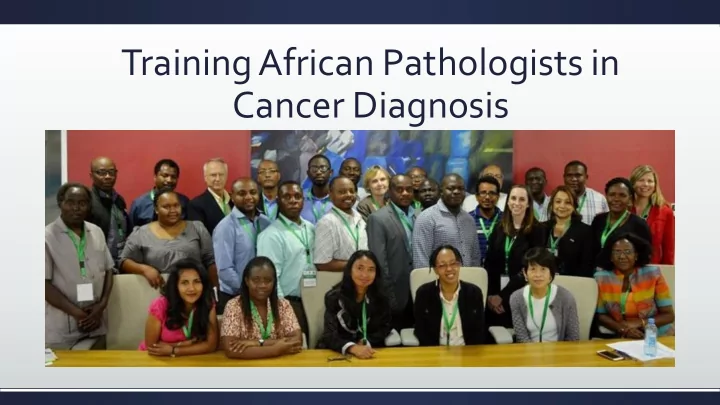
Training African Pathologists in Cancer Diagnosis Background - - PowerPoint PPT Presentation
Training African Pathologists in Cancer Diagnosis Background Following the success of our prior research conducting skill enhancement workshops with 52 pathologists from 16 different institutions in 11 countries in SSA has shown that among
workshops with 52 pathologists from 16 different institutions in 11 countries in SSA has shown that among three training styles, including lectures, case-based training (CBT), and a blend of lectures and CBT, the blended workshop style is the most effective at engaging participants and allowing participants to retain information (Wilson, et al).
practices for processing, diagnosing, and reporting common, locally relevant cancers.
and treatment. In most low- and middle-income countries (LMICs), varying quality of pathology training and an inadequate pathology workforce limit both quality cancer diagnosis and pathologic staging of cancer.
continuing professional development (CPD) is a critical need for the anatomic pathology workforce in sub-Saharan Africa (SSA) (Wilson, et al).
current best practices for processing, diagnosing, and reporting
In order to provide state of the art teaching of current best practices for processing, diagnosing, and reporting common cancers in SSA, we delivered as series of workshops in a blended short lecture model highlighting four cancers in an evidence- based format. These four cancers are:
Mutuku A, Roberts D, Stall J, Sayed S. Improving anatomic pathology in sub- Saharan Africa to support cancer care. American Journal Of Clinical Pathology, 149(4), 310-315. doi: 10.1093/ajcp/aqx158
for improving capacity for evidence-based decision making in public health. BMC Health Services Research. 2015;15:547. doi:10.1186/s12913-015-1224-2.
2017
Jan – Sept 2018
Sept – Oct 2018
Nov 2018