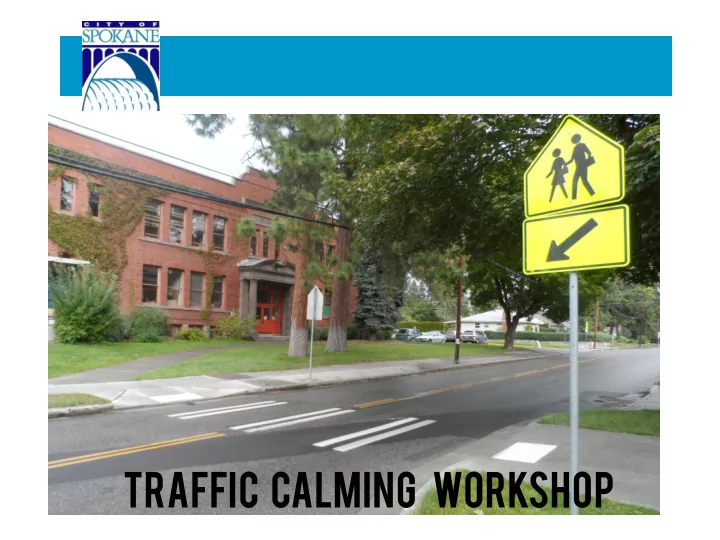
Traffic Calming Workshop Purpose of Traffic Calming Slow - - PowerPoint PPT Presentation

traffic calming workshop purpose of traffic calming
SMART_READER_LITE
LIVE PREVIEW

Traffic Calming Workshop Purpose of Traffic Calming Slow - - PowerPoint PPT Presentation

Traffic Calming Workshop Purpose of Traffic Calming Slow vehicular travel speeds Reduce the frequency and severity of collisions Reduce the need for police enforcement Reduce residential cut-through motor vehicle travel


slide-1
SLIDE 1

Traffic Calming Workshop

slide-2
SLIDE 2

Purpose of Traffic Calming

  • Slow vehicular travel speeds
  • Reduce the frequency and severity of

collisions

  • Reduce the need for police enforcement
  • Reduce residential cut-through motor

vehicle travel patterns

  • Increase safety for non-motorized street

users

  • Increase access for all modes of

transportation

  • Enhance the street environment
slide-3
SLIDE 3

Project Funding

  • Photo Red Light Funds

– 15 red light cameras at 10 intersections throughout Spokane

  • Cameras implemented in 2008
  • The program is a safety program

designed to reduce red light violations and collisions in intersections.

  • Funding is expected to be available on

an annual basis.

  • Minimum of $100,000 per district per year.
slide-4
SLIDE 4

What the Program Funds

  • Installation of

– Traffic Control devices – Pedestrian and bicycle improvements – Physical roadway features

  • Transportation Studies
  • Project Designs
slide-5
SLIDE 5

Traffic Calming Projects

  • There is not a single tool to solve traffic

issues and one tool that may work well in

  • ne area for a particular issue may not

be effective in another area.

  • Typical Problems Traffic Calming Solves

– Excessive Speeds – Excessive Volume – Lack of Safety

slide-6
SLIDE 6

Potential Speed Control Measures

  • Textured & Colored

Pavement

  • On-street parking
  • Modern Roundabout
  • Traffic Circle
  • Narrowed Lane
  • Bumpout

(Neckdown/Bulbout/Curb Extension)

  • Signage
  • Reduced Corner Radii
  • Landscaping
  • Gateway
  • Stationary Radar Sign
  • Pavement Marking
slide-7
SLIDE 7

Potential Volume Control Measures

  • Roadway Closures
  • Diverter
  • Turn Restrictions
slide-8
SLIDE 8

Potential Safety Measures

  • Bike Lanes
  • In-fill sidewalks
  • Marked Crosswalk

– With pedestrian crossing island

slide-9
SLIDE 9

Project Selection Requirements

  • 1. There is a $40,000 threshold unless there are

identified matching funds (i.e. CDBG funds)

  • 2. Each neighborhood can submit only 1 residential and

1 arterial application.

  • 3. Applications must be singed or have a signed letter

from the Neighborhood Council chair to be eligible.

  • 4. Projects must be ranked 1 or 2 (projects should not

hold the same ranking)

  • 5. Project scope should stop at logical breaks
  • 6. No dead-end or sidewalks that lead to nowhere
  • 7. Consider whole street and whole neighborhood when

choosing projects, outreach to the membership.

slide-10
SLIDE 10

Traffic Calming Project Timeline

Traffic Calming Application Timeline

NEIGHBORHOOD

INTERNAL

MARCH 1ST: APPLICATION DEADLINE FOR CURRENT YEAR, APPLICATIONS AFTER THIS DATE WILL GO INTO NEXT YEAR APPLICATION CYCLE AUGUST 1ST: TRAFFIC ASSESSMENT REPORTS PRESENTED TO CITY COUNCIL SUBCOMMITTEE TRAFFIC ASSESSMENT REPORTS GIVEN TO THE NEIGHBORHOODS COMMUNICATE TO NEIGHBORHOOD COUNCILS THAT FINAL DESIGNS ARE COMPLETE & PROJECTS ARE GOING TO BID

  • OCT. 1ST:

DESIGN AUTH. FORMS NOTIFICATION SIGN POSTED FOR 15 DAYS FOR RESIDENTIAL PROJECTS BID OUT PROJECTS CITY BLOG POST SHOWING PROJECT STATUS AND/OR COMPLETION March April May June July August September October November December January February March April May June July August September October PERFORM TRAFFIC ASSESSMENTS

  • SEPT. 1ST:

FINAL CITY COUNCIL PROJECT SELECTION VISIT NEIGHBORHOOD COUNCILS FOR COMMENT ON CHOSEN PROJECTS

WORK ORDERS & CONSTRUCTION

PROJECT DESIGN APRIL 15TH: INFORM NEIGHBOHOOD OF CONTRACTOR & CONSTRUCTION SCHEDULE

slide-11
SLIDE 11

Project Traffic Assessment

slide-12
SLIDE 12

Basic Analysis Process

  • Define The Problem
  • Is There a Realistic Solution?
  • Gather Facts For The Problem
  • Create Possible Solutions to The

Problem

  • Review Possible Solutions and Select

Your BEST Solution

  • Submit your BEST Solution
slide-13
SLIDE 13

Basic Analysis Process

  • Define The Problem

– Clearly state what you believe to be the problem

  • Speeding?
  • Too many collisions - safety?
  • Too much volume?
  • Example

– ABC Street has a lot of speeding cars with a lot of collisions and we want to reduce the number of collisions

  • This is potentially Speeding AND Safety
slide-14
SLIDE 14

Basic Analysis Process

  • Is There A Reasonable Solution?

– Look at solutions that are realistic

  • Refer to the Traffic Calming Toolbox
  • Meet with City staff for help
  • Example

– ABC Street should be closed to all traffic immediately

  • This is effective by not realistic for residents or emergency

services

– ABC Street should have a traffic circle or bump

  • uts
  • This is realistic and still accommodates all users of the

street

slide-15
SLIDE 15

Basic Analysis Process

  • Gather Facts For The Problem

– What facts would help to determine our next steps?

  • Traffic counts
  • Speed counts
  • Collision records
  • Example

– ABC Street has 1,000 cars a day, an average speed

  • f 30 mph, and an average of 3 collisions per year
  • This is higher than usual volume and speed, collisions not

unusual

  • ABC Street collisions all occurred at night and involved

pedestrians

slide-16
SLIDE 16

Basic Analysis Process

  • Create Possible Solutions to The Problem

– Look at available resources to brainstorm

  • Refer to the Traffic Calming Toolbox
  • Meet with City staff for help
  • Example

– ABC Street possible solutions:

  • Traffic circle
  • Better street lighting if collisions are at night
  • Improve the closest arterial to make it more inviting
  • Interactive speed signs
  • Street bump outs
slide-17
SLIDE 17

Basic Analysis Process

  • Review Possible Solutions and Select Your

BEST Solution

– Look at the possible solutions and select your BEST

  • City staff can help
  • Select the solution you feel is most likely to help and be

selected

  • Example

– ABC Street needs a traffic circle MOST

  • This might be supported MOST by the neighborhood
  • Add street lights to it also at crossing points
slide-18
SLIDE 18

Basic Analysis Process

  • Submit your BEST Solution

– Fill out the traffic calming application

  • Clearly define the problem
  • Identify your project solution
  • Submit the supporting information for your project
  • Example

– ABC Street application

  • Be specific and fill out all the boxes!
slide-19
SLIDE 19

Past Project Examples

  • Maxwell and Elm Pedestrian Island and

Crossing

– Define The Problem

  • A lot of pedestrians

during the summer for the pool

  • Speeding cars
  • Too many cars

– Is There a Realistic Solution?

  • Neighborhood wanted a flashing light
  • Costs and seasonality of pedestrians were an issue
  • Look at other pedestrian options
slide-20
SLIDE 20

Past Project Examples

  • Maxwell and Elm Pedestrian Island and

Crossing

– Gather Facts For The Problem

  • Over 5,000 cars per day traffic volume
  • Average speed was 28 mph – posted 30 mph
  • Seasonal 20 mph speed limit zone
  • Over 80 pedestrians in an hour when the pool is open

– Create Possible Solutions to The Problem

  • Pool staff put out signs daily
  • More pedestrian signs
  • Pedestrian refuge island
slide-21
SLIDE 21

Past Project Examples

  • Maxwell and Elm Pedestrian Island and

Crossing

– Review Possible Solutions and Select Your BEST Solution

  • Having pool staff put out signs was not safe
  • Portable signs put out by pool staff could be stolen
  • Hard concrete island in the median to protect

pedestrians

  • Use of special pedestrian crossing signs

– Submit your BEST Solution

  • Concrete pedestrian island
  • Pedestrian signing
  • Special pedestrian signing
slide-22
SLIDE 22

Past Project Examples

  • Maxwell and Elm Pedestrian Island and Crossing
slide-23
SLIDE 23

Past Project Examples

  • Montgomery Traffic Circles

– Define The Problem

  • Cars going through the neighborhood to get to the light

at Monroe

  • Speeding cars
  • Too many cars

– Is There a Realistic Solution?

  • Neighborhood wanted to cut off traffic onto

Montgomery

  • Take the traffic signal out at Montgomery and Monroe
  • Cut off traffic access on Northwest Blvd.
slide-24
SLIDE 24

Past Project Examples

  • Montgomery Traffic Circles

– Gather Facts For The Problem

  • Over 1,800 cars per day traffic volume on a residential

street

  • Average speed was 18 mph – speed limit is 25 mph
  • Trinity Catholic School on Montgomery
  • No pedestrian collisions at Montgomery

– Create Possible Solutions to The Problem

  • Change signal
  • Chicane
  • Bump outs
  • Traffic circles
slide-25
SLIDE 25

Past Project Examples

  • Montgomery Traffic Circles

– Review Possible Solutions and Select Your BEST Solution

  • Changing the traffic signal may not have much effect
  • Bump outs affect street drainage
  • Traffic circles would fit

– Submit your BEST Solution

  • Traffic circles will fit and not effect street drainage
  • Change the signal timing to delay Montgomery more
slide-26
SLIDE 26

Past Project Examples

  • Montgomery Traffic Circles
slide-27
SLIDE 27

Potential NEW Project Example

  • Maxwell and Cedar

– Define The Problem

  • Street alignment leads to speeding and neighborhood

cut thru

  • Street alignment encourages circumventing the traffic

signal

  • Encourages neighborhood speeding

– Is There a Realistic Solution?

  • Block the street (emergency services issues)
  • Traffic circles or bumpouts
  • Change the street alignment
slide-28
SLIDE 28

Potential NEW Project Example

  • Maxwell and Cedar

– Gather Facts For The Problem

  • Collect traffic volumes
  • Collect traffic speeds
  • Review collision history
  • Address long history of complaints

– Create Possible Solutions to The Problem

  • Narrow the roadway
  • Install traffic circles or bumpouts
  • Change the street alignment
slide-29
SLIDE 29

Potential NEW Project Example

  • Maxwell and Cedar

– Review Possible Solutions and Select Your BEST Solution

  • Changing the street alignment is most likely to produce

significant and long lasting change in traffic patterns

– Submit your BEST Solution

  • Street alignment
  • Landscape the new alignment for a neighborhood

amenity

slide-30
SLIDE 30

Potential NEW Project Examples

  • Maxwell and Cedar - Existing
slide-31
SLIDE 31

Potential NEW Project Examples

  • Maxwell and Cedar - Proposed