Traditional Netlist SignOff Model ASIC Vendors ASIC Customers - - PDF document

traditional netlist signoff model
SMART_READER_LITE
LIVE PREVIEW

Traditional Netlist SignOff Model ASIC Vendors ASIC Customers - - PDF document

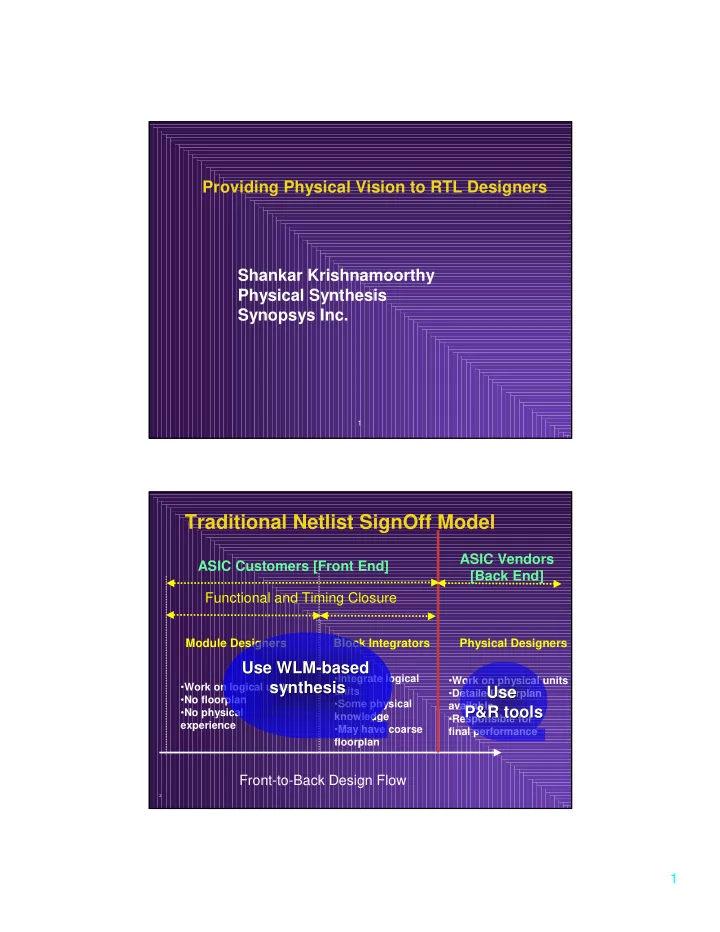
Providing Physical Vision to RTL Designers Shankar Krishnamoorthy Physical Synthesis Synopsys Inc. 1 Traditional Netlist SignOff Model ASIC Vendors ASIC Customers [Front End] [Back End] Functional and Timing Closure Module Designers Block


slide-1
SLIDE 1

1

1

Providing Physical Vision to RTL Designers Shankar Krishnamoorthy Physical Synthesis Synopsys Inc.

2

Traditional Netlist SignOff Model

Block Integrators

  • Work on logical units
  • No floorplan
  • No physical

experience

  • Integrate logical

units

  • Some physical

knowledge

  • May have coarse

floorplan

Module Designers

Front-to-Back Design Flow

  • Work on physical units
  • Detailed floorplan

available

  • Responsible for

final performance

Functional and Timing Closure

Physical Designers

Use Use P&R tools P&R tools Use WLM Use WLM-

  • based

based synthesis synthesis

ASIC Customers [Front End] ASIC Vendors [Back End]

slide-2
SLIDE 2

2

3

Re fe re n c e F lo w (T ry # 3 )

Mo re o p tim istic W L M (tha n Try #2) u se d

  • E n d P o in ts

WNS (ns)

RGXOH %ORFN

Timing Critical Designs: Performance Prediction is a Challenge

4

SignOff Models are evolving

  • Problems with traditional netlist SignOff model

for timing-critical designs

Longer time to convergence Missed performance targets

  • As a result, new SignOff models have emerged

RTL SignOff Placement SignOff

slide-3
SLIDE 3

3

5

New SignOff Models

  • RTL SignOff

RTL and constraints are handed off ASIC vendor responsible for synthesis, P&R ASIC customer responsible for RTL development/verification and design constraint specification

  • Placement SignOff

Netlist, placement, floorplan and constraints are handed off High-level of predictability in performance Requires P&R specialist in front-end team to drive floorplanning process

6

RTL SignOff Model

  • ASIC vendors can achieve certain level of performance

By using physical synthesis tools But no flexibility to change RTL

  • This is an expensive and time consuming process
  • Design constraint specification is an iterative process

Needs knowledge about the design (which ASIC customers know best) Needs accurate timing analysis that factors layout implications (which ASIC vendors know best)

  • Model is not scalable as implementation effort will

shift to the vendor

For timing-critical designs, intensive communication between ASIC customer and ASIC vendor

slide-4
SLIDE 4

4

7

Placement SignOff Model

  • This model offers greater predictability compared

to RTL/Netlist SignOff models

  • Offers ASIC customers “layout-sensitive” timing

estimates resulting in:

RTL that is feasible for physical implementation Design constraints that are realizable

  • However, this must not require ASIC customers

to become layout experts Solution: Physical Prototype generation during RTL synthesis

8

  • Spatial locality maintained

for modules/blocks during placement

  • Leverage this behavior to

auto-generate physical prototypes for modules/blocks

  • Provide flow with very low

cost of adoption for a RTL module designer Has little or no knowledge

  • f physical design

Intuition for Physical Prototyping during RTL synthesis

Design Placement Colored by Logical Hierarchy

slide-5
SLIDE 5

5

9

Performance Prediction with Physical Prototyping during RTL Synthesis

R T L -P la c e d G a te s F lo w

M in im a l P h ysica l C o n stra in t

  • E n d P o in ts

WNS (ns)

0RGXOH %ORFN

Allows designers to identify real critical nets during module compiles

10

Summary

  • RTL SignOff and Placement SignOff have been

proposed as alternatives to traditional netlist SignOff model

  • RTL SignOff limits performance goals that can be

achieved due to its restrictions

  • Placement SignOff improves predictability but

needs to reduce the cost of adoption for front-end designers

  • Quality of SignOffs can be improved dramatically

by introduction of RTL physical prototyping technology in logic synthesis