Traditional Knowledge, and Emic Approaches towards Citizen Science - - PowerPoint PPT Presentation

traditional knowledge and emic
SMART_READER_LITE
LIVE PREVIEW

Traditional Knowledge, and Emic Approaches towards Citizen Science - - PowerPoint PPT Presentation

Recognizing the Roles of Ethnoscience, Traditional Knowledge, and Emic Approaches towards Citizen Science and Sustainable Development Projects : Implications for the Rio Grande Valley, Texas DR. FRANK J. DIRRIGL, JR. Earth, Environmental, &


slide-1
SLIDE 1
  • DR. FRANK J. DIRRIGL, JR.

Earth, Environmental, & Marine Sciences

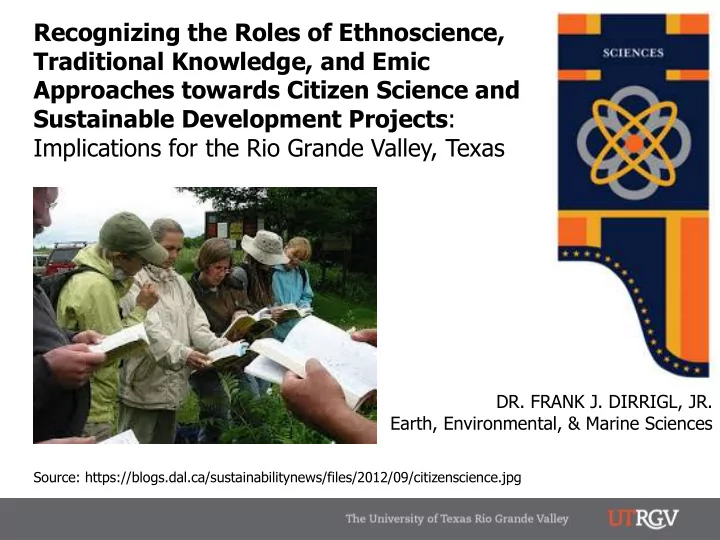
Source: https://blogs.dal.ca/sustainabilitynews/files/2012/09/citizenscience.jpg

Recognizing the Roles of Ethnoscience, Traditional Knowledge, and Emic Approaches towards Citizen Science and Sustainable Development Projects: Implications for the Rio Grande Valley, Texas

slide-2
SLIDE 2

Sources: eoearth.org; Office of the President, General Assembly

  • f the United Nations;

“Development that meets the needs of the present without compromising the ability of future generations to meet their own needs” (World Commission on Environment and Development, 1987),

The Three Pillars

slide-3
SLIDE 3

UN Global Compact Cities Programme Engagement Belief & Meaning

The Fourth Pillar

slide-4
SLIDE 4

Sources: www.sancristoballanguageschool.org; http://ranchero963.blogspot.com

Metzger & Williams 1963, American Anthropologist; 1966, American Anthropologist

Ethnoscience, the Tenejapa Ladino, and Tzeltal [Mayan]

slide-5
SLIDE 5

Sources: Metzger & Williams 1966, American Anthropologist; http://i.imgur.com/IYtqLd7.jpg

Western Example Tzetal Example

Firewood

slide-6
SLIDE 6

Source: http://trabajosocialchiapasegrets.blogspot.com/

Ethnozoology

slide-7
SLIDE 7

Source: The Director General of United Nations Educational, Scientific and Cultural Organization (Mayor, 1994); www.nativescience.org

“The indigenous people of the world possess an immense knowledge of their environments, based on centuries of living close to nature. Living in and from the richness and variety of complex ecosystems, they have an understanding

  • f the properties of plants and animals, the

functioning of ecosystems and the techniques for using and managing them that is particular and often detailed. In rural communities in developing countries, locally occurring species are relied on for many - sometimes all - foods, medicines, fuel, building materials and other

  • products. Equally, people’s knowledge and

perceptions of the environment, and their relationships with it, are often important elements of cultural identity.

Traditional Knowledge
slide-8
SLIDE 8

Source: Science 06/05/2015

Native & Community Citizen Science

slide-9
SLIDE 9

Source: Haklay 2013, Citizen Science and Volunteered Geographic Information – overview and typology of participation

slide-10
SLIDE 10

Source: Gowda & Nayak 2014, Int J Med Public Health

Common Survey

slide-11
SLIDE 11

Semi-Structured Interviews: Togo People

Source: Spuhler 2007; countryreports.org

slide-12
SLIDE 12

Source: Dirrigl & Vitek 2013, The Applied Anthropologist

Rio Grande Valley: Medical Anthropology

slide-13
SLIDE 13

Source: Dirrigl & Vitek 2013, The Applied Anthropologist

Personify & Humanize

slide-14
SLIDE 14

Emic Approach

Emic Etic

slide-15
SLIDE 15

Source: http://www.nativescience.org

slide-16
SLIDE 16

Source: http://urbanedge.blogs.rice.edu; lubbockonline. Com;

Colonias

slide-17
SLIDE 17
  • 500,000 Texans
  • 73% American Citizens
  • Mexican-American
  • 2, 200 Colonias
  • 3x National Poverty Level

Source: http://urbanedge.blogs.rice.edu

  • 100

Colonias

slide-18
SLIDE 18
  • Potable Water
  • Legal Plats
  • Drainage

Source: http://urbanedge.blogs.rice.edu; www.srh.noaa.gov/

slide-19
SLIDE 19
slide-20
SLIDE 20

Source: quod.lib.umich.edu

slide-21
SLIDE 21

Source: themonitor.com

slide-22
SLIDE 22
slide-23
SLIDE 23
  • Potable Water
  • Legal Plats
  • Drainage

Source: quod.lib.umich.edu

slide-24
SLIDE 24

Source: quod.lib.umich.edu

slide-25
SLIDE 25

Citizen Science & Monitoring

Source: earthwatch.org; devcomconvergence.wordpress.com; www.myhorrynews.com

  • Water Quality Sampling
  • Field Ovipositioning

Trapping

  • Personal Observations &

Landing Rates

slide-26
SLIDE 26
  • Post-Flooding Nuisance Species
  • Disease Vector Species
  • Laboratory Mosquito Rearing

with Flood Waters

Source: http://ecdc.europa.eu/EN/HEALTHTOPICS/DENGUE_FEVER; billclarkbugsperts.com; www.flickr.com

Citizen Science & Monitoring

slide-27
SLIDE 27

Source: https://sustainabledevelopment.un.org

slide-28
SLIDE 28

Source: https://sustainabledevelopment.un.org

slide-29
SLIDE 29

UN Global Compact Cities Programme Water Place Settlements

slide-30
SLIDE 30

Source: www.loyno.edu

slide-31
SLIDE 31

Questions ?