SLIDE 1
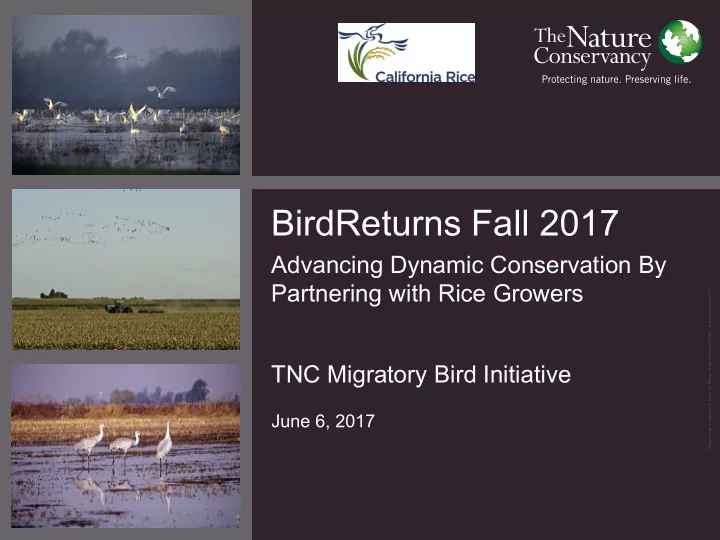
BirdReturns Fall 2017
Advancing Dynamic Conservation By Partnering with Rice Growers TNC Migratory Bird Initiative
June 6, 2017
SLIDE 2
Why are we here?
Thanks to NRCS, Audubon, Point Blue, CRC and TNC, WHEP is successful and the practices continue with RCPP Build on 4 years of successes and lessons learned Opportunity to refine program and respond to habitat needs
SLIDE 3 Program Goals
- Improve habitat conditions for waterbirds (esp. shorebirds)
- Support production of wildlife-friendly rice
- Be responsive to:
- Water availability
- Wildlife habitat needs
- Farm constraints and economics
SLIDE 4
The Pacific Flyway
SLIDE 5
State of the Birds 2014
SLIDE 6
50-80 M Waterfowl ? shorebirds 3-4 M Waterfowl >350K Shorebirds
SLIDE 7
California Migratory Waterbird Habitats
SLIDE 8 Importance of flooded rice fields
Elphick 2000
- 187 species of birds
- 28 special-status
- Globally significant habitat
for waterfowl, waders & shorebirds
Waterbird Species Diversity Waterbird Density
SLIDE 9 Shorebirds Flooded Rice Acres Aug Sept Oct Nov Dec Jan Feb Mar Apr May Jun Jul
Expanding the time window
- f shorebird habitat in rice
SLIDE 10
Predictive models Birds & Water Pop-up wetlands Habitat auctions Save the birds!
BirdReturns
SLIDE 11 Importance of Shallow Water Habitat to Shorebirds
American Avocet Black-necked Stilt Dunlin Greater Yellowlegs Least Sandpiper Lesser Yellowlegs Long-billed Curlew Long-billed Dowitcher Western Sandpiper Whimbrel Wilson's Snipe Black-bellied Plover Killdeer
SLIDE 12
Importance of Shallow Water Depths: Bird Size
SLIDE 13
Importance of Shallow Water Depths to Shorebirds
SLIDE 14
SLIDE 15 Key Points for Fall 2017
- Emphasis on early habitat
- Shallow depths required – 4” or less
- 1-3” is ideal
- Minimal standing stubble, straw mixed with soil
http://www.birdreturns.org
SLIDE 16 Who is eligible?
- Rice growers
- Lands compatible with waterbirds
- No overlap with easement or other habitat program
- Minimum 25 acres per site
- No cap on participation
- Multiple bids permitted for different sites
SLIDE 17 Grower Requirements
Growers commit to:
- Post-harvest management to achieve required field
conditions
- Manage water to achieve required depth of 4” or less
by Day 1, and maintain throughout Program
- Allow access to site to facilitate:
- Inspection of field conditions (prior to enrollment)
- Monitoring water depth and bird use during enrollment
period, and monitoring bird use post-enrollment
SLIDE 18 Post-Harvest Straw & Soil Management
Required field conditions:
stubble/vegetation
- Straw incorporated into soil, not
removed from field
Conditions typically achieved by:
- Disking, chiseling, or stomping
SLIDE 19
Fall 2017 Program Options
All program enrollments are four weeks: Option 1: August 18-September 14 Option 2: September 1-28 Option 3: September 15-October 12 Option 4: September 29-October 27
August
18-Aug 1-Sep 14-Sep 15-Sep 28-Sep 29-Sep 12-Oct 27-Oct
Option 2 (4 weeks) Option 4 (4 weeks) Option 1 (4-weeks) Option 3 (4 weeks) October September
SLIDE 20 Water Management
4” by Day 1 and maintain throughout enrollment period
- Ideal 1-3”
- At least 75% of field
ponded
depth stakes
SLIDE 21
SLIDE 22
Water Management
SLIDE 23
Good Field Conditions
SLIDE 24
Poor Field Conditions
SLIDE 25
Good Field Conditions
SLIDE 26
Poor Field Conditions
SLIDE 27
Good Field Conditions
SLIDE 28
Poor Field Conditions
SLIDE 29
Good Field Conditions
SLIDE 30
Poor Field Conditions
SLIDE 31
Good Field Conditions
SLIDE 32
Good Field Conditions
SLIDE 33 Submit a Bid
- New: Online bidding system!
- Bids due MONDAY, June 19 by 9 a.m.
- Bids should reflect additional costs to provide habitat
- TNC will select most competitive bids, and as many as
possible within budget constraints
SLIDE 34 Online Bidding
- On our website: http://www.birdreturns.org
- Can be saved and filled out at intervals
- Attach maps, and include field names or numbers
- You must go to the review page and hit “confirm”
before you are complete
SLIDE 35 Online Bidding: BirdReturns Website
- Go to “Participate”
- Select “Submit a Bid”
SLIDE 36
SLIDE 37
Attach a Map
SLIDE 38
SLIDE 39
You’re not complete at the Review button
SLIDE 40
Confirmation page
SLIDE 41
Hit confirm to complete
SLIDE 42 How TNC Will Select Bids
Selection Criteria
is better!
- Location
- Water access
- Cost
SLIDE 43 How TNC Will Select Bids
Program 2016 Acres Accepted
1,288 69%
972 67%
997 89%
1,158 19%
1,175 5%
SLIDE 44 Questions about the bid form?
- Today’s workshop
- Assistance sessions with Simon Avery at the
Colusa Library: TBA on BirdReturns website
- Request a paper copy at birds@tnc.org or call
Julia Barfield at (916) 449-2852
- On our website: http://www.birdreturns.org
SLIDE 45 In Summary
- June 19 at 9:00 AM: Application Deadline
- Submit a bid on our website: http://www.birdreturns.org
- Contact us at birds@tnc.org or (916) 449-2852
- Meet with us at Colusa Library: TBA week of June 12
SLIDE 46
Thank You