Tractor & Machinery Operations: Science of Stability Photo - - PowerPoint PPT Presentation

tractor machinery operations science of stability
SMART_READER_LITE
LIVE PREVIEW

Tractor & Machinery Operations: Science of Stability Photo - - PowerPoint PPT Presentation

Tractor & Machinery Operations: Science of Stability Photo Credit: Penn State Agricultural Safety and Health Team Outline Pre-operation Checks Tractor Controls Obstacle Course Photo Credit: Penn State Agricultural Safety and

slide-1
SLIDE 1

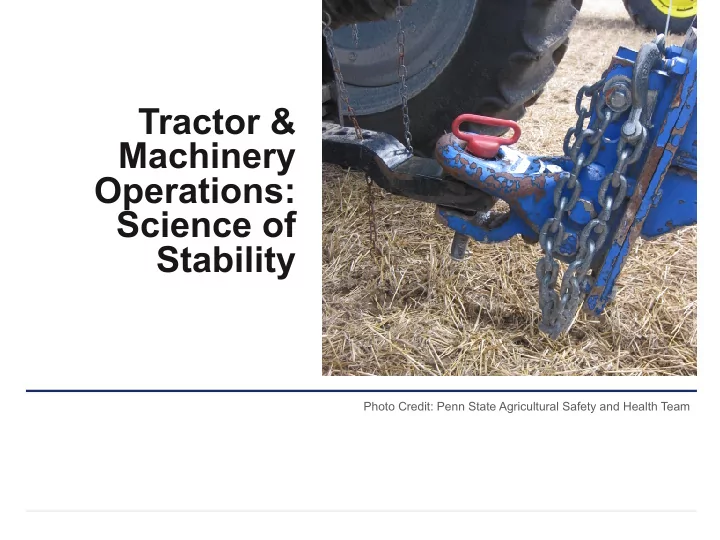
Tractor & Machinery Operations: Science of Stability

Photo Credit: Penn State Agricultural Safety and Health Team

slide-2
SLIDE 2

Outline

  • Pre-operation

Checks

  • Tractor Controls
  • Obstacle Course

Photo Credit: Penn State Agricultural Safety and Health Team

slide-3
SLIDE 3

Pre-operation Inspections

  • Review
  • ground conditions, terrain, obstacles
  • Complete visual inspection of equipment
  • Lights
  • Brakes
  • Steering
  • Tires
  • Fluids
slide-4
SLIDE 4

Mounting and Dismounting

  • Face the operator

platform

  • Use three points of

contact

  • Secure seatbelt

Photo Credit: Penn State Agricultural Safety and Health Team

slide-5
SLIDE 5

Start-up and Controls

  • Know your engine
  • Fuel type
  • Controls color code
  • Black- position and

adjust controls

  • Red- shut down
  • Yellow-Power

engagement

  • Orange-Ground

motion (gear shift pattern, etc.)

  • Monitor Gauges

Photo Credit: Penn State Agricultural Safety and Health Team Michael Houtz, Penn State Extension

slide-6
SLIDE 6

Operating the Tractor

  • Roll-overs hazard
  • Side
  • Rear
  • Run-overs hazard
  • Bystanders
  • Falls
  • Noise
  • Eye Injury
  • Entanglement

Photo Credit: Penn State Agricultural Safety and Health Team

slide-7
SLIDE 7

Safe Operations

Fasten Seat Belt (ROPS equipped tractor) Avoid ditches, embankments, and holes Reduce speed when turning, crossing slopes, and on rough, slick, or muddy ground Stay off slopes too steep for safe

  • peration

Always face the tractor for mounting and dismounting. Use three points of

  • contact. Never jump from the tractor.

Photo Credit: Penn State Agricultural Safety and Health Team

slide-8
SLIDE 8

Safe Operation

Watch where you are going No riders Avoid jerky turns, starts, and stops Hitch properly (Drawbar and three- point) Set brakes securely when stopped (parking brake)

Photo Credit: Michael Houtz, Penn State Extension

slide-9
SLIDE 9

Obstacle Courses

  • Instructor selection
  • Knowledgeable and safe
  • Tractor selection
  • 40-70 hp
  • ROPS
  • Cabs are not necessary
  • Safety features
  • Driving course selection
  • Slope
  • Weather
  • Space
slide-10
SLIDE 10

Obstacle Course Layout

  • Level surface area, free of ruts and
  • bstacles
  • Minimum distance of 50 ft. between tractor/

machinery training stations

  • Traffic cones, stakes, straw bales, etc. as

course markers

  • Twine or rope to form a line or artificial

barrier in the course