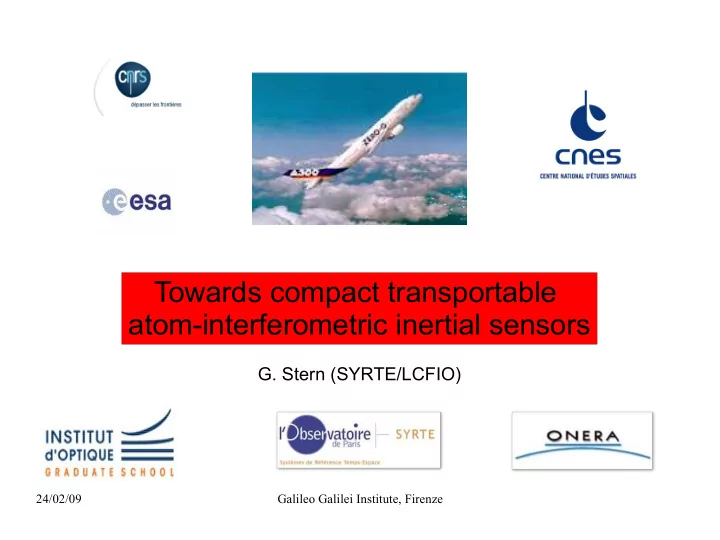
Towards compact transportable atom-interferometric inertial sensors - - PowerPoint PPT Presentation

towards compact transportable atom interferometric
SMART_READER_LITE
LIVE PREVIEW

Towards compact transportable atom-interferometric inertial sensors - - PowerPoint PPT Presentation

Towards compact transportable atom-interferometric inertial sensors G. Stern (SYRTE/LCFIO) 24/02/09 Galileo Galilei Institute, Firenze Increasing the interrogation time T is often the limiting parameter for the sensitivity. Different


slide-1
SLIDE 1

24/02/09 Galileo Galilei Institute, Firenze

Towards compact transportable atom-interferometric inertial sensors

  • G. Stern (SYRTE/LCFIO)
slide-2
SLIDE 2

24/02/09 Galileo Galilei Institute, Firenze

Increasing the interrogation time

  • T is often the limiting parameter for the sensitivity.
  • Different solutions:
  • Atomic fountain (T≈800 ms).
  • 10 meter high interferometer (Stanford): T≈1.4 s.
  • Parabolic flights (cf ICE): T≈ 20 s, 10-2 g.
  • 100 m drop tower in Bremen (cf QUANTUS): T≈ 5 s, 10-6 g.
  • Satellite (PHARAO): 10-6 g.

Need for a compact and transportable interferometer 100 m

slide-3
SLIDE 3

24/02/09 Galileo Galilei Institute, Firenze

Outline

  • 2. Atomic interferometry in microgravity: the ICE project
  • 1. Inertial sensors with cold atoms @ SYRTE
  • 3. A matter-wave cavity for gravimetry
slide-4
SLIDE 4

24/02/09 Galileo Galilei Institute, Firenze

  • A. Landragin, F. Pereira Dos Santos, S. Merlet, T. Mehlstaubler, W. Chaibi,
  • N. Malossi, A. Gauguet, T. Lévêque, Q. Bodart, J. Le Gouët, C. Bordé

Inertial Sensors with cold atoms @ SYRTE: gravimeter and gyroscope

slide-5
SLIDE 5

24/02/09 Galileo Galilei Institute, Firenze

Cold atoms gyroscope

MOT A MOT B

slide-6
SLIDE 6

24/02/09 Galileo Galilei Institute, Firenze

Retroreflected Raman beams Access to the six components of inertia

slide-7
SLIDE 7

24/02/09 Galileo Galilei Institute, Firenze

Tide model 5 mn average

slide-8
SLIDE 8

24/02/09 Galileo Galilei Institute, Firenze

Gyrometer performances

slide-9
SLIDE 9

24/02/09 Galileo Galilei Institute, Firenze

Prospects

slide-10
SLIDE 10

24/02/09 Galileo Galilei Institute, Firenze

Cold atoms gravimeter

slide-11
SLIDE 11

24/02/09 Galileo Galilei Institute, Firenze

Compact gravimeter results

slide-12
SLIDE 12

24/02/09 Galileo Galilei Institute, Firenze

slide-13
SLIDE 13

24/02/09 Galileo Galilei Institute, Firenze

Atomic interferometry in microgravity: the ICE project

  • G. Stern1,2, R. Geiger1, B. Battelier1, G. Varoquaux1, T. Bourdel1,
  • N. Zahzam3, W. Chaïbi2, J-F. Clément1, O. Carraz3, J-P. Brantut1,
  • R. A. Nyman1, F. Pereira2, Y. Bidel3, A. Bresson3, A. Landragin2, and P. Bouyer1

(1)

(2) (3)

slide-14
SLIDE 14

24/02/09 Galileo Galilei Institute, Firenze

A microgravity environment

Ballistic flights for microgravity

  • In the Novespace A300 ZERO-G Airbus

(Bordeaux airport)

  • 31 parabolas per day for 3 days

 ≈ 30 minutes of micro-g (10

  • 2 g)
  • But noisy environment.

Pull-up phase Pull-down phase Micro-g phase

  • The idea: reduced gravity for longer interrogation time
  • Goal: making a differential accelerometer to test the UFF.
  • Technologie developement (compactedness, design of new laser sources,...)

Need for a compact, transportable and robust apparatus

slide-15
SLIDE 15

24/02/09 Galileo Galilei Institute, Firenze

Setup

 ONERA: laser sources (MOT+ Raman)  SYRTE: ultra-stable microwave reference source + control software

 IOGS: optical chamber, optics and control software

A full cold atom experiment in 3 parts (650 Kg, 1500 W) Electrical pannel + High laser power µ-wave reference, laser sources, computer, etc... Science cell (in its magnetic shield)

slide-16
SLIDE 16

24/02/09 Galileo Galilei Institute, Firenze

Laser sources for

87Rb

  • Frequency-agile: switch from MOT to Raman detuning in 3-4 ms with the beat-note lock.
  • Modulation frequency control for MOT or Raman

Sideband generation (MOT/Raman)

Frequency generation part Based on telecom technologies reliable, robust and compact system with fiber components.

slide-17
SLIDE 17

24/02/09 Galileo Galilei Institute, Firenze

Free-space doubling part

  • ≈ 100 mW at each fiber ouptut
  • AOM: optical switch for Raman
  • MOT or Raman with the same beam  No relative misalignment and stable relative phase

3 m W 300 mW

slide-18
SLIDE 18

24/02/09 Galileo Galilei Institute, Firenze

Generation frequency racks Free space doubling stage 11 U 19 '' 19 ''

slide-19
SLIDE 19

24/02/09 Galileo Galilei Institute, Firenze

The science cell

  • MOT: 3 retro-reflected beams provided by

a 1-3 Schäfter-Kirchoff splitter

  • Raman beams : horizontal
  • Atom detection by fluorescence with the MOT beams

 reduced T.O.F. (on Earth at least) but compact interferometer

slide-20
SLIDE 20

24/02/09 Galileo Galilei Institute, Firenze

Ramsey fringes with copropagative Raman transitions

ω2, k2 ω1, k1

Δ≈700 MHz

Ωeff ≈ 2π x 12.5 kHz

T

with Ωeff = π / 2

≈1/T

No more than T=25 ms on Earth for us

slide-21
SLIDE 21

24/02/09 Galileo Galilei Institute, Firenze

On Earth vs microgravity (T=40 ms)

MOT Raman sequence Detection No normalization

slide-22
SLIDE 22

24/02/09 Galileo Galilei Institute, Firenze

On Earth vs microgravity (T=40 ms)

MOT Raman sequence Detection No normalization

slide-23
SLIDE 23

24/02/09 Galileo Galilei Institute, Firenze

  • One point = one shot
  • One scan per parabola
  • Limited by temperature

Results in microgravity

slide-24
SLIDE 24

24/02/09 Galileo Galilei Institute, Firenze

Conclusion/prospects

  • Our laser sources can work in a µ-g environment.
  • Counterpropagating configuration → sensitive to intertial effects.
  • BUT problems with the acceleration noise → need for a vibration isolation.
  • Double species interferometer fot the UFF test.
  • 85Rb or K (D2 line=767 nm =1534nm /2).
slide-25
SLIDE 25

24/02/09 Galileo Galilei Institute, Firenze

A matter-wave cavity for gravimetry

1000 10000 1 2 3 0,01 0,1 1

Collision rate (s

  • 1)

Phase space density time (s)

J-P. Brantut, RM. Robert de Saint Vincent, J -F. Clément,

  • G. Varoquaux, R. A. Nyman, T. Bourdel, P. Bouyer and A. Aspect
slide-26
SLIDE 26

24/02/09 Galileo Galilei Institute, Firenze

A matter-wave cavity for gravimetry

  • Goal: demonstrating a new type of gravimeter permitting long interrogation time

in a compact apparatus (F. Impens, et al., Appl. Phys. B 84, 603)

  • Method: use periodic Bragg or Raman pulses to

make the atoms bounce several times. Wrong period Residual acceleration

  • f the cloud

Loss of atoms

  • Atoms don't fall→ compactedness
  • Sensitivity scales as T3/2
  • Recent estimation of g by Sackett with this

kind of interferometer (K.J. Hughes et al, arXiv 09020109)

slide-27
SLIDE 27

24/02/09 Galileo Galilei Institute, Firenze

First energy levels of

87Rb

  • Ultracold source→ narrow velocity distribution
  • Strong light shifts for 5P3/2 hyperfine levels → possibility to cool and trap at he same time

An all - optical BEC @ 1565 nm as an ultracold atom source

slide-28
SLIDE 28

24/02/09 Galileo Galilei Institute, Firenze

  • First all-optical BEC at this wavelength.
  • Laser souce: 50 W Erbium doped fiber laser

2D MOT 3D MOT Dipole trap Fastest evaporation to BEC: 650 ms 3x10⁵ atoms at Tc 105 atoms in a pure BEC Inversion of ellipticity in time of flight

slide-29
SLIDE 29

24/02/09 Galileo Galilei Institute, Firenze

0.997 T0 0.999 T0 T0

  • 2-photons Bragg transitions in a pulsed 1D static lattice, 6.8 GHz detuned
  • n the F = 2 -> F' = 3 transition (atoms in the F = 1 hyperfine state)

~ 6% of atoms diffusing one photon in 20 bounces

  • Up to 20-30 bounces (~30 ms)
  • Limited by the efficiency of a single (square) pulse (93%)
slide-30
SLIDE 30

24/02/09 Galileo Galilei Institute, Firenze

Ratio of remaining atoms

  • We currently investigate for systematic

bias (tilt, residual magnetic fields,...)

Conclusion

  • A compact interferometer with an simple setup,

as with Bloch oscillations (G. Ferrari et al., PRL 97, 060402).

  • Limited by pulse efficiency.
  • Original interferometer configuration possible.

Ratio of remaining atoms Time (ms)

slide-31
SLIDE 31

24/02/09 Galileo Galilei Institute, Firenze

Thanks for your attention