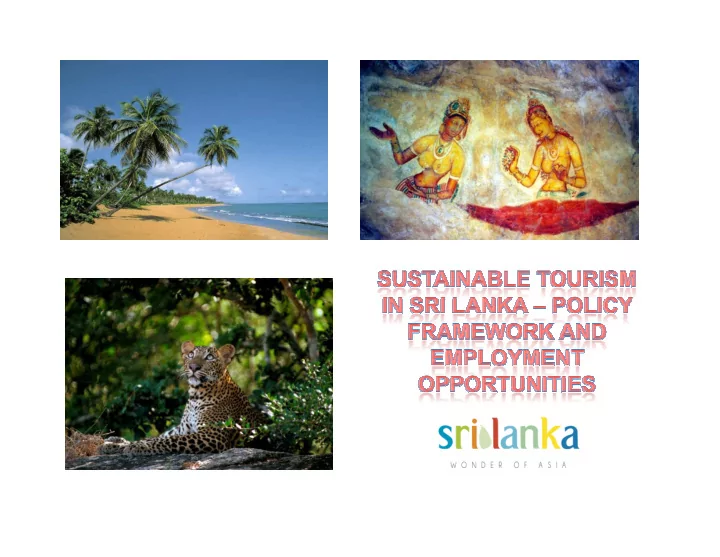
Tourism, the worlds Largest Service Industry has bounced back - - PowerPoint PPT Presentation

tourism the worlds largest service industry has bounced
SMART_READER_LITE
LIVE PREVIEW

Tourism, the worlds Largest Service Industry has bounced back - - PowerPoint PPT Presentation

Tourism, the worlds Largest Service Industry has bounced back Millions Global Tourist Arrivals in millions SOURCE:ITB WORLD TRAVEL TRENDS REPORT 2010/2011 Global Tourism arrivals grew by 6 % in 2010 recovering from a 5% slump in 2009.


slide-1
SLIDE 1
slide-2
SLIDE 2

Global Tourist Arrivals in millions

Tourism, the worlds Largest Service Industry has bounced back

Millions

  • Global Tourism arrivals grew by 6 % in 2010 recovering from a 5% slump in 2009.
  • An all time record of USD 1,045 Billion spent by tourists in 2010.
  • Further growth of about 5-6% expected in 2011 as tourism industry is recovering fast

SOURCE:ITB WORLD TRAVEL TRENDS REPORT 2010/2011

slide-3
SLIDE 3

Market Rank Arrivals 2010 India 1 111,129 UK 2 95,320

Tourist Arrivals to Sri Lanka

Total tourist arrivals in 2010 was more than 654,000. ie , 46% growth Fastest growing markets are India and UK

Germany 3 41,259 Middle East 4 34,106 Maldives 5 30,121 France 6 28,095 Australia 7 25,833 Canada 8 18,617 USA 9 16,144 Netherlands 10 15,521

UK Top ten markets accounted for 73% of arrivals In terms of global tends potential growth markets for Sri Lanka are

  • China
  • Russian Federation
  • Japan
  • Germany
  • France
  • USA
  • Italy
slide-4
SLIDE 4

Year 2010 2016 No of Hotel Rooms 22,735 45,000 Tourist arrivals 620,000 2,500,000 Arrivals: Employee 5:1 5:1

Economic Contribution of Tourism

Arrivals: Employee 5:1 5:1 Direct Employment 55,000 225,000 Indirect Employment 70,000 275,000 Total Employment 125,000 500,000 Dependants per employee 3 3 Total Dependents in tourism 375,000 1,500,000 Total income $ 410 Mn $ 2.75 Bn No of dependents from total population 1.8 % 7 %

The current average spent per tourist is $ 80/day. This should be pushed up by creating more opportunities for tourists to spend during their visits

slide-5
SLIDE 5

The growth strategy

Consolidate first and then target exponential growth

Year 2010 2011 2012 2013 2014 2015 2016 No of Arrivals 620,000 70000 850,000 1,050,000 1,350,000 2,000,000 2,500,000

slide-6
SLIDE 6

Why Sri Lanka ?

  • Authenticity
  • Compactness
  • Diversity

It is a green destination by all means

slide-7
SLIDE 7

Differentiating & Positioning

Beaches like Maldives or Mauritius Ancient heritage sites like Egypt or Greece Rain forests like Congo or Amazon Art & Culture like India or Thailand Waterfalls like Zambia or Canada Wildlife like Kenya or South Africa Wildlife like Kenya or South Africa Natural Beauty like Switzerland or Myanmar Gemstones like Madagascar or Burma Spices like India or Indonesia Festivals like Japan or India

“It is undoubtedly the finest island in the whole world”

Marco Polo (13AD)

“No 1 of the 30 places to visit in 2010”

New York Times

slide-8
SLIDE 8
slide-9
SLIDE 9

The industry has agreed to promote Sri Lanka under 8 different product categories for convenience of categories for convenience of remembering

slide-10
SLIDE 10
slide-11
SLIDE 11
slide-12
SLIDE 12
slide-13
SLIDE 13
slide-14
SLIDE 14
slide-15
SLIDE 15
slide-16
SLIDE 16
slide-17
SLIDE 17
slide-18
SLIDE 18

Attracting new tourists Ensuring that departing Creating an environment conducive to tourism promotion Support

  • Policy Framework
  • Infrastructure
  • Transport
  • Attractions & Events
  • Service Standards
  • Manpower
  • Identifying target markets
  • Marketing communications & promotions
  • Facilitating the visit

(1 ) (4 ) (3 ) (2)

THE CHALLENGES FOR SRI LANKA TOURISM THE CHALLENGES FOR SRI LANKA TOURISM

Ensuring that departing tourists are happy Support Domestic Tourism

  • Manpower
  • Superior value chain
  • Tourist information
  • Public support
  • Tourist safety

(4 ) (3 ) Creating awareness & positive perceptions globally

  • Involving foreign missions
  • Involving of Diaspora
  • International public relations

(5 )

slide-19
SLIDE 19
  • 1. Creating an environment conducive to tourism
  • Policy framework to support investors and trade
  • Infrastructure to meet industry requirements
  • Transport solutions to ensure speedy and convenient travel
  • Attractions easily accessible and professionally managed
  • Events well coordinated and effectively marketed
  • Service Standards of international quality
  • Manpower requirements of the industry addressed
slide-20
SLIDE 20
  • 2. Attracting new tourists
  • Identifying the target markets and customers
  • Focused promotional campaigns in chosen markets
  • Strengthen links with international tour associations
  • Strong web marketing through an interactive web portal
  • Technology driven tourist information centers to support

global requirements

slide-21
SLIDE 21
  • 3. Ensuring that departing tourists are happy
  • Friendly and hassle free entry at immigration
  • Customer satisfaction survey at immigration counters
  • Hassle free & well regulated taxi service at Airport
  • Trained tour guides who are responsible and caring
  • A visit not spoiled by touts, vendors, and beach boys
  • A strong well coordinated tourist police providing protection
  • Awareness campaigns to gain public support for tourism
slide-22
SLIDE 22
  • 4. Domestic Tourism
  • Working with local authorities and other relevant agencies to

raise standards of rest houses, gust houses and small hotels

  • Marketing of lesser known attractions through media
  • Comfort centers along busy roads and near attractions
  • Publications of guidebooks, maps and signboards
  • Awareness campaigns on civic responsibility, cleanliness etc
slide-23
SLIDE 23
  • 5. Creating a positive image and greater

awareness of Sri Lanka globally

  • Working closely with foreign missions
  • Use of Diaspora for tourism promotions
  • Close links with international media particularly in

media houses of target markets

slide-24
SLIDE 24

Sustainable tourism development

Sustainable tourism development refers to the management of all resources available for tourism in such a way that economic, social and aesthetic needs can be fulfilled while maintaining cultural and aesthetic needs can be fulfilled while maintaining cultural integrity, essential ecological processes, biological diversity and life support systems Our approaches to sustainable tourism development will also give greater priority to community participation and poverty reduction. To support this growing interest in environmentally-friendly vacationing, hotels, resorts, and other tourism spots, we should be looking to fill positions, and even create new ones, to meet the demand.

slide-25
SLIDE 25

– Minimize environmental impact.

We would expect those who engage in tourism activities in Sri Lanka to adhere to the following ecotourism principles:

– Minimize environmental impact. – Build environmental and cultural awareness and respect. – Provide positive experiences for both visitors and hosts. – Provide direct financial benefits for conservation a – Provide financial benefits and empowerment for local people. – Understand and appreciate the sensitivities of political, environmental, and social climate.

slide-26
SLIDE 26
  • Travel agents
  • Airline Staff
  • Sales & Marketing
  • Front office staff

Employment opportunities in tourism

  • Airline Staff
  • Transport
  • Courier agencies
  • Hotel Management
  • Accounting
  • Maintenance
  • Engineering
  • Medical Staff
  • Front office staff
  • Food & Beverages
  • Cookery
  • Events Management
  • Tour Planning
  • Tourist Information
  • Guest Relations
  • Tour Guiding
slide-27
SLIDE 27