TOURISM INDUSTRY INDUSTRY SNAPSHOT WHAT ARE TOURISM EXPORTS? - - PowerPoint PPT Presentation

tourism industry industry snapshot
SMART_READER_LITE
LIVE PREVIEW

TOURISM INDUSTRY INDUSTRY SNAPSHOT WHAT ARE TOURISM EXPORTS? - - PowerPoint PPT Presentation

THE INBOUND TOURISM INDUSTRY INDUSTRY SNAPSHOT WHAT ARE TOURISM EXPORTS? Inbound tourism = foreign exchange earnings for AU Every international visitor spends foreign currency here We are effectively exporting destination


slide-1
SLIDE 1

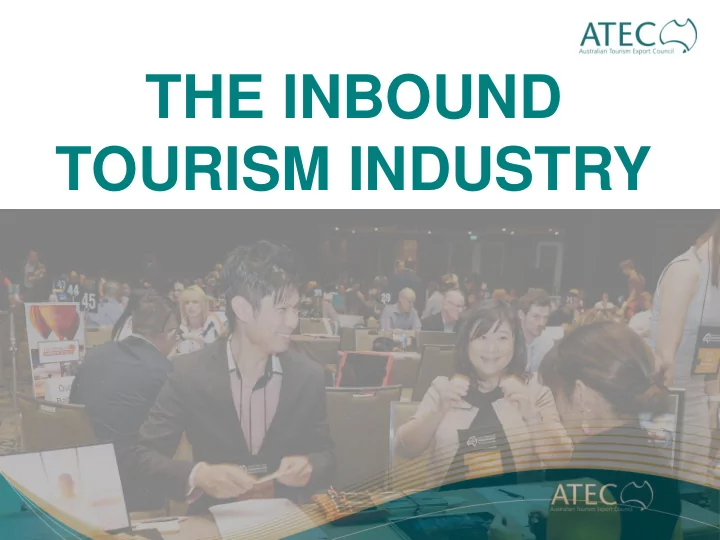
THE INBOUND TOURISM INDUSTRY

slide-2
SLIDE 2

INDUSTRY SNAPSHOT

slide-3
SLIDE 3

WHAT ARE “TOURISM EXPORTS”?

  • Inbound tourism = foreign exchange earnings for AU
  • Every international visitor spends foreign currency here
  • We are effectively “exporting” destination Australia and our

experiences

slide-4
SLIDE 4

Group Inclusive T

  • ur or

Travellers (GIT) Fully Independent Travellers (FIT)

  • Pre-purchase the bulk of their holiday before

leaving home via distributors

  • Prefer structured itineraries
  • Have highly organised and pre booked tour

arrangements

  • Use distributor’s preferred products
  • Common in less mature markets and with

certain segments such as educational groups

  • Like the freedom of planning their own

arrangements

  • Arrange some core holiday components prior to

arrival

  • Organise the bulk of their itinerary

independently often after their arrival

  • Rely heavily on word of mouth, the internet and

social media when planning their trip

Partially Packaged Travellers Visiting Friends and Relatives (VFR)

  • Pre-book ‘skeleton package’ of airfares,

transfers and accommodation prior to arrival

  • Search for competitive rates
  • Optional themed extras such as car hire and

tours are offered at the point of sale to appeal to different segments

  • Cite friends and relatives as the primary reason

for travel

  • Often travel beyond the family base to other

destinations

  • Rely on the recommendations and advice of

their Australian-based friends and relatives when planning their trip

TYPES OF TRAVELLERS

TYPES OF TRAVELLERS

slide-5
SLIDE 5

Backpackers Education Travellers

  • Spend at least one night in a backpacker

hotel or youth hostel during their stay

  • Traditionally 18 to 25 year olds, but often

also 30+

  • Prefer a highly independent and unstructured

approach towards travel

  • Rely heavily on the internet and social media

for information

  • Often include volun-tourism: in their travels
  • volunteering for a charitable cause
  • Includes short course participants, long term

university students, school excursions and exchanges

  • Cite study as the main visit purpose; but may

be a tourism component to the trip

  • May attract VFR. Have families who may visit

and travel throughout the course of study

  • Often require specialised arrangements

depending on the age of students

Business Travellers Special Interest Travellers (SIT)

  • Large conference delegates or individual

business trip Include delegates of a large conference or an individual on a business trip

  • Leisure travel component: pre and post

conference touring

  • Includes delegates of Incentive tours- a

specialised business segment rewarding performance with travel experiences

  • High yield = per head spend often very high
  • Travel for reasons associated with personal

interests such as agri-tourism, health and wellness or bird watching

  • Book through agents or operators who possess

a high level of expertise and can access specialised tours, guides, expert lectures and location visits that are not part of the traditional tourism infrastructure

  • Have customised itineraries
  • Often high yield but low volume
slide-6
SLIDE 6

WHAT IS DISTRIBUTION?

The travel distribution system is a complex, global network of independent businesses. This network includes a series of distributors or intermediaries, who play a specific role in the development, promotion and purchasing process of Australian tourism experiences.

slide-7
SLIDE 7

WHAT IS A TRAVEL DISTRIBUTOR?

  • Travel distributors allow you to broaden your customer

base far beyond the reach of your own limited marketing budget.

  • The travel distribution system covers all the channels

through which an international traveller can buy your product.

slide-8
SLIDE 8

WHAT IS A TRAVEL DISTRIBUTOR?

Types of distributors (or “buyers”) include:

  • Inbound Tour Operators
  • Wholesalers
  • Retail Travel Agents
  • Online Travel Agents
  • Meeting & Incentive Planners
slide-9
SLIDE 9

DISTRIBUTION - WHY USE IT?

  • Grow business across different markets
  • Extend their global footprint
  • Connect with market experts
  • Culture + language assistance
  • Payments and legality can remain on

home soil

TRAVEL DISTRIBUTION – WHY ENGAGE?

slide-10
SLIDE 10

DISTRIBUTION - HOW DOES IT WORK?

  • Used to be simple
  • Today’s technology/digitisation = more

complex

  • Consumers - using a multi channel approach
  • Distributors - using a multi channel approach
  • Products - must distribute via multi-channels

TRAVEL DISTRIBUTION

slide-11
SLIDE 11

THE DISTRIBUTION SYSTEM

slide-12
SLIDE 12
  • Quality products and experiences
  • Reliability and efficiency (consistent operating hours and

regular schedules)

  • High levels of customer service and helpful reservations staff
  • Understanding of the cultural needs of different markets
  • Consistent pricing policies that consider all levels of

distribution

  • Easy communication
  • Fast and efficient turnaround and response times
  • And a payment for their service - commissions

WHAT DO TRAVEL DISTRIBUTORS WANT?

slide-13
SLIDE 13
  • Increased sales in line with your

identified reason for entering inbound

  • Commercial returns in line with pricing

and volume agreements

  • Broader industry partnerships
  • Broader marketing reach
  • A preferential relationship

WHAT’S THE ROI FOR WORKING WITH A DISTRIBUTOR?

slide-14
SLIDE 14

UNDERSTANDING RATES & PRICE

  • What is the cost of distribution?
  • Why should I factor in the cost of distribution?
  • How do I price to incorporate distribution costs?

But I can’t afford to pay commission I hear you say! But can you afford to turn sales away? Do you have the budget and time to be able to market your product across the globe without being part of the distribution network?

slide-15
SLIDE 15

Simplistically this is what you sell your product for at different points in the distribution system. There are different costs of doing business for inbound. When a business is part of a multi-channel distribution network, you need to consider:

  • your costs
  • distributors costs
  • the value of your product
  • your competitors’ prices

PRICING

slide-16
SLIDE 16

Products must be priced:

  • consistently
  • accurately
  • competitively

PRICING ESSENTIALS INTERNATIONALLY

slide-17
SLIDE 17
  • The fee paid to a distributor to market, distribute, and

sell products/experiences.

  • Varies according to each level of the distribution

system.

  • This is their income for the service(s) they provide on

an Australian business’ behalf.

  • Distributors provide promotion and visibility at their

risk.

  • Only paid once a sale has been completed.
  • Should be viewed as a sales / marketing cost.

UNDERSTANDING COMMISSION

slide-18
SLIDE 18

ATEC FOOTPRINT

ATEC –developing a more profitable tourism export sector

  • 45 years of national representation
  • 10 regional branches – 1000+ stakeholders
  • Buyers & sellers: commercially focused
slide-19
SLIDE 19

ABOUT ATEC

Our core functions are to…

  • Facilitate business-to-business opportunities
  • Provide business development advice, opportunity and support
  • Foster and promote excellence in service delivery and business best practice

management

  • Represent the collective views of our membership to governments and other

external stakeholders

  • Liaise with industry and government to facilitate cohesion between commercial

imperatives and policy development

  • Raise the profile of the tourism export sector to the broader community.
slide-20
SLIDE 20

To succeed in tourism, the most important thing is to have rate integrity and parity across all distribution partners and platforms you work

  • with. The tourism industry operates in a very

transparent and seamless environment. Proactively manage and maintain your yield and distribution practices and your distributors/ partners will reward you with revenue generation and strong business relationships.