
SLIDE 1
Total Shoulder Arthroplasty
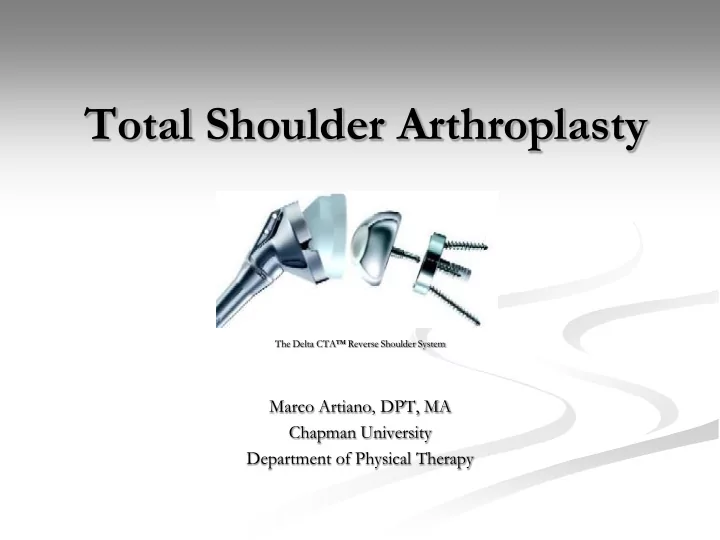
The Delta CTA™ Reverse Shoulder System
Marco Artiano, DPT, MA Chapman University Department of Physical Therapy
Total Shoulder Arthroplasty The Delta CTA Reverse Shoulder System - - PowerPoint PPT Presentation
Total Shoulder Arthroplasty The Delta CTA Reverse Shoulder System Marco Artiano, DPT, MA Chapman University Department of Physical Therapy Inspiration Shoulder Arthroplasty Over 23,000 shoulder arthroplasties are performed annually 1
The Delta CTA™ Reverse Shoulder System
Marco Artiano, DPT, MA Chapman University Department of Physical Therapy
Over 23,000 shoulder arthroplasties are performed
More than 10,000 are total shoulder arthroplasties Currently there is a 5% annual growth of shoulder
First shoulder arthroplasty Jules Pean (1893)3 Charles Neer (1955)4,5
Hemiarthroplasty to treat humeral head osteonecrosis,
fracture, and glenohumeral arthritis.
Complications leading to pain and decreased function
include:
Rotator cuff deficiency Abnormal glenoid surface Continued degeneration of glenoid surface
Solution: Total Shoulder Arthroplasty/ Replacement6
Supraspinatus Infraspinatus Teres minor Subscapularis
http://www.Shoulder1.com
http://www.shoulderdoc.co.uk http://www.nismat.org/orthocor/exam/shoulder.html
http://www.jointreplacement.com
Total arthroplasty Hemiarthroplasty Reverse arthroplasty
http://orthoinfo.aaos.org/fact www.umm.edu/orthopadic/rsr.html
particles from previous arthroplasty
Contraindications7
Loss of deltoid and rotator cuff musculature Severe brachial plexus injury Chronic infection Chronic osteomyelitis Substantial bone loss- especially at the glenoid
lpig.doereport.com/ imagescooked/1435W .jpg
http://www.orthop.washington.edu/uw/shoulderreplacement
http://www.orthop.washington.edu/uw/shoulderreplacement
The Delta CTA™ Reverse Shoulder System
Delta CTA Reverse Shoulder System: For End-Stage Cuff Tear Arthropathy DePuy Orthopaedics, Inc. 2000-2006, All rights reserved. http://www.jointreplacement.com
Indications8
The reverse design is used
in patients without an intact rotator cuff.
The reverse design
http://orthoinfo.aaos.org/fact/thr_report.cfm?thread_id= 291&topcategory=Shoulder
http://www.ejbjs.org/cgi/content/abstract/87/8/1697
Pain9 Infection10 Component loosening11 Fractures12 Inflammatory reactions13,22 Impingement of components-notching14
Review and meta-analysis15
McMaster University, Canada Compared 2 year post-operative outcomes between
hemiarthroplasty and TSA in patients with shoulder
Studies 1966-2004 Major orthopedic meetings 1995-2003
112 patients (50 hemi, 62 TSA)
Pain scores favored TSA Greater increased forward flexion (13 degrees) with TSA
Two-year Results After Exchange Shoulder Arthroplasty
(Katzer 2004)
Good short-term efficacy
Decreased Pain Increased ROM Generally considered better than hemiarthroplasty19,21
Long-term efficacy inconclusive
Osteoarthritis does progress and glenoid degeneration and
X-rays reveal micro-fissures of the peri-glenoid region
suggesting bone fracturing under the glenoid cap.17
Quality of Life Outcomes Following Hemiarthroplasty
42 patients with osteoarthritis randomized at time of surgery Outcomes measured at 3,6,12,18 and 24 months
Constant Score Pain scales- McGill and VAS WOOS Index Global health measure American Shoulder and Elbow Surgeons form
(Lo, et al. 2005)
(Lo, et al. 2005)
Conclusions
Both TSA and hemiarthroplasty improve disease
No significant measurement differences between the
Precautions
First 48 hours (until cleared by surgeon)
Arm in sling Limited active use of arm (e.g. eating) as comfortable No external rotation past neutral No active internal rotation No driving
2 days
*unless specified by surgeon
PROM
Pendulum exercises External rotation to the neutral only unless stated otherwise
Until scapular insertion heals
Forward flexion to 90 degrees
AROM exercises begin immediately after surgery*
Full ROM to elbow, wrist and hand Scapular exercises Forward flexion to 90 degrees to pain tolerance
3 weeks
Begin pulley and t-band exercises as tolerated May lift nothing heavier than coffee cup Begin aerobic exercise Goal:
Forward flexion to 90 degrees External rotation to neutral Scapular awareness
6 weeks
Increase external rotation beyond neutral as tolerated No limit to active forward flexion. Active assisted internal rotation as tolerated Wall walks Active elbow flexion and extension Scapular strengthening exercises Goal:
elevation to 120 degrees, external rotation to 25 degrees
After 12 weeks
Continue range of motion exercises and strengthening
exercises to full movement as tolerated.
Continue strengthening of all rotator cuff muscles.
Full recovery 12 to 18 months
www.aaos.org/wordhtml/research/stats/arthrop.htm
1999;365:100-3.
San Diego, CA. June 14-17, 2000.
arthroplasty in patients with osteoarthritis of the shoulder. J Bone Joint Surgery; Sept 2005; 87, 9; Pro Quest Journals. P. 1947.
CINAHL- Database of nursing and allied health literature. P. 814.
1165
680-690.
prosthesis or the Grammont prosthesis. J Bone and Joint Surgery. 2004.Vol 86 p 29.
arthroplasty in patients with osteoarthritis of the shoulder. J Bone Joint Surgery; Sept 2005; 87, 9; Pro Quest Journals. P. 1947.
Orthopedics; Nov 2004; 27, 11. p. 1165.
Surgical Technology Week. Atlanta: Mar 28, 2004. p.166.
prosthesis or the Grammont prosthesis. J Bone and Joint Surgery. 2004.Vol 86 p 29.
arthroplasty in patients with osteoarthritis of the shoulder. J Bone Joint Surgery; Sept 2005; 87, 9; Pro Quest Journals. P. 1947.
Joint Surgery. Oct 2005; 87, 10. p. 2178.
shoulder Elbow Surgery. 9(4): 323-331.
2004.vol.86, Iss. 8; p. 1187-92.
47.
25.Millet P. Total shoulder arthroplasty/hemiarthroplasty protocol. Brigham and Women’s Hospital. http://www.drmillett.com/image/59/tsa.doc. accessed July 7, 2006.