Topic 20 If they interact with each other, as when sharing a - - PDF document

topic 20
SMART_READER_LITE
LIVE PREVIEW

Topic 20 If they interact with each other, as when sharing a - - PDF document

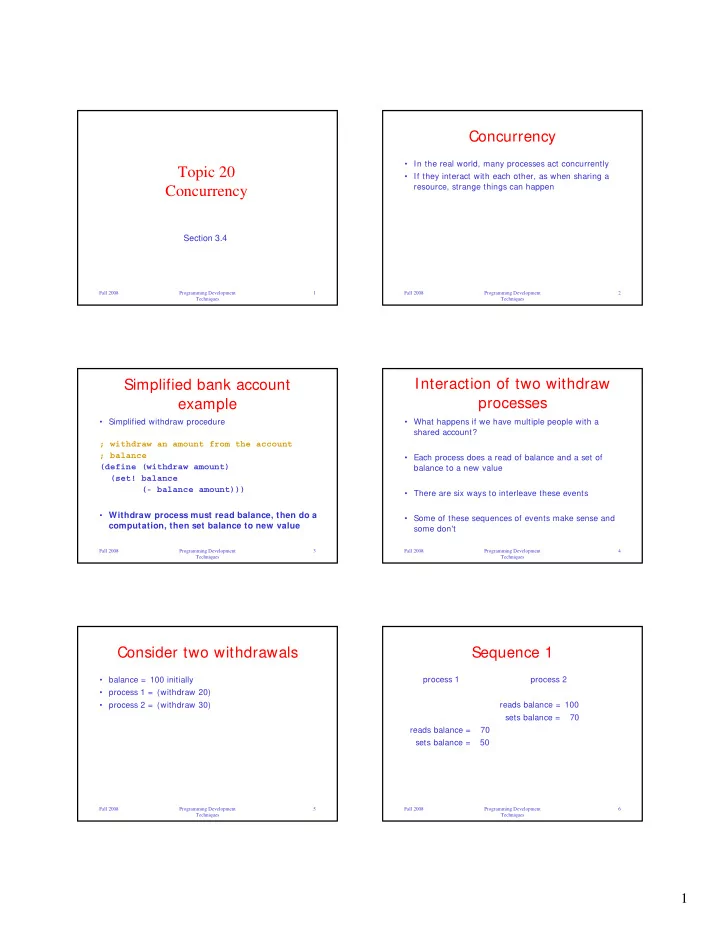
Concurrency In the real world, many processes act concurrently Topic 20 If they interact with each other, as when sharing a resource, strange things can happen Concurrency Section 3.4 Fall 2008 Programming Development 1 Fall 2008


slide-1
SLIDE 1

1

Fall 2008 Programming Development Techniques 1

Topic 20 Concurrency

Section 3.4

Fall 2008 Programming Development Techniques 2

Concurrency

  • In the real world, many processes act concurrently
  • If they interact with each other, as when sharing a

resource, strange things can happen

Fall 2008 Programming Development Techniques 3

Simplified bank account example

  • Simplified withdraw procedure

; withdraw an amount from the account ; balance (define (withdraw amount) (set! balance (- balance amount)))

  • Withdraw process must read balance, then do a

computation, then set balance to new value

Fall 2008 Programming Development Techniques 4

Interaction of two withdraw processes

  • What happens if we have multiple people with a

shared account?

  • Each process does a read of balance and a set of

balance to a new value

  • There are six ways to interleave these events
  • Some of these sequences of events make sense and

some don't

Fall 2008 Programming Development Techniques 5

Consider two withdrawals

  • balance = 100 initially
  • process 1 = (withdraw 20)
  • process 2 = (withdraw 30)

Fall 2008 Programming Development Techniques 6

Sequence 1

process 1 process 2 reads balance = 100 sets balance = 70 reads balance = 70 sets balance = 50

slide-2
SLIDE 2

2

Fall 2008 Programming Development Techniques 7

Sequence 2

process 1 process 2 reads balance = 100 reads balance = 100 sets balance = 70 sets balance = 80 ???

Fall 2008 Programming Development Techniques 8

Sequence 3

process 1 process 2 reads balance = 100 reads balance = 100 sets balance = 80 sets balance = 70 ???

Fall 2008 Programming Development Techniques 9

Sequence 4

process 1 process 2 reads balance = 100 reads balance = 100 sets balance = 70 sets balance = 80 ???

Fall 2008 Programming Development Techniques 10

Sequence 5

process 1 process 2 reads balance = 100 reads balance = 100 sets balance = 80 sets balance = 70 ???

Fall 2008 Programming Development Techniques 11

Sequence 6

process 1 process 2 reads balance = 100 sets balance = 80 reads balance = 80 sets balance = 50

Fall 2008 Programming Development Techniques 12

Interactions can be more complicated

  • Let x = 10
  • Let process 1 = (lambda () (set! x (* x x)))
  • Let process 2 = (lambda () (set! x (+ x 1)))
  • Process 1 must do two reads of x
  • Process 2 might change x between reads by process 1
  • Five different final values for x are possible
slide-3
SLIDE 3

3

Fall 2008 Programming Development Techniques 13

Notation

  • R1(n) means process 1 reads x, obtains n
  • R2(n) means process 2 reads x, obtains n
  • S1(n) means process 1 sets x to n
  • S2(n) means process 2 sets x to n
  • Process 1 does two reads, then a set
  • Process 2 does one read, then a set

Fall 2008 Programming Development Techniques 14

Five different results

x = 10 x = 10 x = 10 x = 10 x = 10 R1(10) R2(10) R2(10) R1(10) R1(10) R1(10) S2(11) R1(10) R1(10) R1(10) S1(100) R1(11) S2(11) R2(10) R2(10) R2(100) R1(11) R1(11) S1(100) S2(11) S2(101) S1(121) S1(110) S2(11) S1(100) x = 101 x = 121 x = 110 x = 11 x = 100

Fall 2008 Programming Development Techniques 15

The only way

The only way to prevent unwanted interactions is to serialize certain processes, that is, they have to occur sequentially rather than in parallel

Fall 2008 Programming Development Techniques 16

Concurrent processing in DrScheme

  • Must use Pretty-Big language
  • Procedures to be run concurrently must have no

arguments

  • Each procedure is run in a separate thread

Fall 2008 Programming Development Techniques 17

Parallel-execute

; cause parallel execution of args (define (parallel-execute . args) (map thread args))

  • Map creates a thread for each procedure
  • They start running immediately
  • Example:

; executes the two procedures in parallel (parallel-execute (lambda () (set! x (* x x))) (lambda () (set! x (+ x 1))))

Fall 2008 Programming Development Techniques 18

Serialization

  • Issue – several processes may share (and be able to

change) a common state variable. Need some way to isolate changes so that only one process can access/change the data at a time.

  • There are several ways to force procedures to run

sequentially – generally, allow us to interleave programs but constrain interleaving

  • Generally – have the process “acquire a flag” – while

that process has the flag, no other process can run until that flag is released.

slide-4
SLIDE 4

4

Fall 2008 Programming Development Techniques 19

Making a Serializer

  • Use a primitive synchronization mechanism called a

mutex.

  • Mutex’s can be acquired and released.
  • A mutex is a mutable object (e.g., a 1 element list)

that can hold the value of true or false.

  • When the value is false, it is available for being

acquired.

  • When the value is true, it is unavailable and the

process that wants it must wait…

Fall 2008 Programming Development Techniques 20

What is required?

  • To implement a mutex, need a mechanism for testing

it and setting it that can not be interrupted…

Fall 2008 Programming Development Techniques 21

Test-and-set!

  • Conceptually behaves like

; if cell is already #t then return #t otherwise ; set it to #t and return #f

(define (test-and-set! cell) (if (car cell) #t (begin (set-car! cell #t) #f)))

  • For this to work, it must not be interruptable
  • Exists as a single machine instruction on some

machines

Fall 2008 Programming Development Techniques 22

Test-and-set! behavior

(define cell1 (list #f)) (car cell1) --> #f (test-and-set! cell1) --> #f (car cell1) --> #t (test-and-set! cell1) --> #t What do we do with a flag like this? Use it for mutual exclusion purposes. Share flag among several processes – let them run only when they get the flag. Specific example of a semaphore.

Fall 2008 Programming Development Techniques 23

Mutual exclusion flag (mutex)

  • A boolean flag that is controlled by one process at a

time (because it is manipulated by test-and-set!)

  • Accepts 'acquire and 'release messages
  • A set of processes (that must be mutually exclusive)

will share the same flag. Grab the flag before they start, and release it when they are done.

  • In this way, only one process at a time can

manipulate the variable.

Fall 2008 Programming Development Techniques 24

Make-mutex

; provides a cell that can be used for ; mutual exclusion purposes among processes (define (make-mutex) (let ((cell (list #f))) (define (the-mutex m) (cond ((eq? m 'acquire) (if (test-and-set! cell) (the-mutex ‘acquire))) ;retry ((eq? m 'release) (clear! cell)))) the-mutex)) (define (clear! Cell) (set-car! Cell #f))

slide-5
SLIDE 5

5

Fall 2008 Programming Development Techniques 25

Serializers

  • A serializer is a higher-order procedure that converts
  • ther procedures into ones that can only run one at a

time

  • All the procedures that are processed by the same

serializer are run in sequence without interleaving

Fall 2008 Programming Development Techniques 26

Make-serializer

; make a serializer by creating a mutex ; to be shared by the mutually exclusive ; procedures (define (make-serializer) (let ((mutex (make-mutex))) (lambda (p) (define (serialized-p . args) (mutex 'acquire) (let ((value (apply p args))) (mutex 'release) value)) serialized-p)))

Fall 2008 Programming Development Techniques 27

Serialization guaranteed

(define s (make-serializer)) (parallel-execute (s (lambda () (set! x (* x x)))) (s (lambda () (set! x (+ x 1)))))

Fall 2008 Programming Development Techniques 28

Protecting bank accounts

; create a bank account that is protected and ; allows parallel execution (define (make-account balance) (define (withdraw amount) (if (>= balance amount) (begin (set! balance (- balance amount)) balance) "Insufficient funds")) (define (deposit amount) (set! balance (+ balance amount)) balance)

Fall 2008 Programming Development Techniques 29

continued

(let ((s (make-serializer))) (define (dispatch m) (cond ((eq? m 'withdraw) (s withdraw)) ((eq? m 'deposit) (s deposit)) ((eq? m 'balance) balance) (else (error "unknown msg-MAKE-ACCOUNT" m)))) dispatch))

Fall 2008 Programming Development Techniques 30

Works for simple transactions

  • Muliple processes withdrawing from and depositing to

the same account are serialized

  • Multiple accounts can still be withdrawn from and

deposited to concurrently

  • Problems can still arise if two or more resources are

involved in a transaction

slide-6
SLIDE 6

6

Fall 2008 Programming Development Techniques 31

Even accounts

; evens up two accounts by splitting the difference (define (even-accounts account1 account2) (if (< (account1 'balance) (account2 'balance)) (let ((temp account1)) ; swap accounts (set! account1 account2) (set! account2 temp))) (let ((amount (/ (- (account1 'balance) (account2 'balance)) 2))) ((account1 'withdraw) amount) ((account2 'deposit) amount)))

Fall 2008 Programming Development Techniques 32

What can happen

  • If two even-accounts processes run

concurrently on the same pair of accounts, it is still possible for the two accounts to end up with balances that are different from each

  • ther
  • To prevent this, processes need access to the

serializers of both accounts

  • Consider making the serializer available by

exporting it via message passing

Fall 2008 Programming Development Techniques 33

Making serializer accessible

; account that can export its serializer via ; Message passing (define (make-account-and-serializer balance) (define (withdraw amount) (if (>= balance amount) (begin (set! balance (- balance amount)) balance) "Insufficient funds")) (define (deposit amount) (set! balance (+ balance amount)) balance)

Fall 2008 Programming Development Techniques 34

continued

(let ((s (make-serializer))) (define (dispatch m) (cond ((eq? m 'withdraw?) withdraw) ((eq? m 'deposit) deposit) ((eq? m 'balance) balance) ((eq? m 'serializer) s) (else (error "unknown msg-MAKE-ACCOUNT" m)))) dispatch))

Fall 2008 Programming Development Techniques 35

Protected deposit

(define (deposit account amount) (let ((s (account 'serializer)) (d (account 'deposit))) ((s d) amount)))

Fall 2008 Programming Development Techniques 36

Protected withdraw

(define (withdraw account amount) (let ((s (account 'serializer)) (d (account 'withdraw))) ((s d) amount))) Disadvantage here is each user of bank- account objects have to explicitly manage the serialization. But, it allows us to run a protected even-accounts!

slide-7
SLIDE 7

7

Fall 2008 Programming Development Techniques 37

Protected even accounts

(define (even-accounts account1 account2) (define (transfer-funds account1 account2) (if (< (account1 'balance) (account2 'balance)) (let ((temp account1)) ; swap accounts (set! account1 account2) (set! account2 temp))) (let ((amount (/ (- (account1 'balance) (account2 'balance)) 2))) ((account1 'withdraw) amount) ((account2 'deposit) amount)))

Fall 2008 Programming Development Techniques 38

continued

(let ((s1 (account1 'serializer)) (s2 (account2 'serializer))) ((s1 (s2 transfer-funds)))))

Fall 2008 Programming Development Techniques 39

Our problems aren't over yet

  • Consider

(parallel-execute (even-accounts acc1 acc2) (even-accounts acc2 acc1))

  • Each process can grab one account (first arg)

and will be forced to wait forever to grab the

  • ther account (second arg)
  • This is called deadlock

Fall 2008 Programming Development Techniques 40

Preventing deadlock

  • One way is to order all the mutexes in a program and

always acquire mutexes in this order, release mutexes in reverse order

  • Other methods of deadlock avoidance and recovery

are being researched

  • Deadlock recovery may be needed in situations where

all the required resources are not known in advance; some have to be accessed first to decide which others are needed

Fall 2008 Programming Development Techniques 41

Extended concurrent processes

  • Concurrent processes that have complex interactions
  • ver a long period of time often need to synchronize

their actions

  • These processes are often allowed to communicate

with each other to achieve synchronization

  • Example: consumer-producer pair of processes