Top-Up ?? J. L. Revol On behalf of the Accelerator & Source - - PowerPoint PPT Presentation

top up
SMART_READER_LITE
LIVE PREVIEW

Top-Up ?? J. L. Revol On behalf of the Accelerator & Source - - PowerPoint PPT Presentation

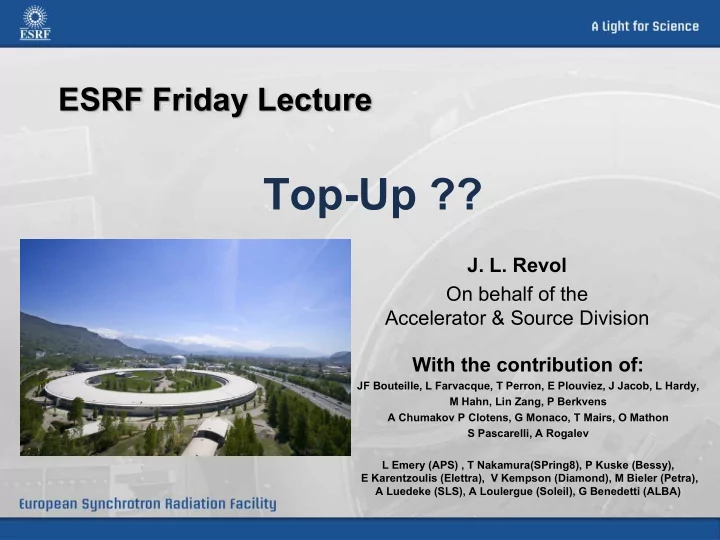
ESRF Friday Lecture Top-Up ?? J. L. Revol On behalf of the Accelerator & Source Division With the contribution of: JF Bouteille, L Farvacque, T Perron, E Plouviez, J Jacob, L Hardy, M Hahn, Lin Zang, P Berkvens A Chumakov P Clotens, G


slide-1
SLIDE 1

Top-Up ??

  • J. L. Revol

On behalf of the Accelerator & Source Division With the contribution of:

JF Bouteille, L Farvacque, T Perron, E Plouviez, J Jacob, L Hardy, M Hahn, Lin Zang, P Berkvens A Chumakov P Clotens, G Monaco, T Mairs, O Mathon S Pascarelli, A Rogalev L Emery (APS) , T Nakamura(SPring8), P Kuske (Bessy), E Karentzoulis (Elettra), V Kempson (Diamond), M Bieler (Petra), A Luedeke (SLS), A Loulergue (Soleil), G Benedetti (ALBA)

ESRF Friday Lecture

slide-2
SLIDE 2

ISDD Friday Lecture -- Top Up ??-- Revol JL, March 23rd, 2012 2

What is Top Up?

Compensate for beam decay

induced by the finite lifetime originating from the different loss processes (vacuum, Touschek, physical aperture, ...) By

Frequent injections

Which Top Up do we need at the ESRF? Which Top Up could we provide at the ESRF?

slide-3
SLIDE 3

ISDD Friday Lecture -- Top Up ??-- Revol JL, March 23rd, 2012 3

Top-Up Top-Up

Bessy II

Top-Up

Petra

Top-Up Top-Up

SLS

Top-Up Top-Up Top-Up Top-Up

APS

Top-Up every 12h

Decay mode

slide-4
SLIDE 4

ISDD Friday Lecture -- Top Up ??-- Revol JL, March 23rd, 2012 4

Con: Increased number of injections. Disturbs stability Pro: Reduced heat load variation on the beamline optics. Improves stability

Survey of Top Up operation at ESRF/ APS/ SPRing8/ PETRA/ SOLEIL/ DIAMOND/ BESSY/ ELETTRA/ ALBA /SLS Top Up is multi parameters with discrepancies between institutes!

slide-5
SLIDE 5

ISDD Friday Lecture -- Top Up ??-- Revol JL, March 23rd, 2012 5

Stability in current

Stability in current at SPring8: 0.03 % "If this level of stability is impossible to achieve, constant decay in ~ a few minutes is preferable.“ said spring8 operation physicist.

slide-6
SLIDE 6

ISDD Friday Lecture -- Top Up ??-- Revol JL, March 23rd, 2012 6

Stability in current

Current (mA) Delta I (mA) % SPring 8 100 0.03 0.03 Bessy 300 0.4 0.13 Elettra 300 1 0.3

ALBA 400 1 0.25

APS 100 0.5 0.5 SLS 400 2 0.5 Soleil 400 2 0.5 Diamond 250 2 0.8 Petra 100 1 1 ESRF 200 40 20 Lower variation is the best, but what is really needed for optics stability ??

slide-7
SLIDE 7

ISDD Friday Lecture -- Top Up ??-- Revol JL, March 23rd, 2012 7

  • Two issues in terms of optic stability at ESRF:
  • Short term stability
  • Long term stability
  • Heat load effects depends on electron beam current but also on:

Photon energy, slit aperture,... and optics and beamline design

  • ESRF has developed a lot of expertise in the design of the optics and in

the layout of beamlines to manage heat load variation, especially for the UPBLs, which should be less sensitive to refills.

  • Could we still gain (a lot) by reducing the current variation ?
  • What would be the (maximum) current variation which would

make a refill transparent? Difficult to get a single answer from the ESRF experts !! Beamlines have already made a lot of efforts to be less sensitive to heat load variation, solution optimized for the different techniques........ Only experimental data would really give precise information ..

slide-8
SLIDE 8

ISDD Friday Lecture -- Top Up ??-- Revol JL, March 23rd, 2012 8

Heat-load on the Si(111) monochromator UPBL06 Inelastic scattering- TDR

Thermal slope error on the first crystal

Displacement field at the beam spot of the first crystal (7 keV) Power on the crystal: 5 mA →10 W 100 mA →200 W 200 mA →400 W 240 mA →475 W

Change the beam divergence corrected by vertically deflecting white beam mirror mounted on a bender

Short term stability

slide-9
SLIDE 9

ISDD Friday Lecture -- Top Up ??-- Revol JL, March 23rd, 2012 9

50 100 150 200 250 300 5 10 15

slits, ΔHxΔV (mm

2)

2.0 x 1.0

Rocking curve FWHM (μrad) Storage ring current (mA) Si(333) at 43.236 keV

  • 4
  • 3
  • 2
  • 1

1 2 3 4 5 10 15

10 mA 50 mA 100 mA 150 mA 200 mA 250 mA 300 mA

Slit 2 x 1 mm

2

Horizontal position (mm) Surface height (nm)

Bragg angle narrow vertical slit at various vertical positions

Setup:

ID18 Measurement of crystal curvature

Short term stability

Optics optimized for 200 mA Ideal collimation between 160 and 200 mA, crystal flat due to the power deposit But crystal too cold to be ideally flat between 60 and 90 mA More disturbance in 16bunch than in 7/8+1

16 Bunch 7/8+1 16 Bunch 7/8+1

slide-10
SLIDE 10

ISDD Friday Lecture -- Top Up ??-- Revol JL, March 23rd, 2012 10

Long term stability

Sensitive to short term and long term thermal effects. Optimization of the design and feedback on the slits as a function of the beam current to maintain a constant thermal load

10000 20000 30000 40000 50000

  • 50
  • 40
  • 30
  • 20
  • 10

10 20 30 40 50 60 70 80 90 100 110 120 130

Stability (μm) time (s) Stability on a long timescale 2008 Horizontal 2008 Vertical 2011 Horizontal 2011 Vertical

ID24/ UPBL11 Time resolved and Extreme conditions X-ray Absorption Spectroscopy

But the stability of the

  • ptics is still a strong

issue with the present ΔI, especially with the use of the 4 undulators.

slide-11
SLIDE 11

ISDD Friday Lecture -- Top Up ??-- Revol JL, March 23rd, 2012 11

Stability Number of shots Time between injection SPring 8 0.03 % One ≈ 2 to 3 mn

Hybrid 10 to 30 sec

Bessy 0.13 % One ≈ 20 to 30 sec Soleil 0.5 % One ≈ 2 to 5 mn Elettra 0.3 % 20 shots ≈ 6 mn at 2 GeV

25 mn at 2.5 GeV

SLS 0.5 % 10 shots ≈ 1 to 2 mn Petra 1 % 40-50 low

charge shots

≈ 8 mn

1 mn (timing mode)

APS ≈ 0.5 % One 1 and 2 mn Diamond ≈ 0.8 % Few 10 mn ESRF ≈ 20% 400 12 hours

Injection at fixed Delta I Injection at fixed Delta Time

Two Operating Modes

slide-12
SLIDE 12

ISDD Friday Lecture -- Top Up ??-- Revol JL, March 23rd, 2012 12

Stability perturbation induced by an injection:

Injection kickers Depends on the closure of the bump and on the lattice Injection septum Depends on the magnet design and shielding Booster magnets field Depends on the leaking magnetic field, the shielding, the compensation field and the fast orbit feedback performances Cleaning process Depends on the process

slide-13
SLIDE 13

ISDD Friday Lecture -- Top Up ??-- Revol JL, March 23rd, 2012 13

K1 K2 K3 K4 Septum

Stored beam

SR axis

Shielding

Ideal situation: Bump is perfectly closed, even during transient Septum is perfectly shielded Stored beam is moved close to the injected beam via K1,2,3,4 Injected beam is moved close to the stored beam via septum and K3,4 For the duration of the injected beam pulse (= booster length= 1μs at ESRF) Never perfectly achieved in any of the machines For each shot, the stored beam is shacked and damped with the transverse damping time given by the lattice (typically a few ms)

Typical injection perturbation

slide-14
SLIDE 14

ISDD Friday Lecture -- Top Up ??-- Revol JL, March 23rd, 2012 14

K1 K2 K3 K4 Septum

Stored beam

SR axis

Shielding

Typical injection perturbation

  • Stored beam is disturbed
  • ± 250 um horizontally
  • ± 150 um vertically
  • Lasts 10 to 12 msec.

“The issue is we have to actively maintain the tuning of the injection system kicker magnets to keep it at a minimum, then because we are pretty sure that our users can’t see the kick we have been a bit more relaxed about keeping it at a minimum and retune kickers less often leading to a higher value. We have also found the injection efficiency is not necessarily optimum at these minimum levels of stray kick”. Said Diamond Operation Manager...

slide-15
SLIDE 15

ISDD Friday Lecture -- Top Up ??-- Revol JL, March 23rd, 2012 15

H Stability perturbation V Stability perturbation Sextupoles in the bump

μm

μm

SLS Negligible 40 No Soleil 100 (peak) 70 (rms) 50 No Elettra 100 (peak) 20 No Petra 100 10 No Diamond 250 (peak) 150 No Bessy 500 (peak) 1000 No SPring 8 400 (peak);(<200 rms) 1 Yes (strength optimized) ESRF 1700 (peak) 100 Yes (4) APS 3000 (peak) 200 Yes (14) All machines are in the μm stability standards, injection disturbs all machines for ≈ a few ms time ! Need gating for the most demanding experiments

slide-16
SLIDE 16

ISDD Friday Lecture -- Top Up ??-- Revol JL, March 23rd, 2012 16

Usage of gating trigger SLS Trigger provided, used by some Soleil Trigger provided, not used Elettra Trigger provided to 2 beamlines Petra Trigger provided, not used Diamond Trigger provided, very few use Bessy Trigger provided SPring 8 Trigger provided, not used ESRF Software trigger provided, used by a few APS Trigger provided, not used Need gating for the most demanding experiments Very little use of gating !!

slide-17
SLIDE 17

ISDD Friday Lecture -- Top Up ??-- Revol JL, March 23rd, 2012 17

Booster power supply type Injection Every Number of Kicks SPring 8 Ramping 1 Hz 2 mn One APS Ramping 2Hz 1 mn One Elettra Ramping 2Hz 6 mn Few Soleil Ramping 3Hz 2 mn One SLS Ramping 3Hz 1 mn Few Diamond Ramping 5Hz 10 mn Few Bessy Resonant 10Hz 20 sec One ESRF Resonant 10Hz 12 hours Few Petra Resonant 12Hz 8 mn Few Resonant power supply is more efficient. Ramping power supply is more flexible Is few shots injection mode worse? Main issues for Top-Up: Reproducibility & Switching ON sequence

slide-18
SLIDE 18

ISDD Friday Lecture -- Top Up ??-- Revol JL, March 23rd, 2012 18

UPBL 4: NINA Nano-Imaging and Nano-Analysis NINA will not be sensitive to heat load variation

(Beam horizontally cut by the primary slits)

…But doing acquisition with 1ms acquisition time Sensitive to fast disturbance during image scan Sensitive to vertical emittance variation ID12: Circular Polarisation Beamline Not sensitive to heat load variation But making a difference between scans with different polarization Sensitive to very small disturbance during acquisition scan

  • r between two scans (one scan is ≈10 mn)

No disturbance for at least 20 mn would be the best.

slide-19
SLIDE 19

ISDD Friday Lecture -- Top Up ??-- Revol JL, March 23rd, 2012 19

Reliability of the injector is mandatory to benefit from Top_Up

Reliability of the injector Soleil Close to 100 % Bessy Very good SLS 99.4 Petra 98 % APS 97.6 % Elettra 97 % Diamond 44 missed injections SPring 8 > 8 hours MTBF ESRF

Bad for Top-Up, but presently not an issue , could be improved

Ideal issue: Sustain a few missed injections at the beamline

281 hours

slide-20
SLIDE 20

ISDD Friday Lecture -- Top Up ??-- Revol JL, March 23rd, 2012 20

Multibunch Current in 7/8+1 mA 196 + 4 Horizontal emittance nm

4

Vertical emittance

pm 3.5

Lifetime at 200 mA h 45 Reduction of the lifetime in multibunch limited to less than 10 hours despite a reduction of the coupling by one order of magnitude For a few weeks at the beginning of 2011, to compensate for the reduction in lifetime, the number of refills was increased from 2 to 3 per day, with a long decay during the night and two shorter decays during day time. Current variation / 2 After investigation, beamline scientists report that they prefer 2 long

  • decays. .....

now back to 2 refill/day

Current variation still too high to be beneficial Or Large current variation already sustained

slide-21
SLIDE 21

21

91 % of Beam time available for Timing Experiments

Filling modes

ISDD Friday Lecture -- Top Up ??-- Revol JL, March 23rd, 2012

Need cleaning at each injection

slide-22
SLIDE 22

ISDD Friday Lecture -- Top Up ??-- Revol JL, March 23rd, 2012 22

Cleaning process SPring 8

In the booster

APS

In the particle accumulator ring (upstream booster) Envisaged in the Booster

ESRF

In the SR Tested in the booster

Soleil

No, Envisaged in the booster

Bessy

No, Envisaged in the SR

SLS

No

Petra

No

Elettra

No

Diamond

No

Operational at ESRF

Robust, but generates a vertical blow up Tested at ESRF, but need more work: Not efficient at the gun of the Linac due to dark current produced in the accelerating sections Not reproducible enough in the booster Operational at SPring8 Flat top during the ramping of the booster

In the storage ring In the injector

slide-23
SLIDE 23

ISDD Friday Lecture -- Top Up ??-- Revol JL, March 23rd, 2012 23

Vertical emittance 6 pm 4 pm 160 mA 200 mA

9h00 9h05

Injection ≈< 1mn [600 kicks] Cleaning = 20 sec

3 Dec 2011 11 Sep 2011

Vertical emittance 8 pm 6 pm 57 mA 91 mA

9h00 9h05

Injection ≈> 1mn [600 kicks] Cleaning = 2 *20 sec 27 pm 42 pm

3000 pm !!

Refill in 16 Bunch Refill in 7/8+1 During Injection [1mn] beam is shacked every 100 ms for a few ms

Which results in a small vertical emittance blow up measured by our averaging diagnostic

During Cleaning [20 sec] In 7/8+1: small blow up: Only single bunch (4mA) excited

(gated cleaning)

In 16 bunch: strong blow up: Beam is excited for 20 sec

Which results in an increase of the vertical emittance to 3000 pm !! Extremely high perturbation !! A new method using the bunch by bunch feedback electronics is now available with a the blow -up <50 pm Users are often confused between blow up by injection and blow up by cleaning!

slide-24
SLIDE 24

ISDD Friday Lecture -- Top Up ??-- Revol JL, March 23rd, 2012 24

16Bunch (20%of user time) A mode to improve !!

Delivery at low vertical emittance 5 pm (instead of 40-30 pm, with excitation being f(I)) Lifetime of 6 hours instead of 12 hours Reduction of the current variation: Today 40% with 4 refills /day and a vertical emittance *10 Proposed : Refill every 30mn (preserving long decay, for stable data acquisition) Max current 90mA, (decaying to ≈ 82 mA) Improved cleaning in the SR (50 pm blow up),

continue the development in the injector.

Refill time reduced to less than 2mn (with automation) Proposal: Could be tested during MDT time on 29 May and 5 June

Or other MDTs

slide-25
SLIDE 25

ISDD Friday Lecture -- Top Up ??-- Revol JL, March 23rd, 2012 25

Reliability of injector (....including control..), Strongly depends on the injection frequency Opening of the In-Vacuum during injection Electrical consumption

Strongly depends on Δt, (for ΔT=30mn: < 0.5 MWh/h, < 40€/h, 1000€/day) improved with, SSA RF on the booster, Faster switching ON sequence on BPSS

Improve present BPSS control. New booster Power Supply ? New injection scheme using no linear kickers Improved septum Injection efficiency Filling pattern diagnostics Improved purity diagnostics in the SR and in the Booster Cleaning in the booster Stability and reproducibility of the Linac and of the Injection/extraction elements ............................. But one of the most important issues is the required minimum stability To be worked out with the beamlines during MDT A lot of additional issues have to be worked on or investigated.......... To determine the optimum ΔI and Time between Injection

slide-26
SLIDE 26

ISDD Friday Lecture -- Top Up ??-- Revol JL, March 23rd, 2012 26

Mode multibunch 200 mA,45h, 5pm vertical emittance, no cleaning :

Injector multibunch 5ma, efficiency ≈70%, ΔI/shot= 1 mA 1 shot Δt >≈ 15 mn

  • ΔI ≈ 1

mA

  • stability≈ 0.5

% Δt= 30 mn

  • ≈2

shots ΔI<≈ 2 mA

  • stability≈ 1

% Δt= 300 mn

  • ≈20

shots ΔI<≈20 mA

  • stability≈ 10

%

Mode 7/8 200 mA, 45h, 5pm vertical emittance, cleaning:

Injector single 0.1mA, efficiency ≈70%, ΔI/shot= 0.02 mA

1 shot Δt >≈ 20 sec

  • ΔI ≈ 0.02 mA
  • stability≈ 0.01

% Δt= 3 mn

  • ≈10

shots ΔI<≈ 0.2 mA

  • stability≈ 0.1

% Δt= 30 mn

  • ≈100

shots ΔI<≈ 2 mA

  • stability≈ 1

% Δt= 300 mn

  • ≈1000

shots ΔI<≈ 20 mA

  • stability≈ 10

%

Mode 16 bunch 90 mA, 6h, 6pm vertical emittance, cleaning:

Injector single 0.1 ma *5 bunch, efficiency ≈70%, ΔI/shot= 0.1 mA

1 shot Δt >≈ 20 sec

  • ΔI ≈ 0.1 mA
  • stability≈ 0.1

% Δt= 1 mn

  • ≈3

shots ΔI<≈ 0.3 mA

  • stability≈ 0.3

% Δt= 3 mn

  • ≈10

shots ΔI<≈ 1 mA

  • stability≈ 1

% Δt= 30 mn

  • ≈100

shots ΔI<≈ 10 mA

  • stability≈ 10

%

Single shot or few shots for ESRF??

(Figures are order of magnitude)

Standard decay 2mA 30mn

slide-27
SLIDE 27

ISDD Friday Lecture -- Top Up ??-- Revol JL, March 23rd, 2012 27

MANY thanks for your attention