Less is More Neil Heseltine Hill Top Farm Malham @hilltopfarmgirl - - PowerPoint PPT Presentation

less is more
SMART_READER_LITE
LIVE PREVIEW

Less is More Neil Heseltine Hill Top Farm Malham @hilltopfarmgirl - - PowerPoint PPT Presentation

Less is More Neil Heseltine Hill Top Farm Malham @hilltopfarmgirl Hill Top Farm @hilltopfarmgirl HILL TOP FARM Live & work at Hill Top Farm, Malham; 300 acre family farm, Grandparents moved here in 1950 as tenants; Parents


slide-1
SLIDE 1

Less is More

@hilltopfarmgirl
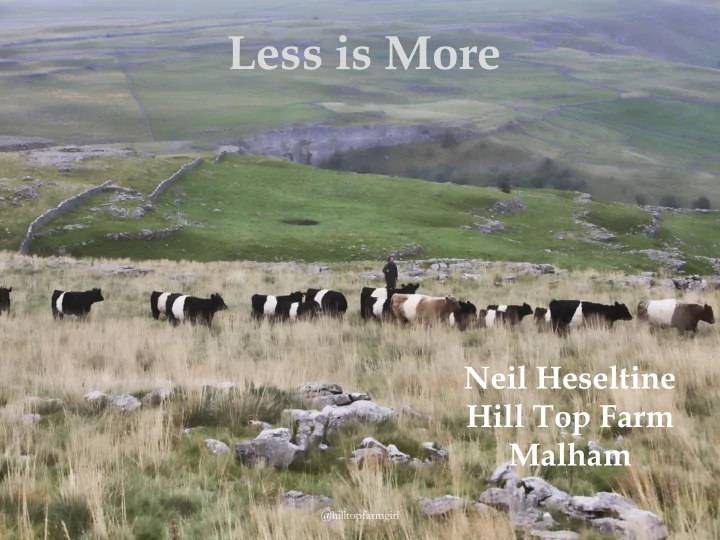
Neil Heseltine Hill Top Farm Malham

slide-2
SLIDE 2

Hill Top Farm

@hilltopfarmgirl

slide-3
SLIDE 3

HILL TOP FARM

  • Live & work at Hill Top Farm,

Malham;

  • 300 acre family farm,

Grandparents moved here in 1950 as tenants;

  • Parents bought it in 1980;
  • Parents converted cow

shed to bunk barn accommodation in 1987;

  • Leigh runs family holiday

cottage and bunk barn;

  • Cattle reintroduced 2003.

@hilltopfarmgirl

slide-4
SLIDE 4

HILL TOP FARM

  • Built up to 1100 acres, split

between Malhamdale and Littondale;

  • Bought 200 acres;
  • 500 acres rented from private

landlords;

  • 100 acres rented from National

Trust;

  • All Less Favoured Area (LFA);
  • All Severely Disadvantaged;
  • All limestone permanent

pasture;

  • All under HLS/ELS schemes;
  • Heights ranging between 800-

1800ft above sea level.

@hilltopfarmgirl

slide-5
SLIDE 5

SOCIAL MEDIA

@hilltopfarmgirl

slide-6
SLIDE 6

HILL TOP FARM

  • 400 Swaledale ewes;
  • 300 crossed with BFL ram;
  • 100 bred pure to Swaledale

ram;

  • Dipping, clipping, dosing,

scanning;

  • Lambing in mid March;
  • Ewes fed concentrates over

winter and spring;

  • Wethers sold as stores/fat by

end of August;

  • Mule gimmers sold for

breeding in September;

  • Lambs creep fed through

summer.

@hilltopfarmgirl

slide-7
SLIDE 7

THE TUP – NOT ME LOCAL CHAMPION MALHAM SHOW 2013

@hilltopfarmgirl

slide-8
SLIDE 8

HILL TOP FARM

  • 20 Belted Galloway

breeding cattle introduced in 2003;

  • 120 in total;
  • Hardy native breed;
  • Out wintered on the hill, fed

hay in adverse weather conditions;

  • Extensively managed;
  • Low labour input;
  • Entirely grass fed;
  • Conservation grazers
  • Improve biodiversity and

wildlife habitat

@hilltopfarmgirl

slide-9
SLIDE 9

WILDLIFE HABITAT

Photo by @neil_bilsborough Photo by Brian Rabbitts

@hilltopfarmgirl

slide-10
SLIDE 10

WILDLIFE HABITAT

@hilltopfarmgirl

slide-11
SLIDE 11

BIODIVERSITY - PLANTS

@hilltopfarmgirl

slide-12
SLIDE 12

HILL TOP FARM

SHEEP

  • Higher output
  • High feed costs
  • Labour intensive
  • Environmental Impact
  • Marketed as a

commodity

  • Regular

worming/vaccination programme

CATTLE

  • Lower output
  • No purchased feeds
  • Minimal intervention
  • Increased biodiversity
  • Marketed as a

premium product

  • Zero routine treatments

@hilltopfarmgirl

slide-13
SLIDE 13

HILL TOP FARM 2012 COSTINGS

SHEEP

  • Sales

£59,318

  • Labour

£12,000

  • Feed

£15,178

  • Haulage

£ 320

  • Other costs

£11,202

  • Livestock purchases

£18,900

  • Vets costs

£ 1,240

  • Total

£58,840

  • Contribution to drawings

£ 478

CATTLE

  • £17,828
  • £ 1,755
  • £ 270
  • £ 668
  • £ 3,675
  • £ 220
  • £ 6,588
  • £11,240

@hilltopfarmgirl

slide-14
SLIDE 14

HILL TOP FARM SHEEP

Replicate the lessons we have learnt from the cattle enterprise:

  • The right breed for the right situation
  • Allow sheep to exhibit natural behaviour

To achieve this?

  • Breed is crucial
  • An extensive system – reduce breeding ewe numbers to

200

  • Lambing in late April, early May

@hilltopfarmgirl

slide-15
SLIDE 15

HILL TOP FARM CURRENT COSTINGS

SHEEP

  • Sales
  • Labour
  • Feed
  • Haulage
  • Other costs
  • Livestock purchases
  • Vets costs
  • Total
  • Contribution

CATTLE

2016 £ 32,081 750 3,724 2,600 7,042 186 14,302 17,779 2016 £ 21,310 1,260 500 1,318 3,040 117 6,265 15,045 2012 £ 59,318 12,000 15,178 320 11,202 18,900 1,240 58,840 478 2012 £ 17,828 1,755 270 668 3,675 220 117 6,588 11,240

@hilltopfarmgirl

slide-16
SLIDE 16

CONCLUSION

Reducing sheep numbers has resulted in:

  • Lower impact on the environment
  • Improved sheep health
  • Increased quality of family life
  • Good business decision

@hilltopfarmgirl

slide-17
SLIDE 17

LIFE AND TRADITION IN THE DALES

  • Emphasising nature
  • Improving resilience
  • Retaining farming families
  • Continuation of farming communities
  • LESS IS MORE!

@hilltopfarmgirl

slide-18
SLIDE 18

HOW DOES IT FEEL BY HARRIET FRASER

@hilltopfarmgirl