Top polarisation at colliders Top polarisation: what physics can - - PowerPoint PPT Presentation

top polarisation at colliders top polarisation what
SMART_READER_LITE
LIVE PREVIEW

Top polarisation at colliders Top polarisation: what physics can - - PowerPoint PPT Presentation

Top polarisation at colliders. Rohini M. Godbole Top polarisation at colliders Top polarisation: what physics can it probe Probes of the top polarisation and effects of anomalous coupling on them. Example of use of angular


slide-1
SLIDE 1

Top polarisation at colliders. Rohini M. Godbole

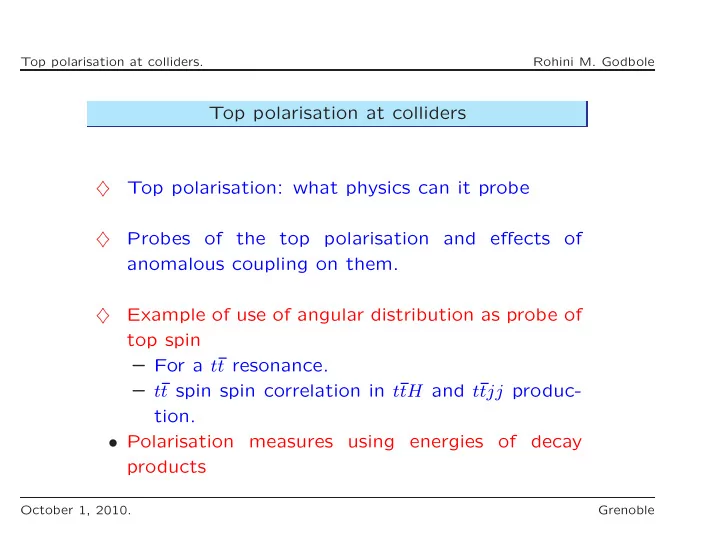
Top polarisation at colliders ♦ Top polarisation: what physics can it probe ♦ Probes of the top polarisation and effects of anomalous coupling on them. ♦ Example of use of angular distribution as probe of top spin – For a t¯ t resonance. – t¯ t spin spin correlation in t¯ tH and t¯ tjj produc- tion.

  • Polarisation

measures using energies

  • f

decay products

October 1, 2010. Grenoble

slide-2
SLIDE 2

Top polarisation at colliders. Rohini M. Godbole

Based in part on 1)RG, Rindani and SinghJHEP 0612, 021 (2006), 2)D. Choudhury, R. G. , S.D. Rindani, R. Singh and K. Wagh, in hep-ph/0602198 3) RG, S.D. Rindani, Kumar Rao, Ritesh Singh.arXiv:1010.XXXX 4)D. Choudhury, RG, Pratishruti Saha (in preparation) arXiv: 10YY:XXXX

October 1, 2010. Grenoble

slide-3
SLIDE 3

Top polarisation at colliders. Introduction

Top quarks at the LHC:

  • Copious production of t¯

t pairs at LHC (SM c.s. ≈ 800 pb at 14 TeV)

  • Large single top production (seen at Tevatron)
  • Important role in new physics signatures: Top quarks can also arise

in the decays of new particles – resonances, new gauge bosons, Higgs bosons, squarks, gluinos . . .

  • Template for issues in new physics : example of determination of

spin and mass!

  • Most important background to a lot of new physics. What features

can be used effectively to de lineate SM from BSM tops!

  • Polarisation can be one important handle.

October 1, 2010. Grenoble

slide-4
SLIDE 4

Top polarisation at colliders. Production mechanisms and top polarization

  • Top polarization can give more information about the production

mechanism than just the cross section does.

  • Top partners with the different spin (SUSY) or same spin UED/Little

Higgs..

Shelton : PRD 79, Nojiri et al JHEP, Perelstein. Produce t in cascade de-

cays of top partners and top polarisation can carry information on the model parameters. Polarisation measurement can provide model parameter information, mdoel descrimination, kinematic features due to polarisation effects can be used efffectively to isolate signal from background in searches.

  • Non zero polarisation requires parity violation, and hence measures

left-right mixing. R-parity violating SUSY can give rise to nonzero top polarisation (Hikasa PRD, 1999).

  • It can give a clue to CP violation through dipole couplings.

October 1, 2010. Grenoble

slide-5
SLIDE 5

Top polarisation at colliders. Specific models

One example is t¯ t resonance with Parity violating couplings. Look for illustration at an extra Z model. Little Higgs model has an extra massive gauge boson ZH with (left) right-handed couplings to fermions depending on one parameter (θ) gu

V = (−)gu A = g cot θ

gd

V = (−)gd A = −g cot θ

t¯ t production and decay via γ, Z, Z′ depends only on two new param- eters: mZ′ and cot θ. SM t¯ t production through QCD. mt¯

t distribution for total (unpolarised) c.section and polarised (dσR/dmt¯ t−

dσL/dmt¯

t) (only the new physics contribution).

October 1, 2010. Grenoble

slide-6
SLIDE 6

Top polarisation at colliders. t¯ t invariant mass distribution

−0.05 0.05 0.1 0.15 0.2 0.25 900 1000 1100 1200 1300 1400 dσ/dM

tt −

(pb/GeV) M

tt −

(GeV) Unpolarized Polarized SM, Unpolarized (X100) SM, Polarized

The model can be tested using the t¯ t invariant mass distribution Polarization can be a further more sensitive test and also tool to get information on the couplings.

October 1, 2010. Grenoble

slide-7
SLIDE 7

Top polarisation at colliders. Top longitudinal polarization

Pt ≡ σR−σL

σR+σL

Can be enhanced using cuts on mt¯

t

0.05 0.1 0.15 0.2 0.25 600 800 1000 1200 1400 Polarization M

Z’ (GeV)

cot θ = 1.2 cot θ = 1.6 cot θ = 2.0

October 1, 2010. Grenoble

slide-8
SLIDE 8

Top polarisation at colliders. R-parity violating SUSY

Hikasa PRD 60, 114041, 99

d R
  • d
R ~ e i L t L
  • t
L (a) d R
  • d
R ~ d i R t R
  • t
R (b)

Expected polarisation at Tevatron:

October 1, 2010. Grenoble

slide-9
SLIDE 9

Top polarisation at colliders. R-parity violating SUSY

Expected poalrisation at the Tevatron:

October 1, 2010. Grenoble

slide-10
SLIDE 10

Top polarisation at colliders. BSM characterisation using top polarisation

CDF and D0 reported FB asymmetry in t¯ t production D0:PRL 100, 142002

(2008), CDF: PRL 101, 202001 (2008).

At

FB = 0.193 ± 0.0065 ± 0.024

CDF published result, newer value somewhat lower SM expectation (NLO : Rodrigo/Kuehn) : 0.051

October 1, 2010. Grenoble

slide-11
SLIDE 11

Top polarisation at colliders. BSM characterisation using top polarisation

A host of new physics models: Examples of some which explain most of the observed features ’sat- isfactorily’ 1)t-channel colour triplet (sextet) scalar object: (generalisation of RPV case above, but not necessarily chiral couplings) J. Shu, T. M. P. Tait,

  • K. Wang, PRL D81, 034012 (2010)

2) t-channel colour singlet vector exchange:

  • S. Jung, H. Murayama, A. Pierce

et al., PR D81, 015004 (2010) Chiral couplings.

3) s-channel strongly interacting vector exchange: (axigluon: (pre)dicted :D. Choudhury, RG, Singh and Wagh, PLB 657 (2007) 69: alas wrong sign!) Generalisation: flavour non-universal axigluon

  • P. Frampton, J. Shu and K.

Wang, PLB 683 (2010) 294. Non-chiral couplings. October 1, 2010. Grenoble

slide-12
SLIDE 12

Top polarisation at colliders. BSM characterisation using top polarisation

The Forward backward top asymmetry origniates due to different reasons in different model explanations. The chirality structure is also different. Expected top polarisation can be different.

October 1, 2010. Grenoble

slide-13
SLIDE 13

Top polarisation at colliders. BSM characterisation using top polarisation

  • 0.2
  • 0.1

0.1 0.2 0.3

  • 0.05

0.05 0.1 0.15 0.2 0.25 0.3 0.35 0.4 AP AFB Φ Z′ A

Φ : Tait et al colour triplet/sextet scalar Z′: Murayama, Wells t–channel vector A: Flavour nonuniversal axigluons. In all the three different models expected top po- larisation quite different for different physics ex- planations. Corrleation between top polarisation and FB asymmetry quite different. Exploring Measurement

  • f top polarisation a use-

ful tool to get informa- tion on production mech- anism.

October 1, 2010. Grenoble

slide-14
SLIDE 14

Top polarisation at colliders. Top spin correlation vs. single top polarization

When t and ¯ t are produced, a useful observable is top spin correlation: 1 σ dσ d cos θad cos θb = 1 4(1 + B1 cos θa + B2 cos θb − C cos θa cos θb) This has been very well studied theoretically (for example: t¯ tH, t¯ t produced in RS Graviton decay etc.) Needs reconstruction of both t and ¯ t rest frames. It is conceivable that single top polarization can give better statistics.

October 1, 2010. Grenoble

slide-15
SLIDE 15

Top polarisation at colliders. Measuring Polarisation

Polarisation can be measured by studying the decay distribution of a decay fermion f in the rest frame of the top: 1 Γ dΓ d cos θf = 1 2

  • 1 + Ptκf cos θf
  • ,

θf is the angle between the f momentum and the top momentum, Pt is the degree of top polarization, κf is the “analyzing power” of the final-state particle f. κf depends on the weak isospin and the mass of decay product f.

October 1, 2010. Grenoble

slide-16
SLIDE 16

Top polarisation at colliders. Analyzing power for various channels

The analyzing power kf for various channels is given by: κb = −m2

t − 2m2 W

m2

t + 2m2 W

≃ −0.4 κW = −κb ≃ 0.4 κℓ+ = κd = 1; κu = κνl = −0.31

  • The charged lepton or d quark has the best analysing power
  • d-quark jet cannot be distinguished from the u-quark jet.
  • In the top rest frame the down quark is on average less energetic

than the up quark. Thus the less energetic of the two light quark jets can be used. Net spin analyzing power is κj ≃ 0.5

October 1, 2010. Grenoble

slide-17
SLIDE 17

Top polarisation at colliders. Corrections to the analyzing power

Leading QCD corrections to κb and κj are of order a few per cent. QCD corrections decrease |κ| [Brandenburg,Si,Uwer 2002] κ also affected by corrections to the form of the tbW coupling (“anoma- lous couplings”) It is useful to have a way of measuring polarization independent of such corrections. Also useful is distribution in lab. frame, rather than in top rest frame. κf for ℓ+ and down-quark is unchanged by anom. tbW vertex (RG, Rindani, Singh)

October 1, 2010. Grenoble

slide-18
SLIDE 18

Top polarisation at colliders. Lab observables?

Angular distribution of the decay lepton l in the rest frame of the top is the most efficient polarisation observable. Which of the kinematic observables of the decay lepton as measured in the lab frame carry this polarisation information faithfully? What are the special issues here since LHC is a pp machine. For highly boosted tops : what about rest frame reconstruction and angle measurements?

October 1, 2010. Grenoble

slide-19
SLIDE 19

Top polarisation at colliders. A “theorem”

The angular distribution of charged leptons (down quarks) from top decay is not affected by anomalous tbW couplings (to linear order)

Rindani, Singh, Godbole

Checked earlier for e−e+ → t¯ t

[Grzadkowski & Hioki, Rindani (2000)] and for

γγ → t¯ t [Grzadkowski & Hioki; Godbole, Rindani, Singh] This is shown for any general process A+B → t+X in the c.m. frame

[Godbole, Rindani, Singh (2006)]

Assumes narrow-width approximation for the top This implies that charged-lepton angular distributions are more accu- rate probes of top polarization, rather than energy distributions or b

  • r W angular distributions.

How can these be best used?

October 1, 2010. Grenoble

slide-20
SLIDE 20

Top polarisation at colliders.

  • Amom. tbW couplings.

Anomalous tbW couplings General ¯ tbW vertex can be written as Γµ = g √ 2

  • γµ(f1LPL + f1RPR) − iσµν

mW (pt − pb)ν (f2LPL + f2RPR)

  • .

In SM, f1L = 1, f1R = f2L = f2R = 0. Deviations from these values will denote “anomalous” couplings Current liimits: Bernreuther, J. Phys. G., Nucl. Part. Phys. 35 (2008) Only f2R can be nontrivial. −0.57 < f2R < 0.15 Talk by Tony Liss at Top Workshop at CERN: |f2R|2 < 0.20

October 1, 2010. Grenoble

slide-21
SLIDE 21

Top polarisation at colliders.

  • Amom. tbW couplings.

Lepton energy distribution and anomalous couplings Various energy and angular distributions can be measured in top decay. Energies of lepton, b jet, light jets, and their angular distributions can measure top polarization. However, they can be affected by anomalous couplings.

October 1, 2010. Grenoble

slide-22
SLIDE 22

Top polarisation at colliders.

  • Amom. tbW couplings.

The angular distribution in the lab frame can be obtained from the

  • ne in the top rest frame.

Our calculations show that the normalised, energy averaged angu- lar distributions of the decay lepton in the lab are not affected by the anomalous parts of the tbW vertex. I.e., there will be factors dependent on the top momentum etc. but nothing to do with the anomolous tbW vertex. Hence the correlation with top polarisation is faithfully reflected. The decay lepton energy distributions in the laboratory contain some piece due to the anomalous couplings as well.

October 1, 2010. Grenoble

slide-23
SLIDE 23

Top polarisation at colliders. Factorization property

Our theorem depends on the factorization property of the decay den- sity matrix in the rest frame of the top: Γ(λ, λ′) = (mtE0

ℓ ) |∆(p2 W )|2 A(λ, λ′) F(E0 ℓ )

where A(±, ±) = (1 ± cos θl), A(±, ∓) = sin θle±iφl (1)

October 1, 2010. Grenoble

slide-24
SLIDE 24

Top polarisation at colliders. Factorization property

For A + B → t + P1 + ...Pn, with t → b + W → b + ℓ + νl, One can show: dσ = 1 32 Γtmt(2π)4

  

  • λ,λ′

dσ2→n(λ, λ′) × g4A(λ, λ′)

   dEt d cos θt d cos θℓ

dφℓ × Eℓ F(Eℓ) dEℓ dp2

W .

The only terms dependent on tbW anom. coupling are F(Eℓ) and Γt and to leading order they cancel each other!

October 1, 2010. Grenoble

slide-25
SLIDE 25

Top polarisation at colliders. A simple argument

A simple argument to understand the independence of the angular distributions Thanks M. Peskin

t l ν b

z-axis

λt= +1

t l ν b

z−axis

λt= −1

The configuration with lepton momentum along the top quantization axis, the z axis. All the other configurations can be obtained by simple rotations.‘

October 1, 2010. Grenoble

slide-26
SLIDE 26

Top polarisation at colliders. A simple argument

Note in the SM: M(t↑ → l+

bνl; φb = 0) = CSM + O(fi) M(t↓ → l+

bνl; φb = 0) = 0 + O(fi). The second amplitude is nonzero only for anom. couplings.

October 1, 2010. Grenoble

slide-27
SLIDE 27

Top polarisation at colliders. A simple argument

Can be then easily shown that the φb averaged decay density matrix is, Neglecting the terms of O(f2

i ) we get

Γt ∝ (1 + O(fi))

  • 1
  • ,

where O(fi) term comes as normalization of the density matrix.

October 1, 2010. Grenoble

slide-28
SLIDE 28

Top polarisation at colliders. A simple argument

Matrix upon rotation becomes Γt ∝ (1 + O(fi))

  • 1 + cos θl

sin θleiφl sin θle−iφl 1 − cos θl

  • ,

(2) Similar to the result mentioned before; all the anomalous dependence

  • ccurs in the normalization factor F(El) and the angular dependence

is un-altered

October 1, 2010. Grenoble

slide-29
SLIDE 29

Top polarisation at colliders. Plan

1) Discuss one possible way of tracking the polarisation through an- gular distribution in the laboratory frame. 2)How this may lead to a laboratory observable which tracks spin spin correlations 3)Effect of tbW anomalous couplings on probes of Pt using decay lepton energies.

October 1, 2010. Grenoble

slide-30
SLIDE 30

Top polarisation at colliders. Probe polarisation using lepton angular distributions?

Different candidates: 1) Angle between top and the decay lepton in the lab: 2) Angle between the decay lepton and the beam direction For the Tevatron energies, we (RG, Poulose, Rindani) showed that in R-parity violating case, effect can be seen as FB asymmetry of the lepton. The distributions for the LHC case will show no sensitivity. This can work ONLY for an asymmetric collider : i.e there is a pre- ferred direction. (Tevatron) This can not happen at LHC: x1 – x2 symmetrisation will wipe it out.

October 1, 2010. Grenoble

slide-31
SLIDE 31

Top polarisation at colliders. Probe polarisation using lepton angular distributions?

0.002 0.004 0.006 0.008 0.01 0.012 0.014 0.016 0.018 45 90 135 180 225 270 315 360

(1/

σ) d σ/dφl φl [degree]

tR tL SM Azimuthal distribution

  • f

the charged lepton in the lab.: Distribution in φl, the azimuthal angle, defined with respect to the t¯ t production plane, with beam di- rection as the z axis. The two curves correspond to the top completely Left handed

  • r

right handed. The choice of beam direction (ie. +ve or -ve) is not relevant as the distribution symmetric for φl to 2π − φl. In practice effects of finite polar- ization and/or spin coherence ef- fects from off diagonal elements need to be included.

October 1, 2010. Grenoble

slide-32
SLIDE 32

Top polarisation at colliders. Azimuthal asymmetry of charged lepton

Azimuthal asymmetry A = 1 σ [σ(φl < π/2) + σ(φl > 3π/2) − σ(π/2 < φl < 3π/2)] O = A − ASM

October 1, 2010. Grenoble

slide-33
SLIDE 33

Top polarisation at colliders. Azimuthal asymmetry of charged lepton

But this does not even reflect the sign of polarisation over the entire range! How to optimise and how to make this asymmetry a true reflector of polarisation?

October 1, 2010. Grenoble

slide-34
SLIDE 34

Top polarisation at colliders. Predictions: polarisation/asymmetries

Look at polarisation as a function of kinematic variables: First once again dσ/dmt¯

t (polarised and unpolarised)

10-5 10-4 10-3 10-2 10-1 1 10 102 500 750 1000 1250 1500 1750 2000 2250 2500 dσ/dmtt [ fb/GeV ] mtt [ GeV ]

σtot |σpol| cot(θ) = 2 Left chiral LHC 14 TeV

SM 500 750 1000 1250

October 1, 2010. Grenoble

slide-35
SLIDE 35

Top polarisation at colliders. Predictions: polarisation/asymmetries

Same for 7 TeV

10-6 10-5 10-4 10-3 10-2 10-1 1 10 500 750 1000 1250 1500 1750 2000 2250 2500 dσ/dmtt [ fb/GeV ] mtt [ GeV ]

σtot |σpol| cot(θ) = 2 Left chiral LHC 7 TeV

SM 500 750 1000 1250

October 1, 2010. Grenoble

slide-36
SLIDE 36

Top polarisation at colliders. Polarisation as a function of MZ′

Polarisation for 7 TeV and Tevatron:

  • 0.15
  • 0.1
  • 0.05

0.05 0.1 0.15 500 600 700 800 900 1000 1100 1200 1300 1400 1500 Pt MZ’ [ GeV ]

Right chiral Z’ Left chiral Z’ LHC 14 TeV

cot(θ)=0.5 cot(θ)=1.0 cot(θ)=1.5 cot(θ)=2.0 Pt

October 1, 2010. Grenoble

slide-37
SLIDE 37

Top polarisation at colliders. Polarisation as a function of pT

t

10-5 10-4 10-3 10-2 10-1 1 10 102 250 500 750 1000 1250 1500 dσ/dpt

T [ fb/GeV ]

pt

T [ GeV ]

σtot |σpol| cot(θ) = 2 Left chiral LHC 14 TeV

SM 500 750 1000 1250

Peak occurs at pT

t = βMMZ′/2. Use this information to optimise the

polarization observables

October 1, 2010. Grenoble

slide-38
SLIDE 38

Top polarisation at colliders. Polarisation as a function of pT

t

For 7 TeV:

10-7 10-6 10-5 10-4 10-3 10-2 10-1 1 10 250 500 750 1000 1250 1500 dσ/dpt

T [ fb/GeV ]

pt

T [ GeV ]

σtot |σpol| cot(θ) = 2 Left chiral LHC 7 TeV

SM 500 750 1000 1250

October 1, 2010. Grenoble

slide-39
SLIDE 39

Top polarisation at colliders. Azimuthal angle distributions

0.05 0.1 0.15 0.2 0.25 0.3 0.35 0.4 0.45 0.5 π/2 π 3π/2 2π 1/σ dσ/dφl [ rad-1 ] φl [ rad ]

LHC 14 TeV MZ’ = 500 GeV

SM LH RH 0.05 0.1 0.15 0.2 0.25 0.3 0.35 0.4 0.45 0.5 π/2 π 3π/2 2π 1/σ dσ/dφl [ rad-1 ] φl [ rad ]

LHC 14 TeV MZ’ = 750 GeV

SM LH RH

The φℓ distribution has two effects : 1)Polarization dependent effect and 2)Polarization independent effect depending on the boost from the rest frame of the t. For right chiral couplings (positive polarisa- tion) effect NOT diluted. Want to make cuts such that only the polarisation dependent effects are projected out.

October 1, 2010. Grenoble

slide-40
SLIDE 40

Top polarisation at colliders. Effect of a cut on MZ′

  • 0.03
  • 0.02
  • 0.01

0.01 0.02 0.03 0.04 0.05 500 600 700 800 900 1000 1100 1200 1300 1400 1500 δAl MZ’ [ GeV ]

Right chiral Z’ Left chiral Z’ LHC 14 TeV

cot(θ)=0.5 cot(θ)=1.0 cot(θ)=1.5 cot(θ)=2.0

  • 0.06
  • 0.04
  • 0.02

0.02 0.04 0.06 0.08 0.1 500 600 700 800 900 1000 1100 1200 1300 1400 1500 δAl MZ’ [ GeV ]

Right chiral Z’ Left chiral Z’ LHC 14 TeV |mtt-MZ’| < 50 GeV

cot(θ)=0.5 cot(θ)=1.0 cot(θ)=1.5 cot(θ)=2.0

Choose mt¯

t around the MZ′ window.

October 1, 2010. Grenoble

slide-41
SLIDE 41

Top polarisation at colliders. Cuts on P T

t

Asymmetry at 7 TeV.

  • 0.06
  • 0.05
  • 0.04
  • 0.03
  • 0.02
  • 0.01

0.01 0.02 0.03 0.04 0.05 500 600 700 800 900 1000 1100 1200 1300 1400 1500 δAl MZ’ [ GeV ]

Right chiral Z’ Left chiral Z’ LHC 7 TeV pt

T > 300 GeV

cot(θ)=0.5 cot(θ)=1.0 cot(θ)=1.5 cot(θ)=2.0

Asymmetry now faithfully tags the polarisation sign and magnitude.

October 1, 2010. Grenoble

slide-42
SLIDE 42

Top polarisation at colliders. Cuts on P T

t

October 1, 2010. Grenoble

slide-43
SLIDE 43

Top polarisation at colliders. Sensitivity

  • 25
  • 20
  • 15
  • 10
  • 5

5 10 15 20 500 600 700 800 900 1000 1100 1200 1300 1400 1500 Sensitivity (δAl) MZ’ [ GeV ]

Right chiral Z’ Left chiral Z’ LHC 14 TeV pt

T > 300 GeV

cot(θ)=0.5 cot(θ)=1.0 cot(θ)=1.5 cot(θ)=2.0

  • 15
  • 10
  • 5

5 10 15 500 600 700 800 900 1000 1100 1200 1300 1400 1500 Sensitivity (δAl) MZ’ [ GeV ]

Right chiral Z’ Left chiral Z’ Tevatron 1.96 TeV pt

T adaptive

cot(θ)=0.5 cot(θ)=1.0 cot(θ)=1.5 cot(θ)=2.0

October 1, 2010. Grenoble

slide-44
SLIDE 44

Top polarisation at colliders. Spin-Spin correlation

Consider t¯ tH production: The Higgs is emitted from t by a chirality flipping Yukawa coupling for t¯ tH production. Main background t¯ tjj: A jet is produced by the chirality preserving QCD coupling, apart from effects of t mass. This can give rise to different spin-spin correlation for t¯ tH and t¯ tjj case. Azmimuthal distributions in the laboratory can probe such correla- tions (RG, SDR, Ritesh K. Singh: JHEP, Dec. 2006)

  • S. Parke: CERN top workshop , similar results for SM t¯

t production.

October 1, 2010. Grenoble

slide-45
SLIDE 45

Top polarisation at colliders. Azimuthal distribution

This is the distribution in the azmimuthal angle between lepton from the deacy of the t and the b-quark from the decay of the ¯ t (or vice versa). Different for the t¯ tH signal and t¯ tjj background!

October 1, 2010. Grenoble

slide-46
SLIDE 46

Top polarisation at colliders. t¯ tH and the LHC

Characteristic shape of the distri- bution in the invariant mass of t¯ tφ

  • system. [PRL 100, 051801 (2008), Djouadi,

RG, et al]: Observation for e+e− pro-

duction. The pp → t¯ tφ : Idea: can one use this feature along with the azimuthal angle distriutions to control the bkgd? The b¯ b in the t¯ tb¯ b QCD back- ground is produced from a spin 1 gluon. Djouadi, S. Ferrag, RG, Fabio Maltoni, F. Picininni (in progress). 1) Clean variable to decide the CP at large luminosity 2)Perhaps use this feature to help clean up the signal?

October 1, 2010. Grenoble

slide-47
SLIDE 47

Top polarisation at colliders.

  • Inv. mass and Azimuthal distribution

The shapes of the signal and background are quite different.

October 1, 2010. Grenoble

slide-48
SLIDE 48

Top polarisation at colliders. Combine the two

Can the differences in shape be utilized effectively to distinguish signal from the background?

October 1, 2010. Grenoble

slide-49
SLIDE 49

Top polarisation at colliders. Collimated top quarks

Systems with large invariant mass

  • f t¯

t can produce highly boosted tops – with collimated decay prod- ucts Lian-Tao wang, Thaler; G. Perez, Ster-

man..

Collimated leptonic top quarks al- low the energy of the lepton and the b-jet to be separately mea- sured, but not the angular distri- butions. The momentum fraction of the visible energy carried by the lepton provides a natural polarimeter. u = Eℓ/(Eℓ + Eb),

[J. Shelton arXiv:0811.0569]

(1/Γ)(dΓ/du) as a function of u.

0.2 0.4 0.6 0.8 1 0.5 1 1.5 2

Blue line: Negative helcity top Red line: positive helicity top β = 1

October 1, 2010. Grenoble

slide-50
SLIDE 50

Top polarisation at colliders. u distr. and anom. coupling: Boosted tops

Can one use the u variable? Need to study Effect of anomalous couplings on the u distribution:

0.5 1 1.5 2 2.5 0.1 0.2 0.3 0.4 0.5 0.6 0.7 0.8 0.9

(1/Γ) dΓ/du u P = 1 P = 0 P = -1 f2R= -0.3 f2R= 0.0 f2R= 0.3

If the expected polarisation is large then contamination by the anom. couplings seems small. Recall that shape of lepton energy distn. did not change too much with anomalous coupling. Position of the peak shifted.

October 1, 2010. Grenoble

slide-51
SLIDE 51

Top polarisation at colliders. u distn. and anom. couplings

For top polarisation = 0.2:

0.2 0.4 0.6 0.8 1 1.2 1.4 1.6 1.8 0.1 0.2 0.3 0.4 0.5 0.6 0.7 0.8 0.9

(1/Γ) dΓ/du u P = 0.2 P = 0 P = -0.2 f2R= -0.3 f2R= 0.0 f2R= 0.3

Restricted to f2R = 0.3. Need to include quadratic terms for higher values?. Aim: for the current limits on the anom. couplings what is the minimum value of expected polarisation where this probe can work?

October 1, 2010. Grenoble

slide-52
SLIDE 52

Top polarisation at colliders. Hadronically decaying top

For hadronically decaying tops she suggests: z = Eb/Et Blue line: negative helicity. Red line: positive helicity. (Almeida,Sung, Perez et al had also similarly suggested the distri- bution of the total pT of b jet.)

0.2 0.4 0.6 0.8 0.25 0.5 0.75 1 1.25 1.5 1.75

October 1, 2010. Grenoble

slide-53
SLIDE 53

Top polarisation at colliders. z distn. and anom. coupling

1 Γ dΓ dz = m2

t

β(m2

t − m2 w)

  • 1 + Ptκb
  • −1

β + 2m2

t z

β(m2

t − m2 w)

  • with κb = −0.406 + 1.43f2R.

0.5 1 1.5 2 2.5 0.1 0.2 0.3 0.4 0.5 0.6 0.7 0.8 (1/Γ) dΓ/dz z P=+1 P=-1 f2R= 0.0 f2R= 0.1 f2R= -0.1 0.5 1 1.5 2 2.5 0.1 0.2 0.3 0.4 0.5 0.6 0.7 0.8 (1/Γ) dΓ/dz z P=+1 P=-1 f2R= 0.0 f2R= 0.2 f2R= -0.2

October 1, 2010. Grenoble

slide-54
SLIDE 54

Top polarisation at colliders. z distn. and anom. coupling

Effect for lower values of expected polarisation:

0.75 0.76 0.77 0.78 0.79 0.8 0.81 0.82 0.1 0.2 0.3 0.4 0.5 0.6 0.7 0.8 Normalized z distribution z=Eb/Et βt=1, f2R=0.0, Pt=-0.5 Pt=0.0 Pt=0.5 βt=1, f2R=0.2, Pt=-0.5 Pt=0.5

For the b–jet distributions the effect of anomalous couplings on the enerrgy fraction distribution in the lab is large.

October 1, 2010. Grenoble

slide-55
SLIDE 55

Top polarisation at colliders. z distn. and anom. coupling

Effect for lower values of expected polarisation:

0.75 0.76 0.77 0.78 0.79 0.8 0.81 0.82 0.1 0.2 0.3 0.4 0.5 0.6 0.7 0.8 Normalized z distribution z=Eb/Et βt=1, f2R=0.0, Pt=-0.5 Pt=0.0 Pt=0.5 βt=1, f2R=0.2, Pt=-0.5 Pt=0.5 βt=1, f2R=0.4, Pt=-0.5 Pt=0.5

With f2R = 0.4 even the sign of the slope changes!

October 1, 2010. Grenoble

slide-56
SLIDE 56

Top polarisation at colliders. z distn. and anom. coupling

Conclusions

  • Measurement of Top polarization can be a very good probe of

some types of BSM physics

  • Secondary decay lepton angular distributions are the most faithful

polariometers, robust to effects of non standard tbW couplings as well as higher order corrections.

  • At the LHC showed that φ distibutions can be used to construct
  • beservables which directly probe the polarisation produced in the

decay of a resnonance. An example of an extra Z’ decaying into t¯ t was presented.

October 1, 2010. Grenoble

slide-57
SLIDE 57

Top polarisation at colliders. z distn. and anom. coupling

  • The distribution in azimuthal angle between the decay fermions of

the t and ¯ t in the laboratory frame reflects faithfully the spin-spin correlations between the t and ¯ t.

  • Energy fraction of the lepton and b–jet can be used for the boosted
  • tops. Lepton distribution less sensitive to the anom. coupling and

hence a better probe.

October 1, 2010. Grenoble

slide-58
SLIDE 58

Top polarisation at colliders. z distn. and anom. coupling

Additiomal slides

October 1, 2010. Grenoble

slide-59
SLIDE 59

Top polarisation at colliders. τ(t) polarisation in MSSM

  • M. Nojiri, PRD 51 (1995) 6281 [hep-ph/9412374] for τ
~ f R ~ B f R f = t= ~ f R ~ H f L

˜ bL ˜ W tL ˜ bL ˜ H tR

  • In MSSM mass eigenstates of ˜

f (sleptons/squarks) ˜ f1, ˜ f2, are mix- tures of ˜ fL and ˜ fR, f = t, τ.

October 1, 2010. Grenoble

slide-60
SLIDE 60

Top polarisation at colliders. τ(t) polarisation in MSSM

  • Mixing affects gauge couplings of ˜

fi, i = 1, 2 and hence the produc- tion rates.

  • The ˜

χ±

j , j = 1, 2, ˜

χ0

j , j = 1, 4 are mixtures of higgsinos and gauginos.

  • Couplings of sfermions with higgsinos flip chirality whereas those

with gauginos do not.

  • Net helicity of produced f in the decay ˜

fi → ˜ χ0

j f AND ˜

fi → ˜ χ±

j f′

depends on the L–R mixing in the sfermion sector and on the gaugino- higgsino mixing.

October 1, 2010. Grenoble

slide-61
SLIDE 61

Top polarisation at colliders. τ(t) polarisation in MSSM

500 600 700 800 0.5 0.6 0.7 0.8 0.9

Shelton: 0811.0569, Phys. Rev. D 79, 014032, 2009. For purely chiral couplings. Solid lines for opposite spin part- ners (SUSY) Dashed lines for same spin partner (little Higgs/UED..) Blue lines for a fixed mass dif- ference between decaying particle and the χ0/heavy boson partner , red for a fixed mass of the boson partner. Top polarisation for the same spin cascade is less than that for the

  • pposite spin cascade.

October 1, 2010. Grenoble

slide-62
SLIDE 62

Top polarisation at colliders. Lepton energy distns.

  • 0.01

0.01 0.02 0.03 0.04 0.05 0.06 20 40 60 80 100 120 140 160 180 200 220 (1/σ) dσ/dEl

lab [GeV-1]

El

lab [GeV]

(a)

Re(f)= 0.0, η3 = +0.83 Re(f)= 0.3, η3 = +0.83 Re(f)=-0.3, η3 = +0.83

  • 0.01

0.01 0.02 0.03 0.04 0.05 0.06 0.07 0.08 20 40 60 80 100 120 140 160 180 200 220 (1/σ) dσ/dEl

lab [GeV-1]

El

lab [GeV]

(b)

Re(f)= 0.0, η3 = -0.83 Re(f)= 0.3, η3 = -0.83 Re(f)=-0.3, η3 = -0.83

October 1, 2010. Grenoble