Todays Menu I. Justice (Cont.) A. How should we decide what is - - PowerPoint PPT Presentation

today s menu
SMART_READER_LITE
LIVE PREVIEW

Todays Menu I. Justice (Cont.) A. How should we decide what is - - PowerPoint PPT Presentation

Todays Menu I. Justice (Cont.) A. How should we decide what is just? B. Entitlements and Justice C. The Libertarian's Answer D. Should We be free to own all of the fruits of our talents? Or are our talents collective assets? G. The


slide-1
SLIDE 1

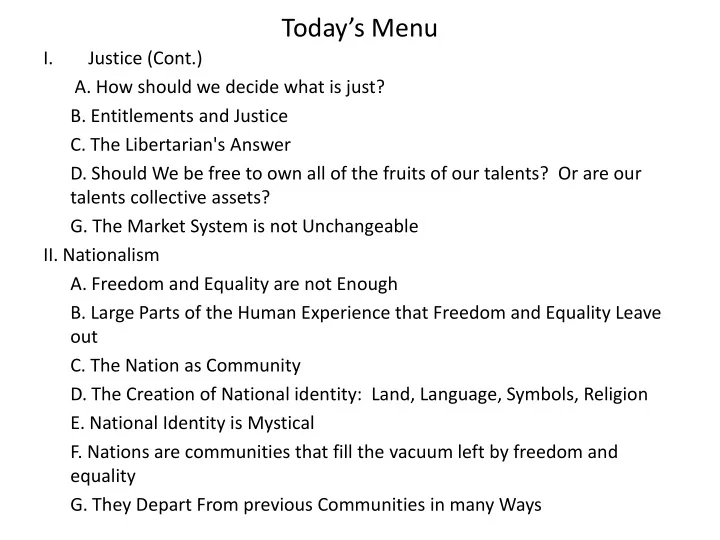
Today’s Menu

I. Justice (Cont.)

  • A. How should we decide what is just?
  • B. Entitlements and Justice
  • C. The Libertarian's Answer
  • D. Should We be free to own all of the fruits of our talents? Or are our

talents collective assets?

  • G. The Market System is not Unchangeable
  • II. Nationalism
  • A. Freedom and Equality are not Enough
  • B. Large Parts of the Human Experience that Freedom and Equality Leave
  • ut
  • C. The Nation as Community
  • D. The Creation of National identity: Land, Language, Symbols, Religion
  • E. National Identity is Mystical
  • F. Nations are communities that fill the vacuum left by freedom and

equality

  • G. They Depart From previous Communities in many Ways
slide-2
SLIDE 2
  • C. How should we decide?
  • renounce old social order. Justice

is Blind. It applies to all equally. (Liberal , egalitarian view)

  • Equal distribution (Marxist view)
  • Equality of opportunity is
  • Necessary. (equity—fairness—

based on merit)

  • is it enough? (level playing field)
  • Does it still leave room for

arbitrary factors that create inequality? Talent? Effort?

  • Redistributive Principle
slide-3
SLIDE 3
slide-4
SLIDE 4

Smith: Redistributive Principle

unequal but better

slide-5
SLIDE 5
  • D. Entitlements and Justice in The

Market system

  • Economy : Market

provides entitlements but not what we necessarily deserve

Society

slide-6
SLIDE 6
  • E. The Libertarian’s Answer
  • "Life is not fair. It is tempting to think that

government can rectify what life has spawned." --Milton Friedman

slide-7
SLIDE 7
  • F. Should we be free to own all of the

fruits of our talents?

– there is no freedom in a poor person’s decision to buy food and not buy a Porsche.

  • Those who focus on the issue of equality ask:

Who wins and who loses?

  • The liberal answer is that we all benefit, and so no
  • ne loses.
  • Distributive justice theories say because the

market creates inequalities, The rich stay rich and the poor stay poor

  • The result is not only economic, but social and

political inequality

?

Or Are our Talents collective assets?

slide-8
SLIDE 8
slide-9
SLIDE 9
  • G. The Market system is not

unchangeable…..

  • M

The social system is not an unchangeable order beyond human control but a pattern of human action.... The principle [of Distributive Justice] is a fair way of meeting the arbitrariness of fortune"

Society

“The social system is not an unchangeable order beyond human control but a pattern of human action.... The principle [of Distributive Justice] is a fair way of meeting the arbitrariness of fortune"

Market

slide-10
SLIDE 10

Nationalism

From Ancient to Modern Theories of Community

slide-11
SLIDE 11

Why Nationalism? Failures of Liberalism……

The focus on reason leaves out emotion or a set of higher principles to guide human

behavior. the focus on freedom leaves out the human need for security Market makes no provision for community solidarity – The “cash nexus” destroys solidarity – Focus on the individual leaves out community The focus on competitiveness leaves out cooperation and heroism Keynes: The decadent international but individualistic capitalism, in the hands of which we find ourselves. . . Is not a success. It is not intelligent, it is not beautiful, it is not just, it is not virtuous, and it doesn’t deliver the goods….” Maybe consideration for higher principles, security, human solidarity, and cooperation should also guide allocative systems But are these principles compatible with the Market?

slide-12
SLIDE 12

And Marxism……

Freedom leaves out important social needs

  • All behavior is reduced to

private choices

  • The good of the community is

identified only with those individuals who are effective competitors in the struggle for life.

  • All rationality, no emotion
  • All law, no heros
  • Markets  insecurity,

fragmented community

Equality (the Marxist critique

  • f Liberalism
  • All class conflict, no feeling
  • f human solidarity
  • Class conflict  fragmented

community

  • Equality does not erase

alienation

  • equality does not create

communal solidarity

slide-13
SLIDE 13

The Nation as imagined community

  • Humans long for community
  • People crave for an identity bigger than

themselves

  • National identity is “modern”

– Identity with strangers in an impersonal world – Ties with others are impersonal, remote, – Vicarious communication

  • A nation is an imagined community
  • A nation is a finite community
  • What are the ingredients of a national identity?
slide-14
SLIDE 14

The 6 ingredients of National Identity

slide-15
SLIDE 15

Possibly the Biggest Ingredient of national identity: Identity with the Land

This Land is Your Land This Land is My Land From California to the New York Island

slide-16
SLIDE 16

National Identity is mystical, not rational

  • The identity is not an accident but a mystical

“given”

– Mazzini: "Your Country is the token of the mission which God has given you to fulfill in Humanity."

  • National uniqueness

– Mazzini: "To you, who have been born in Italy, God has allotted, as if favouring you specially, the best- defined country in Europe."

  • Nations have “souls”
  • Nations have “missions”
slide-17
SLIDE 17

Emotion, land, tradition, religion, sense of historical mission,

  • "My country 'tis of thee, sweet land of liberty, of thee i sing." Land of the

Pilgram's pride, land where my fathers died, from every mountain side, Let freedom ring.

  • My native country thee, Land of the noble free, Thy name I love. I love thy

rocks and rills, Thy woods and templed hills, My heart with rapture thrills, Like that above.

  • Our fathers' God, to thee, author of liberty, to thee we sing.Long may our

land be bright, with freedom's holy light; protect us by thy might, Great God our King.

slide-18
SLIDE 18

Nations are ideological communities that fill the vacuum left by freedom and equality

  • They evoke emotion, not reason
  • They evoke solidarity
  • They provide an identity bigger than ourselves
  • They provide security
  • They provide an arena for cooperation

– Mazzini: "A Country is not a mere territory; the particular territory is only its foundation. The Country is the idea which rises upon that foundation; it is the sentiment of love, the sense of fellowship which binds together all the sons of that territory."

slide-19
SLIDE 19

But they depart from other communities because they are led by states

Liberals would say that The state is a necessary evil--- individuals create the state Marx would say……..The State creates the nation

  • National identity serves a political purpose
  • National identity is socially constructed
  • It is an ideology constructed by a political elite

to serve the interests of the elite A cultural view…..The Nation creates the state

slide-20
SLIDE 20

Liberal and Illiberal Nationalism

  • Liberal Nations are in Tension
  • When push comes to shove, will liberalism

give way to nationalism? Two liberal thinkers:

slide-21
SLIDE 21

Adam Smith:

The love of our own country seems not to be derived from the love of mankind. We do not love our country merely as a part of the great society of mankind: we love it for its own sake... The wise and virtuous man is at all times willing that his own private interest should be sacrificed to the public interest ... the greater interest of the state or sovereignty, He should ..be willing [to sacrifice] to the greater interest of the universe....However, the care of universal happiness is the business of God and not of man. To man is allotted a much humbler department, but one much more suitable to the weakness of his powers, and to the narrowness of his comprehension; the care of his own happiness, of that of his family, his friends, his country

slide-22
SLIDE 22

Guiseppe Mazzini

You are free, and therefore responsible. From this moral liberty is derived your right to political liberty, your duty to conquer it for yourselves and to keep it inviolate, and the duty of others not to limit it. Do not be led astray by hopes of material progress which in your present conditions can only be illusions. Your Country alone can fulfill these hopes. You cannot obtain your rights except by

  • beying the commands of Duty. O my Brothers ! love your
  • Country. Our Country is our home, the home which God has given

us, with which we have a more intimate and quicker communion

  • f feeling and thought than with others; a family which by its

concentration upon a given spot, and by the homogeneous nature

  • f its elements, is destined for a special kind of activity. Our

Country is our field of labour; the products of our activity must go forth from it for the benefit of the whole earth; In labouring according to true principles for our Country we are labouring for Humanity;

slide-23
SLIDE 23

How did Liberal Nationalism emerge? The Early Nationalizers (some history)

  • Britain

– Henry VIII wanted to unify territory – Transfers of loyalty and state-building – Religion: The Church of England – Language – Traditions and ideology – Civic nationalism (based on Liberal ideology

  • France

– Mystical interpretation of Rousseau – Napoleon and Liberal Imperialism

slide-24
SLIDE 24

Illiberal Nationalism: Germany

  • Language the only identity marker—no tangible

frontiers

  • Upper classes spoke French
  • Other nations wanted to keep Germany fragmented
  • Language and Religion……Luther and the Bible (Printing

Press + Translation of the Bible into German

– Used “German” symbols to fight the Catholic church – Protestant religion in Northern Germany

  • Backlash against French imperialism
slide-25
SLIDE 25

Herder

  • Don’t imitate the French!
  • Each “people” have their own spirit and character

(collective vs. individual identity)

– The “Volk” and rejection of individual identity – Herder began to fight against the ideology of freedom and individualism: Liberalism

  • Emphasized collective intuition and genius as opposed to

individual reason

  • Emphasized cultural difference rather than human equality

– Herder was the father of “multi-culturalism” – Did not say that the German People was “superior”

  • Germans began to long for a “state of their own”
slide-26
SLIDE 26

Father Jahn and Fichte

  • Father Jahn: organized a youth movement

– Nationalism through exercise: “political gymnastics”—calisthenics for the Fatherland – Taught kids that they should be suspicious of Jews and foreigners (Jews were “internationalists”)

  • Fichte

– The German spirit is primordial and immutable – More Noble than that of other people

slide-27
SLIDE 27

Militarism needs Nationalism

  • Prussian state became the German state
  • Prussia put a militaristic mark on German nationalism: militarism +

collective identity

  • Began to conquer territory for itself and created the “German

Reich”

  • Bismark used Nationalism to undermine trade unions fighting for

workers’ rights

– Gave workers a sense of protection and unity – A deeper worth as part of a group

  • German nationalism was collectivistic (ethnic) and authoritarian
  • A response to liberal imperialism (French imperialism)
  • Could not be based on liberal values
  • Came to be “illiberal nationalism” Based on community identity

(blood, ethnicity) not “rights”--- rather ascriptive characteristics