Menu provides an avenue for ODE to Documentation introduce the - - PDF document

menu
SMART_READER_LITE
LIVE PREVIEW

Menu provides an avenue for ODE to Documentation introduce the - - PDF document

This afternoon we are discussing menu Slide 1 documentation and recipes. This topic was chosen as a follow - up to this mornings session on Food Purchasing for Child Care Centers. The topic also Menu provides an avenue for ODE to


slide-1
SLIDE 1

Slide 1

Menu Documentation and Recipes

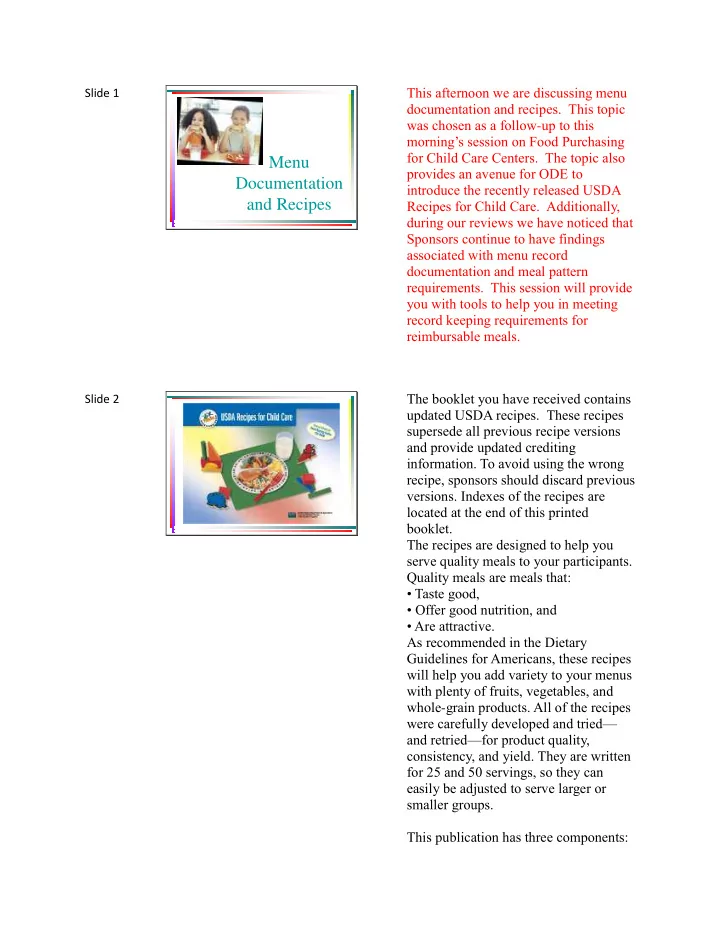
This afternoon we are discussing menu documentation and recipes. This topic was chosen as a follow-up to this morning’s session on Food Purchasing for Child Care Centers. The topic also provides an avenue for ODE to introduce the recently released USDA Recipes for Child Care. Additionally, during our reviews we have noticed that Sponsors continue to have findings associated with menu record documentation and meal pattern

  • requirements. This session will provide

you with tools to help you in meeting record keeping requirements for reimbursable meals.

Slide 2

The booklet you have received contains updated USDA recipes. These recipes supersede all previous recipe versions and provide updated crediting

  • information. To avoid using the wrong

recipe, sponsors should discard previous

  • versions. Indexes of the recipes are

located at the end of this printed booklet. The recipes are designed to help you serve quality meals to your participants. Quality meals are meals that:

  • Taste good,
  • Offer good nutrition, and
  • Are attractive.

As recommended in the Dietary Guidelines for Americans, these recipes will help you add variety to your menus with plenty of fruits, vegetables, and whole-grain products. All of the recipes were carefully developed and tried— and retried—for product quality, consistency, and yield. They are written for 25 and 50 servings, so they can easily be adjusted to serve larger or smaller groups. This publication has three components:

slide-2
SLIDE 2

a) this printed booklet, b) a CD-ROM containing recipes, the booklet, and supplemental information resources including food safety posters, and c) a bonus CD-ROM of Team Nutrition’s Food Buying Guide to help with purchasing food for your program.

Slide 3

Food Buying Guide for Child Nutrition Programs

http://www.ode.state.or.us/search/page/?id=1442 (under Menu Planning Tools), or http://teamnutrition.usda.gov/Resources/foodbuyingguide.html

The USDA Recipes for Child Care packet includes a CD with the Food Buying Guide. If you have a hard copy in the three-ring binder, you have an

  • ut-dated version. The latest update to

the Food Buying Guide was made in January, 2008. It will be important to utilize the CD enclosed with the USDA Recipes for Child Care booklet you have received today or go to the link from our ODE CNP website. It will take you to the most current version posted on the USDA Child Nutrition website.

slide-3
SLIDE 3

Slide 4

Today’s goals:

  • You will:

– Use the tools available for menu development. – Determine that combination foods are reimbursable before service. – Determine that supporting documentation is complete and on-file before service. – Recognize that working menus accurately document reimbursable meals.

Today, we plan to go through this booklet with you and provide a hands

  • n opportunity to use the tools in the
  • booklet. You will be able to develop

and adapt recipes and menus for your individual situation. You will know what documents to retain to support your monthly claim.

Slide 5 We will cover:

  • Current Menu Record Requirements
  • Manufacturers Product Analysis Sheets
  • Standards of Identity
  • The NEW USDA Recipes for Child Care
  • Modifying, writing, and standardizing

Recipes

Slide 6

What is your role?

This is a train-the-trainer training as well as providing hands-on skills. You all hold different positions in your program (directors, cooks, finance, bookkeepers) and some of you may not be responsible for directly planning and preparing food. If you will not be writing, working with

  • r evaluating menus and menu

documentation, you will be able to train those who do on the skills and tools we will cover today. Use the person in your program with the strongest skills as a resource if needed

slide-4
SLIDE 4

Slide 7

What Records are Required?

  • Working menus
  • Food receipts
  • CN labels
  • Manufacturer’s Product

Analysis Sheet

  • Product Label
  • Recipes

Reimbursable meals for the Child and Adult Care Food Program have specific requirements based on the meal patterns

  • used. The meal pattern depends on the

type of meal being served (breakfast, lunch, snack, or supper). A reimbursable meal must contain a specified quantity by age for each of the food components:

  • Meat or meat alternate
  • Vegetable or fruit
  • Grains/breads
  • Milk

Activity: At each table, have participants discuss what records are required to support reimbursable meals. Give 45 seconds to do this. The person at each table who exercised the greatest number of minutes yesterday is the table leader. At the end of 45 seconds have the each table leader share one supporting record that their group identified. The documents listed on this slide are the supporting documents you need to verify that menus and meals served meet meal pattern requirements and minimum portion sizes. Activity #2: Assign each table one record type. Each table will have as a table leader the person who has worked the longest for their organization. The table leader will be the scribe and report back to the group. Each table will take 3 minutes to brain storm everything they know about the record they have been assigned. After reporting post the flip chart on the wall. We have discussed the different types of menu records that Sponsors must keep.

slide-5
SLIDE 5

Slide 8

000000

This 5.00 oz pizza with Ground Beef and Vegetable Protein Product provides 2.00 oz equivalent meat/meat alternate, 1/8-cup serving of vegetable, and 1-1/2 servings of bread alternate for the Child Nutrition Meal Pattern Requirements. (Use of this logo and statement authorized by the Food and Nutrition Service, USDA XX-XX**)

An Authentic CN Label Contains

Meal Pattern Contribution Statement Month and Year of Approval 6-Digit Product Identification Number Logo With Distinct Border Statement Specifying CN Label Was Authorized by FNS

This morning we had a thorough discussion about CN labels. We would like to talk about what we are finding in your files when we come on review and what we are seeing some manufacturers, wholesalers or food brokers submitting to Sponsors when asked for a CN label.

Slide 9

Do you know your CN Labels?

The rectangle is not the CN label. It is the CN around the rectangle and the information in the rectangle that determine whether the CN label is valid. 5 minutes Some valid CN labels Some invalid CN labels Review in groups and then talk about why a label is valid and why a label is not/what’s missing. Envelope with a label or two and a question sheet. Then discuss.

Slide 10

Manufacturer’s Product Analysis Sheet (MPAS)

  • Not the product label
  • Not the Nutrition Facts label
  • Not a Summary End Product Data

Schedule

  • Must contact the manufacturer to obtain

If you are serving a commercially prepared combination food without a CN-label then you should try to obtain a MPAS to support the meal pattern contribution. A Manufacturer’s Product Analysis Sheet (MPAS) is an official product analysis sheet from the food

  • manufacturer. It has been signed by the

manufacturer’s representative and is not a product spec sheet from the sales representative.

slide-6
SLIDE 6

A Summary End Product Data Schedule – The manufacturer creates this sheet for USDA to use with the commodity foods.

Slide 11

Manufacturer’s Product Analysi lysis s Sheet t (MPAS)

  • A list of all ingredients
  • Weight per serving of each ingredient to be credited
  • The weight of ingredients specified as raw or

cooked

  • The weight or volume of the product serving size,
  • r the number of pieces per serving.
  • The signature and title of a manufacturer’s official

Must be an official statement from the manufacturer showing the formulation

  • f the product, the amount of each

ingredient credited toward a pattern component

  • , i.e. grain products must be specified

whole grain or enriched;

Slide 12

(Center letterhead here) Date Manufacturer Name Address Address Dear____________: Our Child Care Program would like to utilize your product listed on the attached form as part of our USDA Child and Adult Care Food Program (CACFP). Prior to menuing your product we require very specific information to guarantee the product will be creditable* towards the meal components required by USDA Child Nutrition Program regulations. We/I are/am requesting that you complete the attached form and return it to us as soon as possible. Your product cannot be menued and served prior to our office receiving this information. If you have any questions or require clarification about any of the information requested, please do not hesitate to contact us/me. Thank you, in advance, for your assistance with this process. We/I look forward to serving your product as part of the nutritious CACFP meals we prepare each day for our children/participants/adults. Sincerely, Sponsor’s name, title ENC: Manufacturer’s Product Analysis Sheet form *Creditable foods: foods that may be counted toward meeting the requirements for a reimbursable meal in each of the four types of meal pattern components. Reference Document: USDA Food Buying Guide for Child Nutrition Program, http://teamnutrition.usda.gov/Resources/foodbuyingguide.html

Sometimes you might desire to write to a manufacturer to obtain an MPAS for a product you would like to menu. This slide provides some sample wording and the next slide provides a sample format to ensure that the manufacturer provides all the information you need. This sample letter is located on the CD for your convenience.

slide-7
SLIDE 7

Slide 13

Manufacturer’s Product Analysis Sheet (MPAS) Manufacturer Name____________________________________________________________________ Address______________________________________________________________________________ Street City State Zip Phone______________________ Fax_____________________ E-Mail___________________________________

********************************************************************************************************************************** Product Name______________________________________________________________ Product Item Number or Product Code__________________________________________ Purchase Unit______________________ Serving Size (weight, volume, number of pieces) _____________________ Ingredients as listed on the product label: _______________________________________________________________________________________________ _______________________________________________________________________________________________ _______________________________________________________________________________________________ _______________________________________________________________________________________________ _______________________________________________________________________________________________

Creditable foods* meal component contribution (Complete all that apply for the product listed above. Enter N/A if not applicable): Meat/Meat Alternate per serving: Variety(ies) of meat used in the product: ______________________________________ Variety(ies) of cheese used in the product: ______________________________________ Weight of uncooked meat, poultry or fish: ______________________________________ Percent fat of raw meat: ______________________________________ Weight of fully cooked meat, poultry or fish: ______________________________________ Weight of cheese by type: ______________________________________ Weight of Dry APP (if used)**: ______________________________________ Weight of Hydrated APP (if used)**: ______________________________________ Percent Protein of Dry APP (if used)**: ______________________________________ Weight of Seasonings, etc.: ______________________________________ Grains/Breads per serving: Weight of creditable* grains/breads: ______________________________________ Vegetables/Fruits per serving: Weight of creditable* vegetable/fruit: _______________________________________ ******************************************************************************************* I certify that the above information is true and correct, for one serving of the above product (ready for service and prepared according the manufacturer’s instructions). I further certify that any Alternate Protein Product (APP), if used in this product, conforms to USDA/FNS requirements for use in meeting a portion of the meat/meat/alternate (M/MA) requirements of the Child Nutrition Program.

____________________________________________ _________________________ __________________ Official Company Signature Title Date *Creditable foods: foods that may be counted toward meeting the requirements for a reimbursable meal in each of the four types of meal pattern components. Reference Document: USDA Food Buying Guide for Child Nutrition Program, http://teamnutrition.usda.gov/Resources/foodbuyingguide.html. ** Alternate Protein Product (APP) must conform to Food and Nutrition Services regulations 7CFR Parts 210, 220, 225,
  • r 226, Appendix A.

The language used on this sample form is language that food manufacturers will recognize and understand your request.

Slide 14

This is a sample MPAS for a grilled cheese sandwich. Note all the requirement are met.

Slide 15

Standards of Identity

  • Meet the minimum requirement
  • A limited number of meat and

poultry food products

  • May be listed in the FBG.

Products that have a Standard of Identity must meet the minimum requirements of that standard in

  • rder to carry the

name of the product on the label. A very limited number of meat and poultry food products used by Sponsors in CACFP have a Standard of Identity. Products with a Standard of Identity may be listed in the FBG because they must contain a minimum amount

  • f meat or

poultry to meet the standard; therefore, the contribution of the product to

slide-8
SLIDE 8

the meal patterns is predictable.

Slide 16

Standards of Identity

Standards of Identity establish minimum requirements for a food product in order for that product to carry a particular name on the label. Standards of Identity ensure that the name

  • n the label accurately

describes the food product in the package!

Slide 17

.

When using commercially prepared that has a standard of identity, it is important to make sure the product name is exactly as stated on exhibit 23.43. For example Chicken with Noodles is not the same product as Chicken and Noodles.

slide-9
SLIDE 9

Slide 18

Which of these items need a CN Label or Manufacturers Product Analysis Sheet? Yes No

  • Frozen Pizza
  • Frozen Burrito
  • Corn Tortillas
  • Pork and Soy Isolate

Patty

Add script for review

Slide 19

Which of these items need a CN Label or Manufacturers Product Analysis Sheet? Yes No

  • Muffin
  • Chocolate Milk
  • Frozen Pizza
  • Prepared Tossed

Salad

Slide 20

Which of these items need a CN Label or Manufacturers Product Analysis Sheet? Yes No

  • Canned Ravioli
  • Fully Cooked Chicken Nuggets
  • Fully Cooked Frozen Beef Patty

with Soy Protein Concentrate

The important take home message is that if you are using a commercially prepared combination food in your menus, then you must have a CN label, the MPAS, or a product label showing the food has a standard of identity on file before you serve the food in your

  • centers. Prior to meal service you must

ensure that the meal meets meal pattern components and minimum portion

  • sizes. If you do not have the required

documentation for commercially prepared combination foods before serving the item, then do not serve the item until you have the required documentation on file.

slide-10
SLIDE 10

Slide 21

Meal Pattern Menu Planning

Menu Planning Principles

Basic menu planning principles are a great starting point to meet both food preferences and the nutritional needs of your participants.

We have discussed the requirements for menu documentation. Planning creative, appealing and well-liked menus takes some time and thought. One way to develop menus is to find a quiet time and sit down with a list of your recipes/foods that your center has

  • n hand. Evaluate what meals served

by the center are well-accepted. What meals are not as well-liked. What can be changed in those meals to make them more acceptable. When considering the food preferences

  • f your participants, think about their

cultural background. The nutritional needs of your participants are being partially met when you follow the meal pattern. However, there are ways to fine tune your menus so that the meals are more in line with the dietary guidelines. Think about the following questions when planning your meals. How many meals during a week have fresh fruits and vegetables compared to canned fruits and vegetables? How many food items are being served during the week that are high in fat or sodium? What foods could be substituted to lower the sodium and fat content of your menu?

slide-11
SLIDE 11

Slide 22

Meal Pattern Menu Planning

5 Basic Menu Planning Principles

  • 1. Strive for balance
  • 2. Emphasize variety
  • 3. Add contrast
  • 4. Think about color
  • 5. Consider eye appeal

Activity: Assign a menu planning principle to each table . Choose the person who cooks the fewest meals for your organization to be the scribe and the reporter. Brainstorm as many ideas, considerations and points about your principle . Write them on a flip chart and be ready to share with the room. After reporting post the flip chart on the wall.

Slide 23

The Nation al Food Service Management Institute has an 8 week cycle menu for children. These menus use the USDA Child Care Recipes and can be a good starting point for planning your center. This 8 week cycle menu is designed for 3-5 year olds, so the portion sizes are the minimum for that age group. If you are serving participants older or younger than 3-5 years old, then you will need to adjust the portion sizes according to the age group.

slide-12
SLIDE 12

Slide 24

http://nfsmi- web01.nfsmi.olemiss.edu/documentLibraryFiles/PDF/20 080225095731.pdf http://www.ode.state.or.us/search/page/?id=1989

You may ay ac access ss the 8-wee eek cycle le Menus us for Chil ildcare re at:

Or,

Slide 25

Recipe Requirements

  • When do you need a recipe
  • What needs to be included on

a recipe

  • How to adjust the number of

servings a recipe makes

We have discussed required records as supporting documentation for meals claimed for reimbursement. During the next section on recipe requirements we will discuss when a recipe is needed, what needs to be included on the recipe and how to adjust a recipes to meet your center’s needs.

slide-13
SLIDE 13

Slide 26

When Do You Need a Recipe?

  • When you serve a

homemade combination food

(Combination food—combines foods from more than one food group)

Many centers are trying to use more homemade combination foods instead

  • f commercially prepared combination

foods and sandwiches to offer variety, interest, and color in the foods offered to their participants. Often your meal may be the highlight of the day for the children and it may be the only hot meal they get for the day. We encourage you to use the USDA Child Care Recipes as your first source

  • f recipes and we will spend time

reviewing the booklet you have received and going over recipes.

Slide 27

Recipes for Homemade Combination Foods must include:

1. Name of the recipe (match name on the menu) 2. List all ingredients with weight and/or volume 3. Form of the ingredient

4.

Serving/Portion Size (must be a reasonable size)

5.

Yield (total # of portions, or total bulk amount)

6.

Component Contribution (two maximum)

7.

CN Label or MPAS or Standard of Identity

(when an ingredient is a commercial product with more than one component)

  • 8. Directions

The purchase state of the ingredient (such as fresh, frozen, canned) should be listed before the ingredient name. And, the form of the ingredient (such as peeled, sliced, etc.) comes after the ingredient name. When preparing or preparing recipes it is important to know the total yield of the recipe as well as the serving or portion size. The total yield can be stated in weight or volume

  • measurements. However, the serving or

portion size should be stated in measurements that are easy for anyone serving the food to measure. It is impractical to state that a serving size of lasagna is 3 oz if there will not be any scales or time to weight each portion size before serving. When a recipe is first prepared the entire recipe yield should be

  • determined. This can be done by

measuring the product before serving.

slide-14
SLIDE 14

Slide 28

The USDA Recipes for Child Care booklet that you have received contains a discussion on recipes, the importance if recipes, and how to adjust recipes. During this portion of the workshop, we will be going through this booklet, so that you understand the information that is contained on the USDA recipes and how to use the information when determining that your menus are reimbursable.

Slide 29

For the purposes of evaluating the format of USDA recipes, we will be using the Stir-Fry Chicken Recipe (D- 18). This recipe is in your packet. First let’s look at the Recipe Header: This area contains the recipe title, credited food components, and file location. The recipe title: Recipe titles have been kept as straightforward as possible. Descriptive words related to texture or flavor have been avoided. The recipe file location: The recipes are

  • rganized by food categories and recipe

numbers. The food categories are: A – Grains/Breads B – Desserts C – Dips, Sauces, and Toppings D – Main Dishes E – Salads and Salad Dressings F – Sandwiches G – Snacks H – Soups I – Vegetables The food components contributing credit toward the reimbursable meal: This indicates the food components of a particular recipe that contribute credit to the reimbursable meal. Our sample

slide-15
SLIDE 15

recipe, Stir-Fry Chicken (D-18), contributes credit to both the Meat and Vegetable meal components. On the following pages, we will take a close look at how each recipe is

  • rganized. Each recipe has been

assigned: (1) a letter to identify the recipe category and (2) a number indicating its place within this category. Letters that appear after the number indicate a variation of the main recipe. For example, a recipe with a designation of B-17 would indicate that this recipe is number 17 within the Desserts category.

Slide 30

Ingredients: In this next example, the first column of the Stir-Fry Chicken (D-18) recipe is

  • highlighted. First, note the order in

which ingredients are listed: Ingredients are listed in the same order as they are required for production. Second, note the form in which ingredients are listed: You will see that our sample recipe specifies: Fresh carrots, peeled, 1/4"

  • slices. This tells you the carrots are to

be purchased fresh, and then peeled and cut into 1/4"

  • thick slices prior to being

used in the recipe. When you are purchasing ingredients, remember to: Select the best possible quality The quality of the final product will rely heavily on the quality of ingredients used. Purchase products that will produce the “healthiest”

  • verall product For example, our

sample recipe for Stir-Fry Chicken (D- 18) calls for chicken stock, non- MSG (without monosodium glutamate). When purchasing stocks and bases, select brands that do not contain MSG and have a moderate level of sodium (salt).

slide-16
SLIDE 16

Read food labels carefully. Food manufacturers must list ingredients in descending order of predominance by

  • weight. So, if salt is the first ingredient

listed, you know that the product contains more salt than anything else.

Slide 31

Alternate Ingredients: Alternate ingredients are listed in many

  • f the recipes to give you flexibility

when ordering. They may also help you accommodate limitations in labor or

  • equipment. This example shows how

alternate ingredients appear in the recipe format. Several lines are

  • highlighted. As you can see, alternate

ingredients are listed on separate lines separated by the word “OR.” It is important that you select

  • nly one of the options provided. Do not

add both the primary and the alternate ingredients to the recipe. In the Stir-Fry Chicken (D-18) example: You may choose to use the fresh carrots, sliced, which is listed in the ingredients. OR You may choose to use the alternate, frozen sliced carrots. Also, you may choose to use the fresh broccoli, chopped, OR You may choose to use the alternate, frozen mixed Oriental vegetables. Optional Ingredients: Some of the recipes include optional

  • ingredients. These are typically used for

seasoning and garnishing. If an ingredient is optional, the word “(optional)” will immediately follow it in the ingredient list. Optional

slide-17
SLIDE 17

ingredients may be used to increase a recipe’s appeal in a particular area or

  • region. While certain ingredients may

be preferred by children in some regions

  • f the country, they may not appeal to
  • thers.

Slide 32

Weights and Measures for 25 and 50 servings: In this example, the center of the recipe format is highlighted. These columns show the quantities you will need for producing 25 and 50 portions of the

  • recipe. Weight measurements are given

for dry and solid ingredients The weight measurements are written in pounds (lb) and ounces (oz). Because it is sometimes necessary to use volume measure, the volume equivalents have also been given for the dry and solid ingredients. All recipes were tested using weight measurements unless only a volume measurement is given. Volume measurements are given for liquid ingredients and include:

  • Teaspoons (tsp)
  • Tablespoons (Tbsp)
  • Cups (c)
  • Quarts (qt)
  • Gallons (gal)

Note: Can sizes are provided in the recipes for estimating how much food to take from the storeroom. However, using can sizes is not an accurate measuring method. Spices, flavorings, and other ingredients

  • f less than 2 ounces are given a volume

measurement since most scales are not

slide-18
SLIDE 18

able to measure such a small quantity accurately. A note about baking: When measuring dry ingredients you will be using in a baked product, it is very important that you measure the ingredients by weight whenever possible. This is because even slight variations in measurement can alter the quality of the final product. Consider the following:

  • One pound of unsifted all-purpose

flour can range from 2 1/2 cups to 4 cups.

  • One pound of sifted all-purpose flour

can range from 3 cups to 4 1/2 cups.

  • These examples make it easy to see

why measuring the flour for a baked product only by volume can result in an inconsistent product.

Slide 33

Directions: In our next example, the far-right column is highlighted. This section lists all the steps needed to prepare the

  • recipe. Each step is numbered in

sequence and is directly across from the ingredients to which it applies. The directions include:

  • Mixing speeds and times
  • Cooking procedures
  • Panning procedures
  • Baking times and temperatures
  • Critical control points
  • Portioning directions
  • Garnishing and serving instructions

The directions do not account for any advance preparation work that must be done in order to prepare the ingredients for recipe production. However, it is important to account for any preparation tasks in scheduling, and a good idea to take care of these well in advance of the actual

  • production. For example, for the Fruit
slide-19
SLIDE 19

and Rice Dessert (B-09) you will need to allow time to prepare rice and time to refrigerate the prepared rice for at least an hour before you can assemble the dessert. We encourage you to read the directions for the recipe carefully before you begin

  • production. Use them as you would a

road map before starting out on a trip, and keep in mind the following: In order to obtain the maximum possible quality from each recipe and ensure that the reimbursable meal requirements are met, all

  • f the procedures outlined in this

section of the recipe must be followed

  • precisely. For example, when you read

the recipe for Stir-Fry Chicken (D-18) you will see in Step 8: “Portion with 2 rounded No. 10 scoops.” This is important because level No. 10 scoops will not provide enough food to meet meal pattern contributions.

Slide 34

The recipe format also includes a variety of other useful information, such as:

  • Portion size
  • The specific contribution of each

serving toward the reimbursable meal

  • Yield for 25 and 50 servings
  • Variations
  • Marketing guide for selected items
  • Nutrients per serving

You will find this information on the last page of each recipe. Most recipes are two pages long; however, some are three or four. Again using the Stir-Fry Chicken (D-18) example, let us first look at portion size, contribution to reimbursable meal requirements, and

  • yield. These sections are highlighted.

Serving:

slide-20
SLIDE 20

The portion size and the suggested portioning tools are listed here. Contribution to the reimbursable meal This section of the recipe format provides information on the specific contribution of each serving toward the reimbursable meal. Reimbursable meals contain foods that Alternate, Vegetable/Fruit, and Grains/Breads. In

  • ur sample recipe, a 3/4 cup, 1-

tablespoon (2 rounded No. 10 scoops) portion of Stir-Fry Chicken (D-18) contributes 2 ounces of cooked lean meat and 5/8 cup of vegetable. Yield: The total recipe yield for both 25 and 50 servings is stated by weight (pounds,

  • unces). For some recipes, the total

yield is also stated by volume (gallons, cups). Marketing Guide for Selected Items: The Marketing Guide for Selected Items provides special purchasing information

  • n foods that will sustain trimming loss

during preparation. These foods are marked with an asterisk (*) in the ingredients column of the recipe format. In the Stir-Fry Chicken (D-18) example, you will see information given for three

  • ingredients. Turning back to page 8, you

will see each of these is preceded by an asterisk. What you need to know: For ingredients marked with an asterisk, the quantity listed under “Weight” and “Measure” in the recipe is the EP (Edible Portion). This is the quantity required for preparation of the needed servings and therefore does not allow for any trimming loss. Any trimming must be done before measuring. The Marketing Guide shows the AP (As Purchased) quantity required when

  • rdering. In our example, 3 pounds 8
  • unces of broccoli must be purchased
slide-21
SLIDE 21

(AP) in order to yield 2 pounds 13

  • unces (EP), the amount of fresh

broccoli, chopped required in the recipe to produce 25 portions of Stir-Fry Chicken (D-18

Slide 35

Adjusting USDA Recipe Yields

Number of servings you want to make Number of servings USDA recipe makes

=

Factor (number you will use to multiply each ingredient in USDA recipe)

Recipes in USDA Child Care Recipe manual are developed to produce 25 servings or 50 servings. If you need to make a different number of servings, you can change the number of servings without changing the crediting information*

* When recipes are adjusted using this method, the portion size stays the same and the crediting information is still accurate.

The recipes in this package are standardized to yield both 25 and 50

  • servings. For example, if you look at the

recipe for Chicken or Turkey Salad (E- 07, page 18 of your booklet), you will see directions to make either 25 servings (1/2 cup each) or 50 servings (1/2 cup each). Since few child care centers serve exactly 25 or 50 servings, you may need to increase or decrease the quantities of ingredients to produce the number of servings you need. To help you do this, formulated steps and two worksheets are given on the following pages that will show you how to:

  • 1. Calculate the quantities of food

needed in a recipe, and

  • 2. Use the Marketing Guide (listed in

some recipes in this package) to calculate the quantities of food needed to purchase for

slide-22
SLIDE 22

Slide 36

35 (number of servings you want to make) = 1.4 (Factor) 25 (number of servings USDA recipe makes)

Multiply each recipe ingredient by 1.4

35

Example:

When adjusting recipes you first determine the multiplying factor. To

  • btain the multiplying factor take the

number of servings you want to make and divide it by the number of servings the recipe makes. In this example for Chicken or Turkey Salad, we want to make 35 servings instead of 25 servings. When we divide 35 by 25 we get the multiplying factor

  • f 1.4, then we can use the following

table to calculate the amount of ingredients needed for 35 servings.

Slide 37

Recipe Ingredients Old Quan Old Quan

  • ne

measure X Factor = Adjusted amount New Quantity Cooked chicken or turkey chopped 3 lb 3

  • z

51 oz X 1.4 = Fresh celery chopped 11 oz 11 oz X 1.4 = Fresh onions chopped 6 oz 6 oz X 1.4 = Sweet pickle relish undrained 7 ½ oz 7.5 oz X 1.4 = Ground pepper 1 tsp 1 tsp X 1.4 = Dry mustard 2 ¼ tsp 2.25 tsp X 1.4 = Reduced calorie salad dressing 1 ½ cup 2 tbsp 1.625 cups X 1.4 = 71.4 oz 4 lb 8 oz 15.4 oz 15 ½ oz 8.4 oz 8 ½ oz 10.5 oz 10 ½ oz 1.4 tsp 1 ½ tsp 3.15 tsp 1 tbsp 2.275 cups 2 ¼ cups

Converting the recipe for Chicken or Turkey Salad from 25 servings to 37 servings

Slide 38

slide-23
SLIDE 23

Slide 39

Recipe Ingredients Old Quan Old Quan

  • ne

measure X Factor = Adjusted amount New Quantity Raw ground beef < 20% fat 3 lb 4

  • z

52 oz X .4 = Fresh onions chopped 6 oz 6 oz X .4 = Canned tomato paste 1 lb 2

  • z

18 oz X .4 = Water 1 qt ½ c 4.5 c X .4 = Sugar 1 tbsp 1 tsp 4 tsp X .4 = Dried basil ¾ tsp .75 tsp X .4 = Dried oregano ¾ tsp .75 tsp X .4 = Salt ¾ tsp .75 tsp X .4 = Granulated garlic 2 tsp 2 tsp X .4 = Ground pepper ¾ tsp .75 tsp X .4 = Cooked macaroni, noodles, spaghetti 1 qt 2 1/4 c 6.25 c X .4 = 20.8 oz 1 lb 5 oz 2.4 oz 2 ½ oz 7.2 oz 7 1/4

  • z

1.8 c 2 c 1.6 tsp 1 3/4 tsp .3 tsp ½ tsp .3 tsp ½ tsp .3 tsp ½ tsp 1 tsp 1 tsp .3 tsp ½ tsp 2.5 c 2.5 c

Converting the recipe for Beef and Spaghetti Casserole from 25 to 10 servings In your packet there is a blank recipe conversion worksheet for you to use.

Slide 40

Steps to Writing a Recipe

Sometimes USDA does not have a recipe that you want to use, or you might have a favorite recipe that has always been used in your center and you want to continue using it. You will then need to be able write and credit your own recipes. Bean and Cheese Quesadilla is a recipe that is not in the USDA Child Care Recipes .

Slide 41

Steps to Writing a Recipe

1. Determine the following:

  • The ingredients you want to use in the recipe
  • which components you want to credit in the recipe
  • the amount that each portion will credit in the recipe, according to

the ages of children you serve

  • the minimum amount of ingredients to include in the recipe, using

the Food Buying Guide 2. Make the recipe 3. Adjust the recipe if necessary, and make again 4. Determine the total yield of the recipe 5. Use the yield to determine the portion size

slide-24
SLIDE 24

Slide 42

ODE Recipe Form Optional form, documents all required recipe information. If Sponsor uses

  • wn form, must

document all required information.

Recipe Name:

(whole, chopped, etc.)

Weight

  • r

Measure Directions:

Ingredient Form

Recipe Yield ____________________ Portion Size __________________________ Component Contribution Resource used for Crediting

(only two components may be credited)

_____Meat/Meat Alternate _____Grain/Bread _____Vegetable/Fruit

Slide 43

Practice

  • 1. Find the Bean & Cheese

Quesadilla Recipe form and activity sheet

  • 2. Use the FBG to determine

the amount of Refried Beans and cheese needed for the recipe. You purchase Refried Beans in

  • No. 10 cans.

Slide 44

Bean & Cheese Quesadilla Activity

You are developing a recipe to make Bean and Cheese

  • Quesadillas. You need to know how many No. 10 cans of Refried

Beans to include in the recipe. The following information will help you write your recipe. Write your answer on the recipe form included. A Number of Portions Needed B Servings per purchase unit, FBG column 3 C Calculation needed to determine amount to purchase A÷B=C

How many ounces of meat/meat alternate do you need? How many ounces of meat/meat alternate do you get from each No. 10 can of Refried Beans as purchase? How many oz of meat/meat alternate do you get from 1lb of cheddar cheese shredded? Divide the number of

  • unces of meat/meat

alternate you need by the

  • unces of refried beans and

cheese that you will get from the amount purchased. Ingredients Available  Tortillas, 6 inch Flour, enriched (24 each)  Refried Beans, canned in No. 10 cans  Cheddar Cheese, shredded Planning Information 24 children ages 3-5 years Credit towards Meat/Meat Alternate and Grain/Bread for Lunch You need 24 Quesadillas with .5 oz of cheese and 1 oz m/ma from the refried

  • beans. Note: ¼ cooked dry beans/peas =

1 oz m/ma Each child will get one whole quesadilla

slide-25
SLIDE 25

Slide 45

Tortillas, 6 inch Flour, enriched Refried Beans, No. 10 can

24 quesadillas 1 whole quesadilla

Bean & Cheese Quesadilla

USDA Food Buying Guide 1.5 1 24 each ? Cheddar Cheese, shredded ?

Slide 46

24

# Servings for 3-5 year

  • lds

Oz m/ma for the lunch meal (per serving) Oz of m/ma total needed

X 1.5= 36

First determine the amount of meat/meat alternate you will need in the recipe to meet minimum portion size for 3-5 yr

  • lds.

Number of Portions Needed

Our activity sheet says that we want to prepare quesadillas for 24 3-5 yr olds. Each 3-5 year old needs to have 1.5 oz meat/meat alternate. From the activity sheet we know that .5 oz of the meat/meat alternate will come from shredded cheddar cheese and 1 oz meat/meat alternate will come from refried beans. Therefore we will need to calculate the total number of meat/meat alternate we will need for 24 servings.

Slide 47

A Number of portions Needed B Servings per Purchase Unit, FBG Column 3 C Purchase Units Needed Calculation: A B = C How many oz of m/ma do you need? 36 oz total

How many ounces of meat/meat alternate do you get from each No. 10 can of Refried Beans as purchase? How many oz of meat/meat alternate do you get from 1lb of cheddar cheese shredded? Divide the number of

  • unces of meat/meat

alternate you need by the

  • unces of refried beans

and cheese that you will get from the amount purchased. 24 oz refried beans 12 oz shredded cheese

We know that we need 36 oz meat/meat alternate for the total recipe, but how much should come from refried beans and how much should come from shredded cheese. Since we want 1 oz to come from refried beans and we have 24 servings, then we will need enough refried beans to provide 24 oz meat/meat alternate. We want .5 oz to come from the shredded cheese, so we will need enough shredded cheese to provide 12 oz meat/meat alternate (24/2). We will go to the food buying guide to

slide-26
SLIDE 26

determine how many # 10 cans of refried beans and how many pounds of shredded cheese we will need to provide the amounts we need for each.

Slide 48

From the Food Buying Guide we learn that there is 49.6 oz meat/meat alternate per No. 10 can refried beans. Remember on the activity sheet that we are given the information that ¼ cup of refried beans is equal to 1 oz meat/meat alternate.

Slide 49

A Number of portions Needed B Servings per Purchase Unit, FBG Column 3 C Purchase Units Needed Calculation: A B = C How many oz of m/ma do you need? How many oz of m/ma do you get from each No. 10 can of Refried Beans, as purchased? Divide the number of

  • z m/ma you need

by the number of oz you get from each

  • No. 10 can

purchased 49.6 oz m/ma per No. 10 can of Refried Beans, as purchased 24 oz 24 ÷ 49.6 = .48 No. 10 can (or 0.5 No. 10 can)

We can use the table to solve for how many No. 10 cans of refried beans we need.

slide-27
SLIDE 27

Slide 50

From the Food Buying Guide we see that 4 cups of shredded cheese is equal to 1 pound or 16 oz of cheese.

Slide 51

A Number of portions Needed B Servings per Purchase Unit, FBG Column 3 C Purchase Units Needed Calculation: A B = C How many oz of m/ma do you need? How many oz of m/ma do you get from each No. 10 can of Refried Beans, as purchased? Divide the number of

  • z m/ma you need

by the number of oz you get from each

  • No. 10 can

purchased 16 oz meat/meat alternate per pound

  • f shredded cheese

purchased 12 oz 12 ÷ 16 = .75 pound or 12 oz cheese

We can use the table to solve for how many pounds of shredded cheese we

  • need. Note that cheese has no waste so

1 pound of cheese would provide 16 oz

  • f meat/meat alternate. From the Food

Buying Guide we can convert 12

  • unces of cheese into cups of cheese.

Since 4 cups of cheese is equal to 16

  • unces of cheese, then 3 cups of

shredded cheese would provide 12

  • unces of shredded cheese.

Slide 52

Tortillas, 6 inch Flour, enriched Refried Beans, No. 10 can

24 quesadillas 1 whole quesadilla

Bean & Cheese Quesadilla

USDA Food Buying Guide

1.5 oz 1 24 each 0.5 No. 10 can Cheddar Cheese, shredded 12 oz 3 cups

The recipe for Bean and Cheese Quesadilla is written, but it is not

  • complete. It is important to include

directions about how to make the

  • recipe. Do we cut the tortillas in half ,

spread with beans and shredded cheese??? Do we spread beans and shredded cheese on one tortilla and fold in half???? How much beans and how much cheese do we put on each tortilla??? The directions in the recipes give the specific steps to follow. If the alternate ingredients can be used, then the recipe should include the alternate ingredients and clearly indicate the ingredient to

slide-28
SLIDE 28

replace. The directions section might also specify additional meal pattern components to include to ensure that minimum portions of components are

  • met. For example if a peanut butter and

jelly sandwich was being served, but the peanut butter would only provide 1 oz meat/meat alternate, the recipe could also state “serve with 4 oz yogurt” for 3-5 year olds.

Slide 53

Writing a Recipe

You can’t write a complete recipe until you make it!!!

Why is that? Because you need to know how much the total volume the recipe will yield…how many pans, how many quarts, how many cups,

  • etc. you will get when you mix the ingredients

together. Simply adding up the amounts of each ingredient will not give you an accurate total volume

Once the recipe has been tried, the cook should make it again, following the directions , making sure that the beans and cheese are accurately portioned on each tortilla. This is called standardization of the recipe – making the recipe enough times to make sure that the quality, the yield and the portions are the same each time.

Slide 54

Important Point! Do Not Confuse Weight and Volume Measure!

Weight is measured in

  • unces and is used for

determining portion size

  • f M/MA (exception:

cooked dried beans and peas) and G/B (exception: cooked cereals). Tool: scale Volume is measured in fluid ounces and is used for determining portion size of V/F and milk. Tools: measuring c, qt, and gal

When you are making the recipe it is important to use the correct measuring

  • utensils. Some foods like shredded

cheese can be both weighed and measured.

slide-29
SLIDE 29

Slide 55

An 8 fl oz Cup May Not Weigh 8 oz

Fill an 8 fl oz cup with rose petals and another with rocks. Their volumes measure exactly the same (8 fl oz or 1 cup). Will they weigh the same? Will either weigh 8 oz?

Weight measurements are given for dry and solid ingredients. The weight measurements are written in pounds (lb) and ounces (oz). In the USDA recipes the volume equivalents have also been given for the dry and solid ingredients. This is done, because in quantity cooking it sometimes necessary to use volume measures. Cheese is an example

  • f a solid food that will often be

measured in weight or volume

  • measurements. All the USDA recipes

were tested using weight measurements unless only a volume measurement is given. Volume measurements are given for liquid ingredients and include:

  • Teaspoons (tsp)
  • Tablespoons (Tbsp)
  • Cups (c)
  • Quarts (qt)
  • Gallons (gal)

It is important when writing your recipes that you use volume measurements for liquid ingredients and weight measures for dry or solid ingredients.

Slide 56

Common Measures for Volume, Liquid or Dry Teaspoons, tablespoons, cups, fractions

  • f a cup, pints, quarts, and gallons are

all volume measures which can be described in fluid ounces.

slide-30
SLIDE 30

Slide 57

Review Steps to Writing a Recipe

  • Determine the following:

– The ingredients you want to use in the recipe – which components you want to credit in the recipe – the amount that each portion will credit in the recipe, according to the ages of children you serve – the minimum amount of ingredients to include in the recipe, using the Food Buying Guide

  • Make the recipe
  • Adjust the recipe if necessary, and make again
  • Determine the total yield of the recipe
  • Use the yield to determine the portion size
  • Determine the crediting information for each component

Slide 58

You must document what you actually do when you make the recipe Specifically, the actual amounts of each ingredients you use, and the amount and total number of servings the recipe makes.

Recipe Name:

(whole, chopped, etc.)

Weight

  • r

Measure Directions:

Ingredient Form

Recipe Yield ____________________ Portion Size __________________________ Component Contribution Resource used for Crediting

(only two components may be credited)

_____Meat/Meat Alternate _____Grain/Bread _____Vegetable/Fruit

The directions in the recipes give the specific steps to follow. If the alternate ingredients can be used, then the recipe should include the alternate ingredients and clearly indicate the ingredient to replace. The directions section might also specify additional meal pattern components to include to ensure that minimum portions of components are

  • met. For example if a peanut butter and

jelly sandwich was being served, but the peanut butter would only provide 1 oz meat/meat alternate, the recipe could also state “serve with 4 oz yogurt” for 3-5 year olds.

slide-31
SLIDE 31

Slide 59

SUMMARY SLIDE

  • Menu Records to support the claim
  • Reviewed the USDA Recipes for Child

Care

– The information on the USDA recipes – Adjusting USDA recipes

  • Writing your own recipes

Gallery walk – review flip charts that are posted on the wall about menu documentation and creating menus.