Todays lecture ! User Testing User Testing ! Overview ! Examples ! - - PDF document

today s lecture
SMART_READER_LITE
LIVE PREVIEW

Todays lecture ! User Testing User Testing ! Overview ! Examples ! - - PDF document

Todays lecture ! User Testing User Testing ! Overview ! Examples ! Techniques CSE 510 ! Case study Richard Anderson Ken Fishkin Product development vs. User testing scientific studies Both valid dont knock dev ! Why do you want to


slide-1
SLIDE 1

1

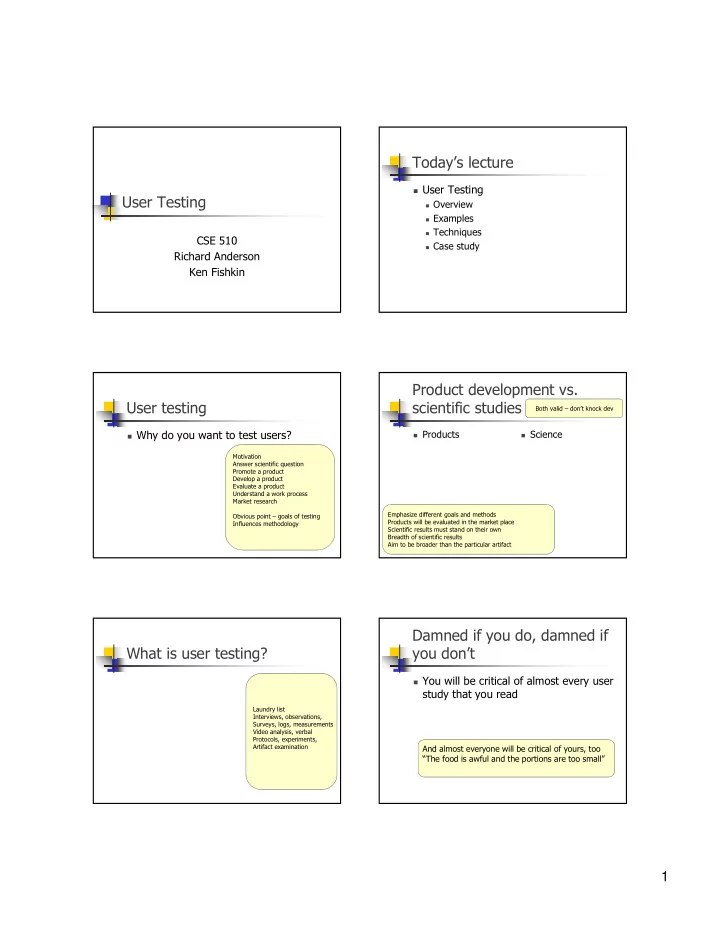
User Testing

CSE 510 Richard Anderson Ken Fishkin

Today’s lecture

! User Testing

! Overview ! Examples ! Techniques ! Case study

User testing

! Why do you want to test users? Motivation Answer scientific question Promote a product Develop a product Evaluate a product Understand a work process Market research Obvious point – goals of testing Influences methodology

Product development vs. scientific studies

! Products ! Science Both valid – don’t knock dev Emphasize different goals and methods Products will be evaluated in the market place Scientific results must stand on their own Breadth of scientific results Aim to be broader than the particular artifact

What is user testing?

Laundry list Interviews, observations, Surveys, logs, measurements Video analysis, verbal Protocols, experiments, Artifact examination

Damned if you do, damned if you don’t

! You will be critical of almost every user

study that you read

And almost everyone will be critical of yours, too “The food is awful and the portions are too small”

slide-2
SLIDE 2

2

Why are user studies hard?

! Achieving statistical significance ! Confounding factors

! Often trying to measure a low order effect

! Users are not always easy to deal with ! Experimental design is not easy ! Large resource requirements

User studies for IO devices

! How would you evaluate the NYU

Quikwriting

This is a speculative idea What do you want to figure Out? One obvious challenge is that It is slow to learn the device. Can an expert use it effectively Is it learnable? Why or Why not.

User studies for Tablet PC grading tool (paperless grading)

! TAs annotate CS1 assignments using

Tablet PC

Quality of grading Efficiency of Grading Design and use of Annotation system Bring up Hawthorne effect

Ethical Considerations

! Do not harm the participants Broad definition of Harm Pain, embarassment Discomfort Do not rant about HSB If HSB discussion There have been serious problems HSB often oriented Towards medicine

Informed consent

! Participant must be given full

information

! Ability to opt out (without penalty) ! Free from coercion Optional – HS form – “Is Deception used in this study” Levels of deception

Privacy

! HSB very concerned about participant

privacy

! Concerns about data linked to

individuals

! Access to records ! Retention of information

Audio and video recordings, logged data

slide-3
SLIDE 3

3

Basic techniques

! Surveys ! Unstructured interviews ! Semi-structured interviews Emphasize that other disciplines Have done a lot of work on these Its easy to get these wrong

  • Mr. Wizard Testing

! Testing before

building

Examples of mockups Paper based studies Classic Clipee study

Verbal Protocols

! Need to know what users are thinking, not

just what they are doing

! Ask users to talk while performing tasks

! tell us what they are thinking ! tell us what they are trying to do ! tell us questions that arise as they work ! tell us things they read

! Make a recording or take good notes

! make sure you can tell what they were doing

Thinking Aloud (cont.)

! Prompt the user to keep talking

! “tell me what you are thinking”

! Only help on things you have pre-decided

! keep track of anything you do give help on

! Recording

! use a digital watch/clock ! take notes, plus if possible

! record audio and video (or even event logs)

Design Experiments

! Qualitative ! Inform design of educational

intervention

Done in real setting

Ethnography

! Immersive study

slide-4
SLIDE 4

4

Case study

! Classroom Feedback

System

! Student devices give

real time feedback to lecturer

! Feedback associated

with slide content

Limit discussion of the system Main point of discussion – Mechanics of classroom evaluation

Questions

! Does this work?

! Does this improve the large lecture class? ! Is this information valuable for instructors ! Will students give useful feedback?

Questions of interest – but Avoid discussion of them Why we did not look at “learning outcomes”

Methodology

! Design experiment

! Gather information from multiple sources ! Study the application in the real setting ! Use results to alter the design of the

intervention

! Qualitative, not quantitative

The studies

! Pen and paper ! CSE 100, 4 classes observed, 1 with

CFS

! CSE 142, 20 classes observed, 6 with

CFS

! Classroom experiments, 10 students

with laptops for feedback

Major undertaking – even for a Small number of classes

Methodology

! Surveys ! Instructor interviews

! With tape recording and transcript

! Detailed classroom observations

! Instructor and student utterances

! System logging

Data analysis

! Survey tabulation ! Transcription ! Coding of observations ! Analysis of logs ! Correlating events

slide-5
SLIDE 5

5

Results

! Raw data analysis –

! Basic class had low interaction rate ! The system received modest usage – but

did increase communication rate

! Detailed analysis

! Identified specific episodes of interaction

! Cases where instructor used feedback

! Discovery of usage patterns

! Feedback lag ! Anticipatory feedback

Next Week

! February 17. President’s day, no class ! February 19. Tangible Interfaces

! Hiroshi Ishii and Brygg Ullmer, "Tangible Bits:

Towrads Seamless Interfaces between People, Bits, and Atoms". CHI '97 Conference Proceedings, March 1997

! Roy Want, Kenneth Fishkin, Anuj Gujar, Beverly

Harrison, "Bridging Physical and Virtual Worlds with Electronic Tags", CHI '99 Conference Proceedings, April 1999.