to the same solution nullifies both the ionization of the acid and - - PowerPoint PPT Presentation

to the same solution nullifies both
SMART_READER_LITE
LIVE PREVIEW

to the same solution nullifies both the ionization of the acid and - - PowerPoint PPT Presentation

Addition of large amounts of a weak acid and its conjugate base Addition of large amounts of a weak acid and its conjugate base both the ionization of the acid and to the same solution nullifies both the ionization of the acid and to the same


slide-1
SLIDE 1

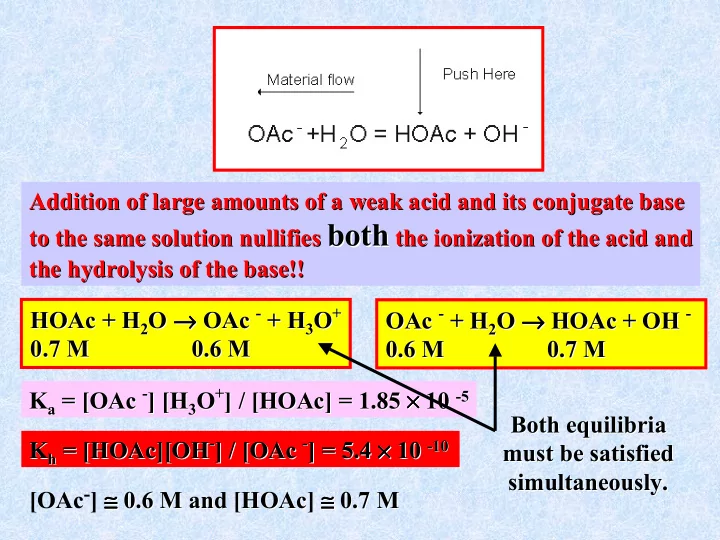
Addition of large amounts of a weak acid and its conjugate base Addition of large amounts of a weak acid and its conjugate base to the same solution nullifies to the same solution nullifies both

both the ionization of the acid and

the ionization of the acid and the hydrolysis of the base!! the hydrolysis of the base!! OAc OAc -

  • + H

+ H2

2O

O → → → → → → → → HOAc HOAc + OH + OH -

  • 0.6 M 0.7 M

0.6 M 0.7 M K Ka

a = [

= [OAc OAc -

  • ] [H

] [H3

3O

O+

+] / [

] / [HOAc HOAc] = 1.85 ] = 1.85 × × × × × × × × 10 10 -

  • 5

5

[OAc-] ≅ ≅ ≅ ≅ ≅ ≅ ≅ ≅ 0.6 M and [ 0.6 M and [HOAc HOAc] ] ≅ ≅ ≅ ≅ ≅ ≅ ≅ ≅ 0.7 M 0.7 M HOAc HOAc + H + H2

2O

O → → → → → → → → OAc OAc -

  • + H

+ H3

3O

O+

+

0.7 M 0.6 M 0.7 M 0.6 M K Kh

h = [

= [HOAc HOAc][OH ][OH-

  • ] / [

] / [OAc OAc -

  • ] = 5.4

] = 5.4 × × × × × × × × 10 10 -

  • 10

10

Both Both equilibria equilibria must be satisfied must be satisfied simultaneously. simultaneously.

slide-2
SLIDE 2

[H [H3

3O

O+

+]=2.185x10

]=2.185x10-

  • 5

5 M} This result is accurate to 4 significant

M} This result is accurate to 4 significant figures (gives same result as solving quadratic to this accuracy figures (gives same result as solving quadratic to this accuracy)! )! A solution containing substantial amounts of a weak acid A solution containing substantial amounts of a weak acid and its conjugate base is known as a buffer solution. and its conjugate base is known as a buffer solution. Thus, have [H Thus, have [H3

3O

O+

+] = {[acid]/[salt]}

] = {[acid]/[salt]} K Ka

a

Depends only on Depends only on K Ka

a and the

and the ratio

ratio of [acid] to [salt]

  • f [acid] to [salt]

If we dilute such a solution, [H If we dilute such a solution, [H3

3O

O+

+] will not

] will not change since [acid] and [salt] change identically change since [acid] and [salt] change identically when such a solution is diluted! when such a solution is diluted!

Thus have [H Thus have [H3

3O

O+

+] =

] = {[ {[HOAc HOAc]/[ ]/[OAc OAc-

  • ]}

]} × × × × × × × × K Ka

a ≅

≅ ≅ ≅ ≅ ≅ ≅ ≅ (0.70/0.60) (0.70/0.60) × × × × × × × × (1.85 (1.85 × × × × × × × × 10 10-

  • 5

5 )

)

slide-3
SLIDE 3

Example: 1 liter of 0.25 M Example: 1 liter of 0.25 M HCl HCl, add 0.600 moles of , add 0.600 moles of NaOAc NaOAc(s) (s) Assume no volume change occurs upon addition of salt. Assume no volume change occurs upon addition of salt. Find [ Find [OAc OAc -

  • ], [

], [HOAc HOAc], [H ], [H3

3O

O+

+], [OH

], [OH-

  • ]

] NaOAc NaOAc → → → → → → → → Na Na+

+ +

+ OAc OAc -

  • H

H2

2O +

O + HCl HCl → → → → → → → → H H3

3O

O+

+ +

+ Cl Cl-

  • (1)

(1) OAc OAc -

  • + H

+ H3

3O

O+

+ →

→ → → → → → → HOAc HOAc + H + H2

2O

O 0.600 0.250 ~ 0 initially 0.600 0.250 ~ 0 initially (2) (2) OAc OAc -

  • + H

+ H3

3O

O+

+ →

→ → → → → → → HOAc HOAc + H + H2

2O

O ~ .350 ~ 0 ~ .250 ~ .350 ~ 0 ~ .250 [ [OAc OAc -

  • ] = .350 [

] = .350 [HOAc HOAc] = .250 ] = .250 Ka = [OAc−][H3O+] [HOAc] = 1.85 ×10⁻⁵ Equation far to the right Equation far to the right Recognizing a buffer Recognizing a buffer when you see it. Not when you see it. Not always an easy task. always an easy task. Buffer conditions! Buffer conditions!

slide-4
SLIDE 4

1) Add 1 ml of 1 M 1) Add 1 ml of 1 M HCl HCl to 1 liter of pure H to 1 liter of pure H2

2O:

O: [H [H3

3O

O+

+]

] ≅ ≅ ≅ ≅ ≅ ≅ ≅ ≅ 0.001 0.001 Or, the Or, the H H3

3O

O+

+ concentration changes

concentration changes From 10 From 10-

  • 7

7 to 10

to 10-

  • 3

3 (4 orders of magnitude)!

(4 orders of magnitude)! 2) Now add 1 ml of 1M 2) Now add 1 ml of 1M HCl HCl to one liter of solution containing to one liter of solution containing 0.7 moles of 0.7 moles of HOAc HOAc and 0.6 moles of and 0.6 moles of NaOAc NaOAc. . Remember, this is a buffer, so [ Remember, this is a buffer, so [HOAc HOAc] ] ≅ ≅ ≅ ≅ ≅ ≅ ≅ ≅ 0.7M and [ 0.7M and [OAc OAc-

  • ]

] ≅ ≅ ≅ ≅ ≅ ≅ ≅ ≅ 0.6M 0.6M

Max Max change in

change in HOAc HOAc occurs if all H

  • ccurs if all H+

+ added reacts with

added reacts with OAc OAc-

→ → → → → → →HOAc HOAc: Reaction : Reaction stoichiometry stoichiometry is as follows: is as follows: OAc OAc -

  • + H

+ H3

3O

O+

+ →

→ → → → → → → HOAc HOAc + H + H2

2O

O 0.599 0.599 ≅ ≅ ≅ ≅ ≅ ≅ ≅ ≅ 0 0.701 0.701 Initially: Initially: OAc OAc-

  • + H

+ H3

3O

O+

+ →

→ → → → → → → HOAc HOAc + H + H2

2O

O 0.600 0.001 0.600 0.001 0.700 0.700 = 1.325x10 = 1.325x10-

  • 5

5 M

M Clamping of [H Clamping of [H3

3O

O+

+] by a buffer solution

] by a buffer solution [H3O+] = Ka [HOAc] [OAc−] ≈ 1.855 × 10⁻⁵ .25 .35    

slide-5
SLIDE 5

If not buffered, get 10 If not buffered, get 104

4 change in H

change in H3

3O

O+

+ concentration!!

concentration!! “ “Physically Physically” ” the H the H+

+ is being

is being “ “stored stored” ” as as undissociated HOAc undissociated HOAc: : If add OH If add OH-

  • also find pH does not change because the OH

also find pH does not change because the OH-

  • reacts

reacts with with HOAc HOAc to give H to give H2

2O and

O and OAc OAc-

  • !

! [ [HOAc HOAc] = 0.701 and [ ] = 0.701 and [OAc OAc-

  • ] = 0.599

] = 0.599 and [H and [H3

3O

O+

+] =

] = [acid] [anion] Ka = 0.701 0.599 1.85 ×10

−5

New [H New [H3

3O

O+

+] = 2.17

] = 2.17 × × × × × × × × 10 10-

  • 5

5

Before addition of Before addition of HCl HCl, [H , [H3

3O

O+

+] = 1.85

] = 1.85 × × × × × × × × 10 10-

  • 5

5 = 2.16

= 2.16 × × × × × × × × 10 10-

  • 5

5

.700 .600

“ “No No” ” change in [H change in [H3

3O

O+

+] when buffered!

] when buffered! OAc OAc-

  • + H

+ H3

3O

O+

+ →

→ → → → → → → HOAc HOAc + H + H2

2O

O

slide-6
SLIDE 6

pH pH

10 10 20 20 30 30 40 40

Volume 0.10 Volume 0.10 M

M NaOH

NaOH ( (mL mL) )

13 13 12 12 11 11 10 10 9 9 8 8 7 7 6 6 5 5

H H2

2O(100mL)

O(100mL)

1.0 1.0 M M CH CH3

3COOH

COOH/

/1.0

1.0 M M NaCH NaCH3

3COO (100mL)

COO (100mL)

Unbuffered Unbuffered Buffered: small change in pH compared to Buffered: small change in pH compared to unbuffered unbuffered. .

0.10 0.10 M M CH CH3

3COOH

COOH/

/0.10

0.10 M M NaCH NaCH3

3COO (100mL)

COO (100mL)

Buffered Buffered Higher buffer concentration Higher buffer concentration resists pH changes more effectively. resists pH changes more effectively.

Add strong Add strong base to: base to: 1) Pure water 1) Pure water 2) 0.1 M/0.1 M 2) 0.1 M/0.1 M Acetate buffer Acetate buffer 3) 1.0 M/1.0M 3) 1.0 M/1.0M Acetate buffer Acetate buffer

slide-7
SLIDE 7

pH

50 100

12 11 10 9 8 7 6 5 4 3 2 1

Volume 0.1000 Volume 0.1000 M

M NaOH

NaOH ( (mL mL) )

Titration of a strong acid by a strong base. Titration of a strong acid by a strong base.

Equivalence point 100.0 100.0 mL mL of

  • f

0.1000 0.1000 M

M HCl

HCl titrated titrated with with 0.1000 0.1000 M

M NaOH

NaOH. .

At start At start [H [H3

3O

O+

+]=10

]=10-

  • 1

1 M

M

slide-8
SLIDE 8

Titration Curve for Titration Curve for aWeak aWeak Acid HA (red curve/points) Acid HA (red curve/points) HA + OH HA + OH-

→ → → → → → → H H2

2O + A

O + A-

  • Mostly

Mostly HA HA at start at start Mix of HA Mix of HA and A and A-

  • in

in buffer buffer region region

QuickTime™ and a Animation decompressor are needed to see this picture.

slide-9
SLIDE 9

Ratio of yellow, In Ratio of yellow, In-

  • form, to red,

form, to red, HIn HIn form, controlled only by form, controlled only by [H [H3

3O

O+

+] for a given K

] for a given KI

I

Indicators Indicators Dye molecules whose color changes with pH or [H Dye molecules whose color changes with pH or [H+

+].

]. Useful way to follow pH changes. Useful way to follow pH changes. HIn HIn + H + H2

2O

O → → → → → → → → H H3

3O

O+

+ + In

+ In-

  • In

In-

  • yellow,

yellow, HIn HIn red red In = Indicator In = Indicator

KI = [H3O+][In−] [HIn]

[In [In -

  • ] / [

] / [HIn HIn] = K ] = KI

I / [H

/ [H3

3O

O+

+]

] (Indicators are themselves weak acids or bases.)

slide-10
SLIDE 10

Bonus * Bonus * Bonus * Bonus * Bonus * Bonus Bonus * Bonus * Bonus * Bonus * Bonus * Bonus

slide-11
SLIDE 11

Some Important Acid Some Important Acid-

  • Base Indicators

Base Indicators ( (Skoog Skoog and West p 189, table 9 and West p 189, table 9-

  • 1)

1) Indicator Indicator Sensitive pH Range Sensitive pH Range Acid Color Acid Color Base Color Base Color Thymolphthalein Thymolphthalein 9.3 9.3 -

  • 10.5

10.5 colorless colorless blue blue Phenolphthalein 8.0 Phenolphthalein 8.0 -

  • 9.8

9.8 colorless colorless red red-

  • violet

violet Methyl Yellow 2.9 Methyl Yellow 2.9 -

  • 4.4

4.4 red red

  • range
  • range-
  • yellow

yellow → → → → → → → → K KI

I /

/ [H [H3

3O

O+

+] = 1

] = 1 → → → → → → → → [H [H3

3O

O+

+] = K

] = KI

I

Sensitivity range brackets: [In Sensitivity range brackets: [In-

  • ]/[

]/[HIn HIn] = 1 ] = 1 → → → → → → → → pH = pH = pK pKI

I where

where pK pKI

I =

= -

  • log

log10

10 K

KI

I

Center of pH range where indicator works best is pH = Center of pH range where indicator works best is pH = pK pKI

I

slide-12
SLIDE 12

Thermodynamics Thermodynamics (1st part) (1st part) Introduction Introduction

Thermodynamics is the study of energy flow for bulk matter. It i Thermodynamics is the study of energy flow for bulk matter. It is s not a subject which concerns itself with the behavior of individ not a subject which concerns itself with the behavior of individual ual molecules. molecules. Rather it describes the behavior only of large numbers of Rather it describes the behavior only of large numbers of molecules taken together. molecules taken together. Thermodynamics is only valid under certain relatively restricted Thermodynamics is only valid under certain relatively restricted

  • conditions. Most simply
  • conditions. Most simply Thermodynamics describes equilibrium

Thermodynamics describes equilibrium situations and change between equilibrium situations situations and change between equilibrium situations. . All of Thermodynamic principles are based completely on All of Thermodynamic principles are based completely on experimental findings in the laboratory. experimental findings in the laboratory. As such it is a totally empirical science. Example: Sun rises ev As such it is a totally empirical science. Example: Sun rises every ery

  • morning. Statement based on experience or measurement.
  • morning. Statement based on experience or measurement.

Thermodynamics is a discipline with only 3 laws: Thermodynamics is a discipline with only 3 laws: 1st Law : Energy of the Universe is constant 1st Law : Energy of the Universe is constant (can only pay Paul by robbing Peter) (can only pay Paul by robbing Peter)

slide-13
SLIDE 13

2nd Law : Entropy of the universe can only increase, (more 2nd Law : Entropy of the universe can only increase, (more sophisticated). sophisticated). Some Definitions : Some Definitions : 1) System : Object or box or part of the physical universe which 1) System : Object or box or part of the physical universe which we we want to study. want to study. 2) Surroundings: Every thing that isn't the system (i.e. the 2) Surroundings: Every thing that isn't the system (i.e. the remainder of the universe) remainder of the universe) 3) Equilibrium states or more simply and sloppily just states: A 3) Equilibrium states or more simply and sloppily just states: A situation in which a system does not change with time i.e. The b situation in which a system does not change with time i.e. The bulk ulk properties don't change. properties don't change. To describe the state of a system we usually need to know severa To describe the state of a system we usually need to know several l things such as things such as Temperature Temperature Pressure Pressure Density Density Composition (chemical) Composition (chemical) 3rd Law: Entropy vanishes at T=0 Kelvin. 3rd Law: Entropy vanishes at T=0 Kelvin.

slide-14
SLIDE 14

4) State Functions: These are the most important quantities in 4) State Functions: These are the most important quantities in Thermodynamics and also the most difficult to define. Thermodynamics and also the most difficult to define. A state function is a property of a system which may have differ A state function is a property of a system which may have different ent values for different equilibrium states of the system ; values for different equilibrium states of the system ; but a state function always has exactly the same value in a give but a state function always has exactly the same value in a given n equilibrium state regardless of the past history of the system. equilibrium state regardless of the past history of the system. Changes in values of state functions are easy to determine becau Changes in values of state functions are easy to determine because se the change depends only on the initial and final equilibrium sta the change depends only on the initial and final equilibrium states of tes of the system. the system.

slide-15
SLIDE 15

Example : Example :Temperature is a state function Temperature is a state function Distance traveled between 2 points is not a state function Distance traveled between 2 points is not a state function. . T Ti

i

x x x x T Tf

f

d d1

1

d d2

2

∆ ∆T= T=T Tf

f-

  • T

Ti

i (Either path)

(Either path)

d d1

1 ≠

≠ d

d2

2