
SLIDE 1
Richard Johns, March 6 2003
Probability and Random Events
- 1. Introduction
Suppose you repeat the same experiment a number of times, setting up the same apparatus in exactly the same way, but it doesn’t always give the same result. Moreover, if you repeat the experiment a large number of times (say 10,000 times) then the proportion of outcomes of a given type seems fairly stable. For example, on repeated rolls of a (weighted) die, the proportion of fours might converge to somewhere around 0.121. What’s going on here? There are two possibilities.
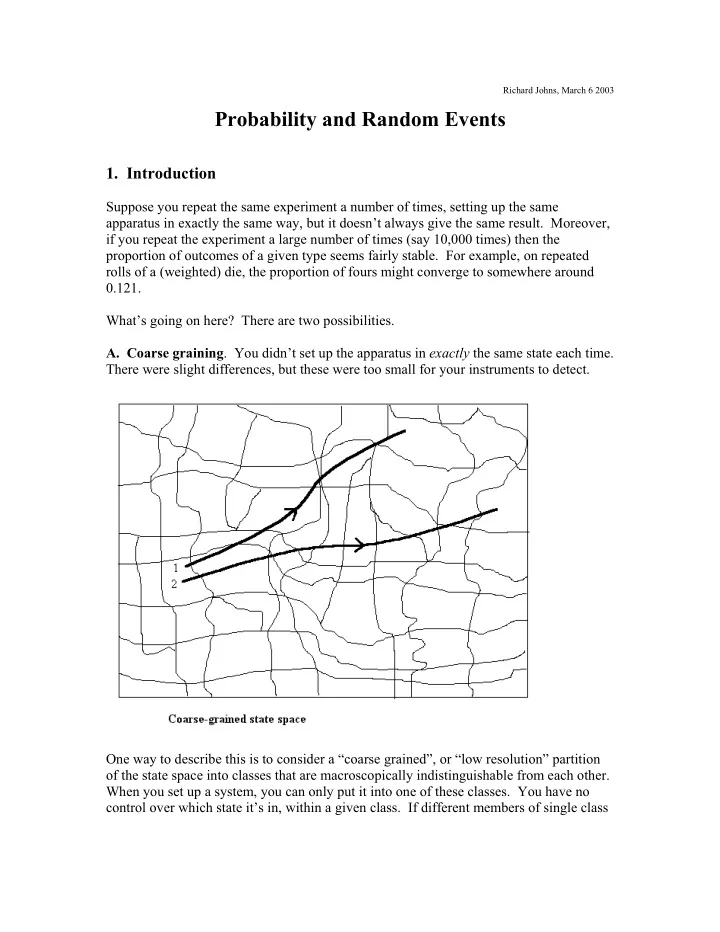
- A. Coarse graining. You didn’t set up the apparatus in exactly the same state each time.
There were slight differences, but these were too small for your instruments to detect. One way to describe this is to consider a “coarse grained”, or “low resolution” partition
- f the state space into classes that are macroscopically indistinguishable from each other.