TITLE: Waiver Personal Care Services PowerPoint DATE: 6/3/2020 - - PDF document

title waiver personal care services powerpoint date 6 3
SMART_READER_LITE
LIVE PREVIEW

TITLE: Waiver Personal Care Services PowerPoint DATE: 6/3/2020 - - PDF document

TITLE: Waiver Personal Care Services PowerPoint DATE: 6/3/2020 NUMBER OF SPEAKERS: 1 speaker TYPE: PowerPoint presentation with audio transcription NUMBER OF SLIDES: 29 Slide #1 Title: Waiver Personal Care Services By: Integrated Systems of


slide-1
SLIDE 1

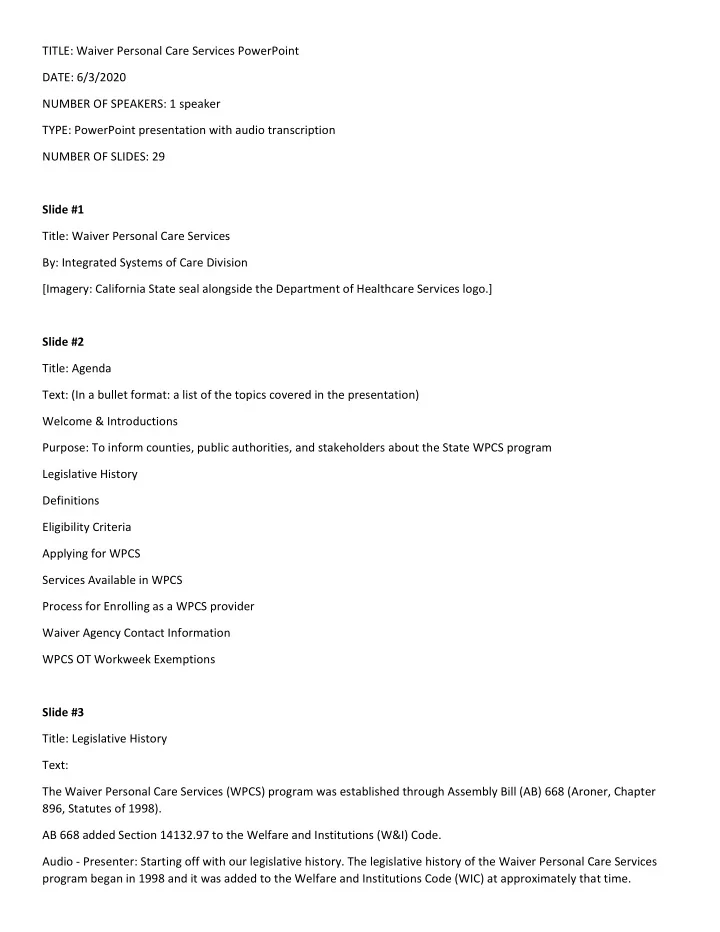
TITLE: Waiver Personal Care Services PowerPoint DATE: 6/3/2020 NUMBER OF SPEAKERS: 1 speaker TYPE: PowerPoint presentation with audio transcription NUMBER OF SLIDES: 29 Slide #1 Title: Waiver Personal Care Services By: Integrated Systems of Care Division [Imagery: California State seal alongside the Department of Healthcare Services logo.] Slide #2 Title: Agenda Text: (In a bullet format: a list of the topics covered in the presentation) Welcome & Introductions Purpose: To inform counties, public authorities, and stakeholders about the State WPCS program Legislative History Definitions Eligibility Criteria Applying for WPCS Services Available in WPCS Process for Enrolling as a WPCS provider Waiver Agency Contact Information WPCS OT Workweek Exemptions Slide #3 Title: Legislative History Text: The Waiver Personal Care Services (WPCS) program was established through Assembly Bill (AB) 668 (Aroner, Chapter 896, Statutes of 1998). AB 668 added Section 14132.97 to the Welfare and Institutions (W&I) Code. Audio - Presenter: Starting off with our legislative history. The legislative history of the Waiver Personal Care Services program began in 1998 and it was added to the Welfare and Institutions Code (WIC) at approximately that time.

slide-2
SLIDE 2

Slide #4 Title: Legislative History Text: WPCS was initially established as a personal care services (PCS) benefit through the Nursing Facility/Acute Hospital (NF/AH) and In Home Operations (IHO) waivers. On May 16, 2017 the Centers for Medicare and Medicaid (CMS) approved the Home and Community- Based Alternatives (HCBA) waiver (formerly the NF/AH waiver). WPCS remains a waiver benefit available under the IHO and HCBA waivers. Audio – Presenter: Moreover, the Waiver Personal Care Services program was initially established as a Personal Care Services benefit through the Nursing Facilities and Acute Hospital program as well as the In-Home Operations Waiver

  • program. You may remember those programs if you worked previously in this area because prior to the HCBA/HCBS

waiver, it was known as the Nursing Facility/Acute Hospital Waiver. Now as you may be aware, on May 16, 2017 the centers for Medicare and Medicaid services approved the HCBA Waiver, which was previously known as the Nursing Facility/Acute Hospital Waiver. Slide #5 Title: IHO Waiver Sunset / Transition Text: The IHO Waiver sunset on December 31, 2019 and all IHO Waiver participants were transitioned to the HCBA Waiver before that date. Upon transition to the HCBA Waiver, IHO Waiver participants maintained all WPCS services and providers previously authorized under the IHO Waiver. Audio – Presenter: The In-Home Waiver - Sunset transitioned as you may be aware on December 31, 2019, and the program participants were transitioned into the HCBA Waiver. The IHO Waiver participants maintained all WPCS services, and the providers previously authorized under the prior waiver of Sunset. That is a little bit of information on the IHO Waiver – Sunset, and why you are not likely to hear too much about it moving forward in the future. Slide #6 Title: Definition Text: WPCS is designed to assist the waiver participant with gaining independence with the activities of daily living (ADLs) and preventing social isolation. WPCS assist the waiver participant with maintaining independence in their home and the community. Audio – Presenter: To focus specifically on WPCS and what it is, WPCS is designed for waiver participants to gain additional independence with activities in their home related to daily living, and for the purposes of preventing social isolation, which could happen if they are not allowed to remain in their homes in the community. That is the real idea behind both the IHSS and the WPCS program; it is to assist the waiver participants in maintaining the continuity of living in the home and living in the community because that is the best place for folks, and that is where we would like them to be whenever possible.

slide-3
SLIDE 3

Slide #7 Title: Eligibility Criteria Text: To be eligible for WPCS, the participant must: Be enrolled in and receiving federally funded State Plan PCS via the In-Home Supportive Services (IHSS) program Exhaust their current authorized PCS benefits Audio – Presenter: So how does one gain eligibility for WPCS, you might be wondering. Well, to be eligible for WPCS, you have to meet two entrance criteria. First of all, you have to be enrolled and receiving federally funded, state-planned Personal Care Services via the In-Home Supportive Services program. Now federally funded is an important part of that so please do note that is critical there. In addition to already being in federally funded IHSS, you need to have exhausted all of your current Personal Care Services benefit. Potentially what you need to be is already approved for IHSS and you need to have exhausted all of your Personal Care Services hours. Potentially if you need additional hours, and you can’t contain them under the IHSS program, then you would come over to WPCS under that criteria, under the eligibility entrance criteria. Slide #8 Title: Application Process Text: Applicants must first apply for enrollment in the HCBA Waiver. A representative from the applicable waiver agency will schedule an initial in-home assessment with a case manager and/or nurse evaluator. HCBA Waiver service needs are determined during the assessment and authorized as determined medically necessary if the applicant is approved for enrollment. Audio – Presenter: Once you have established that you meet that criteria, how do you apply for WPCS? Well what you do is you apply for enrollment in the HCBA Waiver, and then what happens is a representative from the applicable waiver agency for your location, and we will cover that later in this presentation, will schedule you an in-home assessment with the case manager or a nurse evaluator. They will come to your home. They will do an assessment, and they will see what needs you have that can be fulfilled under the Waiver Personal Care Services program. Slide #9 Role of the HCBA Waiver Agency Waiver agencies are contracted under the HCBA Waiver to conduct waiver administration functions (i.e. enrollment process and service authorizations) and waiver case management. A WPCS participant may contact the waiver agency to reach their waiver care management team (comprised of a registered nurse and social worker). HCBA contracts with nine waiver agencies, each with a specific service area that could include one or multiple counties

  • r specific zip codes within a county. Waiver agency service areas do not overlap.

Alpine, Imperial, Inyo, Marin, Mendocino, Mono, and Napa counties do not have an assigned waiver agency. In these counties waiver administration functions and waiver case management are provided directly by DHCS.

slide-4
SLIDE 4

Audio – Presenter: Additionally, services that are determined during the assessment and authorized, they will be approved if medically necessary when enrolled. That is important to remember that these are things that need to be determined as medically necessary. Now as we talked about it in this, there is a role for the HCBA waiver agency in this process, and now we will talk a little bit more about that role for the HCBA Waiver agency. The role of the HCBA Waiver agency is first of all, they are contracted under the HCBA Waiver to conduct administrative functions; for example, the enrollment and service authorization. As always, they provide case management service for all of the cases, which are in their area and enrolled through them. A WPCS participant may contact the waiver agency as well as the care team, which always involves a nurse and social worker for assistance, and the HCBA waiver agencies are broken up; there are nine of them and they have specific service areas related to counties and/or zip codes if you are in a very large county like LA. The areas are set up so there is no overlap so you will always know which waiver agency to reach out for based

  • n the county that you are in or the zip code in that particular county. A few counties do not have assigned waiver

agencies, and those county cases are managed by the Department of Healthcare Services directly. Slide #10 Title: Waiver Agency Contact Information [A chart lists the waiver agencies, their respective service areas, and phone numbers.] Access TLC provides services to Santa Barbara County, parts of Los Angeles County, and parts of Orange County. The agency can be reached at 805-517-1620 Center for Elders’ Independence provides services to Alameda, and Contra Costa counties. The agency can be reached at 510-318-7375. Home and Healthcare Management provides services to Butte, Glenn, Sacramento, San Joaquin, Shasta, Solano, Sutter, Tehama, Yolo, Yuba, Colusa, Del Norte, El Dorado, Humboldt, Lake, Lassen, Modoc, Nevada, Placer, Plumas, Sierra, Siskiyou, and Trinity Counties. The agency can be reached at 530-343-0727. Institute on Aging provides services to San Francisco, San Mateo, San Bernardino, and Riverside counties. The agency can be reached at 650-285-6437 or 415-750-8761. Libertana Home Health provides services to Kern, Fresno, Kings, Tulare, Madera, Mariposa, Merced, Stanislaus, Tuolumne, San Luis Obispo, Amador, Calaveras, Santa Clara, Santa Cruz, San Benito, Monterey, and sections of Los Angeles and Orange counties. The agency can be reached at 818-902-5000. Partners in Care provides services to sections of Los Angeles County. The agency can be reached at 818-837-3775. San Ysidro Health provides services to San Diego County. The agency can be reached at 833-503-5910. Sonoma County Human Services Department provides services to Sonoma County. The agency can be reached at 707- 565-6440. Ventura County Agency on Aging provides services to Ventura County. The agency can be reached at 805-477-7325. Slide #11 Title: Authorization of Hours Text: A waiver participant can receive up to, but no more than, 24 hours of direct care and protective supervision service hours per day. This hourly maximum includes private duty nursing hours as well as both IHSS and WPCS hours combined.

slide-5
SLIDE 5

Waiver agency staff and nurses confirm IHSS hours prior to authorizing WPCS hours to remain in compliance with the 24 hour direct care maximum. Audio – Presenter: Typically talking about the authorization of hours under the Waiver Personal Care Services program and what can be authorized by the waiver agency. Now it is very important to remember that a waiver participant can receive up to but no more than 24 hours of direct care, which includes protective supervision. Now this is absolutely critical because you need to ensure that you are not receiving more than 24 hours of direct care, and if you are looking for reviewing cases, you need to ensure that there are no more than 24 hours of direct care services authorized in a 24 hour period. Now indirect care and direct care are different, and it is important that you note the difference between the two because you can have 24 hours of direct care and potentially you can have indirect care on top of that related to the services if medically necessary as determined by the care management team at the waiver agency. That is a little bit about the authorization of hours. Additionally it is important to note that the 24 hours of direct care is both IHSS and WPCS hours combined. For example, if you are getting 12 hours of IHSS and 12 hours of WPCS as direct care, then you are at your limit of 24 hours of direct care. Slide #12 Title: WPCS Benefits Include Text: Assistance to support independence in ADLs. Adult companionship and protective supervision. Limited assistance while a participant is hospitalized. Audio – Presenter: WPCS benefits can include support of independence and activities of daily living, adult companionship, and protective supervision is covered as well as limited potential assistance when a participant is

  • hospitalized. For example, when they take a short hospitalization period, and what the beneficiary needs while they are

in the hospital if they need their mail regularly checked by the person who would be doing the services, the WPCS care provider; as well as for example grocery shopping when they are anticipating returning home from the hospital to support the transition back into the community. Those types of limited assistance are available when a participant is hospitalized. Slide #13 Title: Examples of Independence-related ADLs Assistance Text: Verbal cueing Monitoring for safety Reinforcement of the participants attempt to complete self-directed activities Advising the primary caregiver of any problems that occur Providing information for updating the Plan of Treatment (POT) Audio: Talking about the independence-related, activities of daily living assistance, a couple of types of services that would be covered for example is verbal cueing if the particular person receiving care needs verbal cueing if it is medically

  • necessary. This includes activities such as monitoring for safety, reinforcement of the participants attempt to complete

self-directed activities because the idea here is that you are assisting activities of daily living so they can independently live in the community, and they do not have to be in an institution or congregated setting. That is the idea here. Those are a couple examples of activities that would be covered under WPCS.

slide-6
SLIDE 6

Slide #14 Title: Examples of Companionship Assistance Text: Non-medical care Supervision, when appropriate Socialization Assistance with accessing self-interest activities or activities in the local community for socialization and recreational purposes Audio – presenter: Additionally, companion assistance when appropriate is allowed under the WPCS program. It needs to be determined that it is medically necessary by the care management team – the social worker and the RN - when they are doing assessments. Companionship is non-medical care when appropriate related to socialization as well as accessing activities and stuff of interest, activities in the community for recreational purposes. Generally, the idea here again is that you are trying to assist the person in their activities in daily living in the community such that they can stay

  • ut of institutionalized of congregated services. If it is determined that the Waiver Personal Care Services would be

helpful for the beneficiary in a companionship to enhance their activities of daily living, socializing, and recreational purposes, those are covered activities under the Waiver Personal Care Services. Slide #15 Title: Services while Hospitalized Text: WPCS providers may provide services outside of the health care facility setting, while a participant is hospitalized, for a maximum of 7 days. Each time the participant is admitted, the provider must submit written documentation to the Waiver Agency or DHCS describing the specific activities performed, the amount of time each activity required, and the total number of hours they worked. Audio – Presenter: Let us talk a little bit more about hospitalizations and the services that are allowed. This is the most important part, maximum of seven days. WPCS providers can provide services outside of the hospital settings if the participant has been hospitalized for a maximum of seven days. Anything beyond that will not be allowed. It is very important to keep that tracker down for that period of time, and to document the required activities, number of hours worked, and you need to submit that to the waiver agency or department of healthcare services describing that activities that were performed. Next we will have a list of the specific activities that are allowed during hospitalization. Slide #16 Title: Services Available during Hospitalization Text: Routine housekeeping in the participant’s absence. Collection of mail in the participant’s absence. Grocery shopping for the participants return home. Assistance with obtaining medications and medical supplies for the participants return home. Availability to accept delivery of Durable Medical Equipment (DME) and supplies at the participant’s home.

slide-7
SLIDE 7

Audio – Presenter: Here we have a couple of activities that are allowed during hospitalization: Routine housekeeping, collection of mail, grocery shopping for the return home, as well as the acceptance of medication or medical supplies for the return home, as well as accepting deliveries of durable medical equipment and supplies at the participant’s home. The idea behind all these activities is that they assist the successful transition from the hospital setting into the home for the purpose of transitioning the person back into the community with as much continuity as possible with what they were doing before the hospitalization. Slide #17 Title: Enrolling as a Provider Text: Must be at least 18 years of age. If an individual would like to become a WPCS provider, they must complete the IHSS provider orientation and enrollment process first; or Be employed directly by a Personal Care Agency. Audio – Presenter: Now let us talk about how you become a provider. For Waiver Personal Care Services, you must be 18 years of age. This is different than the IHSS program, it should be noted. For Waiver Personal Care Services, you must be at least 18 years of age to be a provider. If you’d like to become a WPCS provider, you must complete the IHSS provider

  • rientation and enrollment process first. That is absolutely critical. Not only are you not allowed by the rules that exist

under the WPCS program if you are not already enrolled, it is also impossible to be paid if you are not a part of the IHSS program already. Do not try to become a WPCS provider before already being an IHSS provider. It will not be successful, and it will simply slow down any applications. Additionally you can be enrolled as a provider directly by a Personal Care Agency. Slide #18 Title: Enrolling a Provider Text: Once a provider is eligible to provide services through the IHSS program, they will need to fill out a WPCS Provider Agreement form. A provider agreement form can be requested from the designated HCBA waiver agency for the applicable service area. The waiver agency will send out the provider agreement form to the participants mailing address. Audio – Presenter: Additionally other activities related to enrolling a provider, you need to of course fill out a WPCS provider agreement form. That is the sign up form for being a WPCS provider, and without one of those, you will be unable to enroll in the WPCS program. You can get that form from the designated HCBA waiver agency in your area. If you are in an area that does not have a waiver agency, please contact the WPCS group with the contact information at the end of this presentation and they will be able to assist you in that area. Slide #19 Title: Enrolling a Provider II Text: Provider agreement forms for those counties serviced by DHCS should be sent directly to DHCS. Provider agreement forms are found at: https://www.dhcs.ca.gov/services/ltc/Documents/Waiver_Service_Provider_Agreement.pdf When sending these provider agreement forms to DHCS, please email them to: Wpcsrequests@Dhcs.ca.gov

slide-8
SLIDE 8

Audio – Presenter: Again as I said earlier, if you are in a county which is serviced by the department of healthcare services, then the provider agreement should be sent directly to us, and you will see the email there at the bottom that is WPCSRequests@DHCS.CA.GOV. That is where you would want to send the provider agreement form. Additionally we also have the link to the agreement form there in the middle if you need to access it for whatever reason. Slide #20 Enrolling a Provider III Provider agreement forms for those counties serviced by a Waiver Agency should be sent directly to the case manager

  • f the appropriate Waiver Agency.

The Waiver Agency will then provide the information of the new provider to DHCS. Audio – Presenter: Just a little bit on enrolling a provider. The information on the provider agreement form should be sent to the waiver agency for your area, and then they will provide that to the Department of Healthcare Services as needed. Slide #21 Title: WA Provider Agreement Form [Imagery: an example of the Provider Agreement displaying two pages with highlighted areas.] Audio – Presenter: In case you are wondering what the WPCS Provider agreement form looks like or if you are signing the right form. Slide #22 Title: Authorized Provider Hours Text: A provider who cares for one participant is allowed to work up to 70.45 hours a work week with IHSS/WPCS hours combined. While a provider who works for two or more participants can work up to 66 hours a work week with IHSS/WPCS hours combined. A WPCS workweek begins at 12:00 a.m. on Sunday and ends at 11:59 p.m. the following Saturday. Audio – Presenter: Very important to know that if a provider who cares for one WPCS participant is allowed to work up to 70 hours and 45 minutes per workweek with IHSS and WPCS combined. It is very important to note that you cannot work 70 hours and 45 minutes of IHSS and then work another 70 hours and 45 minutes for WPCS. They are combined in that total so you want to ensure that you are tracking them together. Now if you are a provider that works for two or more participants, instead of the 70 hours and 45 minutes per week, it is instead 66 hours per week, and again it is combined - the IHSS and WPCS hours. As always, a WPCS workweek begins at 12AM on Sunday and ends at 11:59PM the following Saturday.

slide-9
SLIDE 9

Slide #23 Title: Overtime Exemption Text: If a provider wants to work over the number of authorized hours, they can apply for an OT Exemption. If the provider is approved for the OT Exemption, they would be allowed to work up to 12 hours a day and up to 360 hours a month with IHSS/WPCS hours combined. Audio – Presenter: Now there is such a thing as an overtime exemption. If you are interested in working over the number of allowed hours, you can apply for an overtime exemption. If it is granted, a provider would be allowed to work up to 12 hours per day, and up to 360 hours a month of IHSS and WPCS combined. Slide #24 Title: Overtime Exemption [Description: A link to the overtime exemption form and the first page of the workweek exemption for WPCS care providers.] Link: https://www.dhcs.ca.gov/services/ltc/Documents/WPCS-Exemption-Request-Form.pdf Audio – Presenter: The form for the exemption as well as the link to access that form. Slide #25 Title: Overtime Exemption page 2 Audio – Presenter: Here is page 2 of the overtime exemption, and you will see some key criteria there at the bottom. Slide #26 Title: Overtime Exemption page 3 Audio – Presenter: And then you will see page 3 of the overtime exemption. It is very important when applying for an

  • vertime exemption, please do provide any additional document you may have related to trying to obtain additional
  • providers. Please submit any document you may have that related to trying to find additional providers because that is
  • ne of the criteria that are evaluated when granting or denying an overtime exemption.

Slide #27 Title: Provider Benefits effective July 1, 2019 Text: Beginning July 1, 2019 WPCS providers began receiving new benefits for the purpose of creating parity between the IHSS and WPCS programs, including: Health Benefits Collective Bargaining Rights Union Membership Rights

slide-10
SLIDE 10

Additional county-specific benefits Audio – Presenter: Provider benefits. Beginning in 2019, WPCS providers began receiving new benefits for the purpose

  • f creating parity between the IHSS and WPCS programs. These benefits include health benefits, collective bargaining

rights, union membership rights, and additional county specific benefits. Slide #28 Title: Provider Benefits effective July 1, 2020 Text: Effective July 1, 2020 related to the passage of AB 1811, WPCS providers can begin claiming sick leave using the same process as IHSS providers. For more information, please visit: https://www.cdss.ca.gov/inforesources/ihss-providers/resources/sick-leave Audio – Presenter: It is important to note that there are additional benefits which become effect July 1, 2020. Specifically, effective July 1, 2020 related to the passing of AB 1811, WPCS providers can begin claiming sick leave using the same process as IHSS providers. Slide #29 Title: For Additional Information Text: About the HCBA Waiver: https://www.dhcs.ca.gov/Pages/Search.aspx?q=wpcs HCBA Waiver Application: https://www.dhcs.ca.gov/services/ltc/Documents/2019HCBAApp.pdf 2019 All County Welfare Directors’ Letters (ACWDL) https://www.dhcs.ca.gov/services/medi-cal/eligibility/Pages/2019ACWDLs.aspx WPCS Payroll Line: (916) 552-9214 Electronic Timesheet Service & Direct Deposit Installation (Help Desk): (866) 376-7066 Audio – Presenter: This is probably the most important page of this training; this is where you will find the numbers for the WPCS payroll line. This is also where you will find the number for the electronic timesheet portal related to electronic timesheets, which I know are really important. Additionally you can find the All-County Welfare Director’s Letters as well as information about the HCBA waiver and application. If you have additional questions or would like additional information following the conclusion of this training, we would recommend using those resources.