Titan-like reactors to simulate globally the chemistry in Titans - - PowerPoint PPT Presentation

titan like reactors to simulate globally the chemistry in
SMART_READER_LITE
LIVE PREVIEW

Titan-like reactors to simulate globally the chemistry in Titans - - PowerPoint PPT Presentation

12 th may 2011 Fifth Workshop on Titan Chemistry Titan-like reactors to simulate globally the chemistry in Titans atmosphere Universit de Versailles St Quentin N. Carrasco, T. Gautier, G. Cernogora Main global reactor types


slide-1
SLIDE 1

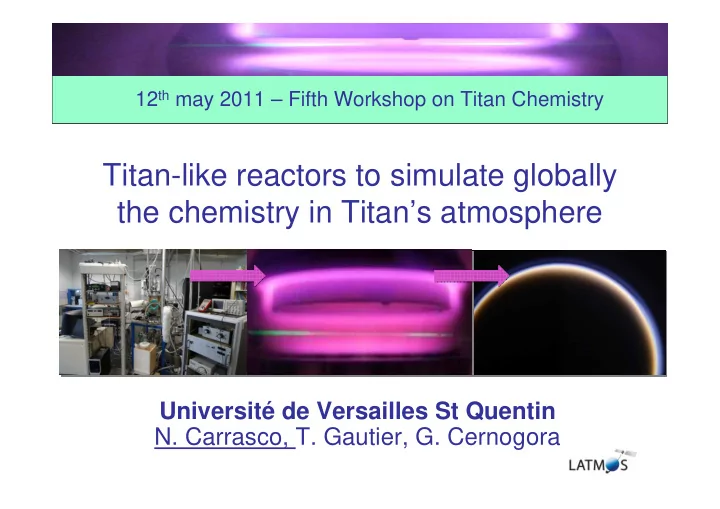
Titan-like reactors to simulate globally the chemistry in Titan’s atmosphere

Université de Versailles St Quentin

  • N. Carrasco, T. Gautier, G. Cernogora

12th may 2011 – Fifth Workshop on Titan Chemistry

slide-2
SLIDE 2

Main global reactor types

  • Photolysis: dissociative ionization of N2 and CH4
  • n synchrotron radiation beamline

Imanaka and Smith@Dpt of Chemistry Tucson

  • Coupling a plasma dissociation of N2 and

methane photolysis at Ly-α M.C. Gazeau @LISA, SETUP

  • Plasma: dissociation and dissociative ionization
  • f N2 and CH4 by electronic impact
  • N. Carrasco PAMPRE, P. Coll @LISA
slide-3
SLIDE 3
  • P [ 1,5 bar-10-8 mbar]
  • T [100-200 K]
  • CH4 [2-10%]
  • ~30 years

TITAN = F(Z)

  • Narrow PN2-CH4 range

[0,2 - 3 mbar]

  • T~ 200-340 K
  • CH4 [0-10%]
  • ~5 min

Pressure Temperature Mixing ratio Time-scale PAMPRE

  • Higher pressure than in the ionosphere:

Mandatory to enable aerosol production in reasonable time-scale

  • Temperature regulation:

Newly implemented. Neutrals temperature determined by OES (Alcouffe et al. 2010) Results presented here performed at Tamb

Comparable physical conditions ?

slide-4
SLIDE 4
  • Photons: Solar spectrum
  • Saturn magnetospheric e-

TITAN = F(Z)

  • Electrons

Energy source PAMPRE

Cassini-Huygens recent obs: 1-Gas-phase

  • Stratosphere (CIRS) : high densities
  • f N-species (HCN, CH3CN, C2N2)
  • Ionosphere (INMS) : major positive

ions contain nitrogen 2-Aerosols Nitrogen rich refractory nucleus (ACP)

Why a plasma ?

⇒ ⇒ ⇒ ⇒ Necessity to produce reactive nitrogen (λ λ λ λ<100nm) Impossible with photolytic chamber (windows): only CH4 and HC chemistry. Note: synchrotron based experiments at 60 and 82.5 nm (Imanaka & Smith)

Vuitton et al. 2008

slide-5
SLIDE 5

Why a plasma ?

  • Photons: Solar spectrum
  • Saturn magnetospheric e-

TITAN = F(Z)

  • Electrons
  • Continuous spectrum,

enhancing the VUV range

Energy source PAMPRE

Measured solar spectrum compared with two maxwellian electron energy distribution functions of the plasma at 1 and 2 eV.

Szopa et al. 2006

slide-6
SLIDE 6

What about the branching ratios ?

  • CH4 photodissociation: br not

known out of Ly-α !!! (Gans et al. 2010)

TITAN = F(Z)

  • Electron energy

distribution not well- known (in progress)

CH4 and N2 photon vs e- PAMPRE

Robertson et al. 2009 PSS

Cassini’s INMS ions spectra more or less similar !

⇒ ⇒ ⇒ ⇒ With a plasma experience:

  • No absolute quantitative

simulations

  • Possible enhancement of the

nitrogen-chemistry

  • But globally representative

mechanisms

slide-7
SLIDE 7
  • Produced in the atmospheric gas

phase

TITAN = F(Z)

  • In suspension in the CCP :

produced in the volume

  • « DUSTY PLASMA »

Aerosols PAMPRE

Why a CCP-RF plasma?

slide-8
SLIDE 8

Conclusion 1

  • In Titan’s upper atmosphere, Cassini’s observations

have shown a complex ionic (positive and negative ions) and neutral chemistry leading to solid organic aerosols.

  • Plasma devices are the most efficient setups to produce

this kind of organic material, despite possible biases concerning an over-estimation of nitrogen dissociation. Review paper in preparation on : Plasma Discharges as a probe of chemical processes in planetary atmospheres (N. Mason et al. 2011)

slide-9
SLIDE 9

1 2 4 5 6 8 10

% CH4 initial

Solid particules (Tholins)

Color in agreement with Titan’s aerosols Chemistry-dependent color/optical properties

slide-10
SLIDE 10

Morphology and size distribution

Scanning Electron Microscopy (SEM)

  • Spherical grains
  • Diameter between 0.1 and 2 µm according to the

plasma parameters, in agreement with Titan’s grains size 400 nm

[CH4]0 = 2% [CH4]0 Flow rate Pulsed or continuous mode Power

Hadamcik et al. (2009)

slide-11
SLIDE 11

Conclusion 2

  • Tholins reproduce nicely several observations

made on Titan’s aerosol

  • Composition mainly unknown, lot of work in

progress

– Carrasco et al. 2009 JPCA – Pernot et al. 2010, Anal. Chem. – M. Smith : MS and NMR – Presentation this morning – S. Hörst : MS – Presentation on Thursday

  • Production processes ? Gazeous intermediates ?
slide-12
SLIDE 12

When [CH4]0 increases :

  • C no change
  • H
  • N

Consistent with a competition between (CH2) and (HCN) polymer patterns (Pernot et al 2010)

Dust elemental analysis: a H/N competition

10 20 30 40 50 2 4 6 8 10

Initial CH4 concentration (%) Molar percentage (%)

H C N

Sciamma-O’Brien et al. (2010) Icarus

slide-13
SLIDE 13

Hydrogen role in heterogeneous processes

  • Hydrogen content increases, but production efficiency

decreases : inhibiting role of hydrogen

  • Atomic or molecular hydrogen ???

Optimum C-limited Inhibited by H + H2?

slide-14
SLIDE 14

Looking for explanation in the gas phase

PHASE IN SITU EX SITU GAS

  • Cryogenic trap/ GCMS

(concentrates the organics)

  • Mass spectrometry (main neutrals)
  • Optical Emission Spectroscopy

(radiative species)

slide-15
SLIDE 15

5.9% 2.4% 1.3% 3.9% 0.6%

In situ mass spectrometry

Methane consumption

PLASMA ON

Titan’s atmospheric CH4 concentration obtained for [CH4]0 = 4-6% in PAMPRE. Saturation of methane consumption for [CH4]0 > 6% in PAMPRE.

Sciamma-O’Brien et al. (2010) Icarus

slide-16
SLIDE 16

Cold trap – GCMS analysis

  • Trap slowly warmed up to room temperature
  • Direct injection of the gaseous products in the

GCMS

  • Column: 30m MXT Q plot / separation
  • ptimized for volatile species no larger than 5C
slide-17
SLIDE 17

Detection of about 40 species

slide-18
SLIDE 18
  • Detection of about 40 species
slide-19
SLIDE 19
  • N

N N N N

Detection of about 40 species

slide-20
SLIDE 20

Consistency with observations and experimental studies

  • ! "
  • "
slide-21
SLIDE 21

Relative quantification of the trapped nitriles

Peaks area Number of carbons (C1 – C4) Decrease well modelled with a power law : consistent with a single pattern polymerization growth (Dobrijevic et Dutour 2007)

slide-22
SLIDE 22

Power law consistent with Titan’s observations

1 2 3 4 10

  • 1

10 10

1

10

2

Number of Carbon Conc entration relativ e to HCN (% ) Experimental data 1% of CH4 Experimental data 4% of CH4 Experimental data 10% of CH4 Lavvas et al. 2008 (300km) Lavvas et al. 2008 (1100km) Vuitton et al. 2007 (300km) Vuitton et al. 2007 (1100km) Power-law fit (y=105.19x-5.124) Fit + 30% Fit - 30 %

  • A growth tendancy

for nitriles in agreement with INMS and CIRS

  • bservations
  • Highlight an

unsuspected reactivity

  • f nitriles, in

agreement with the CIRS observations (Teanby et al. 2010)

  • Enable to predict the concentration of larger nitriles, not yet

detected by Cassini’s observations

slide-23
SLIDE 23
  • Concl. 3: Gazeous phase dominated by the N-bearing species
  • Consistent with the large nitrogen content

detected in tholins

  • Suggest a nitrile chemistry

– Could enrich the description in photochemical models of the reactivity of nitrogen-bearing species

  • Aromatics : mainly heteroaromatics, but

detection of benzene

slide-24
SLIDE 24

Acknowledgement

  • T. Gautier,

PhD student

  • G. Cernogora,

Emeritus Professor J.-J. Correia, Engineer

  • E. Hadamcik,

Volontary Researcher

  • E. O’Brien,

Post-Doc

  • G. Alcouffe,

PhD Student

  • C. Szopa,

Associate Pr.

  • N. Carrasco,

Associate Pr.