Tissue Repair Peptides June 2020 1 Disclaimer This report - - PowerPoint PPT Presentation

tissue repair peptides
SMART_READER_LITE
LIVE PREVIEW

Tissue Repair Peptides June 2020 1 Disclaimer This report - - PowerPoint PPT Presentation

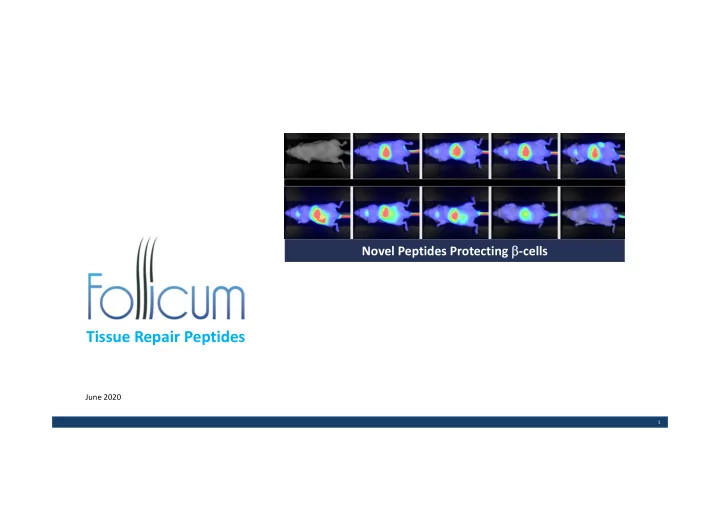
Novel Peptides Protecting cells Tissue Repair Peptides June 2020 1 Disclaimer This report contains certain forwardlooking statements based on uncertainty, since they relate to events and depend on circumstances that will occur in


slide-1
SLIDE 1

1

June 2020

Novel Peptides Protecting ‐cells

Tissue Repair Peptides

slide-2
SLIDE 2

2

Disclaimer

  • This report contains certain forward‐looking statements based on uncertainty, since they relate to events and depend on circumstances that will occur in future and which, by their nature, will have an

impact on the results of operations and the financial condition of Follicum AB. Such forward‐looking statements reflect the current views of Follicum AB and are based on the information currently available to the company. Follicum AB cannot give any assurance as to the correctness of such statements.

  • There are a number of factors that could cause actual results and developments to differ materially from those expressed or implied in these forward‐looking statements. These factors include, among
  • ther things, risks or uncertainties associated with the success of future clinical trials; risks relating to personal injury or death in connection with clinical trials or following commercialization of the

company’s products, and liability in connection therewith; risks relating to the company’s freedom to operate (competitors patents) in respect of the products it develops; risks of non‐approval of patents not yet granted and the company’s ability to adequately protect its intellectual property and know‐how; risks relating to obtaining regulatory approval and other regulatory risks relating to the development and future commercialization of the company’s products; risks that research and development will not yield new products that achieve commercial success; risks relating to the company’s ability to successfully commercialize and gain market acceptance for Follicum’s products; risks relating to the future development of the pricing environment and/or regulations for pharmaceutical products; risks relating to the company’s ability to secure additional financing in the future, which may not be available on favourable terms or at all; risks relating to currency fluctuations; risks associated with technological development, growth management, general economic and business conditions; risks relating to the company’s ability to retain key personnel; and risks relating to the impact of competition.

slide-3
SLIDE 3

3

Tissue Repair Peptides

Peptides are an interesting source of new modern therapies and increasingly important in medicine

  • Endogenous origin
  • Disease specific
  • Organ specific
  • Generally regarded as safe
slide-4
SLIDE 4

Follicum’s Peptide Binds To Insulin Producing Cells

s.c. administration Follicum’s peptide (red) binds to insulin producing cells Uptake in pancreas

4

slide-5
SLIDE 5

I.V. Administration of Cy7.5 Labelled Peptide

5

slide-6
SLIDE 6

FOL‐Peptide Protects β‐cells Due to Glucotoxicity

5 mM (normal glucose) 40 mM glucose (high glucose) 40 mM glucose + Peptide

Representative pictures of cell‐culture wells

6

Glucose control FOL peptide treatment

INS‐1E cells

slide-7
SLIDE 7

Rat INS‐1 cells

  • Follicum’s peptides have a unique capacity to preserve ‐cells
  • Increased insulin secretion and insulin synthesis
  • Decreased cell death
  • Preservation of ‐cell functionality can reduce diabetes & related

complications

FOL‐Peptides Restores ‐cell Function at Glucotoxic Conditions

Source: References (method) Nyblom HK et al. Proteomics. 2006;5193‐8. Luo G, et al. Int J Biochem Cell Biol. 2013; 483–490. 7

G L P

  • 1

P e p t i d e 6 p e p t i d e 7 P e p t i d e 8 P e p t i d e 9 P e p t i d e 1 50 100 150 200 250

Insulin release

(% of control)

High Glucose Control

FOL‐peptides

** ** *** *** ***

slide-8
SLIDE 8

BioBreeding (BB) Diabetes Prone (DR) lyp/lyp rats

At 50‐70 days of age the rats are affected by a spontaneous and aggressive pancreatic islet β-

  • type 1 diabetes (T1D)
  • eripheral T cell lymphopenia that is linked to a single nucleotide deletion

in Gimap5 (an anti‐apoptotic protein) resulting in loss of Gimap5 protein expression that is a prerequisite for onset of spontaneous T1D. The model offers a unique opportunity to study therapies that could prevent β-

  • Åke Lernmark

Bild: Svenska Läkaresällskapet

slide-9
SLIDE 9

FOL‐Peptide Delay Onset of Type 1 Diabetes

9

FOL-Peptide, 3 times/week from day 40, significantly delayed onset of type 1 diabetes in vivo

P l a c e b

  • F

O L

  • 2

Days with blood glucose levels < 11.1 mmol 50 100 150 50 100 Days Survival (%)

Placebo FOL-peptide

***

Log-rank (Mantel-Cox) test P<0.001 Gehan-Breslow-Wilcoxon test P<0.001

A B

BioBreeding (BB) lyp/lyp rats

slide-10
SLIDE 10

In vivo: FOL‐Peptide has Anti‐Inflammatory Effects

10 Method: BB rats are treated with FOL‐peptides (or placebo) during 14 days. Immune cells are then challenged with LPS +/‐ peptides. Cytokine readout after 20h.

Results: FOL‐Peptide treatment of BB rats strongly inhibit pro‐inflammatory cytokine production from immune cells. These results could help to explain the results on β‐cells protection and delayed onset of T1D.

slide-11
SLIDE 11

1 mM 16.7 mM FOL Lira 100 200 300

Insulin secretion (%)

Human Pancreatic Islets Respond to FOL‐Peptides

11

Non‐diabetic Severe Type 2 Diabetes

2‐4 repeats/donor Concentration: 100nM for both peptides

  • Follicum’s peptides on par with

Liraglutide

  • Evident effect in severe Type 2 diabetic

patients

  • Indication of improved ‐cell response

1 mM 16.7 mM FOL Lira 100 200 300 Insulin secretion (%)

high glucose high glucose

slide-12
SLIDE 12

12

Tissue Repair Peptides

slide-13
SLIDE 13

13

Advanced Platform Technology – Tissue Repair Peptides

R educed hair growth Diabetes complications Multiple other conditions S kin conditions Defective wound healing

Impaired Tissue Repair

Biological stress factors Inflammation Metabolic disease Autoimmune disease

Causes Affliction Conditions

Follicum’s focus areas – biologically connected Other conditions

slide-14
SLIDE 14

14

Experienced Team in Developing Peptide‐based Drugs

Management Board of Directors

Fredrik Werner CFO Lars H. Bruzelius Director Jan Alenfall CEO Maria Ekblad R&D Director Gunnar Gårdemyr CBO Susanne Schéele Project Manager Anna Hultgårdh Nilsson, Director Carl‐Johan Spak Director Gun‐Britt Fransson Chairman Alejandra Mørk, Director Mats Persson Director

# Top 10 Shareholders2 Value (SEKm) Capital

1 Avanza Pension 12.27 9.12% 2 Recipharm Venture Fund AB 7.24 5.38% 3 Mats Paulssons Stiftelse För Forskning Innovation Samhällsbygg 6.37 4.73% 4 Brushamn Invest AB 5.57 4.14% 5 Nordnet Pensionsförsäkring 4.85 3.60% 6 Tibia Konsult AB 4.59 3.41% 7 Mats Invest AB 3.62 2.69% 8 Nordic Cross Asset Management 3.52 2.62% 9 Kudu AB 2.74 2.03% 10 Ekhaga Utveckling AB 1.85 1.37% Total Number of Shareholders: 2 835

Company Overview

Ticker / Exchange: FOLLI / Nasdaq Nordic Growth Market Market Cap: SEK 134m1

1) Data as per 2020‐05‐28 (capitaliq.com) 2) Data as per 2020‐03‐31 (holdings.se)

  • Shareholder base includes experts such as Recipharm

Ventures, also represented in the Board of Directors

  • Management and Board of Directors has extensive experience

from commercializing peptide‐based drugs

  • Diabetes collaboration including partners such as Novo

Nordisk and Johnson & Johnson

slide-15
SLIDE 15

15

Company History – Key Events

2011

Follicum AB is founded

2014

Listing on Spotlight Stock Market

2019 2017

Diabetes project start

2012

Collaboration with world leading researchers

  • Successful preclinical

hair growth experiments

  • Vinnova grant – SEK

500k

  • Investments by Lund

University Bioscience and Sunstone Capital

  • Swedish fund ALMI

award – SEK 50k

  • Collaboration with Haifa

University

  • Successful completion
  • f phase I/II with FOL‐

005

  • Diabetes financing from

diabetes research partner Novo Nordisk Foundation

  • Successful in‐vivo study

with FOL‐005

  • Diabetes Scientific

Advisory Board

  • Cooperation agreement

with Bioglan

  • Collaboration

agreement with proDERM Unique topical formulation