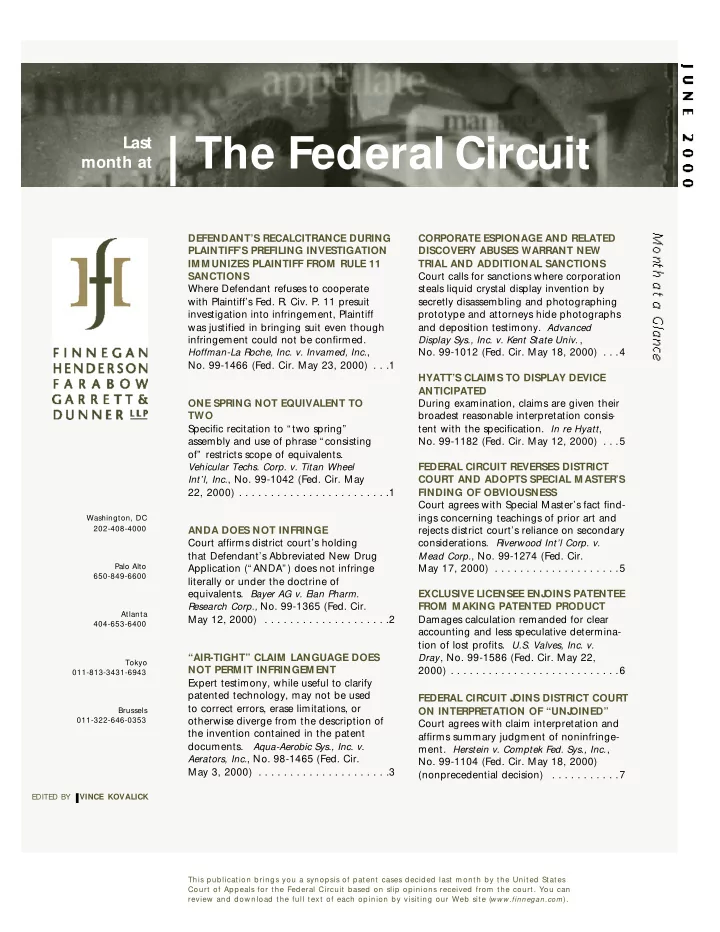
The Federal Circuit month at DEFENDANTS RECALCITRANCE DURING - - PDF document

the federal circuit
SMART_READER_LITE
LIVE PREVIEW

The Federal Circuit month at DEFENDANTS RECALCITRANCE DURING - - PDF document

Last The Federal Circuit month at DEFENDANTS RECALCITRANCE DURING CORPORATE ESPIONAGE AND RELATED PLAINTIFFS PREFILING INVESTIGATION DISCOVERY ABUSES WARRANT NEW IM M UNIZES PLAINTIFF FROM RULE 11 TRIAL AND ADDITIONAL SANCTIONS


slide-1
SLIDE 1

EDITED BY VINCE KOVALICK This publication brings you a synopsis of patent cases decided last m onth by the United States Court of Appeals for the Federal Circuit based on slip opinions received from the court. You can review and dow nload the full text of each opinion by visiting our Web site (www.finnegan.com). Washington, DC 202-408-4000 Palo Alto 650-849-6600 Atlanta 404-653-6400 Tokyo 011-813-3431-6943 Brussels 011-322-646-0353

DEFENDANT’S RECALCITRANCE DURING PLAINTIFF’S PREFILING INVESTIGATION IM M UNIZES PLAINTIFF FROM RULE 11 SANCTIONS Where Defendant refuses to cooperate with Plaintiff’s Fed. R . Civ. P. 11 presuit investigation into infringement, Plaintiff was justified in bringing suit even though infringement could not be confirmed.

Hoffman-La Roche, Inc. v. Invamed, Inc.,

  • No. 99-1466 (Fed. Cir. May 23, 2000) . . .1

ONE SPRING NOT EQUIVALENT TO TWO Specific recitation to “ two spring” assembly and use of phrase “ consisting

  • f” restricts scope of equivalents.

Vehicular Techs. Corp. v. Titan Wheel Int’l, Inc., No. 99-1042 (Fed. Cir. May 22, 2000) . . . . . . . . . . . . . . . . . . . . . . . .1

ANDA DOES NOT INFRINGE Court affirms district court’s holding that Defendant’s Abbreviated New Drug Application (“ ANDA” ) does not infringe literally or under the doctrine of

  • equivalents. Bayer AG v. E

lan Pharm. Research Corp., No. 99-1365 (Fed. Cir. May 12, 2000) . . . . . . . . . . . . . . . . . . . .2

“AIR-TIGHT” CLAIM LANGUAGE DOES NOT PERM IT INFRINGEM ENT Expert testimony, while useful to clarify patented technology, may not be used to correct errors, erase limitations, or

  • therwise diverge from the description of

the invention contained in the patent

  • documents. Aqua-Aerobic Sys., Inc. v.

Aerators, Inc., No. 98-1465 (Fed. Cir. May 3, 2000) . . . . . . . . . . . . . . . . . . . . .3

CORPORATE ESPIONAGE AND RELATED DISCOVERY ABUSES WARRANT NEW TRIAL AND ADDITIONAL SANCTIONS Court calls for sanctions where corporation steals liquid crystal display invention by secretly disassembling and photographing prototype and attorneys hide photographs and deposition testimony. Advanced

Display Sys., Inc. v. Kent State Univ. ,

  • No. 99-1012 (Fed. Cir. May 18, 2000) . . .4

HYATT’S CLAIM S TO DISPLAY DEVICE ANTICIPATED During examination, claims are given their broadest reasonable interpretation consis

  • tent with the specification. In re Hyatt,
  • No. 99-1182 (Fed. Cir. May 12, 2000) . . .5

FEDERAL CIRCUIT REVERSES DISTRICT COURT AND ADOPTS SPECIAL M ASTER’S FINDING OF OBVIOUSNESS Court agrees with Special Master’s fact find- ings concerning teachings of prior art and rejects district court’s reliance on secondary

  • considerations. Riverwood Int’l Corp. v.

Mead Corp., No. 99-1274 (Fed. Cir. May 17, 2000) . . . . . . . . . . . . . . . . . . . .5

EXCLUSIVE LICENSEE ENJ OINS PATENTEE FROM M AKING PATENTED PRODUCT Damages calculation remanded for clear accounting and less speculative determina- tion of lost profits. U.S. Valves, Inc. v.

Dray, No. 99-1586 (Fed. Cir. May 22, 2000) . . . . . . . . . . . . . . . . . . . . . . . . . . .6

FEDERAL CIRCUIT J OINS DISTRICT COURT ON INTERPRETATION OF “UNJ OINED” Court agrees with claim interpretation and affirms summary judgment of noninfringe-

  • ment. Herstein v. Comptek Fed. Sys., Inc.,
  • No. 99-1104 (Fed. Cir. May 18, 2000)

(nonprecedential decision) . . . . . . . . . . .7

The Federal Circuit

Last month at

slide-2
SLIDE 2

Defendant’s Recalcitrance During Plaintiff’s Prefiling Investigation Immunizes Plaintiff from Rule 11 Sanctions

Arie M. Michelsohn

[J udges: Friedman (author), Mayer, and Gajarsa] In Hoffman-La Roche, Inc. v. Invamed, Inc.,

  • No. 99-1466 (Fed. Cir. May 23, 2000), the

Federal Circuit affirmed a district court decision rejecting Defendant’s allegations of R ule 11 viola- tions and unethical conduct by Plaintiffs. Hoffman-La R

  • che, Inc. (“ R
  • che” ) owns a

method patent covering a process for making ticlopidine hydrochloride (“ TICLID” ). Torpharm,

  • Inc. (“ Torpharm” ) filed an abbreviated new drug

application with the Food and Drug Administration (“ FDA” ) to market a generic form

  • f TICLID. R
  • che asked Torpharm to provide

information on its manufacturing process, but Torpharm refused. Torpharm did supply R

  • che

with samples of its drug, but R

  • che was unable

to ascertain through analytical testing whether Torpharm was using R

  • che’s process. R
  • che

then sued Torpharm for infringement, noting Torpharm’s recalcitrance in its complaint and indicating the need to resort to the judicial process to determine whether Torpharm was infringing. Torpharm moved to dismiss for failure to state a claim. R

  • che then contacted Torpharm’s

president, who gave R

  • che a go-ahead to discuss
  • settlement. R
  • che offered to withdraw suit if,

pursuant to a confidentiality agreement, Torpharm’s disclosure of its process showed that it did not infringe R

  • che’s patent. R
  • che sent

the draft confidentiality agreement both to Torpharm’s president and its outside counsel. Torpharm’s president returned the draft agree- ment with a handwritten note asking whether R

  • che should pay Torpharm’s legal costs. R
  • che

responded that it would not pay Torpharm’s costs because Torpharm had incurred the costs as a result of its failure to cooperate. After determining that Torpharm’s process did not infringe, as agreed to, R

  • che dismissed

its case. Torpharm then sued R

  • che, contending

that R

  • che’s complaint violated R

ule 11 of the Federal R ules of Civil Procedure, and asking for sanctions and attorney fees. The district court found for R

  • che, and Torpharm appealed.

The Federal Circuit affirmed, holding that the district court had not abused its discretion in finding R

  • che’s prefiling inquiry to be reason-

able, since “ [i]t is difficult to imagine what else [R

  • che] could have done to obtain facts relating

to Torpharm’s alleged infringement of their process patents . . . . If Torpharm initially had told [R

  • che] under a confidentiality agreement

the processes to manufacture the drug as it sub- sequently did it could have avoided this litigation and the expenses incurred in defending it.”

Hoffman-La Roche, slip op. at 8-9.

Finally, the Court agreed with the district court’s refusal to entertain Torpharm’s pleading that R

  • che had violated R

ule 4.2 of the New J ersey R ules of Professional Conduct by contact- ing Torpharm’s president directly rather than

  • utside counsel, holding that “ [t]he enforcement
  • f [the rule] is the function of . . . state authori-

ties . . . [and] not the responsibility of the United States District Court.” Hoffman-La Roche, slip op. at 13.

One Spring Not Equivalent to Two

Kimani P. Clark

[J udges: Plager, Clevenger, and Rader (per

curiam)]

In Vehicular Technologies Corp. v. Titan Wheel

International, Inc., No. 99-1042 (Fed. Cir. May

22, 2000), the Federal Circuit affirmed a district court’s grant of summary judgment (“ SJ ” ) of noninfringement of a patent directed to a lock- ing differential for use in automobiles. Vehicular Technologies Corp. (“ PowerTrax” ) brought suit against Titan Wheel International,

  • Inc. (“ Tractech” ) for infringement of U.S. Patent
  • No. 5,413,015 (“ the ‘015 patent” ), which claims

a double-spring assembly in a locking differen-

  • tial. A differential is a component of an automo-

bile axle that distributes torque to the wheels of the vehicle and allows wheels on opposite sides

  • f the vehicle to spin at different rates. The ‘015

patent’s claims require a differential having “ a spring assembly consisting of two concentric springs.” Tractech’s accused product contains a single spring with a plug.

page 01

L A ST M O N T H AT T H E F E D E R A L C I R C U I T

F I N N EG A N H EN D ERSO N FA RA B O W G A RRET T D U N N ER L L P

.

slide-3
SLIDE 3

2 0 0 0

JU N E 02

page F I N N EG A N H EN D ERSO N FA RA B O W G A RRET T D U N N ER LL P

.

In a previous opinion, the Federal Circuit had reviewed a preliminary injunction granted to PowerTrax by the district court, which concluded that PowerTrax had shown a reasonable likeli- hood of success of proving infringement under the doctrine of equivalents (“ DOE ” ). See

Vehicular Techs. Corp. v. Titan Wheel Int’l, Inc.,

141 F.3d 1084 (Fed. Cir. 1998). In that appeal, the Federal Circuit vacated the preliminary injunction, finding that the ‘015 patent’s advan- tage of enhancing reliability through the redun- dancy of two springs was a critical objective not realized by Tractech’s product. This finding pre- vented the Federal Circuit from agreeing with the district court that PowerTrax had a reason- able likelihood of success on its claim of infringe- ment under the DOE . On remand, the district court had granted Tractech’s motion for SJ

  • f noninfringement after

reviewing additional evidence. On appeal, the Federal Circuit determined that the only material fact potentially in dispute involved the question of whether Tractech’s sin- gle spring and plug assembly infringed the claimed double-spring assembly under the DOE . In its evaluation, the Court again determined that the ‘015 patent’s reliability enhancement function was a key backup function, and as such, an accused device that does not perform the function does not differ substantially from the claimed invention. The Court recognized that some extrinsic evidence, testimony of inventors and artisans of ordinary skill, discounted the importance of the reliability function. It decided, however, that this evidence did not create a gen- uine issue of fact in light of the patent’s clear

  • teachings. The Court also pointed to the “ con-

sisting of” language in the claim to support its

  • decision. Although that language does

not foreclose infringement under the DOE , the Court stated, it emphasizes the claims limitation to the particular structure recited in the claim and signifies restriction and exclusion as opposed to open-ended construction. J udge R ader concurred, finding that this case falls within the bounds of Sage Products, Inc. v.

Devon Industries, 126 F.3d 1420 (Fed. Cir. 1997).

Here, as in Sage, the claims define a relatively simple structural device, meaning that a skilled patent drafter would have foreseen the limiting potential of the language “ consisting of two con- centric springs,” he concluded. Believing that as between the public and the patent drafter, the burden of negotiating broader claims lies with the patent drafter, J udge R ader found it reason- able for the Court to find no equivalent infringe- ment as a matter of law. He bolstered his con- clusion by pointing to the fact that PowerTrax had learned of the alleged infringement within the two-year period for reissuing a patent, but chose not to enlarge the patent’s claims to cover a spring and plug substitute.

ANDA Does Not Infringe

Gregory A. Chopskie

[J udges: Schall (author), Clevenger, and Bryson] In Bayer AG v. E

lan Pharmaceutical Research Corp., No. 99-1365 (Fed. Cir. May 12, 2000), the

Federal Circuit affirmed the district court’s hold- ing that the Defendant’s Abbreviated New Drug Application (“ ANDA” ) did not infringe the patent-in-suit literally or under the doctrine of equivalents (“ DOE ” ). Bayer AG and Bayer Corp. (“ Bayer” ) charged E lan Pharmaceutical R esearch Corp. (“ E lan” ) with infringement of its U.S. Patent No. 5,264,446 (“ the ‘446 patent” ) by E lan’s filing of an ANDA with the Food and Drug Administration (“ FDA” ). The ‘446 patent claims a pharmaceutical compo- sition that contains nifedipine crystals with a Specific Surface Area (“ SSA” ) of 1.0 to 4.0 m2/g. Seeking approval from the FDA to market a generic version of the drug, E lan filed an ANDA for a tablet form of the drug that included nifedipine crystals that were 6.15 m2/g. E lan later amended its ANDA to include tablets that included nifedipine crystals with a SSA of 5.0 m2/g or greater. As required, Bayer timely brought suit seek- ing to enjoin FDA approval of E lan’s ANDA. On summary judgment, the district court had held that E lan did not infringe the ‘446 patent either literally or under the DOE . R ejecting Bayer’s alle- gations that the tablets sold after approval of the ANDA may actually infringe because the SSA of the nifedipine crystals decreases over time, the district court instead had focused on the specifi- cations included in E lan’s ANDA. The Federal Circuit agreed, emphasizing that E lan could not lawfully produce drugs that did not strictly com- ply with that specification. Since E lan’s specifica-

slide-4
SLIDE 4

tion mandated that the SSA of the nifedipine crystals would be 5.0 m 2/g or greater, the Federal Circuit affirmed the district court’s find- ing of no literal infringement. Turning to the question of infringement under the DOE , the Federal Circuit affirmed the district court’s finding that Bayer had expressly surrendered coverage to nifedipine crystals hav- ing SSAs above 4.0 m2/g. Specifically, the Federal Circuit noted that Bayer had amended its claims during the prosecution of the ‘446 patent, reducing the claimed SSA range from 1.0 to 6.0 m2/g to 1.0 to 4.0 m2/g. Despite the fact that this amendment was made in response to a rejection under section 112, ¶ 1, the Federal Circuit nevertheless found that Bayer had unmis- takenly surrendered coverage to SSAs above 4.0 m2/g. Also, Bayer had repeatedly argued that its claim range of 1.0 to 4.0 m2/g produced unique and unexpected results, while asserting that nifedipine crystals having SSAs above 4.0 m2/g had disadvantages such as decreasing dissolution

  • rates. Based on these statements, the Federal

Circuit affirmed the district court’s conclusion that Bayer was estopped by the prosecution his- tory of the ‘446 patent from claiming that com- pounds having nifedipine crystals of greater than 4.0 m2/g infringed under the DOE .

“Air-Tight” Claim Language Does Not Permit Infringement

R anjeev K. Singh

[J udges: Newman (author), Smith, and Bryson] In Aqua-Aerobic Systems, Inc. v. Aerators, Inc.,

  • No. 98-1465 (Fed. Cir. May 3, 2000), the Federal

Circuit affirmed a district court’s summary judg- ment (“ SJ ” ) holding that Aerators, Inc., and Frank Nocifora (“ Aerators” ) did not infringe, either literally or under the doctrine of equiva- lents, Aqua-Aerobic Systems, Inc.’s (“ Aqua- Aerobic” ) U.S. Patent No. 4,422,771 (“ the ‘771 patent” ). The ‘771 patent is directed to downflow mixers used in water treatment ponds and tanks. Typically, downflow mixers include a pump mounted on a flotation device and a propeller suspended below the surface, where the pro- peller shaft is enclosed in a stabilizer tube. The downflow mixer of the ‘771 patent solved prob- lems present in prior art related to vibration and damage to the propeller due to atmospheric air that enters from around the top of the propeller shaft and then passes downward through the stabilizer tube. The ‘771 patent solved this prob- lem by providing a “ wall means . . . for prevent- ing passage of atmospheric air” and a “ mechani- cal shaft seal means . . . for preventing the flow

  • f atmospheric air.”

Aqua-Aerobic contended at the district court that a downflow mixer made by Aerators called the “ Aqua-Lator DDM Direct Drive Mixer” infringed claim 1 of the ‘771 patent. The dis

  • pute focused on the interpretation of the phrases

“ preventing passage of atmospheric air” and “ preventing the flow of atmospheric air.” The district court had construed the phrase “ prevent- ing the flow of atmospheric air” to mean that the shaft seal means eliminates any smooth, con- tinuous air movement, but could permit the pas- sage of a minuscule amount of air. The phrase “ preventing the passage of atmospheric air,” however, was interpreted to require that all air is excluded from passing by or around the wall, thereby making the structure disclosed in the specification airtight. Having found that neither

  • f these criteria had been met, literally or by

equivalence, the district court granted Aerobic’s motion for SJ

  • f noninfringement.

On appeal, Aqua-Aerobic argued that both claim clauses at issue must be interpreted as per- mitting the passage of more than a minuscule amount of air because that would be consistent with the understanding of persons of ordinary skill in the art. The patentee further argued that the correct claim construction requires the seals to prevent the passage of sufficient air to cause cavitation at the propeller. Accordingly, under this interpretation of the two claim clauses at issue, any downflow mixer that does not suffer cavitation at the propeller would infringe claim 1. Aerator, on the other hand, argued that claims must be construed as they are written and as the invention is described in the specification. Aerator further argued that because its system is not airtight and its mixer passed significantly more than a minuscule amount of air, its mixer cannot infringe claim 1. The Federal Circuit agreed with Aerator, despite the fact that experts on both sides agreed that persons skilled in the art would understand that the structure described in the ‘771 patent is not airtight. In doing so, the Court stated that while expert testimony is often useful to clarify the patented technology, it may not be used to erase limitations, correct errors,

  • r otherwise diverge from the description of the

invention as contained in the patent documents.

page 03

L A ST M O N T H AT T H E F E D E R A L C I R C U I T

F I N N EG A N H EN D ERSO N FA RA B O W G A RRET T D U N N ER L L P

.

slide-5
SLIDE 5

2 0 0 0

JU N E 04

page F I N N EG A N H EN D ERSO N FA RA B O W G A RRET T D U N N ER LL P

.

Thus, the Court upheld the district court’s rejection of Aqua-Aerobic’s proposal that the claim should not be limited by the amount of the air that passes or flows through the system but instead should be construed to cover any downflow mixer that does not suffer cavitation at the propeller. The Court reasoned that even if that was the intended interpretation, it was not the invention described and claimed by Aqua- Aerobic.

Corporate Espionage and Related Discovery Abuses Warrant New Trial and Additional Sanctions

Lawrence F . Galvin

[J udges: Gajarsa (author), Plager, and Schall] In Advanced Display Systems, Inc. v. Kent State

University, No. 99-1012 (Fed. Cir. May 18, 2000),

the Federal Circuit vacated a district court deci- sion holding the Defendants’ patent invalid for anticipation and obviousness and not infringed. The Federal Circuit also remanded the case for a new trial on these issues based on newly discov- ered evidence and reversed the district court’s ruling denying sanctions against Plaintiff and its counsel for discovery abuses.

  • Dr. J
  • hn West (“ West” ) of Kent State

University (“ Kent” ) developed a polymer-free liq- uid crystal display (“ LCD” ). LCDs typically com - prise a sandwich of liquid crystal material between two glass substrates. An electrical driv- er connected to the sandwich stimulates the material to create readable or alphanumeric

  • characters. Traditional LCDs include polymers

combined with the material. West’s polymer-free LCD resulted in U.S. Patent No. 5,453,863 (“ the West patent” ) in 1995. In the mid-1990s, Advanced Display Systems, Inc. (“ ADS” ) was also conducting LCD

  • research. In J

une 1993, an ADS vice president had obtained a written formula for the West polymer-free LCD material. However, ADS still failed to develop a functional LCD because it could not make the required electrical driver. In 1994, the same ADS vice president arranged to secretly disassemble, photograph, and reassemble a working model of the West LCD during a visit by a Kent researcher to show the model. Shortly thereafter, ADS constructed a functional polymer-free LCD and filed a patent application on its device. While the ADS applica- tion was pending, the West patent issued, and the Patent and Trademark Office rejected the ADS claims directed to polymer-free LCDs. During subsequent negotiations to license the West patent, ADS filed a complaint seeking a declaratory judgment of the patent’s invalidity. Shortly thereafter, Kent, as assignee, and two licensees sued ADS for infringement of the West

  • patent. These two cases were consolidated in

the United States District Court for the Northern District of Texas. Coinciding with discovery in the consolidat- ed case, ADS filed a second LCD technology suit against a different company. The deposition of an ADS employee in this second suit revealed the truth about the source of the ADS polymer-free LCD material and electrical driver. ADS’s attor- ney directed the court recorder at the deposition not to prepare a transcript of the testimony, and ADS quickly abandoned this second suit. During discovery in the Kent suit, ADS failed to disclose either the photograph it had made of the West LCD or the ADS employee deposition testimony, despite multiple, relevant discovery requests; instead, it hid the photograph as an “ attorney work product” document. Based on a tip that had been learned during trial, Kent became aware of the ADS corporate espionage. Only when Kent called the deposed ADS employee to testify at trial concerning events sur- rounding the West LCD photograph, did ADS provide the photograph to Kent. Kent did not receive the deposition transcript until after the jury verdict. Kent then moved for a new trial based on the newly discovered deposition and the with- held evidence during discovery, and moved for sanctions against ADS’s counsel. The judge denied Kent’s motions. On appeal, the Federal Circuit found the judge’s instructions to the jury regarding antici- pation to constitute legal error. R egarding obvi-

  • usness, the Court found that the newly discov-

ered deposition evidence was potentially out- come determinative, that Kent could not have discovered the deposition earlier, and that the

slide-6
SLIDE 6

deposition evidence was not merely cumulative

  • r impeaching. R

egarding infringement, the Court found the deposition to be compelling evi- dence relating to infringement and potentially

  • utcome determinative.

Finally, regarding sanctions, the Federal Circuit characterized ADS’s actions as “ corporate espionage.” The Court also found ADS’s counsel to have deliberately and repeatedly flouted the Federal R ules of Civil Procedure by hiding the deposition and photograph from Kent. Thus, the Court considered the sanction of a new trial to be appropriate. On remand, the Federal Circuit also recommended that the judge consid- er disciplinary action and additional sanctions against ADS’s counsel.

Hyatt’s Claims to Display Device Anticipated

Lionel M. Lavenue

[J udges: Bryson (author), Lourie and Rader] In In re Hyatt, No. 99-1182 (Fed. Cir. May 12, 2000), the Federal Circuit affirmed a decision

  • f the Board of Patent Appeals and Interferences

(“ Board” ), rejecting several claims in a patent application for anticipation. Gilbert P. Hyatt (“ Hyatt” ) had filed a patent application directed to an illumination system using display panels with many display devices. The invention related to a system for compensat- ing for a defect in one or more display devices, whereby the surrounding display panels generate sufficient intensity to offset any defective display

  • devices. The E

xaminer had rejected four claims in the patent application based on a single prior art patent, because the four claims did not expressly recite changing the intensity of adja- cent display devices to offset any defect in the display devices. On appeal to the Board, Hyatt had argued that the four claims contained a “ sharing” limita- tion (i.e., the ability to change the intensity of adjacent display devices). However, the Board had affirmed the rejection, adopting the E xaminer’s findings. The Board concluded that the E xaminer had been correct, if the claims were given their broadest reasonable interpreta- tion consistent with the specification. On appeal, the Federal Circuit addressed two arguments by Hyatt. First, citing Gechter v.

Davidson, 116 F.3d 1454 (Fed. Cir. 1997), Hyatt

argued that the Board’s ruling was procedurally defective, because the Board had failed to ana- lyze the claims at issue on a claim-by-claim or element-by-element basis. The Federal Circuit rejected this argument, explaining that Gechter

  • nly required that the Board explain the basis for

its rulings sufficiently to enable meaningful judi- cial review. The Board had based its ruling on the first of the four claims, and the Federal Circuit found this ruling adequate, as the other claims stood or fell with the first claim. Second, Hyatt reiterated the argument made before the Board regarding the sharing limita-

  • tion. In reviewing this argument, the Federal

Circuit outlined three general and undisputed propositions: (1) anticipation is a question of fact; (2) factual matters are upheld, if there is substantial evidence in the record to support the findings; and (3) during examination, claims are given their broadest reasonable interpretation consistent with the specification. In re Hyatt, slip

  • p. at 7. Given these general and undisputed

propositions, the Court upheld the Board’s deci-

  • sion. The Court noted that the patent specifica-

tion did not include a narrower construction of the sharing limitation, as advocated by Hyatt.

Federal Circuit Reverses District Court and Adopts Special Master’s Finding of Obviousness

Robert F . Rotella

[J udges: Mayer (author), Schall, and Gajarsa] In Riverwood International Corp. v. Mead

Corp., No. 99-1274 (Fed. Cir. May 17, 2000) the

Federal Circuit reversed a district court’s ruling

  • n infringement and validity regarding two

asserted claims of U.S. Patent No. 5,241,806 (“ the ‘806 patent” ), finding the ‘806 patent invalid for obviousness. R iverwood International Corp. (“ R iverwood” ) brought suit against The Mead Corp. (“ Mead” ) for infringement of claims 1 and 13 of the ‘806 patent, which is directed to a machine known as a cartoner that automatically groups streams of articles, such as beverage cans or bottles, and loads them into paperboard cartons. The district court had appointed a Special Master who made findings of fact and concluded that the relevant claims were invalid for obvious-

page 05

L A ST M O N T H AT T H E F E D E R A L C I R C U I T

F I N N EG A N H EN D ERSO N FA RA B O W G A RRET T D U N N ER L L P

.

slide-7
SLIDE 7

2 0 0 0

JU N E 06

page F I N N EG A N H EN D ERSO N FA RA B O W G A RRET T D U N N ER LL P

.

  • ness. The district court had accepted the findings
  • f fact of the Special Master in whole, but con-

trary to the conclusions of the Special Master, ruled that the claims would not have been obvi-

  • us to one of ordinary skill in the art.

The Special Master’s findings of fact, accept- ed by the district court, concluded that claim 1

  • f the ’806 patent contains four limitations: (1)

an infeed conveyer, (2) an article selecting con- veyor, (3) a carton conveyor, and (4) an article group transfer means. Claim 13 adds a “ cam track/cam follower assembly” to the fourth ele-

  • ment. According to the Special Master,

R iverwood had stipulated that the prior art, U.S. Patent No. 3,778,959 to Langen (“ the Langen patent” ), discloses the first three limitations of claim 1. The Special Master had found that the fourth limitation of claim 1 defines what is com- monly known in the art as a “ barrel cam loader” and that barrel cam loaders in cartoners were known in the prior art. The Special Master had also found that a “ cam track/cam follower assembly” is a common structure used in barrel cam loaders. In addition, the Special Master had found that the Langen patent disclosed angulat- ed fixed guide rails as an improvement over bar- rel cam loaders. The Federal Circuit agreed with the Special Master’s conclusion that one of ordinary skill in the art would be knowledgeable of problems and solutions to the design of cartoners and that the prior art patents in evidence show that numerous solutions had been developed to solve the problems and the solutions occurred relative- ly frequently in a relatively sophisticated and developed technology. The Court also agreed that these findings support the conclusion that it would have been obvious to someone of ordi- nary skill in the art at the time of the invention to replace the angulated fixed guide rail loader in the Langen patent with a barrel cam loader and that a suggestion or motivation to make that substitution existed in the prior art. R iverwood had presented some evidence of commercial success, but the Special Master found that much of that success was attributable to factors outside the scope of the claims at

  • issue. The Federal Circuit agreed that

R iverwood’s evidence of commercial success con- siderations lacked any nexus to the claims and concluded that the little evidence of any other

  • bjective factors did not carry sufficient weight

to override a conclusion of obviousness based on the primary considerations.

Exclusive Licensee Enjoins Patentee from Making Patented Product

R ebecca M. McNeill

[J udges: Rader (author), Michel, and Clevenger) In U.S. Valves, Inc. v. Dray, No. 99-1586 (Fed.

  • Cir. May 22, 2000), the Federal Circuit affirmed

the district court’s decision on liability, but reversed and remanded the damage award. R

  • bert Dray, the Defendant, had licensed his

patents to U.S. Valves, Inc. (“ U.S. Valves” ) under an exclusive license agreement (“ the Agreement” ). After relations between Dray and U.S. Valves deteriorated, however, Dray began selling valves within the scope of the patents. He also sold an additional type of valve (“ sliding ring valves” ). U.S. Valves sued Dray for breach

  • f contract, and Dray counterclaimed for unpaid

royalties. The district court had found in favor of U.S. Valves, stating that Dray had violated the Agreement, issued an injunction against Dray, and awarded damages in the amount of $241,315.17. On appeal, the Federal Circuit evaluated the substance of the royalty dispute. The dispute focused on an oral agreement regarding a royal- ty discount that U.S. Valves (formed by Dray, his son, and another individual) would receive on valves sold to a third party, Van Dorn DeMag,

  • Inc. (“ Van Dorn” ). The discount allowed U.S.

Valves to attract this customer. Dray asserted that the discount only applied to an initial order, while U.S. Valves contended that the document applied to all valves sold to Van Dorn. As evidence that the discount applied to all sales to Van Dorn, the Federal Circuit noted that Dray had accepted the discounted royalty pay- ment for several years, which, the Court noted,

slide-8
SLIDE 8

created an equitable estoppel, as U.S. Valves had relied on the lower royalty rate. Thus, the Federal Circuit concurred with the lower court’s decision

  • n the merits of the contract dispute.

Second, the Federal Circuit evaluated the dis- trict court’s calculation of damages. Breach of contract damages are calculated according to the state law. Here, the proper measure of damages is the amount that will place the nonbreaching party in as satisfactory a position as it would have been if the contract had been performed fully. The Federal Circuit criticized the district court for not determining how many valves sold by Dray actual- ly fell within the scope of the exclusive license

  • agreement. Specifically, the Federal Circuit stated

that the district court had failed to determine whether the sliding ring valves were included in the agreement. R emanding the case for further damages analysis, the Federal Circuit noted that the district court should remember to account for the royalty that U.S. Valves would have to pay Dray as well as the manufacturing cost of the valves. Third, the Federal Circuit denied U.S. Valves’s request for a damage remedy to protect against potential future harm, as the injunction should adequately protect U.S. Valves’s future interests. Lastly, the Federal Circuit affirmed the permanent injunction against Dray’s sale of valves covered by the Agreement, but clarified that this restriction falls as soon as either the Agreement is terminated

  • r the patents expire.

Federal Circuit J

  • ins District Court
  • n Interpretation of “Unjoined”

David P. F razier

[J udges: Archer (author), Mayer, and Plager] In Herstein v. Comptek F

ederal Systems, Inc.,

  • No. 99-1104 (Fed. Cir. May 18, 2000)(nonprece-

dential decision), the Federal Circuit affirmed a district court’s summary judgment of noninfringe- ment of U.S. Patent No. 4,810,981 (“ the ‘981 patent” ) directed to a microwave assembly config-

  • uration. The claims in question define a stripline

type of connecting device for electrically intercon- necting microwave components. At issue on appeal was the district court’s con- struction of the claim term “ unjoined,” which led to the finding of no literal infringement. Comptek Federal Systems, Inc. (“ Comptek” ) maintained that its device did not meet this claim limitation because its accused terminal portions were joined together by soldering. Dov Herstein (“ Herstein” ) urged that the properly construed term meant “ operational without any separate connection.” According to Herstein, soldering was irrelevant for the operation of Comptek’s device, and infringe- ment could not properly be avoided by adding solder to the connecting components. The Federal Circuit determined that the term “ unjoined” was not specifically defined in the patent specification, but according to the written description, the “ unjoined” connection between microwave components was plainly achieved by mechanical clamping. Further, the patent specifi- cally states that neither cement nor solder is required for the connection and that components can be removed or exchanged without damage simply by unclamping and reclamping the rele- vant unjoined connections. Therefore, the Federal Circuit concluded that ease of connection and dis- connection of the components was one of the salient features of the invention. Turning to the patent prosecution history, the Court determined that the term “ unjoined” had been added only after the claims had been reject- ed over two prior art references that recited devices in which the relevant components were bonded together by soldering. The term unjoined, therefore, had been added as a means

  • f distinguishing the claimed invention from the

prior art, the Court concluded. Thus, the prosecu- tion history, taken together with the written description and the patent claims, led the Court to conclude that the term “ unjoined” could only mean a connection employing mechanical clamp- ing without the addition of solder. Since the accused device was soldered during manufactur- ing, the Court agreed that the claim element was not met and the claim was not literally infringed.

page 07 F I N N EG A N H EN D ERSO N FA RA B O W G A RRET T D U N N ER L L P

. DISCLAIME R:

The case summaries reflect the understanding

  • f the authors only and are not meant to con-

vey legal opinions or advice of any kind. The firm disclaims any liability for any errors or

  • missions in these summaries. This promotion-

al newsletter does not establish any form of attorney-client relationship with our firm or with any of our attorneys.