
SLIDE 1
NON- RIBOSOMAL PEPTIDES
HOW DO WE SEQUENCE PEPTIDES THAT DON’T DEPEND ON MRNA?
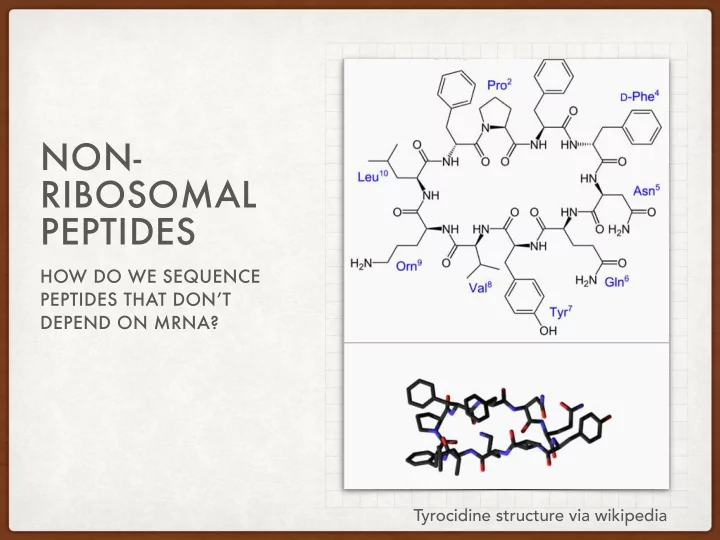
Tyrocidine structure via wikipedia
NON- RIBOSOMAL PEPTIDES HOW DO WE SEQUENCE PEPTIDES THAT DONT - - PowerPoint PPT Presentation
NON- RIBOSOMAL PEPTIDES HOW DO WE SEQUENCE PEPTIDES THAT DONT DEPEND ON MRNA? Tyrocidine structure via wikipedia WHATS DIFFERENT BETWEEN NRPS AND TRADITIONAL PEPTIDES? Linear peptides traditionally transcribed via ribosome
HOW DO WE SEQUENCE PEPTIDES THAT DON’T DEPEND ON MRNA?
Tyrocidine structure via wikipedia
WHAT’S DIFFERENT BETWEEN NRPS AND TRADITIONAL PEPTIDES?
traditionally transcribed via ribosome from mRNA
non-ribosomal peptide sythetases (no mRNA)
acid at a time
peptide that then circularizes
HOW WAS THE CYCLIC PEPTIDE SEQUENCED?
fragments
Use the weights of the fragmented peptides to reconstruct the sequence
HOW WAS THE CYCLIC PEPTIDE SEQUENCED?
HOW WAS THE CYCLIC PEPTIDE SEQUENCED?
from its theoretical spectrum
use as input
CYCLOPEPTIDESEQUENCING(Spectrum) Peptides ⟵ a set containing only the empty peptide while Peptides is nonempty Peptides ⟵ EXPAND(Peptides) for each peptide Peptide in Peptides: if MASS(Peptide) = PARENTMASS(Spectrum) if CYCLOSPECTRUM(Peptide) = Spectrum
remove Peptide from Peptides else if Peptide is not consistent with Spectrum remove Peptide from Peptides
HOW WAS THE CYCLIC PEPTIDE SEQUENCED?
“branch” in Peptides
the known spectrum (input)
Cyclopeptide Sequencing Problem:
NQEL = [0, 113, 114, 128, 129, 227, 242, 242, 257, 355, 356, 370, 371, 484]
CyclopeptideSequencing([0, 113, 114, 128, 129, 227, 242, 242, 257, 355, 356, 370, 371, 484]) ⟶ Returns “NIEQ” … Why?
NQEL = [0, 113, 114, 128, 129, 227, 242, 242, 257, 355, 356, 370, 371, 484]
CyclopeptideSequencing([0, 113, 114, 128, 129, 227, 242, 242, 257, 355, 356, 370, 371, 484]) ⟶ Returns “NIEQ” … Why? If we look back at the amino acid weights… The function works through the list of amino acids in this order, so I matches before L does and is thus the first output This gets us the right amino acids, but they are still in the wrong
N I/L Q E
NQEL = Input NIEQ = Ouput START
Same sequence, different direction Why? Not really sure…
WHAT DO THESE RESULTS MEAN?
in mind…
This approach to answering the question of how to sequence a non-ribosomal peptide works!
used