SLIDE 1
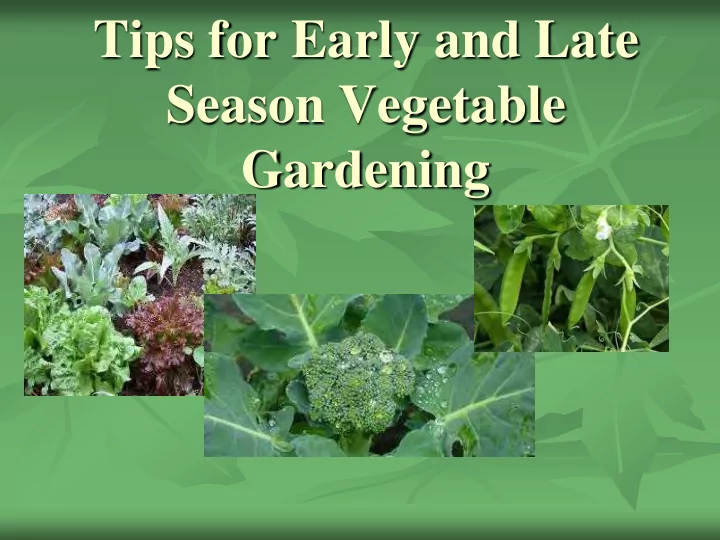
Tips for Early and Late Season Vegetable Gardening
SLIDE 2 Today’s Focus:
Direct seeding or transplanting vegetables for
spring and fall vegetable gardens
Low input approach: raised beds and/or
containers, organic methods and good soil stewardship (including cover crops and companion planting)
Site selection (beds or containers) Succession planting/season extension Resources
SLIDE 3 Benefits of Spring Vegetable Gardening
Pleasant weather = high enthusiasm Fewer weeds/insects/diseases (not animals!) More sunlight/less canopy Less watering Your own “spring” vegetables on demand
including PEAS
SLIDE 4 Good Soils: The basis for healthy plants
Soil Texture: Sand/Silt/Clay Soil Structure: Aggregates protect organic
- matter. Organic matter builds aggregates.
Soil Biology and Chemistry: Good soil
management fosters diverse soil biology and active soil chemistry which increases resilience and nutrient availability
SLIDE 5
Soil Textural Triangle
SLIDE 6
Soil Aggregates
SLIDE 7
It’s Elemental! (and molecular)
SLIDE 8
“The Basic Process of Life”
Plants feed themselves* and the soil *carbohydrates only
SLIDE 9
The Soil Food Web
SLIDE 10 Site Selection
Beds or Containers?
Bright Sun
Leaf Vegetables: 4 hours Root Vegetables: 6 hours Fruiting Vegetables: 8+ hours
Good Drainage
SLIDE 11
Raised Rows, Beds, Boxes (No Till) (Rows = compaction)
SLIDE 12
Containers: Many Choices
SLIDE 13
Containers continued…
SLIDE 14 Make a Plan:
Think about general layout, succession and interplanting
Formal or informal
SLIDE 15
Fill Boxes/Containers with quality soil/media
SLIDE 16
Soil Test
SLIDE 17
Soil pH and Nutrient Availability
SLIDE 18 What will you grow?
So many choices! Catalogs and seed packets are a great source of
information.
Choose what you like, and what is practical for
your space and your needs
SLIDE 19 A note on organic seeds
Why choose organic seeds?
Sustainability and non-GMO
Some sources
High Mowing Seeds, Cook’s Garden, Seeds of Change Many traditional seed companies now offer organic seeds (Park, Johnny’s, Burpees)
SLIDE 20
Start Planting
SLIDE 21
Starting Seeds Indoors/ Pre-germinating
SLIDE 22 Vegetables you can plant today and eat within 8 weeks
Arugula, Asian Greens, Carrots*, Chives, Collards, Kale, Lettuces, Mustard Greens, Peas, Radishes, Spinach, Chard
*Carrots take more like 10-12 weeks.
Google: Zone 7 Planting Guide
SLIDE 23 Companion Planting
Mechanisms:
- Impart desired characteristics (e.g. acidity, N fixation)
- Repellants to insects and animals (fragrance)
- Trap Plants (nasturtiums/aphids)
- Attract beneficial insects (flowers)
- Maximize season/root zone (interplant)
- Provide structure or shade (corn)
- Bring nutrients from soil depth (perennial grains)
SLIDE 24 Companion Planting
http://www.almanac.com/content/plant-
companions-list-ten-common-vegetables
SLIDE 25
Enjoy your spring, summer harvest and then…
SLIDE 26 Thinking Ahead: Intercropping & Succession Planting
Take advantage of “spaces” in the garden, both
physical and seasonal
Maximize yield and interest Build soil health through plant
variety/diversity
SLIDE 27 Thinking ahead: Season Extenders
For production in early spring, late fall or even
SLIDE 28
Thinking ahead: Season Extenders (cont’d)
Cold Frames/Hot Beds
SLIDE 29 Thinking ahead: Cover Crops
Bare soils are unproductive and release carbon into
the atmosphere as CO2, contributing to global warming.
Cover crops keep carbon in the soil and also: Retain soil and minimize erosion/water runoff Legumes Fix N in the soil Foster mycorrhizal fungi Reduce compaction/increase aeration Suppress weeds Add soil organic matter Attract beneficial insects/pollinators
SLIDE 30 Best Cover Crops for Northeast Gardens*
*www.gardening.cornell/edu/factsheets/ecogardening/impsoil.html
Spring: Clovers, Buckwheat, Hairy Vetch Late Summer: Oats/Peas mixture, Buckwheat
*Note: Rye, though recommended, can be very invasive and hard to control, as well as allelopathic
SLIDE 31 Legumes “fix” Nitrogen
Symbiotic relationship between bacteria and
plant
Nodules house bacteria that transform N2 gas
into plant available NO3- and NH4+
SLIDE 32 Continuous Cover (cont’d) Arbuscular Mycorrhizal Fungi
A symbiosis between fungus and root (80% of all
plants have it)
AMF hyphae produces glomalin, a glycoprotein
that helps create stable soil aggregates (structure)
SLIDE 33
If using fertilizer, choose the right one.
(Nutrients only available in solution)
SLIDE 34
One last thing… Consider necessary barriers
SLIDE 35 Plant something/anything today! (You’ll be glad you did.)
Seeds or seedlings out now in beds or
containers
Pre-germinate seeds indoors
Later…
Interplant summer crops in May Sow/plant successively throughout summer Sow fall crops in late July
SLIDE 36
Happy Spring Gardening!
Virginia Lamb Groundwork Education and Consulting 347-262-0704 vlamb@groundworkec.com