
SLIDE 1
INVESTIGATING THE ROLE OF PLANT DIVERSIFICATION ON ATTRACTION AND PEST SUPPRESSION IN AN INSECTARY BORDER
Jermaine Hinds & Mary Barbercheck Penn State Department of Entomology
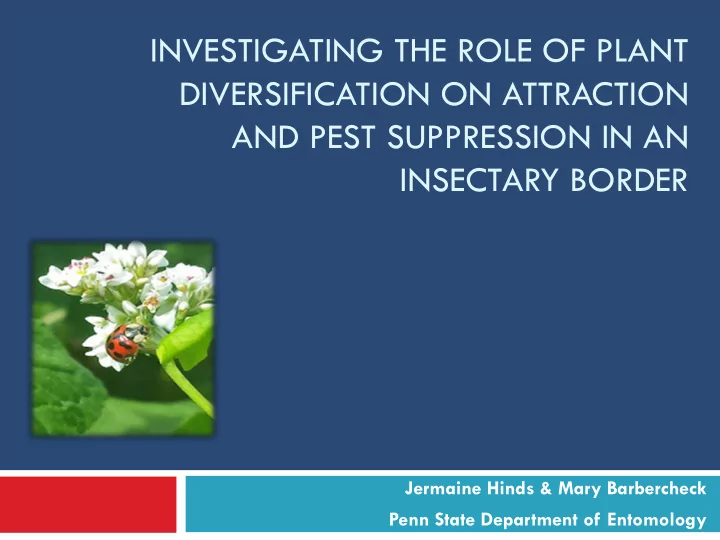
Jermaine Hinds & Mary Barbercheck Penn State Department of - - PowerPoint PPT Presentation
INVESTIGATING THE ROLE OF PLANT DIVERSIFICATION ON ATTRACTION AND PEST SUPPRESSION IN AN INSECTARY BORDER Jermaine Hinds & Mary Barbercheck Penn State Department of Entomology Natural Enemies Resource Plant Provisioning Insectary
Jermaine Hinds & Mary Barbercheck Penn State Department of Entomology
Insectary plants provision
Natural enemies prefer
Insectary mixtures may
Can plant-based resources promote natural enemy
Can a mixture provide further support?
Objectives:
Evaluate potential of two plant species to support natural
Resource availability Natural enemy abundance Predation levels
Natural enemy abundance greater in presence of plant-based
Sampling:
Resource abundance Sweep net samples Sentinel eggs (Ostrinia
Vigorous buckwheat growth; anthesis 3 weeks after planting Poor cowpea establishment Buckwheat dominated biculture
2 4 6 8 10 12 3 4 5
Average # EFN per Plant Weeks After Planting
Number of Cowpea EFNs
CP BI
* * *
2 4 6 8 10 12 3 4 5
Average # Inflorescences per Plant Weeks After Planting
Number of Buckwheat Inflorescences
BW BI
* *
50 100 150 200 250 300
Anthocoridae Miridae Coccinellidae Thomisidae Aphididae
Total Arthropods
Cicadellidae Miridae Parasitica Chrysomelidae Anthocoridae
50 100 150 200 250 300 Anthocoridae Miridae Coccinellidae Thomisidae Aphididae
Total Arthropods
Orius spp. Coleomegilla maculata
2 4 6 8 10 12 3 4 5
Mean C. mac Found per 5 Sweeps Weeks After Planting
BW CP BI
* P<0.0001 *P=0.0011 * P<0.017 *P=0.057 * P<0.0001 *P=0.0001
2 4 6 8 10 12 3 4 5
Mean # of Orius Found per 5 Sweeps Week After Planting
BW CP BI
ns
0.1 0.2 0.3 0.4 0.5 0.6 0.7 0.8 0.9 1
BW CP BI Corn
Can plant-based resources promote natural enemy
C. maculata and Orius spp. greater in floral plots Natural enemies not abundant in cowpea
Can a mixture further support natural enemies?
Does insectary strip enhance predation?
Not affected by treatment
Future Directions Are insectary strips reducing predation on
How does insectary plants influence predation
Can management of insectary plants be used to
USDA NIFA-OREI Program Cover Crop Cocktails Group NE-SARE Graduate Student Grant Bunton-Waller Fellowship Alfred P. Sloan Foundation Lloyd. E. Adams Memorial Award International Association of Black
Russell E. Larson Ag Research