Māori Data Sovereignty: Tikanga in Technology
- Prof. Tahu Kukutai
University of Waikato Te Mana Raraunga
Data Summit ‘18 Informed decision-making through the ethical use of data
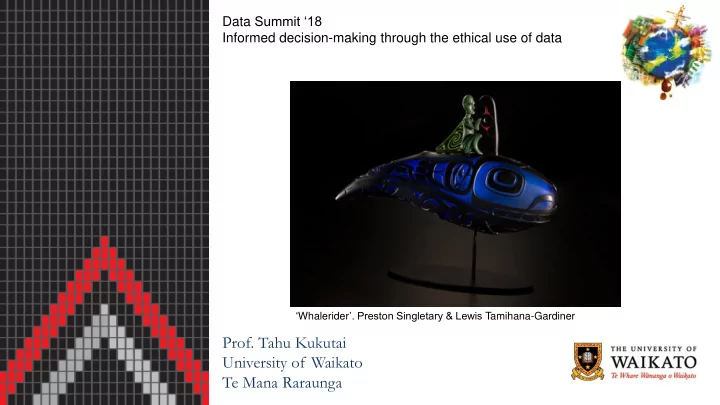
‘Whalerider’. Preston Singletary & Lewis Tamihana-Gardiner
Tikanga in Technology Whalerider . Preston Singletary & Lewis - - PowerPoint PPT Presentation
Data Summit 18 Informed decision-making through the ethical use of data Mori Data Sovereignty: Tikanga in Technology Whalerider . Preston Singletary & Lewis Tamihana-Gardiner Prof. Tahu Kukutai University of Waikato Te Mana
University of Waikato Te Mana Raraunga
Data Summit ‘18 Informed decision-making through the ethical use of data
‘Whalerider’. Preston Singletary & Lewis Tamihana-Gardiner
Data Sovereignty states that data is subject to the laws of the nation within which it is stored Indigenous Data Sovereignty states that data is subject to the laws of the nation from which it is collected (including Tribal nations) Māori Data Sovereignty refers to the inherent rights and interests that Māori have in relation to the collection, ownership, and application
http://www.temanararaunga.maori.nz/
@MaoridDSov
Māori data refers to information or knowledge in a digital or digitisable form that is about or from Māori peoples and our environments, regardless of who controls it.
Data from Māori (self-generated) Eg. Māori/iwi organisations and businesses Data about Māori (generated by others) Eg. IDI Data about Māori resources (self and/or others) Eg. Māori land
is a key mechanism for enabling self-determination and innovation is concerned with protecting Iwi/Māori rights of access to data participation in data integration activities partnership in the governance and/or ownership of data (TeTiriti is foundational) recognises that Māori data should be subject to Māori governance
Access and Use to transform the lives of Māori
Governance and Control to ensure the data is relevant and responsive
LOW CONTROL HIGH CONTROL
TRIBAL REGISTERS
DATA GOVERNANCE OPPORTUNITIES
Control. Māori have an inherent right to exercise control
but is not limited to data creation, development, stewardship, analysis, dissemination and infrastructure. Jurisdiction. Decisions about the physical and virtual storage of Māori data should enhance control for current and future generations. Whenever possible, Māori data should be stored in Aotearoa NZ Self-determination. Māori have the right to data that is relevant and empowers sustainable self-determination and effective self-governance.
Stewardship. Maori data needs to be stored and transferred in such a way that it enables and reinforces the capacity of Māori to exercise kaitiakitanga over Māori data . Restrictions. Māori should decide which Māori data sets should be controlled (tapu) or open (noa) access. Ethics. Tikanga, kawa (protocols) and mātauranga Māori (knowledge) should underpin the protection, access and use of Māori data.
Respect. The collection, use and interpretation of data should uphold the intrinsic dignity of Māori individual, groups and communities. Consent. Free, prior and informed consent should underpin the collection and use of all data from or about Māori. Less defined types of consent must be balanced by stronger governance arrangements.
National Institute of Demographic and Economic Analysis Te Mana Raraunga