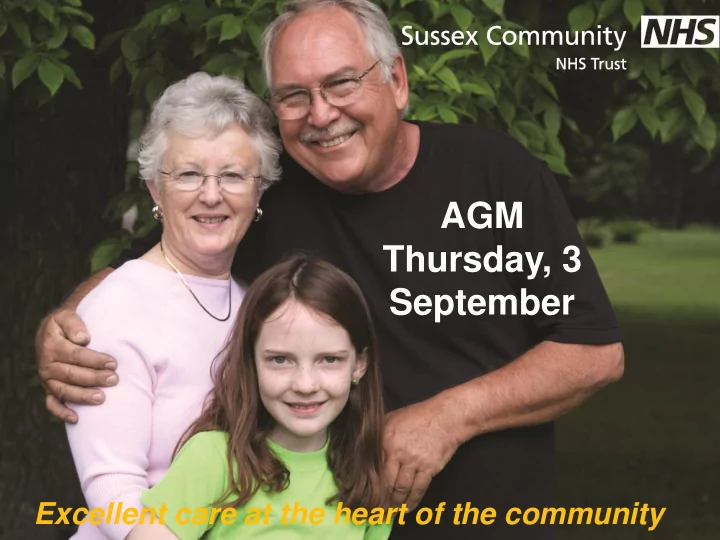
Thursday, 3 September Excellent care at the heart of the community - - PowerPoint PPT Presentation

thursday 3
SMART_READER_LITE
LIVE PREVIEW

Thursday, 3 September Excellent care at the heart of the community - - PowerPoint PPT Presentation

AGM 2015 AGM Thursday, 3 September Excellent care at the heart of the community AGM 2015 AGM 2015 Chair Sue Sjuve Programme Welcome Chair, Sue Sjuve Our year of achievement and success Chief executive, Paula Head Annual report and


slide-1
SLIDE 1

AGM 2015

AGM Thursday, 3 September

Excellent care at the heart of the community

slide-2
SLIDE 2

AGM 2015

AGM 2015 Chair Sue Sjuve

slide-3
SLIDE 3

Programme

Welcome

Chair, Sue Sjuve

Our year of achievement and success

Chief executive, Paula Head

Annual report and strategic report 2014/15 and annual accounts

Executive director of finance, facilities and estates, Jonathan Reid

Presentations

  • Proactive Care and Frailty/Homelessness
  • Healthy Child Programme

Closing remarks

slide-4
SLIDE 4

AGM 2015

Our year of achievement and success Chief executive Paula Head

slide-5
SLIDE 5

Spring

‘Thank you’ volunteers

Caring for carers Developing

  • ur leaders
slide-6
SLIDE 6

Summer

Investing in

  • ur future

More health

visiting

New MSK contract

slide-7
SLIDE 7

Autumn

A top place to work

Care environments

amongst the best Proactive care

slide-8
SLIDE 8

Winter

We’re GOOD! Most improved Best for breastfeeding

slide-9
SLIDE 9

CQC result

slide-10
SLIDE 10

Winter

Time to Talk success Innovate to succeed Good staff survey results

slide-11
SLIDE 11

AGM 2015

Annual Report and Strategic Report & Annual Accounts 2014/15

Executive director

  • f finance, facilities & estates

Jonathan Reid

slide-12
SLIDE 12

Highlights 14/15 Delivered all financial targets including £1m surplus – 0.5 per cent of turnover. Another difficult year for operational staff.

slide-13
SLIDE 13

Annual accounts

Stewardship of public funds is a key responsibility

  • f the board.

The annual report and strategic report demonstrates what we do with the resources given to us each year and how we deliver our vision and values. The summary financial statements are a summary of the full accounts. Full accounts are available from our website: www.sussexcommunity.nhs.uk/reports Clear audit opinion was provided by the Audit Commission.

slide-14
SLIDE 14

Looking forward

Significant challenge for this financial year and future years. Plan to increase surplus to 1 per cent of turnover, whilst maintaining investment in clinical, community-based services. Building on continued successful delivery of service, quality improvement and financial stability we remain well placed to respond to the challenging local and national health environment, with a focus to provide more care out of hospital and in the community.

slide-15
SLIDE 15

AGM 2015

Chair Sue Sjuve

Adopt 2014/15:

  • Annual Report & Strategic Report
  • Annual Accounts
slide-16
SLIDE 16

Proactive Care

Transformational Change – Adult Services

Sean Cemm Clinical Nurse Manager

slide-17
SLIDE 17

Why transformational change?

  • Segregated care provided in silos.
  • Demographic shift to an ageing population.
  • Healthy life expectancy not growing as fast

as life expectancy.

  • Pressure on acute hospitals – increased visits to A&E.
  • Need to shift more care into the community.
  • GPs to “keywork” elderly and vulnerable patients.

“I can plan my care with people who work together to understand me and my carers, give me control, and bring together services to achieve the outcomes important to me.” “I am now able to sit in the garden and see the butterflies.”

slide-18
SLIDE 18

Vision for Proactive Care The vision – 2012

  • An efficient, joined-up collaborative health and social care system pioneering a

new way of working.

  • Working with patients, carers and their families.
  • Patients at the heart of decision making.
  • In control of their own care where possible.
  • Shared vision across partner organisations.
  • Ability to inspire and realise the “burning ambition” of self care.
slide-19
SLIDE 19

PaC MDT GPs Carers Acute Secamb Housing Nursing V Sector OT Social Workers Mental Health Physio Fire

P

Proactive Care MDT

RAIT ICT

Proactive Care partners

CCG

slide-20
SLIDE 20

Benefits

  • Keeps people well in their own homes where possible for longer.
  • Reduces pressure on acute hospitals, GPs, ambulance and community.
  • Improves experience: patients, carers, families and professionals.
slide-21
SLIDE 21

How it works

 Proactive care.  Risk stratification.  Self care self-management.  Integrated teams.  Case management approach.

slide-22
SLIDE 22

Caring for people with complex needs

Personalised, Proactive, Proportionate

30% 10% 2%

Coping complex Living well with a long-term condition or care need Most frail

Mr Wilson is frail and has complex health and care needs. He has had several admissions to hospital recently and is known to multiple health and care teams.

  • Quality of life – this is the most important priority for him and his carers.
  • Plan for a good death – he is likely to be in the last 2 years of life so it’s important that his

affairs are in order and he has made informed decisions about the end of his life.

  • Minimise length of stay in hospital – he is unlikely to avoid some admissions to hospital so

getting him back home as soon as possible is the priority.

  • Proportionate medical management – he needs his treatment and medicines reviewed and

anything stopped that isn’t necessary.

Mrs Smith has health and care needs. She is likely to be seeing her GP and community team regularly and be on multiple

  • medication. She copes but minimal

disruption e.g. a UTI or an unwell carer tips her quickly into crisis. Mrs Smith may be deteriorating and at risk of admission when:

  • Quality of life – a bespoke approach to her and her carers, planning around

what matters most to her.

  • Care co-ordination – she and her carers have one person they can rely on.
  • Care planning – she and her carers have a plan to stay happy and well, and

she knows what to do if she is poorly.

  • Holistic medical management – her health is managed in line with her goals.
  • Less ad-hoc use of services – she has regular, planned reviews with

someone who knows her and may not need active support in-between.

Goal for Mrs Smith if she deteriorates – services mobilise to provide extra support in a planned way

  • Quality of life – his condition is part of his life and

not dominating it.

  • Skills and tools to self care – he knows how to

look after himself.

  • Optimal medical care – he works together with his

medical team to keep his condition well controlled and to stop it progressing.

  • Signposting – he knows what other agencies and

community services are available to support him.

Goal for Mr Cooper – in control of his condition and care

Goal for Mrs Smith – plan ahead and be prepared Goal for Mr Wilson – every moment counts Mr Cooper is well and

  • independent. He has a

long-term condition or care need that is under control and visits services for Planned follow ups e.g. diabetic clinic.

  • Her ad-hoc use of services increases.
  • There are cries for help from her carers.
  • She is not coping with activities of daily life.

Everyone else Goal – staying happy, healthy and active

slide-23
SLIDE 23

Proactive Care in Coastal West Sussex

  • Proactively identifying and supporting frail/elderly people and their carers to

prevent deterioration.

  • Admission avoidance.
  • Supporting primary care through case management and care coordination –

enabling patients to adopt a self care/self-management process.

  • Personalised care plans with contingency.
  • Communication systems.
slide-24
SLIDE 24

2340 2967 3274 3458 3624 3886 4133 4371 4616 4946 5199 5441 2281 2900 3253 3432 3463 3820 4066 4283 4529 4848 5097 5343

1000 2000 3000 4000 5000 6000 Contingency plans Month

Coastal Proactive Care – contingency plans (year to date)

Contingency Plans Contingency Plans On IBIS

98% of contingency plans are on IBIS

Contingency plans

slide-25
SLIDE 25

SECAmb data

Matches and Patients by CCG

1 Jul 2015 00:00:00 - 31 Jul 2015 23:59:59

CCG Name Patients 999 Call Matches Conveyed Non- conveyed IBIS Conveyance Rate Calls Per Patient Ratio Conveyances Avoided Admissions Avoided

2 0.00% 0.00 0.00 0.00 886 66 28 38 42.42% 0.07 16.22 5.35 597 271 60 211 22.14% 0.45 121.57 40.12 1392 166 61 105 36.75% 0.12 50.22 16.57

NHS Coastal West Sussex CCG 6,364 1050 353 697 33.62% 0.16 350.50 115.67 NHS Crawley CCG 727 105 48 57 45.71% 0.14 22.35 7.38

1348 124 45 79 36.29% 0.09 38.08 12.57 705 94 39 55 41.49% 0.13 23.98 7.91 2344 205 65 140 31.71% 0.09 72.35 23.88 677 195 56 139 28.72% 0.29 74.65 24.63 3485 338 132 206 39.05% 0.10 94.46 31.17 17 2 1 1 50.00% 0.12 0.34 0.11 385 50 21 29 42.00% 0.13 12.50 4.13 NHS Horsham & Mid Sussex CCG

1,952 248 109 139 43.95% 0.13 57.16 18.86

396 28 16 12 57.14% 0.07 2.76 0.91 379 36 17 19 47.22% 0.09 7.12 2.35 5270 553 276 277 49.91% 0.10 94.51 31.19 483 95 43 52 45.26% 0.20 20.65 6.81 1040 76 25 51 32.89% 0.07 25.92 8.55 77 26 12 14 46.15% 0.34 5.42 1.79 430 50 14 36 28.00% 0.12 19.50 6.44 202 18 11 7 61.11% 0.09 1.06 0.35 676 192 45 147 23.44% 0.28 83.64 27.60 11 0.00% 0.00 0.00 0.00 21 0.00% 0.00 0.00 0.00 11 0.00% 0.00 0.00 0.00 12 0.00% 0.00 0.00 0.00 2 0.00% 0.00 0.00 0.00 15 0.00% 0.00 0.00 0.00 8 0.00% 0.00 0.00 0.00 27 0.00% 0.00 0.00 0.00 1 0.00% 0.00 0.00 0.00 1 0.00% 0.00 0.00 0.00 1 0.00% 0.00 0.00 0.00 1 0.00% 0.00 0.00 0.00 1 0.00% 0.00 0.00 0.00 109 2 1 1 50.00% 0.02 0.34 0.11 1 0.00% 0.00 0.00 0.00 1 0.00% 0.00 0.00 0.00 Report Totals: 30057 3990 1478 2512 37.04% 0.13 1195.30 394.45

slide-26
SLIDE 26

Success

  • 22 proactive multidisciplinary, multi-agency teams across West Sussex (North and Coastal

localities).

  • 9,540 referrals since April 2014.
  • 1,907 admissions avoided since April 2014 (SECAmb data).
  • Reduced conveyance rate to 32% compared to 67% for patients over 65 years not on caseload.

Patient Experience

  • 90% happy with proactive care intervention.
  • 82% felt the team took notice of their views on how to deal with their health problem(s).
  • 83% felt their discussions with a member of team helped them to improve how they managed

their health problem.

  • 91% said after intervention they would know what to do next if they became unwell.

(Feb 2015 survey)

slide-27
SLIDE 27

Proactive Care review

Trustwide workshops to review proactive care. Key themes include:

  • There isn’t a standardised model across West Sussex.
  • Performance monitoring and governance frameworks are not aligned to all partner
  • rganisations.
  • Further integration with other SCT services – reduce internal referrals and multiple

contact points.

  • ‘One size does not fit all’.
  • The ‘top 2%’ methodology may inhibit full benefits realisation.
  • Expand teams to include access to other services is essential.
  • Lack of integrated IT systems between partners inhibits closer multi-agency working.
slide-28
SLIDE 28

Key future principles for Proactive Care

  • Support greater GP engagement from the wider practice.
  • Clear quantitative benefits demonstrated by data.
  • Constructive scrutiny from CCGs.
  • More consistency between acute trust sites across West Sussex.
  • Seamless pathways between urgent care and proactive care – emerging between One Call

One Team (OCOT) and proactive care.

  • Reconfigured team sizes to population demographics to match need and demand to work

with next 10% of population – more preventive work.

  • More partnership working with voluntary sector.
slide-29
SLIDE 29

Proactive Care – realising individual’s burning ambition

slide-30
SLIDE 30

AGM 2015

Homelessness – Brighton & Hove

Mia Cruttenden – Senior Locality Nurse Sue Winder – Advanced Nurse Practitioner

slide-31
SLIDE 31

Homelessness

  • Increasing year-on-year in Brighton & Hove – well above national level.
  • People who are homeless are often extremely vulnerable with complex physical,

mental health and substance use needs.

  • May be excluded from or have difficulty engaging with mainstream services, relying
  • ften on emergency or urgent care services such as A&E and hospital admissions.
  • Improving outcomes and delivery of an integrated homeless care model is a key

component of the Brighton & Hove Better Care Plan.

slide-32
SLIDE 32

What we do

  • Small healthcare team pilot in 2014/15.
  • Team includes clinical nurse lead, occupational therapist (OT), physiotherapist and

healthcare assistant.

  • Provided in-reach into 7 hostels and uncovered unmet health and care needs.
  • Provided healthcare assessments and interventions.
  • Supported hostels to set up occupational therapy groups to engage and build

relationships with residents.

  • Provided individual OT and physiotherapy support to facilitate independence.
  • Engaged successfully with hard to reach residents supporting them to access

mainstream services – tissue viability, diabetes and respiratory services.

slide-33
SLIDE 33

New – multi-agency homeless healthcare meeting

  • Multi-agency partners include: primary care, police, rough sleepers team,

homeless health team, homeless hostel team, mental health homeless team, Equinox, Pathway Plus, adult social care and more.

  • People are discussed fortnightly due to risks of:

– Death. – Deteriorating health. – Serious adverse health outcomes. – Serious adverse social outcomes (including eviction). – Hospital admissions. – A&E attendances.

  • Agree clear management plans and action points and to improve wellbeing and

mitigate the risk of mortality, morbidity and adverse social outcomes.

slide-34
SLIDE 34

Healthy Child Programme

Healthy Child Programme (HCP) – West Sussex

Julie Warwick HCP Manager School Nursing & Health Visiting North

slide-35
SLIDE 35

Healthy Child Programme

  • 0-19 public health service.
  • 0-2 years Family Nurse Partnership.
  • 0-5 years (Specialist Community Public Health Nurse) Health Visitor.
  • 5-16 years (Specialist Community Public Health Nurse) School Nurse.
  • 0-19 years Looked After Children.
slide-36
SLIDE 36

Health visiting service

slide-37
SLIDE 37

Health visitor implementation plan 2011/15

slide-38
SLIDE 38

Model for Health Visiting

slide-39
SLIDE 39

Current service development

  • Early intervention.
  • Sleep clinics.
  • HENRY.
  • Early Help plans.
  • Integrated two-year review.
  • Teenage parent pathway.
  • UNICEF Baby Friendly status.
slide-40
SLIDE 40

Current health visiting projects

  • Registered to resident population – links with GP surgeries.
  • SystmOne and mobile working.
  • Partnership working.
  • Co-location of services.
  • Co-delivery of some services.
  • Joint training.
  • Integrated management meeting.
slide-41
SLIDE 41

Next steps

  • Alignment of teams to children and family centre clusters.
  • Improve liaison with maternity services.
  • Improve performance of the core contacts.
  • Early help resource centre – secondment and continued staff commitment.
  • Development of a 0-19 team.
  • Change of Commissioner from October 2015:
slide-42
SLIDE 42

AGM 2015

Thank you to our presenters

slide-43
SLIDE 43

AGM 2015

Questions

slide-44
SLIDE 44

AGM 2015

AGM

Thursday, 3 September 2015

Excellent care at the heart of the community

Thank you for coming

slide-45
SLIDE 45

AGM 2015

AGM Thursday, 3 September

Excellent care at the heart of the community