Think Social Media Isnt a Public Record Think Again November 20, - - PowerPoint PPT Presentation

think social media isn t a public record think again
SMART_READER_LITE
LIVE PREVIEW

Think Social Media Isnt a Public Record Think Again November 20, - - PowerPoint PPT Presentation

Think Social Media Isnt a Public Record Think Again November 20, 2019 Prepared by Washington State Attorney Generals Office 1 Local Government PRA Consultation Program Local Government Consultation Program The program assists local


slide-1
SLIDE 1

1

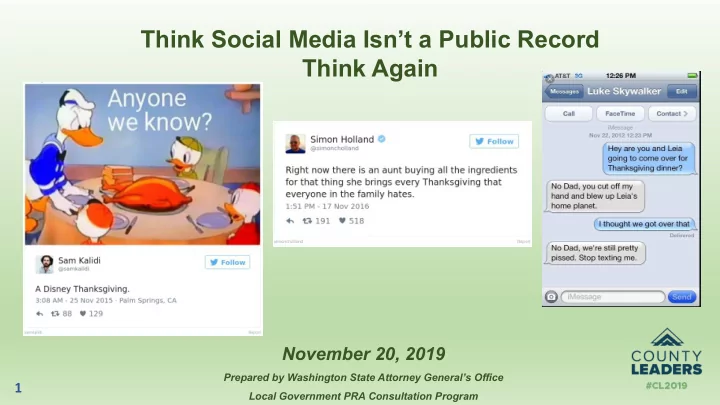
Think Social Media Isn’t a Public Record Think Again

November 20, 2019

Prepared by Washington State Attorney General’s Office Local Government PRA Consultation Program
slide-2
SLIDE 2

2

Local Government Consultation Program

  • The program assists local government agencies by providing

information and assistance to local agencies for developing PRA best practices, including but not limited to:

  • Responding to records requests.
  • Seeking additional public and private resources for developing and updating

technology information services.

  • Mitigating liability and costs of compliance.
  • No cost to the agency.
  • Contact:

Morgan Damerow (360) 570-3418 Kathy Bodnar (360) 664-8756

PRAConsultation@atg.wa.gov

  • Web page: www.atg.wa.gov/pra-consulting-program
slide-3
SLIDE 3

3

Why Attend PRA Training

  • 1. A little knowledge goes a long way.
  • 2. Helps keep your agency our of court.
  • 3. If you did err, training bolsters your defense;

it is a mitigating factor.

Hoffman v. Kittitas County, Decided September 26, 2019.

slide-4
SLIDE 4

4

We will cover agency best practices and personal obligations:

  • Some basic public records & transparency principles.
  • Preparing for a request.
  • What is a “public record”?
  • What does a public records request look like?
  • Initial response - the 5 day letter.
  • Searching for public records.
  • Records retention.
  • Records review and some exemption basics.
  • Records production.
  • Enforcement and penalties.
slide-5
SLIDE 5

5

Public Records Act

When was the Public Records Act enacted?

slide-6
SLIDE 6

6

Public Records Act

¢ Passed in 1972 – Initiative 276 ¢ RCW 42.56 (formerly RCW

42.17)

slide-7
SLIDE 7

7

The PRA Evolves

Legislature - 2019

  • 1295 – Concerning Public Works Contracting Procedures
  • 1667 – Records consultation; grants; JLARC reporting
  • 1692 & 2020 – Employment investigations; harassment/stalking
  • 5418 – Concerning Local Government Procurement

modernization and efficiency

Courts

  • 2018 – 33 decisions.
  • 2019 – 26 decisions.
slide-8
SLIDE 8

8

Why You Should Care

Examples of some PRA penalties/judgments for noncompliance:

What is the largest PRA judgement in the state to date?

slide-9
SLIDE 9

9

Why You Should Care

Examples of some PRA penalties/judgments for noncompliance:

$1.77 M – City of Tacoma $600,000 – Snohomish County $575,000 – Snohomish County $550,000 – Clallam County $502,827 – L & I (upheld by State Supreme Court) $371,340 – King County $192,000 – LCB (included other open government claims) $175,000 – Mesa (reduced from $353,000 - possible appeal) $150,000 – Jefferson County $85,000 – San Juan County Penalties and judgements are paid directly from agency funds.

slide-10
SLIDE 10

10

Touchstone

  • Public records of government agencies are presumed
  • pen.
  • Records or information in records can be withheld only

by law (e.g. exemption in law).

  • Exemptions must be “narrowly construed.”
  • Non-exempt public records must be disclosed.
  • Location does not matter. Public record can be located

in/on agency files/accounts/servers, or non-agency files/accounts/servers.

  • Public records must be retained pursuant to records

retention laws.

slide-11
SLIDE 11

11

PRA Applies to Records of:

  • State government agencies*
  • Local government agencies*
  • Extent to Legislature – pending

~ RCW 42.56.010 * And to agencies that are the functional equivalent of public agencies.

PRA Does Not Apply to:

  • Court records (court files)
  • Records of certain volunteers
  • Private organizations or persons*

*Unless, for example, the records are used or retained by a government agency.

slide-12
SLIDE 12

12

What is a Public Record

“Public record” means:

  • any writing containing information
  • relating to the conduct of government

OR the performance of any governmental or proprietary function

  • prepared, owned, used, or retained
  • by any state or local agency
  • regardless of physical form or characteristics.

RCW 42.56.010

slide-13
SLIDE 13

13

Wr Writing

“Writing” includes “handwriting, typewriting, printing, photostating, photographing, and every other means of recording any form of communication or representation including, but not limited to, letters, words, pictures, sounds, or symbols, or combination thereof, and all papers, maps, magnetic or paper tapes, photographic films and prints, motion picture, film and video recordings, magnetic or punched cards, discs, drums, diskettes, sound recordings, and other documents including existing data compilations from which information may be obtained or translated.” RCW 42.56.010

slide-14
SLIDE 14

14

Can there be public records on your personal cell phone?

Pe Personal Devices

slide-15
SLIDE 15

15

Nissen v. Pierce County (2015)

  • Text messages sent and received by a public employee in the

employee’s official capacity are public records of the employer, regardless of the public or private nature of the device used to create them; thus, even if the employee uses a private cell phone.

  • A record that an agency employee prepares, owns, uses, or retains

within the scope of employment is a record “prepared, owned, used or retained by a state or local agency” under the PRA.

  • An employee’s communication is “within the scope of employment” when the job requires it, the employer

directs it, or it furthers the employer’s interests.

  • This inquiry is always case - and record - specific.
  • The Nissen court equated “official capacity” with “scope of employment” when referring to an elected
  • fficial.

Do you have to turn over your cell phone?

Text Messages

Personal Devices

slide-16
SLIDE 16

16

  • PRA requests for public records in a local elected official’s personal

residence, on a personal computer, and in a personal email account (2016); and personal Facebook site (2018).

  • Court of Appeals:
  • West v. Vermillion, Puyallup (2016): Public records must be disclosed.

The constitutions do not provide an individual a privacy interest in those public records. State Supreme Court denied review. (See upcoming slide

  • n “privacy.”)
  • West v. Puyallup (2018): Facebook posts on an elected official‘s personal

site are public records if they relate to the conduct of government and are prepared within the scope of employment or official capacity.

Social Media

Personal Accounts

slide-17
SLIDE 17

17

  • Adopt a Policy
  • No Personal Cell Phone Use
  • Content Restrictions – only transitory content
  • Acknowledge Personal Use

– Require Search and Production – Plan for: Production Records Retention

  • Pay attention to reality.

Make a clear distinction between official accounts, campaign accounts and personal accounts.

  • Agency Accounts
  • Be Clear About Your Agency’s Business

Purpose for Using Social Media

  • Who can post to agency social media

accounts.

  • Content guidelines
  • Plan for Records Retention
  • Watch for OPMA Issues.
  • Personal Accounts
  • Educate Elected Officials and Agency Staff
  • Plan for PRA Search and Production
  • Watch for OPMA Issues.

Personal Devices

Controlling Risk Related to Personal Devices and Accounts

Social Media

slide-18
SLIDE 18

18

P R A Tracking Number

P R A Request Close Request Records Search Records Production Records Ready - Fee Records Review Third Party Notice 5 – Day Letter

slide-19
SLIDE 19

19

What does a PRA Request Look Like?

Why do people make PRA requests? Can we ask what they are going to do with the records?

slide-20
SLIDE 20

20

What does a PRA Request Look Like?

  • Did you receive one?
  • Test: “FAIR NOTICE”
  • Examples:

Says “I am making a public records request for….” On the agency’s Public Records Request form Says it is a “Public Records Act” or “PRA” request Cites PRA - RCW 42.56, “Freedom of Information Act” or “FOIA” Says “Attention: Public Records Officer”

  • No specific format or form required.

BEST PRACTICE REFER PERSONS TO PUBLIC RECORDS OFFICER. IF YOU RECEIVE A COMMUNICATION SUCH AS THOSE ABOVE, GET IT TO PUBLIC RECORDS OFFICER ASAP.

No official format is required. Agencies can recommend requesters use their form or web page. Must accept in person requests made during normal office hours.

slide-21
SLIDE 21

21

From The Requestors Perspective

  • Persons must request identifiable public records from public agencies.
  • At minimum, requester must identify documents with sufficient clarity to allow the

agency to locate them.

  • A request for “information” is not a request for “records” under the PRA.
  • Requesters can ask to inspect records, or request copies of records. Requests can be made

via mail, e-mail, in person.

  • Agencies can adopt procedures explaining where requests must be submitted and other

procedures.

  • Generally no need to identify purpose of request, unless required by law (e.g., restriction on

providing lists of individuals for a commercial purpose).

  • Requestors may make PRA requests in addition to discovery in a law suit.

RCW 42.56.520; RCW 42.56.080; RCW 42.56.040; RCW 42.56.100; Hangartner v. City of Seattle; Bonamy v. City of Seattle; Hobbs v. State.

slide-22
SLIDE 22

22

Initial Responses to Requests aka - The 5-day Letter

  • The agency has five business days to respond to a public records request.
  • Agency response must do one of the following:
  • 1. Acknowledge receipt of the request and provide a reasonable estimate for a further response,

provide records production date;

  • 2. Fulfill the request;
  • 3. Provide an internet address and link to the records on the agency’s website (which fulfills part
  • r all of the request);
  • 4. Seek clarification; see upcoming slide, or
  • 5. Deny the request with an accompanying written statement of the specific reasons.

RCW 42.56.520

slide-23
SLIDE 23

23

Records Management circa 1972 PRA circa 1972

Search ching For Public c Records

slide-24
SLIDE 24

24

Re Records Management ci circa 2019 2019

slide-25
SLIDE 25

25

Do you have to find every responsive record to a request? Re Records Search Generally

slide-26
SLIDE 26

26

  • An agency must conduct an adequate search for responsive records.
  • PRO must have an understanding of the agency’s organization and business.
  • The search should be reasonably calculated to uncover responsive records.
  • The search should follow obvious leads to possible locations where records are

likely to be found.

  • If responsive public records are on or in employees’/officials’ personal devices,

personal accounts, or personal files, those must be searched, too.

  • The focal point of the judicial inquiry is the agency’s search process, not the
  • utcome of the search.
  • The agency bears the burden of proof to show the adequacy of the search.
  • Provide missed records as soon as possible when located.

.

Re Records Search Generally

slide-27
SLIDE 27

27

Ø For records that are not searched centrally by your PRO or designee:

  • YOU must promptly:

q SEARCH for your responsive records [agency devices/accounts, and any personal devices/accounts/files (next slide), other locations], q RETAIN them (do not delete/destroy them), and q PRODUCE them to your PRO/designee per instructions. Ø If you need more time, or if the request needs clarifying or you have questions, YOU must promptly: q TELL that to your PRO/designee, and q Explain WHY.

Ø Cast a wide net and document all of your

search efforts.

q Search terms used q Locations searched (accounts/devices) q Description of records produced & how q Description of records not produced q Other relevant information q Note metadata issue

Your Search & Production Responsibilities

slide-28
SLIDE 28

28

Th The PRA & Records Retentio ion

slide-29
SLIDE 29

29

“Public Records” are State Property

  • RCW 40.14.020: “All public records shall be and remain

the property of the state of Washington. They shall be delivered by outgoing officials and employees to their successors and shall be preserved, stored, transferred, destroyed or disposed of, and otherwise managed, only in accordance with the provisions of this chapter.” ØThey are not your records, even if you created them, and even if they are

  • n/in

your personal devices/accounts/files. Ø You are required to manage and dispose them only in accordance with state law.

slide-30
SLIDE 30

30

KEEPPUBLIC RECORDS for

MINIMUM RETENTION

then

DESTROY TRANSFER

INTENTIONAL RETENTION

slide-31
SLIDE 31

31

Know What Records You Need to Retain, and for How Long

Ø PRA:

Records requested under PRA request must be retained until request is resolved, even if scheduled for destruction. RCW 42.56.100.

Ø Records Retention Laws: RCW 40.14

Local Government Common Records Retention Schedule (CORE) Record Retention Schedules for Cities and Towns

Specialty schedules by department type.

slide-32
SLIDE 32

32

Ø Remember - Records are presumed open.

Ø An exemption must exist in law (state or federal; PRA or other laws). § A public record cannot be withheld based only on a (your) promise of confidentiality. § Exemptions are narrowly construed. Agency can lawfully withhold only exempt information that fits squarely within an exemption, must release other information. Ø An agency must, in writing, cite the exemption for the requester and provide a brief explanation. No “silent withholding.” Ø Requesters can go to court to challenge exemptions cited by an

  • agency. If agency is incorrect, court can award civil penalties.

Some Basics About Exemptions

RCW 42.56.050; RCW 42.56.210 - .510; RCW 42.56.550

slide-33
SLIDE 33

33

  • When withholding part (redacting) or all of a record, agency must describe record by

date, type, authors/recipients, and total number of pages.

  • Agency must list exemption and give brief explanation.
  • This information can be provided to the requester in an “exemption log” or in other

formats, so long as the required information is provided.

  • The agency bears the burden of proof to justify the exemption.
  • There is no PRA general exemption for a “draft.”
  • Redaction Methods:
  • Sharpie
  • Electronic Sharpie i.e. the black box
  • Redaction Codes

Ex Exempti tions ns (Cont. t.)

RCW 42.56.050; RCW 42.56.210 - .510; RCW 42.56.550

slide-34
SLIDE 34

34

A A Sampl pling ng of Common n Ex Exempti tions ns Pe Personal Info formation Em Empl ployees, Volun unteers and nd Depe pende ndents ts

  • The residential addresses, residential telephone numbers, personal wireless

telephone numbers, personal electronic mail addresses, social security numbers, driver's license numbers, identicard numbers, and emergency contact information of employees or volunteers of a public agency, and

  • The names, dates of birth, addresses, telephone numbers, and electronic mail

addresses, social security numbers, and emergency contact information of dependents of employees or volunteers of a public agency.

RCW 42.56.250(4)

slide-35
SLIDE 35

35

Em Empl ployee Date of Birth th

  • PRA request for names, date of birth and work email address of public
  • employees. Names and email address released.
  • Court of Appeals (March 5, 2018): Disclosing public employees’ full

names and associated dates of birth held to violate the state constitutional right to privacy under Art. 1, Sec. 7 due to the risk of identity theft.

  • Washington Supreme Court (October 24, 2019): Applying the required

narrow construction requirements for PRA exemptions the Court did not find a statutory exemption authorized withholding the record. While Art. 1, sec. 7 may form a basis for withholding records it did not apply in this instance as dates of birth are not private and even if they were, there is a legitimate interest in their release.

slide-36
SLIDE 36

36

Pu Public Employee’s Personnel Files

  • Personal information in files maintained for employees, appointees, or elected
  • fficials of any public agency to the extent that disclosure would violate their

right to privacy (information regarding misconduct is not exempt).

  • There is no general “privacy” exemption in the PRA.
  • If privacy is an express element of another exemption, privacy is invaded only if

disclosure about the person would be: “Highly offensive to the reasonable person” and “Not of legitimate concern to the public.”

  • This means that if information does not satisfy both these factors, it cannot

be withheld as “private” information under other statutes.

RCW 42.56.230(3) & 42.56.050

slide-37
SLIDE 37

37

Co Commercial P Purpose se

  • General Rule: Requestors may use records for any purpose including a commercial

purpose.

  • Exception: List of Individuals
  • Agencies are prohibited from releasing a list of individuals to a requestor when the

intended use is for a commercial purpose.

  • Providing access to electronic records that can, by means of internal queries or

sorting, display lists of individuals would be tantamount to providing access to lists of individuals which, if requested for commercial purposes, is prohibited.

  • Agency must make the determination based on the nature of the request, the identity
  • f the requestor and any other information that may be available.

RCW 42.56.070(8), AGO Opinion 2019 No. 3, SEUI Healthcare 775 v. State.

slide-38
SLIDE 38

38

EE EEO/H /Har aras assment in investig igatio ions

  • HB 2020 amends RCW 42.56.250(6).
  • Investigative records compiled by an employing agency in connection with an

investigation of a possible unfair practice under chapter 49.60 RCW or of a possible violation of other federal, state, or local laws or an employing agency's internal policies prohibiting discrimination or harassment in employment.

  • Records are exempt in their entirety while the investigation is active and ongoing.
  • After the agency has notified the complaining employee of the outcome of the

investigation, the records may be disclosed only if the names of complainants, other accusers, and witnesses are redacted, unless a complainant, other accuser, or witness has consented to the disclosure of his or her name. The employing agency must inform a complainant, other accuser, or witness that his or her name will be redacted from the investigation records unless he or she consents to disclosure.

  • Consult Legal Counsel.
slide-39
SLIDE 39

39

In Inves estig igativ ive e Exemp emption ion

  • Specific intelligence information and specific investigative records
  • Compiled by investigative, law enforcement, and penology agencies, and state

agencies vested with the responsibility to discipline members of any profession,

  • Nondisclosure of which is essential to effective law enforcement or for the protection
  • f any person's right to privacy
  • Records related to a specific investigation.
  • Exemption is often based on investigation status.
  • Open – Closed – Reopened impacts the analysis.

RCW 42.56.240(1)

slide-40
SLIDE 40

40

Production of Records When and How

  • If requestor asked to inspect records:
  • Notify requestor of records availability and how long they will be available. (30 days

per WAC 44-14-040.)

  • The PRA prohibits any charge for inspection of records.
  • Use of cell phone to take pictures of pages?
  • If records are to be produced:
  • Inform requestor of fee (if any) and provide time for requestor to pay.
  • Provide records to requestor.
  • Agencies can produce records in installments, particularly for larger requests.
  • Agencies can provide an installment by providing links to records on its website.
slide-41
SLIDE 41

41

  • Copy fee schedule:
  • Agencies can charge actual costs (following certain procedures & notice/public hearing) or,
  • A default statutory cost (following a declaration of undue burden in rule),
  • Alternative up to $2 for entire request (see details in statute).
  • The default schedule includes paper copies, scanned copies, and electronic records costs.
  • No fee for records routinely posted on agency website.
  • Must provide an estimate of costs to requester upon request.
  • Act provides for other fee arrangements in defined circumstances.
  • “Customized access charge” under defined circumstances.
  • No fees for inspection.
  • Fees can be waived but be consistent with all requestors.
  • Court action can be brought to challenge agency’s estimate of fees.

Fe Fees

RCW 42.56.120; RCW 42.56.070; RCW 42.56.130; RCW 42.56.550

slide-42
SLIDE 42

42

Enforcement & Penalties

  • PRA enforced by courts for claims listed in PRA.
  • A court can impose civil penalties. No proof of “damages”

required.

  • A court is to consider factors in requiring an agency to pay a

penalty.

  • Plus, a court will award the prevailing requester’s attorneys fees

and costs.

  • Special penalty provisions and court procedures apply to

lawsuits involving inmate requests.

RCW 42.56.550, RCW 42.56.565; Yousoufian v. Sims

slide-43
SLIDE 43

43

Enforcement and Penalties (Cont.)

Mitigating Factors

  • A lack of clarity in the PRA request.
  • The agency's prompt response or legitimate

follow-up inquiry for clarification.

  • The agency's good faith, honest, timely, & strict

compliance with all PRA procedural requirements & exceptions.

  • Proper training & supervision of the agency's

personnel.

  • The reasonableness of any explanation for

noncompliance by the agency.

  • The helpfulness of the agency to the requester.
  • The existence of agency systems to track and

retrieve public records.

Aggravating Factors

  • A delayed response by the agency, especially in

circumstances making time of the essence.

  • Lack of strict compliance by the agency with all the PRA

procedural requirements and exceptions.

  • Lack of proper training & supervision of the agency's

personnel.

  • Unreasonableness of any explanation for noncompliance

by the agency.

  • Negligent, reckless, wanton, bad faith, or intentional

noncompliance with the PRA by the agency.

  • Agency dishonesty.
  • The public importance of the issue to which the request is

related, where the importance was foreseeable to the agency.

  • Any actual personal economic loss to the requestor

resulting from the agency's misconduct, where the loss was foreseeable to the agency.

  • A penalty amount necessary to deter future misconduct by

the agency considering the size of the agency and the facts

  • f the case.
  • The inadequacy of an agency’s search for records.

Yousoufian v. Sims, Neighborhood Alliance v. Spokane County

slide-44
SLIDE 44

44

General PRA Procedure Wrap Up

Remember there can be changes in law (statutes, case law). Under PRA, agencies must:

  • Appoint a public records officer.
  • Publish procedures describing certain agency organization, operations, rules of procedure, and

adopt/enforce rules/regulations that:

  • Provide full public access to public records
  • Protect public records from damage/disorganization
  • Prevent excessive interference with other agency functions
  • Provide fullest assistance to requesters
  • Provide most timely possible action on requests.
  • Publish fee schedule. (Revised 2017)
  • Maintain a list of laws the agency believes exempts or prohibits disclosure.
  • Provide certain indexes of records.
  • Make non-exempt records available for inspection and copying during customary business hours for a

minimum of 30 hours per week, excluding holidays.

  • Post customary business hours on the agency’s website and make hours known by other public means.

RCW 42.56.040; RCW 42.56.070 - .090; RCW 42.56.100; RCW 42.56.580

RCW 42.56.040; RCW 42.56.070 - .090; RCW 42.56.100; RCW 42.56.580

slide-45
SLIDE 45

45

QUESTIONS?